A patient survey reveals gaps at every stage of care
Nearly seven in ten patients in a Chinese gastric cancer survey discovered their disease only after seeking care for symptoms, and 55.2% had stage III or IV cancer when diagnosed. The China Gastric Cancer Patient Quality of Life White Paper, reported as released on September 18, 2026, during the Chinese Society of Clinical Oncology annual meeting in Jinan, describes problems extending well beyond early detection.
Contents
- A patient survey reveals gaps at every stage of care
- Why waiting for symptoms misses early disease
- Targeted endoscopy offers a practical route
- What screening studies show, and what they cannot prove
- Who should be considered for screening?
- Blood testing is promising, but validation remains essential
- Preventing infection related damage complements screening
- New treatments depend on completing the right tests
- Nutrition and psychological support belong in treatment
- Key Points
Based on data from about 1,000 patients, the white paper found that 82.4% had at least mild malnutrition and 87.4% experienced some restriction in social activity after becoming ill. Willingness to consider newer treatments was relatively high, yet testing needed to guide some treatment decisions was much less common than awareness of those tests.
Shen Lin, director of gastrointestinal medical oncology at Peking University Cancer Hospital and the white paper’s lead advising expert, argues that improving outcomes requires three connected changes: finding cancer before symptoms prompt a hospital visit, making recommended molecular testing routine, and providing nutritional and psychological support throughout treatment.
The white paper was initiated by the Beijing Bethune Public Welfare Foundation, guided by the CSCO gastric cancer expert committee and the Chinese Gastrointestinal Oncology Group, and conducted by patient platform Mijian. Astellas China provided charitable support. Its findings describe the surveyed patients, rather than establishing national prevalence: details needed to judge representativeness, including recruitment methods and the balance between hospitals and disease stages, are not specified in the accounts of its release.
That distinction matters when comparing its figures with national estimates. Nevertheless, the survey identifies several concrete points where patients can lose access to timely diagnosis, appropriate treatment or support.
Why waiting for symptoms misses early disease
The survey found that 69.0% of patients were diagnosed after seeking care for symptoms. Among that group, 39.8% delayed seeking medical attention. That second percentage refers specifically to patients who presented because of symptoms, not to all survey participants.
Shen explains that early digestive system cancers, particularly early gastric cancer, often cause no symptoms. When discomfort finally prompts investigation, the best opportunity for early discovery may already have passed. Early symptoms can also resemble common digestive problems, making them easy to dismiss.
The national clinical practice guideline on early gastric cancer similarly states that most early cancers and precancerous lesions have no specific symptoms. It reports an early diagnosis and treatment rate below 10% in China and cites five year survival of 31.3%.
Other figures differ. A review published on April 30, 2021, cited more than 80% of Chinese gastric cancer patients being diagnosed at an advanced stage and five year survival of 35.1%. Those figures should not be treated as directly comparable with the white paper’s 55.2% share at stages III and IV. They come from different populations, periods and potentially different definitions of advanced disease. The survey alone cannot establish that late diagnosis has declined nationally.
Targeted endoscopy offers a practical route
China’s screening programs have concentrated on selected areas and people at higher risk, rather than offering endoscopy to the entire population. Endoscopy uses a flexible instrument to inspect the stomach; suspicious tissue can be sampled and examined by a pathologist. This combination remains the standard for diagnosing gastric cancer.
The 2021 screening review, published in the Chinese Journal of Cancer Research, explains why nationwide endoscopy is difficult: examinations require equipment, skilled endoscopists and pathologists, while cost, discomfort and concerns about an invasive procedure can discourage attendance.
The review records more than 2.16 million upper gastrointestinal endoscopies across 194 program sites by the end of 2018. The cancer detection rate was 2.05%, and 70% of detected cancers were early. A later academic review records more than 2.6 million eligible rural residents examined by 2021, with over 70% of upper gastrointestinal cancers detected early. These results cover both stomach and esophageal cancers, not gastric cancer alone.
National programs developed through several stages:
- 2008: Government funded gastric cancer screening began in Linqu, Shandong, and Zhuanghe, Liaoning.
- 2010: Wuwei, Gansu, joined as a screening site.
- 2012: Gastric and esophageal screening merged into the Upper Gastrointestinal Cancer Early Detection program; the Cancer Screening Program in Urban China also began.
- 2021: Opportunistic upper gastrointestinal screening, arranged through medical encounters or individual requests, reached 2.61 million people and detected 56,677 cases.
The opportunistic screening detection rate was 2.17%. It represents a way to reach people outside organized programs, although it still depends on clinicians recognizing risk and patients completing the examination.
What screening studies show, and what they cannot prove
The early detection review, Early detection of gastric cancer in China: progress and opportunities, describes a prospective study involving 375,800 people in Linqu during 2012–2018. Endoscopic screening was associated with lower invasive gastric cancer incidence and lower mortality.
The relative risk was 0.69 for incidence and 0.33 for mortality. Compared with the unscreened group, these figures correspond to approximately 31% lower incidence and 67% lower mortality. They are relative comparisons, not reductions of 31 or 67 percentage points in an individual’s chance of developing or dying from cancer.
Among gastric cancer cases, five year survival was 31.9% in the unscreened group, 73.4% among those screened once and 90.2% among those screened repeatedly. These are results from a particular population, not a national survival forecast. Survival measured from diagnosis can also look longer when screening starts the clock earlier, so the separate mortality findings are important.
The review also describes an economic model predicting that targeting people at higher risk could reduce the cost per quality adjusted life year gained by 44%–49% compared with nationwide general screening. A quality adjusted life year combines length of life with health quality. The result is a modeling estimate, rather than a measured reduction in hospital spending, but it supports directing limited endoscopy capacity toward people most likely to benefit.
Who should be considered for screening?
The national early gastric cancer guideline recommends screening people older than 40 who have Helicobacter pylori infection and other gastric cancer risk factors. Listed factors include male sex, smoking, pernicious anemia, an immediate relative with gastric cancer, severe atrophic gastritis, intestinal metaplasia and gastric adenoma. Atrophic gastritis involves loss of normal stomach glands; intestinal metaplasia is a change in which stomach lining cells resemble intestinal cells.
The guideline recommends combining H. pylori testing with pepsinogen I and the pepsinogen I/II ratio as screening indicators. Pepsinogens are precursors of a digestive enzyme, and their blood levels can provide information about changes in the stomach lining. It also suggests using the prediction model developed by Li and colleagues to direct endoscopic screening according to risk, while grading the evidence for that recommendation as very low certainty.
Age thresholds differ across programs and documents. Historical Chinese programs generally targeted ages 40–69; the later review describes National Cancer Center guidance using 45–75. Japan’s 2018 guidance recommends screening from age 50, generally every two to three years. Korean guidance recommends screening asymptomatic adults aged 40–74 every two years. The Korean starting age is therefore younger than the simplified comparison that groups Japan and Korea together as screening people over 50.
For people who decline or cannot tolerate conventional gastroscopy, or face a higher complication risk, the Chinese guideline recommends considering magnetically controlled capsule gastroscopy after excluding contraindications. The capsule cannot take tissue samples or perform treatment, and the 2021 review notes its higher cost. It is an alternative for selected patients, not a complete replacement for conventional examination.
Blood testing is promising, but validation remains essential
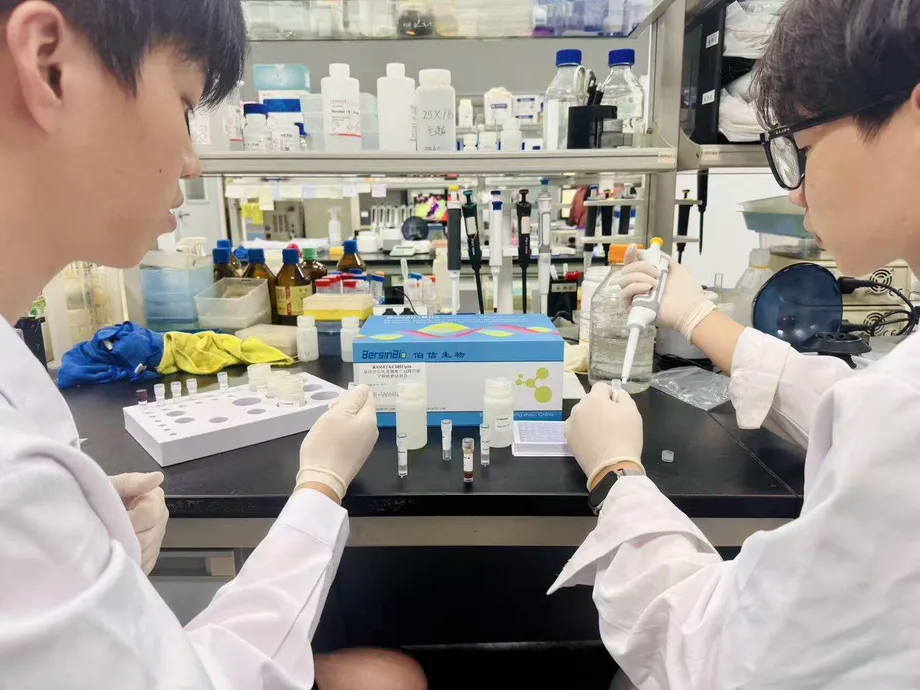
A Guangzhou Medical University team has reported developing a gastric cancer screening system called Zhiqi Weilai that uses a blood sample to assess risk. The 15 member team is led by Wan Daqing, described as a second year clinical medicine student, with guidance from clinicians including Liang Min, an associate chief physician in oncology at the university’s Fifth Affiliated Hospital.
The system combines PNA-SERS nanoprobe testing for methylation signals in several genes, an independent RCA-HRM cross check, indicators related to copper induced cell death, and an artificial intelligence model. Methylation is a chemical marking of DNA that can change in cancer; the proposed system aims to use several signals together to identify people who need endoscopy.
The team says it underwent validation at multiple centers and identified several asymptomatic early gastric cancers during trial use at a hospital in Loudi, Hunan. Those cases were subsequently confirmed by gastroscopy. However, no exact sample size, sensitivity, specificity, price or independently assessable performance results are given in the report. Claims of superiority to commercial tests cannot be evaluated from those descriptions alone.
The team has established a company to develop the technology and plans to seek Class III medical device registration. That is a planned regulatory application, not evidence of approval. No application deadline is stated.
The academic reviews explain why caution is necessary. A pooled analysis of 42 studies found pepsinogen sensitivity of 77% and specificity of 73% for identifying gastric atrophy under specified thresholds, not for diagnosing gastric cancer itself. Newer blood markers also require prospective validation, affordability assessment and testing in the populations where they would be used. A risk test must reliably direct patients toward confirmatory investigation rather than reassure them incorrectly.
Preventing infection related damage complements screening
H. pylori is a bacterium that can persist in the stomach, cause chronic inflammation and increase gastric cancer risk. Gastroenterologist Barry Marshall, who shared the 2005 Nobel Prize in Physiology or Medicine with Robin Warren for discovering the organism and its role in gastritis and peptic ulcer disease, has called for wider testing, appropriate treatment and confirmation that infection has cleared.
Marshall explains why its significance extends beyond ulcers:
"H. pylori is much more than an ulcer organism. If the infection persists for many years, it can cause chronic inflammation in the stomach and increase the risk of gastric cancer," Dr. Marshall said.
The 2021 screening review cites intervention evidence, including the Shandong Intervention Trial, supporting reductions in gastric cancer incidence and mortality after eradication. Treating infection and screening serve different purposes: eradication addresses a cause of stomach damage, while screening seeks existing precancerous changes or cancer. Successful eradication does not establish that a person has no remaining cancer risk.
New treatments depend on completing the right tests
The white paper found that 64.7% of patients were very or fairly willing to receive newer targeted gastric cancer treatments. Yet awareness of CLDN18.2 testing was 63.5%, while actual testing was 36.9%, a gap of 26.6 percentage points. Those aggregate percentages do not show exactly how many individual patients knew about the marker but went untested.
CLDN18.2 is a protein whose expression in tumor tissue can help determine suitability for certain targeted treatments. Other markers used in gastric cancer care include HER2, PD-L1 and MSI/MMR, which describe different tumor features relevant to treatment selection. Screening markers used to assess cancer risk and tumor markers used after diagnosis answer different clinical questions.
Accounts of the white paper’s release state that the 2025 CSCO gastric cancer guideline upgraded CLDN18.2 expression testing to a Grade I recommendation. A Chinese expert consensus on its clinical testing was also published in 2025, addressing laboratory procedures, interpretation and reporting.
Shen identifies uneven clinician knowledge as a major obstacle. Her team’s analysis of more than 220,000 gastric cancer patients at 53 hospitals across 27 provincial areas found inadequate coverage of standardized molecular testing and fewer than 2% receiving neoadjuvant treatment, meaning treatment before surgery. Without information on how many patients were eligible, that treatment percentage cannot establish the size of any shortfall.
Bi Feng, director of abdominal oncology at Sichuan University’s West China Hospital, points to additional barriers: misunderstanding the clinical need for testing, family finances, relatives’ support, insurance arrangements and charitable assistance. These accounts suggest that improving testing requires both clinician education and practical help with access, rather than information campaigns alone.
Nutrition and psychological support belong in treatment
The survey’s 82.4% rate of at least mild malnutrition included 57.5% with moderate or severe malnutrition. Gastric cancer can directly disrupt eating and digestion, while treatment and changes in daily life can add further strain. Shen also describes anxiety among relatives, making family support part of the care need.
A phase III randomized trial by her team, published in the Journal of Clinical Oncology in 2021, provides evidence beyond the survey. It enrolled 328 patients with previously untreated metastatic esophagogastric cancer and compared early multidisciplinary nutritional and psychological support alongside standard cancer treatment with standard treatment alone.
Median overall survival was 14.8 months with early support and 11.9 months with standard treatment alone, a difference of 2.9 months. The result applies to the trial’s population, which included esophagogastric cancers rather than gastric cancer alone. It does not mean every patient receiving support will live an additional 2.9 months, but it shows that supportive care can affect more than comfort.
Information needs also change during illness. At diagnosis, surveyed patients wanted explanations of causes, stage, pathology results and treatment eligibility. During treatment, priorities shifted toward individualized care, recurrence or spread, adverse effects and nutrition. With 77.9% obtaining disease knowledge through face to face conversations with doctors, clinical appointments remain central to meeting those needs.
Shen’s team is exploring a specialist artificial intelligence model for gastrointestinal oncology to help clinicians make decisions. No evidence presented establishes that it improves patient outcomes. Similarly, the early gastric cancer guideline stated an intention to update its 40 recommendations in 2025, but that statement alone does not confirm publication of an update. The immediate priorities are better supported: earlier risk assessment, completed testing and continuous care that addresses the person as well as the tumor.
Key Points
- The patient survey found 69.0% were diagnosed after seeking care for symptoms, and 55.2% had stage III or IV disease.
- Chinese screening programs target selected populations; strong early detection results in those programs are not national averages.
- CLDN18.2 awareness exceeded actual testing by 26.6 percentage points, with clinical knowledge, costs and family support affecting access.
- A reported Guangzhou blood screening system still lacks published numerical performance details needed to assess its claims.
- Malnutrition affected 82.4% of surveyed patients; a randomized trial found longer median survival with early nutritional and psychological support.
- H. pylori eradication, risk based screening, appropriate tumor testing and continuing support address different parts of gastric cancer care.