Growth arrives faster than the roads can absorb it
The three municipalities around TSMC's first Kumamoto factory recorded 38 major congestion locations in 2025, about 40% more than in 2021, when the Taiwanese chipmaker announced its move into the prefecture. Kikuyo, Koshi and Ozu also gained a combined 5,465 residents compared with the 2020 census, putting them at the top of Kumamoto's population growth rankings.
Contents
- Growth arrives faster than the roads can absorb it
- Official traffic data show where the pressure is building
- Factory journeys overlap with residential commuting
- Road improvements stretch across several fiscal years
- The planned factory expansion sets the scale of demand
- Population gains extend beyond the factory town
- Municipal finances improve, but the gains are uneven
- Higher land prices put pressure on local businesses
- Most surveyed businesses report no clear positive or negative effect
- Key Points
Those two figures capture the competing pressures reshaping the area. Semiconductor investment is bringing people, stronger municipal finances and demand for accommodation and meals. It is also putting more vehicles on roads that were not built for the expanding industrial cluster, while rising property costs and competition for workers squeeze some local businesses.
The prefecture has signed 71 location agreements with semiconductor related companies since TSMC announced its arrival, according to the reported tally at the end of March. These agreements show the breadth of investment interest, although they should not be read as a count of 71 completed factories.
The expansion is far from finished. Kumamoto's science park initiative seeks to attract companies that use semiconductors, universities and research institutions around Semicon Technopark. Five new industrial estates in Kikuyo and surrounding municipalities are expected to begin offering plots by fiscal 2031.
The central issue is therefore more specific than whether TSMC has brought growth. Population and fiscal figures show gains, but the business survey finds relatively few respondents reporting a direct benefit. Meanwhile, official transport analysis identifies worsening commuter traffic along several routes serving the factory district.
Official traffic data show where the pressure is building
The Ministry of Land, Infrastructure, Transport and Tourism's Kyushu Regional Development Bureau explains on its congestion locations page that it identifies major trouble spots using traffic technology and local assessments. The selection framework dates to January 2013, and the page lists September 2025 editions for Kumamoto and the other Kyushu prefectures.
The designation counts locations identified as serious congestion problems, rather than measuring the length of every queue or the total time commuters lose. The increase to 38 locations across Kikuyo, Koshi and Ozu nevertheless indicates that traffic pressure has spread beyond isolated roads.
A separate decision on December 16, 2024, added 12 intersections in those three municipalities to the prefecture's major congestion list. The prefectural traffic congestion council, which includes national transport officials, Kumamoto Prefecture, Kumamoto City and police, brought the prefecture's total to 285 locations at that point. The 285 figure covers the whole prefecture; the 38 figure concerns the three municipalities in 2025.
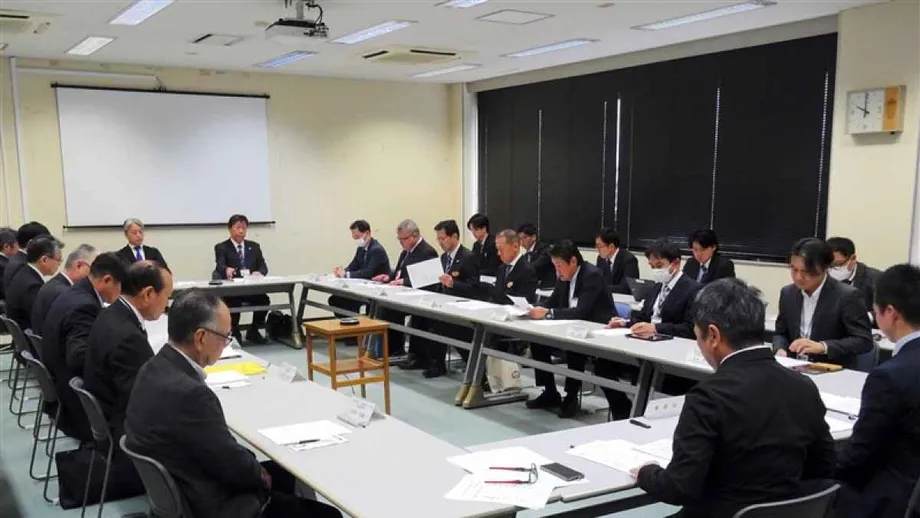
More detailed evidence appears in the road coordination materials published for a February 26, 2025, meeting involving the Kyushu Regional Development Bureau, Kumamoto Prefecture and Kumamoto City. The analysis compares weekday traffic during the 7 a.m. and 6 p.m. hours in April 2016, April 2019 and April 2024.
Using ETC2.0 vehicle probe data, which record vehicle movements and travel speeds, the document finds progressively worsening morning speeds toward Semicon Technopark on National Route 57 and Prefectural Route 30, the Ozu Ueki route. It identifies increased traffic associated with company arrivals, expanded facilities and additional employment as one contributing factor.
Factory journeys overlap with residential commuting
The official analysis shows that the traffic problem is not confined to a factory gate. Around Hikari no Mori, vehicles heading toward Semicon Technopark mix with commuters traveling toward Kumamoto City. In the evening, traffic returning from the industrial district overlaps with journeys into nearby residential areas.
At 6 p.m., falling speeds are particularly evident on routes toward Kumamoto City, including National Routes 57 and 387. This matters for road planning because improvements at a single intersection may not resolve congestion across the wider commuting network.
Kikuyo is widening roads and considering changes in commuting times alongside construction. An unnamed official in the town's construction department described the approach. Translated from Japanese, the official said:
Alongside road improvements, we will also pursue measures such as staggered commuting times.
Staggered starts would spread journeys across a longer period rather than add road capacity. The accounts do not specify how many employers would participate, when a coordinated program would begin or how much traffic it could shift away from the busiest hours.
Road improvements stretch across several fiscal years
The February 2025 coordination document lists projects with target dates ranging from fiscal 2024 to fiscal 2029. The schedule helps explain why businesses can arrive faster than the transport network can adapt: widening, bypass construction, land acquisition and design are proceeding across several authorities and routes.
The main dates and milestones include:
- 2021: TSMC announced its move into Kumamoto Prefecture.
- February 6, 2024: TSMC announced a second JASM factory in Kumamoto.
- December 16, 2024: The prefectural congestion council added 12 intersections in Kikuyo, Koshi and Ozu to its list.
- February 26, 2025: The road coordination meeting documented worsening traffic and proposed further road measures.
- Fiscal 2026: The document scheduled openings for the Takinomurozaka Road and two local road projects in the Haramizu area.
- Fiscal 2028: Several widening and access road projects had target dates, including work on the Ozu Ueki route and the Koshi interchange access road.
- Fiscal 2029: Koshi's Takezako and Second Techno route widening had a target date.
- Fiscal 2031: Plot sales at five new industrial estates are expected to have begun.
These are targets recorded in the plans, not confirmation that every project is complete or will open on schedule. The document also lists sections of the Ozu Kumamoto Road that remained in design, land acquisition or construction, with no single completion date given for the entire network.
Kumamoto Prefecture and Kumamoto City requested early implementation of the Kumamoto ring connecting road so that it would not lag behind the opening of the Ozu Kumamoto Road. They also proposed introducing a toll road arrangement between Ozu Nishi and Shimomikawa to help accelerate development.
Illustrative passenger car tolls included 720 yen between Ueki and Koshi interchanges and 850 yen between Ueki and Ozu Nishi. The document explicitly cautions that these estimates, calculated from urban planning maps, need not match the eventual operator's charges. They are proposed examples, not settled fares.
The planned factory expansion sets the scale of demand
TSMC's JASM expansion announcement of February 6, 2024, put the combined investment in two Kumamoto factories at more than US$20 billion, with Japanese government support. JASM, Japan Advanced Semiconductor Manufacturing, is TSMC's majority owned manufacturing subsidiary in Japan.
The announcement scheduled the second factory to begin operations by the end of 2027 and planned construction to start by the end of 2024. Those dates describe the company's plan when it issued the statement. They do not establish the project's current construction status or confirm that the operating deadline has remained unchanged.
Together, the two factories were expected to produce more than 100,000 wafers measuring 12 inches in diameter each month and directly create more than 3,400 professional technology jobs. A wafer is the circular material on which many chips are manufactured before being separated into individual components.
The planned production technologies range from 40 nanometers to 6 and 7 nanometers, serving automotive, industrial, consumer and high performance computing applications. These process labels describe chip manufacturing technologies; the company said its capacity plan could be adjusted according to customer demand.
The planned ownership stakes were approximately 86.5% for TSMC, 6% for Sony Semiconductor Solutions, 5.5% for DENSO and 2% for Toyota, subject to closing conditions. The projected 3,400 jobs concern direct employment at the two factories, not a measured total for suppliers, construction firms and other businesses across Kumamoto.
Population gains extend beyond the factory town
Koshi recorded the largest population increase in the prefecture, adding 2,542 residents compared with the 2020 census. Ozu added 1,728 and Kikuyo 1,195. Together, their increase was 5,465, with Koshi accounting for about 47% of that combined gain.
The census figures show where population increased, but do not isolate how many people moved because of TSMC. Koshi officials attribute arrivals partly to the semiconductor investment and partly to the city's role as a residential base for people working in Kumamoto City. Families raising children are among those moving in.
Koshi expects further population growth. The prefecture's industrial plans could sustain demand for nearby housing, although no quantified population forecast accompanies the accounts. Five planned industrial estates, each roughly 10 to 25 hectares, are spread across Kikuyo, Kikuchi, Koshi and Ozu.
The science park initiative announced in 2025 aims to bring semiconductor users and research activity into the area around Semicon Technopark. That makes the development strategy broader than attracting factories alone. It also means future transport demand will depend on the location and timing of several kinds of institutions, not just TSMC's expansion.
Municipal finances improve, but the gains are uneven
Kikuyo's fiscal strength index reached 0.95 in fiscal 2024, the highest among Kumamoto's municipalities. Ozu recorded 0.73 and Koshi 0.63, compared with a prefectural municipal average of 0.36.
The index compares a municipality's standard revenue capacity with its standard fiscal needs, generally using an average across three years. A higher value indicates greater capacity to fund services from its own revenue base. It is not a measure of household wealth or proof that every business is earning more.
Kikuyo's index was about 2.6 times the prefectural average, while Ozu's was about twice that average and Koshi's about 1.8 times. From fiscal 2025, Kikuyo became a municipality not receiving the ordinary local allocation tax grant used to help balance differences in local revenue capacity.
The 0.95 index and the change in grant status should not be treated as contradictory. The published index reflects an averaged measure, while ordinary grant eligibility depends on the relevant year's fiscal calculation. Stronger finances give the municipality more capacity, but expanding roads and accommodating new residents also create spending needs.
Higher land prices put pressure on local businesses
Across Kikuyo, Koshi and Ozu, average residential land prices rose roughly 30% to 50% over the five years through 2026. Commercial land prices reached between 1.3 and 2.2 times their earlier levels, equivalent to increases of 30% to 120%.
These figures describe land prices, not a measured increase in every residential or business rent. They nevertheless sit alongside accounts of rising rental costs affecting local operators. The Ozu commerce association says some businesses have withdrawn from membership or closed amid higher rents and other pressures.
The association also describes workers leaving for better paid employment at semiconductor related companies. That creates a different experience of the investment boom for a small business: more potential customers may arrive, while retaining employees becomes harder and premises become more expensive.
Yukihisa Matsunaga, chairman of the Ozu commerce association, said smaller businesses need to make themselves more attractive to compete for staff. Translated from Japanese, he said:
To secure personnel, small and medium enterprises must make efforts to increase their appeal.
No count of closures or departures is given, and the accounts do not establish that TSMC alone caused them. The evidence supports a narrower conclusion: some businesses report rising costs and recruitment difficulties during the semiconductor expansion.
Most surveyed businesses report no clear positive or negative effect
A March survey by the Kumamoto Prefecture Federation of Societies of Commerce and Industry covered 489 establishments. The reported breakdown was 88% neither positive nor negative, 9% positive and 3% negative. Positive responses cited spending on accommodation and food by Taiwanese visitors and construction personnel; negative responses included higher personnel costs and labor shortages.
The detailed counts were 434 neutral responses, 40 positive and 15 negative. Those add up to 489, but the accompanying percentages do not precisely match them. Calculated from the counts, the shares are approximately 88.8%, 8.2% and 3.1%, respectively. Either presentation leaves the same main finding: the large majority did not identify a clear positive or negative effect.
Neutral responses should not be read as proof that those businesses experienced no changes. They indicate that respondents did not classify the effect as distinctly favorable or unfavorable. The survey also does not show how gains and losses differ by business size, location or sector.
The next milestones are concrete but conditional: road projects carry targets through fiscal 2029, industrial plot sales are planned by fiscal 2031, and TSMC's 2024 statement scheduled second factory operations by the end of 2027. What is still unquantified is how far these measures will reduce commuting delays, ease recruitment pressure or spread spending benefits among existing businesses.
Key Points
- Kikuyo, Koshi and Ozu had 38 major congestion locations in 2025, about 40% more than in 2021.
- The three municipalities gained a combined 5,465 residents compared with the 2020 census.
- Official traffic analysis found worsening morning journeys toward Semicon Technopark and evening journeys toward Kumamoto City.
- Road projects have target dates extending through fiscal 2029; proposed toll examples are not final charges.
- TSMC's 2024 expansion plan projected investment exceeding US$20 billion and more than 3,400 direct jobs across two factories.
- Kikuyo's fiscal strength index reached 0.95, while residential and commercial land prices rose across the surrounding area.
- Most of the 489 businesses surveyed did not identify a clear positive or negative effect, while some reported spending gains or rising employment costs.