Home visits reveal the gaps in elderly care
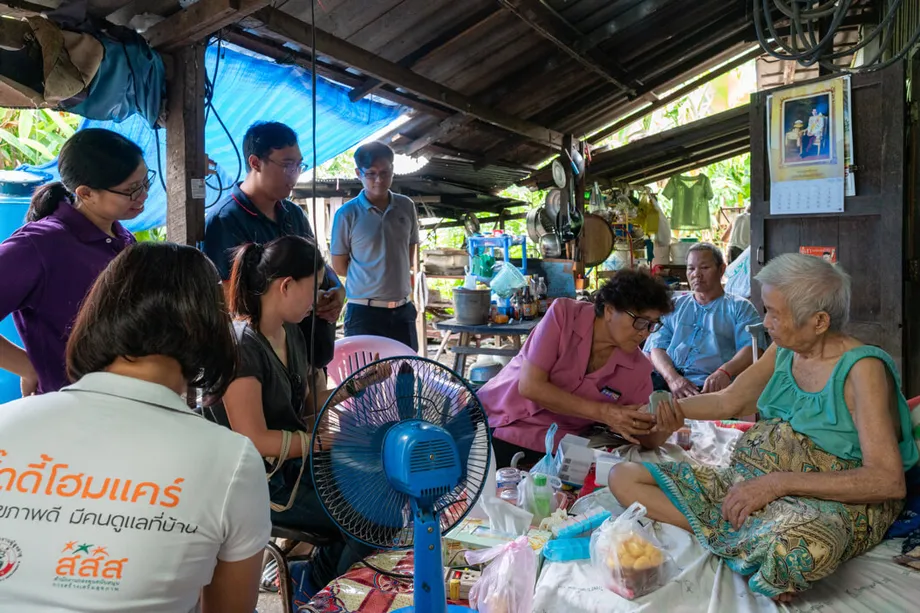
At 84, Amara Chamnanphrai lives alone in a rented room in Chiang Mai's Jai Kaew community, collecting rubbish and vegetables to sell after the death of her husband. She has no children or grandchildren to care for her. During a visit, community volunteers found a blood pressure reading of 170 and advised her to rest and seek a hospital examination.
Contents
- Home visits reveal the gaps in elderly care
- Living alone on limited income
- Community activities stopped, but needs continued
- San Phi Suea plans closer checks and emergency access
- A rehabilitation centre is planned, not yet delivered
- Northern communities have built care networks before
- National research shows both reach and limits
- Buddy Homecare links community support with paid care
- How the response developed, and what is still undecided
- Key Points
Her situation illustrates the practical challenge behind Chiang Mai's expanding volunteer care networks: finding older residents whose health, income and living conditions can deteriorate without anyone noticing. Municipal authorities are preparing closer checks, caregiver visits and emergency access arrangements following the discovery of an older person's body in an abandoned house in San Phi Suea subdistrict.
The proposed response includes checking more than 2,500 older residents in that locality and designing a rehabilitation and physiotherapy centre with a budget of 50 million baht. Across urban Chiang Mai, volunteers providing care at home already support about 300 older people, concentrating on those living alone, needing assistance or missing out on government benefits.
The pressure is greater in Chiang Mai than the national figures alone suggest. Figures for 2025 put older people at 24.35% of the province's population, compared with 21% across Thailand, a difference of 3.35 percentage points. Yet the immediate issue is more specific than population ageing: whether someone can reach a hospital, receive an allowance, move safely around a room or get help when they stop answering the door.
Living alone on limited income
Amara receives an elderly allowance of 800 baht a month and 300 baht through the state welfare scheme. Together, those payments provide 1,100 baht monthly, alongside whatever she earns from selling collected goods and vegetables. Her circumstances show why a home visit needs to assess income and access to services as well as health.
The blood pressure reading reported during her visit is incomplete: no second figure or subsequent hospital assessment is given. It therefore does not establish a diagnosis. What it does show is the role volunteers can play in detecting a possible problem and encouraging medical attention, rather than leaving an isolated resident to recognize and manage it alone.
Jai Kaew has approximately 80 to 90 older residents, including two or three who live alone. Community concerns extend beyond those households to difficulties with transport, everyday living and illness. Eight or nine older residents reportedly died early in the year, although their causes of death and whether they lived alone were not specified. Those deaths should not be treated as a confirmed count of deaths caused by isolation.
Community activities stopped, but needs continued
Activities that once brought Jai Kaew's older residents together for exercise and social contact stopped during the coronavirus pandemic. Their absence removed a regular opportunity for neighbours to see one another and notice changes in mobility, health or mood.
The community has since worked with the municipality to visit people confined to their homes or beds. Residents want government staff and medical personnel to conduct health checks locally, alongside greater welfare support and a transport system for patients. These requests address different parts of the same problem: identifying illness is of limited help when a person cannot afford or arrange the journey to treatment.
The Foundation for Older Persons' Development warns that the risk of dying alone may grow as younger relatives leave to study or work in cities. Older people who have moved from elsewhere, and vulnerable residents without established support, can also lack caregivers. Living in an urban area does not necessarily mean having someone nearby who knows when help is needed.
A network involving volunteers, village health volunteers and residents operates in about 35 communities and covers roughly 100 older people who depend on assistance. That figure and the approximately 300 people supported by urban home care volunteers describe different service networks. They cannot reliably be added together because it is not established whether some people receive support from both.
San Phi Suea plans closer checks and emergency access
After the discovery of the body in San Phi Suea, the municipality prepared to examine the circumstances of more than 2,500 older residents and develop a database of people who need help with daily life. The purpose is to move from responding to an individual tragedy toward identifying residents at risk before an emergency occurs.
The proposed caregiver system would pair people needing assistance with someone visiting two or three times a week. Authorities also intend to check elderly allowance entitlements, reduce hazards inside homes and arrange for spare keys to be held for emergencies. A spare key can help when a resident cannot open the door, although details of consent, storage and authorized access have not been announced.
Elsewhere in the city, volunteers are already recording home locations and conducting initial assessments of residents' problems. Combining these records with regular visits could help distinguish a person who simply misses a meeting from someone whose daily routine has changed because of illness. The effectiveness of that approach depends on what happens after a concern is recorded, including who responds and how quickly.
A rehabilitation centre is planned, not yet delivered
The municipality is also designing a health rehabilitation and physiotherapy centre with a proposed budget of 50 million baht. It is intended to serve older people and other vulnerable groups, including people confined to bed who may be able to regain some ability to care for themselves.
Rehabilitation means helping people recover or maintain practical abilities, such as moving, walking or carrying out everyday tasks. It serves a different purpose from a welfare payment or a companionship visit. For someone who needs physical treatment, volunteers may provide a connection to services, but the treatment itself requires suitable staff and facilities.
No construction date, opening date, staffing plan or final funding approval is specified. The centre should therefore be understood as a proposal under design, rather than an operating service. The announced budget also does not establish its future capacity or the number of patients it could treat.
The community's transport request remains relevant to this proposal. A centre and a visiting network address different needs, but they must connect if people with restricted mobility are to benefit. For residents who cannot leave home, the account does not specify whether the planned centre would provide outreach treatment.
Northern communities have built care networks before
Chiang Mai's current effort has a documented local precedent. The Foundation for Older Persons' Development's community care project ran from 2009 to 2012 in Chiang Mai and neighbouring Lamphun. More than 2,100 older people benefited, with support from 965 community members.
The foundation records repairs to 40 vulnerable households and support for caregivers through activities that generated income. Those measures treated care as more than a sequence of visits. An unsafe home and a caregiver's lack of earnings could both undermine a person's ability to remain supported in the community.
Funding came from AGE UK, HelpAge International, HelpAge Korea, the Thai Health Promotion Foundation, corporate contributors and crowdfunding supporters. The project relied on community participation and multiple funding channels, rather than one source of money or one category of worker.
These are historical results, not figures for the present network. They show that community care and home improvements have previously been organized across the two provinces, but do not establish how many participants remain active today or whether those arrangements continued after 2012.
National research shows both reach and limits
The academic study Volunteer provision of care, comparing Thailand and Costa Rica, provides a caution against expecting volunteers to meet every care need. It records that Thailand's programme trained more than 51,000 volunteers between 2003 and 2013 and reached almost 800,000 older people.
Under the Thai model described in the study, volunteers received 18 hours of training from the Ministry of Social Development and Human Security. Each was responsible for around 15 older people and received about US$14 a month for local travel. Their tasks included help with eating, exercise and taking medicine, as well as contact with health workers. These are historical programme details, not confirmed conditions for Chiang Mai's current volunteers.
A 2014 survey involving 3,694 older people and 179 carers found perceived benefits to physical and mental health, but did not quantify the precise effects. Evaluations involving 498 local government representatives found variable service quality. Only 33% of 76 provincial administrative districts considered volunteer care sufficient for older people's continuing care needs.
Recipients commonly complained that volunteers could address social concerns, such as isolation, but could not manage common health problems associated with ageing. The Ministry of Public Health introduced a new caregiver training initiative with a stronger health services focus in 2016. The study concluded that volunteer networks need training and investment in care services alongside them. That finding closely matches Jai Kaew's request for medical staff, transport and welfare support.
Buddy Homecare links community support with paid care
Another strand of Chiang Mai's care system is Buddy Homecare, which has worked with older residents since 2003. It began as a volunteer service under the Foundation for Older Persons' Development and later developed a business model in which fees from people able to pay helped support care for people in need.
During the coronavirus emergency in April 2020, survey work identified 5,000 households with older people needing care. Community members then selected approximately 200 households facing the greatest difficulties, including illness, severe poverty or relatives unable to be present during the day. The selected households represented about 4% of those identified, illustrating the difference between finding need and having resources to respond to it.
Buddy Homecare planned packs containing food, medicine and masks and mobilized 100 volunteers for a donation campaign. Janevit Wisojsongkram, a coordinator for its coronavirus response, described poverty as an immediate concern alongside infection:
On one level, they're worried about the virus, but the bigger issue is poverty,
The organization also funded scholarships for Karen children to take a nursing course at Chiang Mai University's Faculty of Nursing and then work with it. This created a route into care work while addressing recruitment difficulties. The 2020 account described high turnover when the organization had previously hired volunteers to work as carers, showing that goodwill alone did not guarantee a stable workforce.
How the response developed, and what is still undecided
The present proposals sit within more than two decades of volunteer care development. The dates show successive attempts to widen coverage and strengthen the connection between social support and health services:
- 2003: Thailand established its national home care volunteer programme; Buddy Homecare's work with Chiang Mai's older residents also dates from this year.
- 2009 to 2012: The foundation's project supported more than 2,100 older people in Chiang Mai and Lamphun and repaired 40 vulnerable homes.
- 2013: Thailand's programme had trained more than 51,000 volunteers and reached almost 800,000 older people.
- 2014: An evaluation found that only 33% of 76 provincial administrative districts considered volunteer care sufficient.
- 2016: The Ministry of Public Health introduced caregiver training with a stronger health services focus.
- April 2020: Buddy Homecare organized a coronavirus assistance campaign for approximately 200 households.
- 2025: Figures put older people at 24.35% of Chiang Mai's population and 21% of Thailand's population.
Thailand's 2025 figures show 14.2 million older people, alongside 416,574 births and 559,684 deaths. Deaths exceeded births by 143,110. This comparison describes the balance of births and deaths, not total population change, which also depends on migration.
The foundation proposes a greater role for local older people's clubs in supporting vulnerable residents, including a growing population with dementia. That proposal would bring older residents themselves into care networks, alongside volunteers and municipal services.
Several practical decisions remain unspecified: the completion date for the San Phi Suea survey, the number of caregivers available, funding for patient transport, and the approval and delivery schedule for the rehabilitation centre. There is also no published measure here of whether current visits have reduced deaths alone. The next test is whether identifying residents leads to dependable assistance, especially when the need exceeds what a volunteer can provide.
Key Points
- Urban Chiang Mai home care volunteers support about 300 older people, focusing on isolation, assistance needs and access to benefits.
- San Phi Suea plans checks on more than 2,500 older residents and caregiver visits two or three times a week.
- A rehabilitation and physiotherapy centre is being designed with a proposed budget of 50 million baht; no opening date is specified.
- Older people accounted for 24.35% of Chiang Mai's population in 2025, compared with 21% nationally.
- Historical research found that volunteer networks expanded care access but could not meet all continuing care needs without stronger services.