More than 40 robot products meet everyday care needs
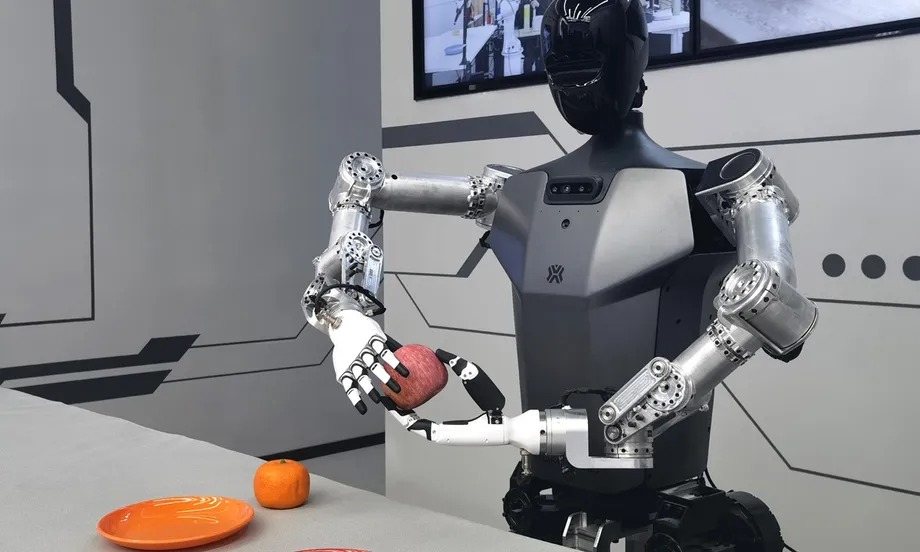
A 1,100 square meter community care center that opened in Beijing on March 12, 2026, is testing a practical proposition: robots may be most useful to older people when they cook lunch, support movement or deliver a consistent massage, rather than simply look human. The four floor facility in Tianhua Yuan Yili, Ronghua Subdistrict, began with more than 40 robot products from 24 companies, and more than 200 older people ate there at lunchtime on its opening day.
Contents
- More than 40 robot products meet everyday care needs
- Cooking robots help, while staff keep the kitchen running
- Rehabilitation attracts interest, but assistance has limits
- A model apartment brings the test closer to home
- Companionship works differently for different visitors
- Residents help decide which products stay
- Costs and staffing put the trial in perspective
- Policy support does not settle safety or data problems
- What happens next is still a trial, not a replacement for care
- Key Points
The Beijing Economic and Technological Development Area administration describes it as the world's first smart robot senior care service station. Its official opening announcement, published on March 13, says the station was built by Ronghua Subdistrict and is operated by a professional organization. That world first description is an official claim, not an independently established comparison with every care facility elsewhere.
The announcement projected about 300 visitors daily and a service area covering tens of thousands of residents. Subsequent reporting describes daily attendance exceeding 300 older visitors. Another later account puts the number of robot products deployed since opening at 43, with about 10 subsequently withdrawn for modifications following user feedback. Those figures describe a changing trial, rather than a fixed collection of machines.
That distinction matters. The station combines community services, a demonstration apartment and a place where manufacturers can test equipment with actual users. Staff still prepare ingredients, operate devices, help visitors and provide care requiring human attention. The project is not evidence that robots can independently run an eldercare service.
Cooking robots help, while staff keep the kitchen running
The ground floor's dining service shows how automation is being divided into specific tasks. A cooking robot follows programmed settings, but kitchen staff cut ingredients, prepare seasonings and load the equipment. On opening day, a chef identified one of six dishes, braised winter melon, as the robot's contribution while he prepared other food.
Other devices dispense trays, carry meals through the dining area and calculate bills. Later reporting describes a camera identifying dishes on a tray and producing a total in less than a second. These are distinct jobs within a staffed canteen, rather than a kitchen operating without people.
Near the entrance, a licensed robot makes jianbing, a savory Chinese pancake, in about three minutes. The official announcement specifies a food business license covering hot food service. Although the initial description calls the product a sandwich, the government announcement and other accounts identify it as a pancake. A later visit recorded a price of 6.9 yuan.
Operator Han Xin has also described a meal registration system that uses facial recognition to retrieve previously entered health conditions and flag dishes that visitors should avoid. Extending that function to ordering through an app was described as a future plan, not an established service.
For some visitors, reliable food is a greater attraction than advanced rehabilitation equipment. Ren, a 74 year old visitor who traveled an hour by bus and returned for a second visit, explained her priorities:
When I can't take care of myself any more, then I'll think about how to get through those days. For now, I just need good meals.
Her experience shows why meal quality and convenience are meaningful tests of the center's usefulness. A machine's technical sophistication does not establish whether it answers the need that brought someone through the door.
Rehabilitation attracts interest, but assistance has limits
The third floor combines rehabilitation, health checks, recreation and day care. A reception robot helps visitors find different areas. Massage machines offer adjustable intensity for different parts of the body, while monitoring equipment measures health indicators.
Moxibustion devices use automated positioning and temperature controls. Moxibustion is a traditional treatment that applies heat near selected points on the body. Locating those points and controlling heat are equipment functions; they do not, by themselves, establish medical effectiveness or guarantee that treatment is appropriate for every visitor.
Later reporting describes three massage robots and an artificial intelligence guided moxibustion machine as heavily booked. A therapist identified by the surname Qi said one therapist could supervise three or four robots at once. That suggests a way to increase the number of sessions staff can oversee, although no audited staffing or cost comparison has been published.
Wearable exoskeletons have drawn particular interest. An exoskeleton is an external support device that helps a person move their limbs. A 74 year old visitor identified as Wang, who usually needed to hold a railing and climb slowly, described feeling support around her thighs and lower legs during an opening day trial.
The wearer still has to move. Such equipment does not make stair climbing automatic, and a favorable personal experience is not proof that it will relieve pain or work safely for everyone. Staff assistance with fitting and settings remains part of the service.
Han Xin later said demand had prompted an expansion from two types of exoskeleton to five. Rehabilitation specialist Zhen Zishuo, whose company supplies the devices, said feedback from an older visitor had accelerated work on a stair climbing mode. Existing assisted movement trials and further development of a dedicated mode should not be treated as the same capability.
A model apartment brings the test closer to home
The fourth floor contains an officially approved Beijing public demonstration apartment for adapting homes to older residents. It has about 60 square meters indoors and an associated outdoor recreation area of about 200 square meters. Reporting places it among 33 such demonstration spaces across Beijing.
The apartment combines smart wheelchairs, companion devices and monitoring systems with less conspicuous features: accessible layouts and flooring designed to reduce slipping. Its value lies in showing how equipment fits into a living space, rather than displaying machines in isolation.
A later description identifies a bedroom, living room, kitchen and bathroom, together with fall detection using visual recognition and millimeter wave radar. Such radar uses radio waves to detect movement. Fall detection can alert others to a possible incident; it should not be confused with physically preventing a fall or guaranteeing an immediate response.
The center also combines services on its premises with support at home, where staff can take portable equipment to residents who need it. However, published accounts do not establish the scale, charges or response arrangements for those visits.
Moving equipment into homes will require more than reproducing a demonstration room. Installation, the resident's mobility, help with operation and arrangements for responding to alerts all affect whether a device becomes a useful care service.
Companionship works differently for different visitors
Not all activity at the station concerns physical care. Visitors can play chess or other board games with robotic arms, talk to interactive devices and watch a tea robot heat water, warm cups, add tea, brew and pour without staff intervening during that sequence. An outdoor obstacle course lets residents operate robot dogs.
The second floor serves infants and young children, with drawing, football and companion robots. The building therefore brings senior services and childcare into one community setting, rather than functioning solely as a residential nursing facility.
Responses to interactive machines vary. An 80 year old visitor identified as Zhuang enjoyed asking a reception robot named Xiaorong to compose a poem. Other reporting describes curiosity alongside unease around machines with human features. Han Xin, by contrast, said she had observed little resistance among visitors. Those accounts reflect different experiences, not evidence of uniform acceptance.
A particularly revealing case involved a humanoid modeled on the Song Dynasty poet Su Dongpo, also known as Su Shi. The device could recite verse and discuss food, but reportedly cost more than 600,000 yuan and was removed after only a few days because it attracted little sustained use.
Han Xin, the station's private operator, explained why the machine did not remain:
Seniors would try it once, but it didn't address any real need.
That does not mean nobody valued it. Zhuang also described enjoying a conversation with the Su Dongpo robot about a recipe and poetry. The contrast shows the distinction between a memorable encounter for one visitor and a service that enough people regularly need to justify its cost.
Residents help decide which products stay
The station's operating structure connects public funding with commercial product development. Local government funds and oversees operations, a private operator manages daily services, and a platform called Robot Mall, described as a state backed enterprise, selects and supplies equipment from 24 firms.
The official announcement says products are screened for practical demand, safety and suitability. Station head Zhang Wendong described a continuing arrangement involving government guidance, company participation and resident oversight, with suggestions collected through community groups and comment boxes.
Later reporting adds feedback collected through QR codes beside devices and follow up conversations with users. The withdrawal of about 10 products for modifications, together with the expansion of exoskeleton options, indicates that feedback can change the equipment on offer. It does not establish how successfully each modification has worked.
Two suppliers named in the official announcement illustrate the range of commercial interests involved. Beijing Shijie Qiusuo Artificial Intelligence Technology supplied companion and therapy products. Its head, Xia Jing, described the station as a place to learn directly from users before attempting wider deployment. Xinggong Jujang (Beijing) Intelligent Technology supplied meal delivery and cleaning robots, together with electric wheelchair assistance systems. Its head, Huo Huayu, described testing in a complex everyday setting as a way to refine product standards.
These companies gain access to users, while residents gain access to equipment they might not otherwise encounter. Those interests can overlap, but a demonstration and sales function is not the same as independent evaluation. No published assessment establishes the center's effects on falls, mobility, loneliness or long term care outcomes.
Costs and staffing put the trial in perspective
Ronghua's robot station is one of four eldercare stations in the subdistrict, with the other three described as traditional facilities. Local officials say residents over 60 account for more than a quarter of the population, reaching 35% in some neighborhoods. That local demand helps explain why rehabilitation and meals feature so prominently.
National population figures in reports differ. One account gives approximately 320 million older people. Another cites 321 million people aged 60 and above at the end of 2025, or 22.86% of the population. A separate account gives 323.38 million, about 23%. The latter two totals differ by 2.38 million, and no explanation for the discrepancy is established here.
Reporting also cites roughly 35 million older people with disabilities requiring long term care and an industry estimate of a shortage approaching 10 million eldercare workers. These figures describe different measures: people needing care and an estimated workforce gap. Neither means that the same number of robots would meet the need.
At the Beijing station, a later account puts robot massage at 68 yuan per hour and says local government subsidizes the machines. Those session prices are not evidence of the full cost of acquiring, maintaining and staffing the service.
More capable care products can cost tens of thousands to hundreds of thousands of yuan. Reporting identifies their exclusion from medical insurance and long term care insurance as a barrier to household purchases. A subsidized community service can spread access across many users, but the center has not published enough financial information to establish whether that arrangement can be sustained elsewhere.
Policy support does not settle safety or data problems
The development area links the station to a broader artificial intelligence program. In January, it issued an implementation plan for 2026 and 2027 to bring artificial intelligence into more industries and homes. The official opening announcement also identifies the area's first dedicated eldercare service plan and ten policy measures supporting embodied intelligence, meaning systems that use artificial intelligence to act through physical machines.
National measures issued by eight departments in late 2025 encouraged technology development for senior services. Ministry of Civil Affairs guidance issued in January 2026 called for the development of high performance intelligent eldercare robots. These measures show policy support, but do not establish that every product at the station has passed a common medical or care safety standard.
Commercial forecasts also need careful reading. A cited industry estimate puts China's eldercare robot market at 7.9 billion yuan in 2024 and 9.1 billion yuan in 2025, with a forecast of 10.4 billion yuan for 2026. The projected rise from 2025 to 2026 is 1.3 billion yuan, about 14%. These are market estimates, not verified revenue from the Beijing facility.
Reporting identifies three obstacles to wider household use: price, incomplete safety standards and disconnected data systems. Health information from station robots and home devices is not yet consistently connected with personal health records, insurance systems or machines from other manufacturers.
Facial recognition, health histories and home monitoring also make privacy a practical concern. The official announcement does not set out detailed consent procedures, retention periods or access controls for those systems. Wider deployment will need to address how information is protected as well as how it is shared.
What happens next is still a trial, not a replacement for care
The sequence so far shows a project moving from policy to community use and then adjustment:
- Late 2025: Eight national departments issued measures supporting technology development in eldercare services.
- January 2026: The Beijing development area issued its artificial intelligence implementation plan, and the Ministry of Civil Affairs issued guidance calling for intelligent eldercare robots.
- March 12, 2026: The Ronghua station opened, with more than 200 older people eating there at lunchtime.
- March 13, 2026: The official announcement detailed the facility, product selection principles and expected daily attendance.
- After opening: Reports described attendance above 300 older visitors daily, additional exoskeleton options and equipment withdrawn for modification.
Local authorities intend to develop more technology based senior care settings in Yizhuang and consider a model that could be used elsewhere in Beijing and nationally. They have not announced a firm expansion deadline, a quantified rollout target or a published timetable for evaluating this station.
The strongest demonstrated role for the robots is narrower than replacing caregivers. They can perform selected repetitive tasks while staff supervise, assist and attend to residents. Whether that produces better care at a sustainable cost requires evidence beyond busy booking schedules and positive individual experiences.
Key Points
- The 1,100 square meter Ronghua station opened in Beijing on March 12, 2026, with more than 40 robot products from 24 companies.
- Services include meals, rehabilitation, health checks, recreation, childcare and demonstrations of home adaptations.
- Later reporting describes 43 products deployed since opening, with about 10 withdrawn for modifications.
- Residents' feedback prompted more exoskeleton options and further work on stair assistance.
- Staff remain responsible for supervision, equipment assistance and direct human care.
- Cost, safety standards and health data connections remain obstacles to wider use. No firm expansion timetable has been announced.