Eleven record years put Vietnam's transition plans in focus
The years 2015 to 2025 were the 11 hottest ever recorded, and 2025 was about 1.43°C warmer than the average for 1850 to 1900, the World Meteorological Organization confirmed in its 2025 climate report, published on March 23, 2026. The warning extends beyond air temperature: Earth's energy imbalance reached its highest level in a record spanning 65 years.
Contents
- Eleven record years put Vietnam's transition plans in focus
- The ocean reveals the scale of accumulated heat
- The forecast points to continued temperature pressure
- What the 1.5°C figures do and do not mean
- Vietnam seeks growth alongside lower emissions
- Large investment totals do not guarantee accessible finance
- People and resilience are part of the same transition
- Six priorities set the policy direction
- A trial forum seeks results beyond the meeting
- Key Points
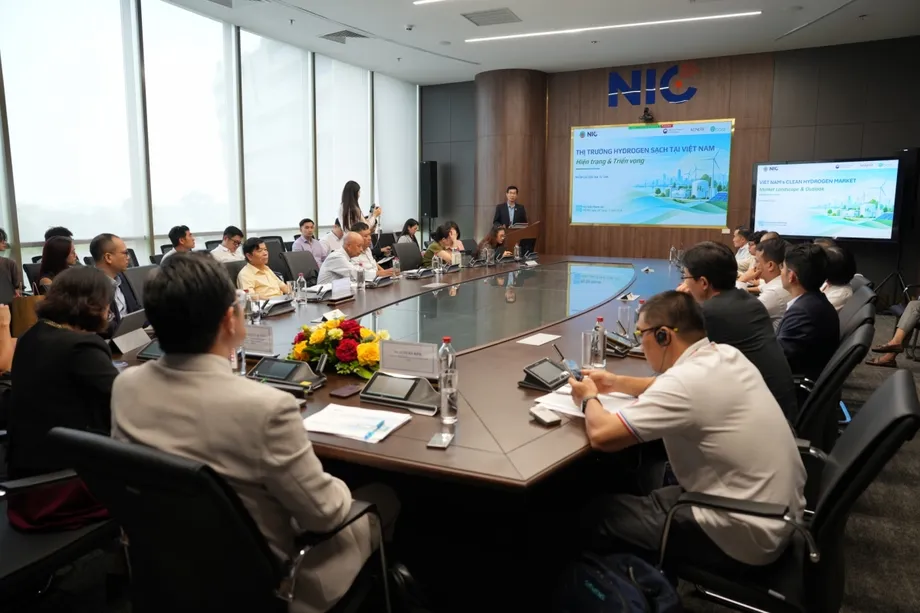
Those findings frame the challenge discussed at the Quy Nhon Dialogue on Climate and Transition, held on October 10 and 11, 2026, at the International Centre for Interdisciplinary Science and Education (ICISE) in Quy Nhon Nam ward, Gia Lai province. More than 100 senior delegates from Vietnam, Southeast Asia and international partner organizations participated.
Vietnamese Deputy Prime Minister Ho Quoc Dung presented climate action as part of Vietnam's development strategy, rather than an alternative to economic growth. Vietnam is pursuing growth of at least 10% while maintaining its commitment to reach net zero emissions by 2050. His central argument was that the transition must create new development opportunities while protecting energy supplies, food, water and living standards.
The scientific and economic messages are closely connected. WMO documents a planet continuing to accumulate heat, while the dialogue focused on how countries can finance and implement changes without restricting development. The meeting was a trial forum, not an international negotiation intended to produce binding commitments.
The ocean reveals the scale of accumulated heat
WMO ranks 2025 as the second or third hottest year on record. Some reports describe it simply as the second hottest, but the organization's own wording preserves both possible rankings. The temperature estimate of about 1.43°C above the historical baseline is consistent across those accounts.
For the first time, the annual report includes Earth's energy imbalance among its main climate indicators. This measures the difference between energy arriving from the Sun and energy escaping into space. When more energy enters than leaves, the planet accumulates heat. Rising concentrations of gases that trap heat disturb that balance.
The report places concentrations of carbon dioxide, methane and nitrous oxide at their highest levels in at least 800,000 years. The energy imbalance has increased since observations began in 1960, particularly during the past two decades, and reached a record in 2025.
More than 91% of the excess heat is stored in the oceans. Over the past two decades, the ocean absorbed energy each year equivalent to about 18 times annual human energy use. That comparison describes the scale of heat accumulation, not electricity production or energy available for consumption.
Ocean heat content reached another record in 2025. The rate of ocean warming more than doubled between the periods 1960 to 2005 and 2005 to 2025. Global average sea level was about 11 centimetres higher in 2025 than in 1993, when satellite measurements began.
The changes extend to frozen regions. Annual Arctic sea ice extent was at or near a record low, Antarctic sea ice extent was the third lowest recorded, and glacier melting continued. Together, these indicators show why a single year's air temperature cannot capture the full state of the climate.
The forecast points to continued temperature pressure
WMO's five year climate forecast, released on May 28, 2025, projected an 80% chance that at least one year from 2025 to 2029 would exceed the temperature record set in 2024. It also estimated an 86% chance that at least one year would be more than 1.5°C above the average for 1850 to 1900.
The forecast put annual global temperatures during that period between 1.2°C and 1.9°C above the historical baseline. These are probabilities issued in 2025, not a fresh assessment incorporating every later observation, and the forecast did not assign a specific global temperature to each individual year.
The Global Annual to Decadal Update 2025–2029 was led by the United Kingdom's Met Office and drew on 220 model ensemble members from 15 institutes. An ensemble combines multiple model simulations to estimate a range of possible outcomes rather than relying on one prediction.
WMO Deputy Secretary General Ko Barrett described the forecast's warning when it was released:
We have just experienced the ten warmest years on record. Unfortunately, this WMO report provides no sign of respite over the coming years, and this means that there will be a growing negative impact on our economies, our daily lives, our ecosystems and our planet,
Her reference to ten years reflected the evidence available in May 2025. The March 2026 assessment subsequently confirmed an eleventh year in the record sequence.
What the 1.5°C figures do and do not mean
The forecast estimated a 70% chance that average warming across 2025 to 2029 would exceed 1.5°C. That compares with 47% in the previous forecast for 2024 to 2028 and 32% in the forecast for 2023 to 2027. The increase from 47% to 70% is 23 percentage points, although the forecasts cover different, overlapping periods.
A calendar year above 1.5°C does not by itself mean that the Paris Agreement's temperature limit has been crossed on a lasting basis. The agreement concerns warming over a longer period, typically assessed across 20 years. A five year average also differs from that longer measure.
WMO estimated that 2024 was 1.55°C above the historical baseline, with an uncertainty of ±0.13°C, making it likely the first calendar year above 1.5°C. The lower estimate for 2025 does not establish that warming has reversed, especially when ocean heat and Earth's energy imbalance reached records.
The sequence of assessments and policy milestones is:
- At COP26 in 2021, Vietnam committed to net zero emissions by 2050.
- In 2024, global annual temperature likely exceeded 1.5°C above the historical baseline for the first time.
- On May 28, 2025, WMO released its forecast for 2025 to 2029.
- On March 23, 2026, WMO confirmed that 2015 to 2025 were the 11 hottest years recorded.
- On October 10 and 11, 2026, the first Quy Nhon dialogue tested a format intended to support annual meetings from 2027.
Vietnam seeks growth alongside lower emissions
At Quy Nhon, Dung set out five principles: connect climate action with development; make the transition fair and suitable for national conditions; match ambition with finance, technology and delivery capacity; put people at the centre; and use knowledge as the foundation for action.
He argued that reducing greenhouse gas emissions must proceed alongside economic growth, energy security, food security, water security and social stability. For a developing economy, that means assessing how climate measures affect production and livelihoods, not measuring success only through emissions totals.
Net zero means balancing remaining greenhouse gas emissions with removals. Vietnam's 2050 commitment therefore sets a destination for the economy, but does not itself specify every investment, technology choice or timetable needed to reach it.
Dung also rejected a single transition model for every country. Differences in development, economic structure, energy infrastructure, technological capacity and exposure to climate hazards require different routes. He reaffirmed support for the Paris Agreement and the principle that countries share responsibility while having different capabilities and circumstances.
Vietnam's stated development pillars include the green economy, circular economy, knowledge economy and digital economy, connected with science, technology and innovation. In this framework, climate resilience and lower emissions are intended to support modernization and competitiveness rather than operate as separate policy goals.
Large investment totals do not guarantee accessible finance
Figures presented at the dialogue projected global energy investment of about $3.4 trillion in 2026. Around $2.2 trillion was expected to go to clean energy, electricity grids, storage, energy efficiency, electrification and technologies with low emissions.
Those categories represent approximately 65% of the projected total, calculated by dividing $2.2 trillion by $3.4 trillion. About $1.2 trillion falls outside the listed categories, although the figures presented do not provide a detailed breakdown of that remainder.
The investment estimates illustrate the scale of the transition, but they are global projections cited at the meeting, not confirmed allocations to Vietnam. They also combine several activities. Grid investment, storage and energy efficiency matter alongside the construction of new generating capacity.
Dung called for connections between public resources, finance on favorable terms, multilateral development banks, climate funds and private capital. His argument went beyond obtaining more money: developing countries also need affordable financing, access to suitable technology and the domestic capacity to implement projects.
That distinction is central to the dialogue's practical purpose. A large global investment total does not show whether a particular country or project can obtain funding at an acceptable cost. No new financing package, project allocation or disbursement schedule was specified in the accounts of the meeting.
People and resilience are part of the same transition
Dung proposed judging success through several outcomes: greater safety from disasters, access to new skills and jobs, opportunities for businesses to innovate, and participation by vulnerable groups in the benefits of development. Emissions reductions and capital raised would remain relevant, but would not be sufficient measures on their own.
This approach connects two distinct tasks. Cutting emissions addresses the causes of warming, while adaptation reduces damage from climate conditions already occurring or expected. The dialogue placed both within the same development agenda.
Practical topics identified for discussion included the resilience of cities, infrastructure and production systems, energy security, affordable capital, technological change and workforce development. These priorities link WMO's warnings about heat, heavy rainfall and tropical cyclones to decisions about investment and public services.
Dung also stressed the sharing of technology, computational models and observation data. Scientists and specialists were assigned a role in transferring knowledge to developing countries, with opportunities for younger researchers to contribute to policy discussions.
Six priorities set the policy direction
Vietnam identified six broad directions for climate action and the green transition. They combine domestic policy changes with financing, energy security, adaptation and international cooperation:
- Improve institutions and policy frameworks that support the transition.
- Advance science, technology and innovation.
- Diversify resources for responding to climate change.
- Protect energy security while shifting toward green and sustainable energy.
- Adapt proactively and promote solutions based on nature.
- Strengthen climate cooperation and diplomacy.
Solutions based on nature use ecosystems to help address climate and development needs. Within the priorities outlined at Quy Nhon, they form part of adaptation rather than a substitute for reducing emissions or strengthening infrastructure.
The six directions describe a policy agenda, not a new law or funded implementation plan. Their importance lies in the combination: technology choices require institutions and financing, while energy changes must be considered alongside resilience and national development needs.
A trial forum seeks results beyond the meeting
The dialogue was organized by Rencontres du Vietnam and ICISE, with support from the French Development Agency (AFD), under the patronage of Vietnam's Ministry of Science and Technology and with assistance from the Gia Lai provincial administration.
Organizers described the 2026 event as Zero Version, an initial trial intended to test the content, discussion format and organization before annual editions beginning in 2027. It was explicitly not an intergovernmental negotiating process and did not aim to produce official declarations or commitments.
Dung proposed three foundations for the forum: science and evidence, practical transition problems, and cooperation that continues after discussions end. He called for research programs, policy ideas and initiatives that could be implemented, supported by lasting relationships among scientists, policymakers, international organizations, financial institutions and businesses.
Professor Tran Thanh Van, president of Rencontres du Vietnam and director of ICISE, similarly argued that the transition should help developing countries respond to climate change, create jobs and improve living standards rather than constrain development. He identified new partnerships and practical action as measures of success, and expressed the hope that Vietnam and Southeast Asia would have a stronger voice.
The next scheduled step is the move toward annual dialogues from 2027. Dung asked ministries and relevant agencies to work with Gia Lai, Rencontres du Vietnam and ICISE to assess delegates' feedback and develop future programs. Specific research partnerships, financing commitments and implementation deadlines have not been identified in the accounts of the event.
Key Points
- WMO confirmed that 2015 to 2025 were the 11 hottest years recorded.
- Global temperature in 2025 was about 1.43°C above the average for 1850 to 1900.
- Earth's energy imbalance and ocean heat content reached records in 2025.
- WMO's May 2025 forecast projected an 80% chance that a year from 2025 to 2029 would exceed the 2024 temperature record.
- Vietnam is pursuing rapid growth alongside its commitment to net zero emissions by 2050.
- The Quy Nhon meeting was a trial dialogue, not a negotiation for official commitments.
- Annual editions are intended to begin in 2027, with an emphasis on research, policy cooperation and practical action.