Overseas Sales Drive Anime to a New Record
Japan wants its overseas anime market to reach 6 trillion yen by 2033, building on a record year in which international revenue grew much faster than sales at home. The ambition puts streaming services, blockbuster films and the working conditions of animators at the centre of a national effort to turn cultural popularity into greater export earnings.
Contents
- Overseas Sales Drive Anime to a New Record
- What Japan Wants to Achieve by 2033
- Streaming Changed How Fans Reach Anime
- More Funding for Films, Distribution and Creators
- A Shortage of Animators Limits Expansion
- Games and Manga Share the Export Ambition
- Blockbusters Bring Opportunity and Creative Risk
- The Dates Behind the Expansion Plan
- The Bottom Line
The Association of Japanese Animations (AJA) valued the anime market at 3.8407 trillion yen, approximately $25.1 billion, in 2024. That was an increase of 14.8% from the previous year and the second highest annual growth rate on record, behind only 2019.
Overseas revenue reached 2.1702 trillion yen, approximately $14.1 billion, after growing 26%. Japan's domestic market increased by 2.8% to 1.6705 trillion yen. International sales therefore accounted for roughly 56% of the total, making audiences outside Japan the larger source of earnings.
2024 was the third consecutive year in which overseas sales exceeded domestic revenue. International earnings first overtook the domestic market in 2020, when the pandemic accelerated the spread of anime through streaming platforms.
Kazuko Ishikawa, chair of the AJA and president of Nippon Animation, described anime as having become a core pillar of Japan's cultural and economic exports during a presentation at the Tokyo International Film Festival Content Market (TIFFCOM).
The government's next challenge is to keep that expansion going while increasing production capacity. More viewers can create demand for films, series, merchandise and events, but studios still need enough people, time and money to make the work that attracts those audiences.
What Japan Wants to Achieve by 2033
Japan's Ministry of Economy, Trade and Industry (METI) outlined its roadmap at the 18th Entertainment and Creative Industrial Policy Seminar on March 27. The ministry aims to expand the overseas anime market to 6 trillion yen, approximately $37 billion, by 2033.
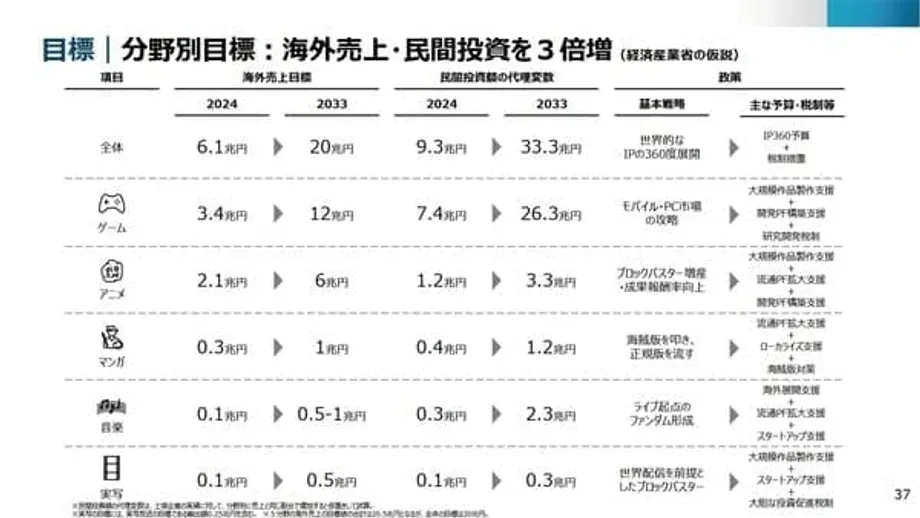
The anime target sits within a broader plan to increase creative industry exports from roughly 6.1 trillion yen in 2024 to 20 trillion yen, approximately $125 billion, by 2033. Games, manga, music and content filmed with actors are also part of that effort.
The anime ambition is presented as effectively tripling the market in less than a decade, with the expansion described as 186% over the next eight years. Using the precise 2024 figure of 2.1702 trillion yen, reaching 6 trillion yen would mean an increase of about 176%. The calendar interval from the 2024 measurement to the 2033 target is nine years.
The recent growth figures show why policymakers see room for expansion. Overseas anime revenue increased from 1.4592 trillion yen in 2022 to 2.1702 trillion yen in 2024. Those figures represent growth of about 49% in two years, rather than a doubling. Maintaining rapid growth from a larger starting point will require changes in production, distribution and the ways companies earn money from anime abroad.
Masahiko Hasegawa, editor-in-chief of the AJA report, explained that international earnings now come from packages of commercial rights extending beyond the programme itself:
The overseas market now far exceeds local revenues, and the gap will only widen. Growth today includes bundled contracts that span theatrical, streaming, merchandising, and event rights, not just content distribution.
A bundled contract can bring several uses of a title into one agreement. Cinema screenings, streaming access, merchandise and events can each generate income, giving a successful story more than one route to an audience.
Streaming Changed How Fans Reach Anime
International fans in the 1990s often had to search specialty shops for rare VHS tapes or exchange recordings through fan clubs. Streaming services now deliver anime with subtitles or dubbing to 200 global markets within hours of its Japanese broadcast.
Nearly half of overseas revenue flows through these digital distribution channels. That makes streaming central to the export strategy, while theatrical releases, merchandise and events provide other ways to earn money from the same titles.
Netflix, Crunchyroll and Amazon Prime Video expanded their acquisition of anime libraries during the pandemic in 2020. Their services introduced anime to mainstream audiences who had previously had little contact with it.
Growing subscriber numbers in North America, Europe and Asia helped support larger production budgets and improved visual quality. Easier access also helped anime move beyond its position as a niche interest. A viewer no longer needed a specialist shop or a fan trading network to discover a series.
The International Otaku Events Association tracks 160 events related to anime across 50 countries. These range from Anime Expo in Los Angeles to smaller gatherings in emerging markets, showing how interest in the programmes also supports activity away from screens.
Megumi Onouchi, an AJA committee member and CEO of HumanMedia, told industry professionals at TIFFCOM that overseas demand still had room to grow:
Overseas revenue is now climbing high and has not yet reached the peak. We're seeing a rise in international events across the globe, and the numbers are increasing.
Streaming and events play different roles in that expansion. A platform can make a series widely accessible, while a convention gives fans a place to gather and buy related goods. The government's revenue ambition depends on developing several of these channels together.
More Funding for Films, Distribution and Creators
METI's strategy has three main priorities: blockbuster production, distribution infrastructure and workforce development. The plan combines support for productions intended to reach large audiences with efforts to improve how content travels abroad and how the people making it are treated.
Government funding for the anime industry is set to rise from under 20 billion yen in fiscal year 2024 to 58.9 billion yen in fiscal year 2026. METI will control 35.5 billion yen, roughly 60% of that total.
The increase places cultural content more firmly within economic policy. Funding for production and overseas distribution is intended to help turn audience demand into export revenue, alongside the artistic work involved in creating films and series.
The blockbuster push draws encouragement from the Demon Slayer franchise. Its 2025 release, Demon Slayer: Kimetsu no Yaiba the Movie: Infinity Castle, became the first Japanese film to surpass 100 billion yen at the global box office.
METI has also launched the IP360 support programme, providing grants of up to 10 million yen, approximately $62,500, to independent developers. Support covers work from preparation before production through localisation and overseas promotion. Localisation means adapting content for another market, including translation, so audiences can follow and enjoy it.
The programme aims to broaden the production pipeline beyond established studios. It also gives attention to better working conditions and higher rates of pay linked to performance for animators, addressing labour practices that have discouraged people from entering or remaining in the industry.
The two strands serve different needs. Large productions can pursue mass audiences, while support for independent developers can help a wider range of projects reach the market. Both still depend on the availability of skilled creators.
A Shortage of Animators Limits Expansion
Industry estimates put Japan's shortage at approximately 30,000 additional animators needed to sustain current output, before allowing for the further expansion required by the 2033 target.
Many studios have a reputation for long hours, low wages and employment through contracts that provide limited security or benefits. These conditions create a practical problem for the growth strategy: increasing demand requires more production work, yet difficult jobs can deter the people needed to do it.
Kadokawa is responding with plans for Studio One Base, a production hub inside the Sunshine City complex in Tokyo's Ikebukuro district. The facility will bring six affiliated animation studios under one roof and is scheduled to open in autumn 2026.
The company wants the shared base to improve collaboration between teams and create an environment in which creators can concentrate on their work. The investment connects the question of production capacity with the daily conditions inside studios.
Tsuyoshi Kikuchi, Kadokawa's Executive Officer and Chief Studio Officer, described the company's goals for the facility and its relationship with the surrounding district:
By renewing the image of anime production sites, improving studio functions to raise productivity, and improving the treatment of creators, we will strive to create a workplace that people can take pride in and a profession others will aspire to. By strengthening regional collaboration with Toshima Ward and Sunshine City, we will develop Ikebukuro into a 'world-class anime city' and establish global IP creation capabilities.
IP means intellectual property, the rights attached to creations such as stories and characters. Building the ability to create globally successful IP means developing work that can generate income through several uses, including the viewing, merchandise and event rights described by Hasegawa.
Studio One Base is a concrete private investment alongside the government's spending plans. Its autumn 2026 opening is the next scheduled development identified for the production hub.
Games and Manga Share the Export Ambition
Video games account for an even larger part of the government's 2033 target than anime. METI aims to increase the overseas game market from 3.4 trillion yen to 12 trillion yen, an increase of approximately 253%.
The strategy focuses particularly on gaining a greater share of mobile and PC gaming. Support includes tax incentives for research and development, alongside translation tools using artificial intelligence to speed up localisation.
Anime and games together account for 18 trillion yen, or 90%, of the total 20 trillion yen ambition. That leaves 2 trillion yen for manga, music and content filmed with actors.
Manga has its own target: growth from 300 billion yen to 1 trillion yen. Adding that goal to anime and games brings the three sectors to 19 trillion yen, leaving 1 trillion yen within the total for music and content filmed with actors.
Japan's manga strategy places particular attention on piracy enforcement and authorised distribution. The government plans closer cooperation with foreign authorities, including action against counterfeit goods in markets such as China.
Translation assisted by artificial intelligence is intended to accelerate official releases. The plan also includes revitalising domestic bookstores, recognising their role in helping develop stories and characters that can later receive anime adaptations.
Music faces a steep increase of its own. The target is to expand overseas revenue from 100 billion yen to between 500 billion and 1 trillion yen, representing growth of 400% to 900%.
The sector targets show how heavily the national plan depends on anime and games. They also show that the remaining industries need substantial growth, rather than simply maintaining their present earnings.
Blockbusters Bring Opportunity and Creative Risk
Japan's pop culture exports already have an established presence in major international markets. Continuing to expand from that position may become harder as the easiest opportunities are taken. This is the idea behind diminishing returns: further effort can produce smaller additional gains as a market becomes more developed.
Japanese game companies face competition from well funded Western and Chinese businesses in a mature industry. The 12 trillion yen ambition therefore requires winning more business in a market where strong competitors are already active.
The emphasis on blockbuster anime also creates a tension within the creative strategy. Productions designed for mass audiences can require larger budgets and longer schedules. As the financial commitment grows, companies may favour familiar stories and commercially safer decisions.
Concerns within the creative community centre on whether that approach could make anime less varied. Its international appeal has long included unconventional narratives and artistic styles that differ from Western animation norms.
Hollywood and major video game productions offer a comparison for the commercial risks described in the strategy: pursuing large audiences can bring expanding costs, lengthy development and caution about new ideas. For anime, preserving the variety that drew audiences abroad is part of sustaining demand.
Streaming growth may also slow as markets mature and competition intensifies. Anime tourism and merchandise provide other possible sources of revenue, but capturing more of that spending requires Japanese companies to build direct retail and event operations overseas instead of relying mainly on licensing fees.
The export challenge is therefore wider than producing more episodes or securing more streaming agreements. Companies need to manage production costs, retain creators and earn revenue across the different activities surrounding successful titles.
The Dates Behind the Expansion Plan
Japan's current ambitions follow several years of change in how anime reaches audiences and where it earns money. The key milestones run from the pandemic shift in distribution to the next studio opening and the government's export deadline:
- 2020: Overseas anime revenue first exceeded domestic earnings as streaming distribution accelerated during the pandemic.
- 2022: The overseas anime market stood at 1.4592 trillion yen.
- 2024: Total anime revenue reached 3.8407 trillion yen, including 2.1702 trillion yen overseas. Creative industry exports stood at roughly 6.1 trillion yen.
- 2025: Demon Slayer: Kimetsu no Yaiba the Movie: Infinity Castle surpassed 100 billion yen at the global box office.
- March 27, 2026: METI outlined its roadmap at the 18th Entertainment and Creative Industrial Policy Seminar.
- Fiscal year 2026: Government funding for anime is set to reach 58.9 billion yen, with METI controlling 35.5 billion yen.
- Autumn 2026: Kadokawa's Studio One Base is scheduled to open in Ikebukuro.
- 2033: Japan aims for 6 trillion yen in overseas anime revenue and 20 trillion yen in total creative industry exports.
As of April 14, 2026, the 2033 figures are goals. The central task is to connect increased funding and international demand with enough production capacity, better employment conditions and a wider range of ways to earn money abroad.
The Bottom Line
- Japan's anime market reached 3.8407 trillion yen in 2024, growing 14.8%.
- Overseas revenue rose 26% to 2.1702 trillion yen and accounted for roughly 56% of the total.
- METI aims for 6 trillion yen in overseas anime revenue by 2033 within a 20 trillion yen creative export plan.
- The strategy supports blockbuster productions, distribution, independent developers and improved conditions for creators.
- Government anime funding is set to reach 58.9 billion yen in fiscal year 2026.
- An estimated shortage of 30,000 animators creates pressure on production capacity.
- Kadokawa plans to bring six studios together at Studio One Base in autumn 2026.
- Anime and games account for 18 trillion yen of the export target; adding manga brings the combined ambition to 19 trillion yen.