Ten Bottles Bring a New Dispute to a Philippine Outpost
The Philippines has accused Chinese crews of using cyanide to damage marine life around Second Thomas Shoal, saying laboratory tests confirmed the poison in bottles seized near its military outpost aboard the BRP Sierra Madre. Philippine officials presented the allegations on Monday in Manila, adding an environmental confrontation to a maritime dispute already marked by dangerous encounters between coast guard vessels.
Contents
- Ten Bottles Bring a New Dispute to a Philippine Outpost
- What Philippine Troops Say They Found
- Why Cyanide Threatens Fish and Coral
- Manila Warns of a Risk to the Warship Itself
- China Rejects the Evidence and Cites Its Own Study
- Diplomatic Talks Continue Alongside the Accusations
- How a Grounded Ship Became a Military Flashpoint
- Military Partnerships Expand Around the Dispute
- The Legal Dispute Meets the Region's Fishing Economy
- Manila Orders Patrols as Late April Exercises Approach
- Key Points
Rear Admiral Roy Vincent Trinidad, spokesperson for the Philippine Navy, said troops seized ten yellow plastic bottles during operations in February, July and October 2025. He described the bottles as containing cyanide. Officials specified that the National Bureau of Investigation had confirmed the chemical in bottles recovered in February and October, while the containers seized in July remained under examination.
Cornelio Valencia, assistant director-general of the Philippine National Security Council, accused Chinese fishermen of deliberately poisoning the surrounding ecosystem to deprive Filipino personnel of fish. He described the alleged activity as calculated environmental sabotage, with possible consequences for the food supply, health and position of the troops stationed on the grounded warship.
Chinese Foreign Ministry spokesperson Guo Jiakun rejected the accusations as a manufactured crisis and a theatrical stunt. Beijing accused Philippine forces of harassing Chinese fishing vessels and seizing their supplies illegally, presenting a sharply different account of what happened around the reef.
As of April 14, 2026, the dispute concerns both the laboratory findings announced by Manila and its allegation that the chemical was being used for a strategic purpose. Philippine officials say Chinese crews were targeting the resources that help sustain an isolated garrison. China says Manila staged the controversy to discredit Beijing and justify greater international involvement.
What Philippine Troops Say They Found
Philippine officials documented four incidents between February 2025 and March 2026 in which vessels identified as Chinese Maritime Militia ships deployed sampans near the Sierra Madre. Sampans are small wooden boats that can operate close to a reef while larger vessels remain farther away.
The smaller boats approached within one nautical mile of the grounded warship. Philippine personnel observed crews conducting diving activities before boarding teams intercepted them. Officials said the bottles recovered during the three operations in 2025 came from boats deployed by larger Chinese Maritime Militia vessels operating inside the Philippine exclusive economic zone.
In March 2026, soldiers said they observed another Chinese crew poisoning waters near the outpost. Water samples collected afterward tested positive for cyanide, according to Philippine military officials. That incident expanded the allegations from chemicals found in containers to contamination detected in the surrounding water.
The sequence presented by Manila spans more than a year:
- February 2025: Philippine troops seized bottles near the Sierra Madre. Laboratory analysis later confirmed cyanide.
- July 2025: Troops recovered similar containers, which remained under examination when officials presented the allegations.
- October 2025: Another interception yielded bottles in which laboratory tests confirmed cyanide.
- March 2026: Soldiers reported seeing a Chinese crew poisoning nearby waters, and subsequent water samples tested positive for the chemical.
- Monday, before April 14, 2026: Security officials presented their findings at a press conference in Manila.
Philippine security officials described their evidence as irrefutable proof of deliberate environmental destruction. Their presentation came as the country prepared for annual military exercises involving the United States, Australia and Japan, bringing the allegations into a wider debate about security in the South China Sea.
Why Cyanide Threatens Fish and Coral
Cyanide fishing involves releasing sodium cyanide near coral reefs to stun fish so they can be captured alive. The fish may then enter the live reef fish trade or aquarium markets. The practice has existed in Southeast Asian fishing communities for decades and has been widely banned across the region because of its destructive effects.
The poison affects more than the fish that fishermen intend to catch. It can kill other marine life and destroy coral polyps, the small living organisms that build reefs. Severe damage can leave reef systems barren for years, reducing the habitat available to fish and other sea life.
Valencia argued that the activity near Second Thomas Shoal served a military purpose rather than simply a fishing one. Philippine personnel aboard the Sierra Madre supplement delivered rations with fish caught in the surrounding waters. Officials described that catch as a vital source of protein during extended deployments at the remote outpost in the Spratly Islands.
Manila therefore sees the alleged poisoning as a way to weaken the garrison by reducing an accessible food source. Damage to fish populations would make the troops more dependent on deliveries, which have repeatedly faced interference from Chinese vessels.
Valencia also warned that cyanide could contaminate the water supply and fish consumed by the personnel. His account placed the health of the troops alongside the ecological damage at the center of the Philippine accusation.
Manila Warns of a Risk to the Warship Itself
The BRP Sierra Madre is already deteriorating after decades of exposure to salt water and sunlight. Philippine officials raised another concern: damage to the coral reef that partly supports the vessel could threaten its physical position.
Officials described cyanide as a corrosive substance and warned that it could gradually weaken the reef structure beneath the ship. In their assessment, crumbling coral foundations could allow the hull to shift or break apart, potentially forcing the Philippines to abandon the outpost.
The allegation connects three forms of pressure on the garrison. Fish losses could reduce its food supply, contamination could endanger personnel, and reef damage could threaten the structure supporting their quarters. Those are the consequences Philippine officials say make the suspected use of cyanide a security issue as well as an environmental one.
China Rejects the Evidence and Cites Its Own Study
Guo Jiakun, the Chinese Foreign Ministry spokesperson, dismissed the Philippine presentation at a regular press briefing. He accused Manila of interfering with Chinese fishing vessels engaged in legitimate maritime activities and staging a farce to support greater international intervention.
Beijing framed the seized bottles as planted evidence or materials that Philippine authorities had misrepresented. Guo maintained that Philippine forces had illegally taken fishing supplies from Chinese boats, directly challenging Manila's account of the interceptions.
China also referred to a November 2025 report by its Ministry of Ecology and Environment concerning Scarborough Shoal, which Beijing calls Huangyan Island. The ministry reported finding no traces of cyanide in seawater, sediment or fish samples there. Scarborough Shoal is a different location from Second Thomas Shoal, where the latest Philippine allegations are centered.
Beijing used the earlier study to argue that Manila had developed a pattern of fabricating environmental accusations against Chinese maritime operations. Its response combined a rejection of the latest evidence with a broader challenge to the credibility of Philippine claims.
Ding Duo, a researcher at the National Institute for South China Sea Studies, offered a political explanation for the timing. He portrayed the cyanide allegations as a recycled narrative intended to distract from domestic problems, including energy shortages in the Philippines. His interpretation was that Manila sought to rally public support for a more confrontational maritime policy while diverting attention from governance failures.
Diplomatic Talks Continue Alongside the Accusations
China and the Philippines had recently resumed discussions before the cyanide dispute intensified. In late March, Chinese Vice Foreign Minister Sun Weidong hosted Philippine Undersecretary Leo Herrera-Lim in Quanzhou for the 24th round of bilateral consultations.
The talks addressed possible oil and gas cooperation and measures intended to build confidence between the two countries. These included communication protocols for their coast guards, whose vessels repeatedly encounter each other in contested waters.
The Philippine Foreign Ministry later clarified that cooperation would exclude sensitive operational areas. That qualification left the scope of the diplomatic opening limited even as the countries discussed ways to manage their disagreements.
The latest accusations place another strain on those efforts. Manila is alleging deliberate damage to an ecosystem that supports its military personnel, while Beijing is accusing Manila of manipulating evidence and obstructing fishing activities. Their discussions about cooperation are continuing against that unresolved disagreement.
How a Grounded Ship Became a Military Flashpoint
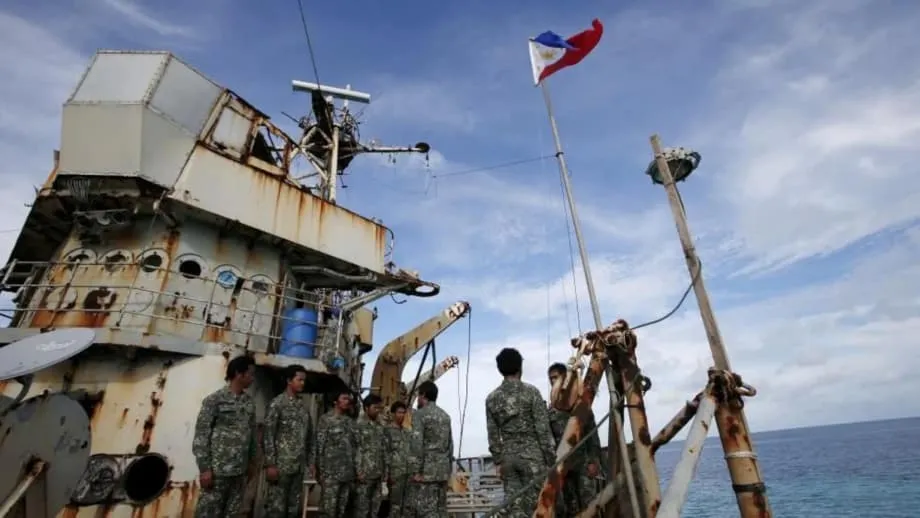
The Philippines deliberately grounded the BRP Sierra Madre on Second Thomas Shoal in 1999. The former United States Navy tank landing ship, dating from World War II, now houses a small contingent of Philippine marines and serves as a makeshift military installation.
Manila placed the vessel there in response to China's establishment of a presence on nearby Mischief Reef. China has since turned Mischief Reef into a militarized artificial island with runways and naval facilities. The Sierra Madre maintains a Philippine presence at Second Thomas Shoal and prevents China from asserting unchallenged control there.
The outpost has required constant resupply through the 26 years described in the Philippine account. Keeping personnel aboard the deteriorating hull depends on deliveries of essentials, including food and medicine, as well as the fish they catch nearby.
Chinese Coast Guard and Maritime Militia vessels have made those missions increasingly hazardous through attempts to intercept Philippine supply boats. Manila says militia vessels continue to gather around the shoal, adding to the pressure applied by China's official coast guard.
In June 2024, a confrontation became violent when Chinese personnel carrying knives, sticks and an axe boarded Philippine navy boats. Several Filipino sailors were injured, including one who lost a finger. The encounter temporarily prevented the delivery of essential supplies.
Negotiations afterward produced a provisional understanding on resupply missions, but the arrangement remains fragile. The continued presence of Chinese vessels means that each delivery takes place in an environment where another confrontation is possible.
Military Partnerships Expand Around the Dispute
Philippine officials describe the Maritime Militia as a force that adds to the reach of China's coast guard. The pressure around the shoal is an example of what is often called gray zone activity: coercive action that stays below direct military conflict while making it harder for another country to operate.
Such tactics allow China to maintain pressure on the Philippine outpost without a direct military confrontation that might activate the Philippines' mutual defense treaties with the United States. Manila's allegation adds resource denial, depriving troops of food or a usable environment, to its account of that pressure.
The Philippines recently conducted joint maritime exercises with the United States and Australia ahead of the annual Balikatan war games scheduled for late April. Japan is due to participate as a full partner in Balikatan for the first time, widening the security cooperation among countries concerned about China's expansion in the region.
Senior Captain Zhai Shichen, spokesperson for the People's Liberation Army Southern Theater Command, criticized the joint patrols as destabilizing provocations that undermine regional peace. Beijing's objections show how the dispute around one Philippine outpost is tied to a broader contest over foreign military activity in the South China Sea.
The United States has also revealed the existence of Task Force Ayungin, named after the Philippine name for Second Thomas Shoal. The task force supports Manila's maritime operations through assistance that includes unmanned surface vessels, intelligence sharing and specialized training.
Washington's support reflects the strategic importance it places on maintaining the Philippine outpost as a barrier to further Chinese expansion. For Manila, that assistance supports operations in an increasingly difficult maritime environment.
The Legal Dispute Meets the Region's Fishing Economy
Second Thomas Shoal lies within the Philippine exclusive economic zone, which extends 200 nautical miles from the archipelago's baseline. Under the United Nations Convention on the Law of the Sea, known as UNCLOS, the Philippines has sovereign rights to explore and use marine resources in those waters.
An exclusive economic zone gives a coastal country rights over resources such as fish and offshore oil and gas. That is why allegations about damage to fish stocks are connected to Manila's legal position as well as the immediate needs of the Sierra Madre garrison.
The 2016 arbitration ruling in The Hague invalidated China's sweeping historical claims in the South China Sea, including the nine dash line covering nearly the entire waterway. China has refused to recognize the judgment.
The environmental stakes extend beyond the grounded warship. South China Sea fishing grounds support millions of livelihoods across Southeast Asia, and more than half of the world's fishing vessels operate in these waters. Shipping routes through the region also carry more than $3 trillion in commerce each year.
Cyanide damage to reef ecosystems could affect the fish on which coastal communities depend. Manila's allegation links that food security concern to a territorial confrontation: the same waters sustain local livelihoods, support an isolated military position and sit within an area claimed by competing governments.
The security concern raised by the alleged sabotage is that environmental damage could become a method of territorial coercion. Resource denial can place pressure on a garrison while leaving the purpose of the activity open to dispute. If established as a deliberate tactic, the use of ecological destruction in this way could set a dangerous precedent for other maritime disputes.
Manila Orders Patrols as Late April Exercises Approach
Philippine authorities have ordered stronger naval and coast guard patrols throughout the Spratly Islands in response to the cyanide findings. The stated aims are to prevent further environmental damage and protect supply missions to the Sierra Madre.
Military personnel have also been instructed to document additional instances of chemical contamination for possible use in international arbitration. That gives future patrols a second task alongside protecting the outpost: collecting evidence that could support a legal case.
Manila has yet to settle whether the allegations will lead to formal international litigation or further diplomatic action. The next scheduled security event is the Balikatan exercise in late April, while Chinese vessels continue to maintain a presence around the shoal.
The immediate dispute combines a confirmed Philippine laboratory finding, an allegation of deliberate sabotage and a categorical Chinese rejection. Its practical consequences center on the troops aboard the Sierra Madre, the reef beneath them and the supply routes that keep the outpost occupied.
Key Points
- Philippine officials said cyanide was confirmed in bottles seized near Second Thomas Shoal in February and October 2025; containers recovered in July remained under examination.
- The Navy reported ten yellow plastic bottles seized during three operations in 2025, followed by a March 2026 incident in which nearby water samples tested positive.
- Manila alleges the chemical was intended to kill fish, threaten personnel and weaken the reef partly supporting the BRP Sierra Madre.
- China rejected the allegations and cited its November 2025 environmental study of Scarborough Shoal, where it reported finding no cyanide.
- The Sierra Madre was deliberately grounded in 1999 and remains a Philippine military outpost dependent on resupply missions.
- A June 2024 confrontation injured Filipino sailors, including one who lost a finger, and disrupted deliveries of essentials.
- The Philippines has ordered stronger patrols and further documentation of contamination, while Balikatan exercises involving expanded international participation are scheduled for late April.