A planned separation, a painful announcement
On July 20, 1965, Singapore's finance minister Goh Keng Swee met Malaysia's deputy prime minister Tun Abdul Razak and home affairs minister Dr Ismail Abdul Rahman in Kuala Lumpur and proposed that Singapore secede. Less than three weeks later, on August 9, prime minister Lee Kuan Yew struggled through a televised announcement that the union with Malaysia was over. Behind the familiar image of his tears lay secret negotiations, legal preparations and decisions made by a small circle of leaders.
Contents
- A planned separation, a painful announcement
- Why the union became unworkable
- Goh's proposal for a quick and quiet break
- The small team that prepared the legal documents
- The final days before independence
- Lee's anguish before the cameras
- How the exhibition brings the records together
- Visiting the National Library display
- A fuller account of public memory
- What classrooms and public reactions add
- At a Glance
Newly accessible records and a newly released oral history interview with Lee's wife, Kwa Geok Choo, bring those public and private moments together. Kwa, a lawyer, described the hours after the announcement as the hardest she had seen her husband endure. Her recollection gives a personal view of a day usually remembered through television footage.
The interview is a centrepiece of The Albatross File: Singapore's Independence Declassified, a permanent exhibition opening on December 8 at the National Library Building. Cabinet papers and handwritten notes kept by Goh help explain how separation was negotiated, who prepared it and why the final steps happened so quickly.
The exhibition and its companion book, The Albatross File: Inside Separation, bring forward documents long kept out of public sight. Working drafts, secret memoranda and oral histories allow visitors to follow the tense final phase of bargaining and preparation almost hour by hour. Together, they present independence as both an emotional rupture and a carefully arranged political settlement.
Singapore and Malaysia's leaders moved through private channels toward a negotiated break after concluding that the federation had become unworkable. Lee's grief sits alongside that planning: he had spent years arguing that merger offered Singapore security and growth, then faced the responsibility of leading a small new state into an uncertain future.
Why the union became unworkable
Lee had championed merger since the late 1950s. He believed that a common market and a larger political home would give Singapore a firmer economic and political foundation. A common market would allow the participating economies to trade more freely with one another, making it central to Singapore's hopes for the union.
Singapore's membership in Malaysia lasted less than two years. During that period, disagreements over politics, race relations and money became increasingly difficult to resolve. The People's Action Party (PAP) campaigned on a non communal platform, while UMNO, the dominant party in Malaya and then Malaysia, organized politics along communal lines.
PAP's decision to contest seats in the 1964 federal elections was seen in Kuala Lumpur as a direct challenge. Public rhetoric grew sharper, and communal riots in Singapore in 1964 left deep scars. Economic arguments, including disputes over revenue sharing and the pace of establishing a common market, added to the strain.
By late 1964, senior figures were exploring alternatives that would preserve some form of association without a full separation. Those discussions stalled. Pressure rose further in mid 1965, as leaders considered how to end the political conflict while limiting the risk of violence.
Goh's proposal for a quick and quiet break
Goh's Albatross File contains notes and papers gathered while he handled secret talks. For decades, the public knew little about the discussions taking place behind closed doors in July and early August 1965. The file supplies details of the bargaining that brought Singapore to independence.
At the July 20 meeting with Razak and Ismail, Goh proposed full separation. He believed that immediate, quiet action would help avoid unrest and give both sides room to move forward. He later recalled that the process should be completed very quickly and very quietly, with the outcome presented as a fait accompli once the legal documents were ready. In plain language, the public would hear about a decision that had already been settled.
Lee learned only years later that Goh had already proposed full separation to the senior Malaysian leaders in July. The timing of that discovery shows how closely information was held within the small team managing the final weeks. Even central participants did not have a complete picture of every discussion as events unfolded.
Goh's approach combined political negotiation with a concern for public order. The goal was to reach an agreement, prepare its legal basis and announce the result before the process could generate further unrest.
The small team that prepared the legal documents
Law minister E. W. Barker was summoned in mid July and instructed to prepare documents that would give legal effect to a complete break. He later recalled being asked whether the attorney general could draft an agreement and whether the work could remain secret.
Barker undertook the drafting himself to keep the number of people involved as small as possible. Only a handful of officials knew what was being prepared. He found a legal precedent in the breakup of the Federation of the West Indies and used it to help shape the documents for Singapore's separation.
Three instruments were needed: an agreement to separate, an amendment to the Malaysia Constitution making separation lawful, and a proclamation of Singapore's independence. Each had a different job. The agreement set out the parting, the constitutional amendment changed the legal framework of the federation, and the proclamation announced Singapore's new status.
A trusted Cabinet secretary typed the manuscripts. The Proclamation of Singapore was plain in presentation and was read over Radio Singapura at 10 a.m. on August 9. A recording of the announcement in Malay is known to survive.
Barker later described the outcome as a "negotiated Separation". His wording captures the work done by leaders and legal officials on both sides before independence became public.
The final days before independence
Singapore's leaders did not all accept separation immediately. S. Rajaratnam and Toh Chin Chye initially opposed the break. Malaysia's prime minister, Tunku Abdul Rahman, wrote to Dr Toh warning that he could not guarantee peace if Singapore remained in the federation.
Dr Toh's anguished reply reflected the pain of the choice. He nevertheless accepted that parting might prevent bloodshed. Legal preparations continued in July while the political decision was being settled.
Lee also continued looking for a way to preserve an association. On August 7, after the separation agreement had been signed in secret, he drove to see Tunku Abdul Rahman and asked whether a looser federation might still be possible. The answer was no.
The main steps unfolded over a compressed period:
- Late 1964: Senior figures explored alternatives short of full separation, but the talks stalled.
- Mid July 1965: Barker was asked to prepare the legal documents for a complete break.
- July 20, 1965: Goh proposed separation in Kuala Lumpur to Razak and Ismail.
- August 7, 1965: After the separation agreement was signed in secret, Lee asked Tunku whether a looser federation remained possible.
- August 9, 1965: The proclamation was read on radio at 10 a.m., Parliament in Kuala Lumpur moved the necessary constitutional changes, and the public learned that Singapore was independent.
Lee's anguish before the cameras
Singaporeans watched Lee announce the end of the union on August 9. Television captured long pauses, difficulty finding words and his request for a glass of water. The leader who had argued that merger was Singapore's surest route to security and growth was now explaining why that political home had disappeared.
Lee Kuan Yew, Singapore's founding prime minister, described his feelings during the broadcast:
For me it is a moment of anguish.
Lee's reaction has shaped public memory of independence for decades. The new records place that moment beside the preparations already undertaken by Goh, Barker and others. The legal groundwork had been laid weeks earlier, while Lee was still seeking a way to retain some form of association.
Kwa Geok Choo's oral history moves the account beyond the press conference. A steady presence beside Lee in public and private life, she recalled the strain of the preceding days, the quiet at home after the television lights went off and the effect of separation's unfolding reality on her husband.
Kwa, Lee's wife and a lawyer, described him as having come:
nearest to a nervous breakdown
Her account connects the exhausting negotiations, the wrenching public declaration and the uncertainty facing a tiny new state. She described the aftermath as the hardest period she had seen Lee endure. The careful preparation for independence and his distress were both part of the same event.
How the exhibition brings the records together
The permanent exhibition has four sections: Room, Records, Atlas and Chatbook. Each approaches the events of 1965 differently, combining documentary evidence with ways to follow the people, places and decisions involved.
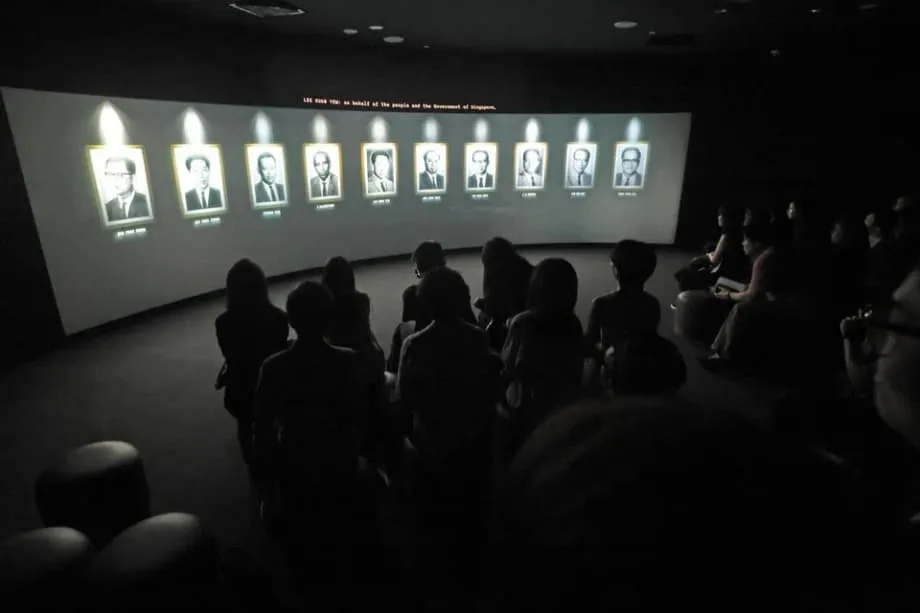
Room presents a dramatized retelling of meetings held behind closed doors and calls made late at night. Its twenty minute film blends archival footage, interviews and cinematic scenes to recreate the compressed atmosphere of the final negotiations.
Records allows visitors to hear oral history clips from leaders on both sides of the Causeway and examine official documents, including extracts from the Albatross File. The voices and papers give visitors access to both later recollections and records created during the separation process.
Atlas is a large interactive wall tracing the final months, days and hours before independence. Its Spacetime Clock shows where key people were at crucial moments, helping visitors connect events that took place in different locations.
Chatbook uses a guide powered by artificial intelligence to answer questions. It draws on The Albatross File: Inside Separation and the national archives, and directs visitors toward primary sources. Primary sources are the documents and recorded accounts that provide direct evidence about the events being studied.
The companion book will be launched with the exhibition. Together, the book and display bring the secret memoranda, working drafts, handwritten notes and recorded memories into a setting where the public can examine the decisions in greater detail.
Visiting the National Library display
The Albatross File: Singapore's Independence Declassified opens on December 8 at Level 10 of the National Library Building. Admission is free, and the exhibition is recommended for visitors aged 10 and above.
Opening hours are 10 a.m. to 9 p.m., except on selected eves and public holidays. Tickets are required and can be booked online, with entry on a first come first served basis. Booking details are available on the official booking page.
Visitors can follow both the personal story of Lee's distress and the administrative work that preceded the announcement. The exhibition's different sections allow the final negotiations to be considered through voices, documents, a film and an interactive timeline.
A fuller account of public memory
Many Singaporeans grew up with an account in which Singapore was expelled unwillingly and independence was thrust upon an island unready for statehood. The newly accessible records, alongside memoirs and oral histories that scholars have used for years, describe a more complex process.
Leaders in both capitals judged that separation could bring stability. Singapore's core team prepared legally and administratively for independence, while Lee faced the loss of a union he had long supported. Planning, reluctance and concern about violence all shaped the decision.
Josephine Teo, Minister for Digital Development and Information, said that opening access to the records would allow people to reach more detailed judgments:
Keen students of history have access to these materials and can form their own nuanced views.
The release gives the public more evidence with which to understand the choices made in 1965. Documents show what officials prepared, oral histories describe how participants later remembered events, and the political circumstances explain why decisions were made under pressure.
What classrooms and public reactions add
Educators and historians have urged textbooks to move beyond a simple account of Singapore being kicked out. The archives support a narrative that includes Malaysia's prime minister concluding that separation was necessary to secure calm, Goh pressing for a quick and quiet solution, and Barker preparing the legal instruments.
Lee accepted the new reality and saw to it that the transition took place without violence. Oral histories record him later thanking Barker and describing the outcome as a "bloodless coup". The phrase reflected relief that the split had avoided bloodshed rather than a celebration of the rupture.
Public reactions in 1965 were varied. Many shared Lee's pain, while others felt relief or joy. Markets rose, and there was celebration in Chinatown. Singapore's independence was experienced differently by people living through the same announcement.
Classroom accounts that include those reactions, the private negotiations and the legal preparations give students a fuller understanding of the event. They show the risks leaders faced, the practical decisions made to manage the crisis and the courage needed to navigate a break that could have turned violent.
Kwa's recollection adds another part of that history: the private cost to a leader who had worked for merger. Goh's notes and Barker's documents explain how independence was prepared. Taken together, the records connect the anguish of August 9 with the deliberate work that made a peaceful separation possible.
At a Glance
- Kwa Geok Choo's newly released oral history describes Lee Kuan Yew as coming "nearest to a nervous breakdown" after the August 9, 1965 announcement.
- Goh Keng Swee proposed separation to Tun Abdul Razak and Dr Ismail Abdul Rahman in Kuala Lumpur on July 20, 1965.
- E. W. Barker prepared a separation agreement, a constitutional amendment and Singapore's independence proclamation.
- Lee sought a looser federation from Tunku Abdul Rahman on August 7, after the separation agreement had been signed in secret.
- The records describe a negotiated break shaped by political conflict, economic disputes and concern about public order.
- The permanent Albatross File exhibition opens on December 8 at Level 10 of the National Library Building, alongside its companion book.
- Room, Records, Atlas and Chatbook combine a film, documents, oral histories, an interactive wall and a guide powered by artificial intelligence.
- Admission is free, tickets are required, and the exhibition is recommended for visitors aged 10 and above.