China accounts for an estimated 55 percent of Korea's fine particle pollution
About 55 percent of South Korea's PM2.5 pollution comes from China, compared with roughly 29 percent from domestic sources, according to an analysis by the National Institute of Environmental Research supported by satellite observations and aircraft data. Other countries and natural sources account for the remaining share. The findings put pollution crossing national borders at the center of a public health problem that also demands action inside Korea.
Contents
- China accounts for an estimated 55 percent of Korea's fine particle pollution
- How scientists trace pollution across the Yellow Sea
- Fine particles and yellow dust create a mixed burden
- Why the health risks reach beyond the lungs
- Weather can turn persistent pollution into an emergency
- Korea's seasonal controls target emissions at home
- Domestic action and diplomacy are linked
- China's air quality gains show the scope for further cuts
- Scientific cooperation faces political limits
- Accountability could focus on measurable seasonal reductions
- What to Know
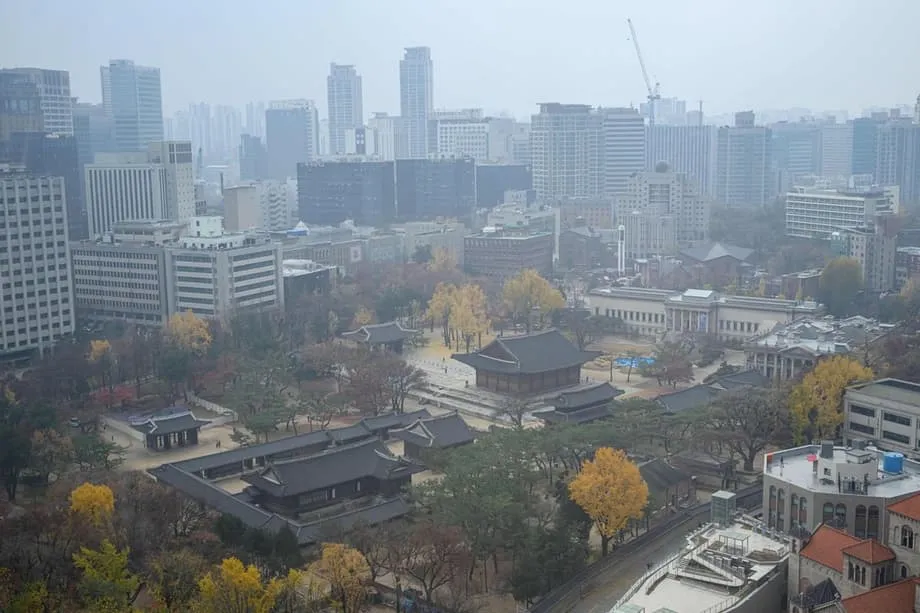
Across South Korea, masked commuters, canceled outdoor classes and phone alerts about hazardous air have become familiar during the worst months for smog. The balance between imported and locally produced pollution changes with the day, season and weather. The institute's estimate nevertheless points to a substantial contribution from across the Yellow Sea.
PM2.5 means airborne particles measuring 2.5 micrometers or less. They come from combustion in power stations and factories, vehicle exhaust, shipping and industrial processes. Some form in the atmosphere rather than leaving a chimney or exhaust pipe as particles. Sulfur dioxide and nitrogen oxides can react in the air to produce sulfate and nitrate, adding to the pollution people breathe.
Winter and spring bring conditions that can transport pollution across the Yellow Sea and trap it over Korea. The health consequences include respiratory illness, heart attacks, strokes and some cancers. Children, older adults and people with chronic illnesses face particularly serious risks. Korea has tightened domestic standards and introduced seasonal controls, but reducing pollution at home addresses only part of the burden described by the government analysis.
How scientists trace pollution across the Yellow Sea
The National Institute of Environmental Research's estimate brings greater detail to a disputed issue: how much of Korea's fine particle pollution originates elsewhere. Studies combining measurements from surface monitors, aircraft sampling and satellite observations have converged on a consistent pattern. Imported pollution makes up a large fraction of PM2.5 over western and central Korea on ordinary days.
High concentrations can bring an even larger imported share. When stagnant conditions allow emissions to build up and transport from abroad intensifies, pollution arriving from China combines with particles and gases already present over Korea. The national estimate describes a changing mixture, with the contribution from each source varying across places and seasons.
Researchers have also examined whether pollution crossing the border is associated with deaths in Korea. A study reviewed by other researchers used the timing of Asian dust events and daily changes in pollution in China to isolate effects reaching Korea. Conditional on dust events, higher pollution levels in China were associated with higher mortality from respiratory and cardiovascular diseases in Korea.
Older adults and children under five faced the greatest risks in that study. Its findings fit laboratory evidence showing that smaller particles can carry harmful compounds and trigger inflammation and stress inside the body. Together, the measurements and health research connect the movement of polluted air with consequences far beyond reduced visibility.
Fine particles and yellow dust create a mixed burden
Springtime yellow dust usually begins in deserts in Mongolia and northern China. It tends to contain larger particles known as PM10. As those plumes travel east, they can mix with industrial pollution, including sulfate and black carbon, creating a mixture of natural dust and particles produced by human activity.
PM2.5 and yellow dust therefore contribute to Korea's air problem in different ways. Particle size and chemical composition matter because smaller, more chemically reactive particles carry greater health risks. A dust plume can also transport or mix with industrial emissions along its route, changing the air that eventually reaches Korean communities.
Korea's worst pollution episodes can involve two pressures at once. Westerly winds bring polluted air from across the Yellow Sea, while a stagnant atmosphere allows emissions from Korean vehicles, heating and industry to accumulate. Residents then breathe a combination of transported pollution and emissions generated close to home.
Weather also changes the relative contribution of domestic sources. On windy days when imported pollution is lower, Korea's own vehicles, factories and power stations can account for a greater share. This shifting balance makes both regional cooperation and domestic controls relevant to the air measured on any particular day.
Why the health risks reach beyond the lungs
PM2.5 particles are too small to see individually, but their effects can be measured in hospitals and clinics. They can penetrate deep into the lungs and pass into the bloodstream. Inflammation and oxidative stress, a process that damages cells, help explain their association with disease in both the respiratory and cardiovascular systems.
Exposure is associated with asthma attacks, flare ups of chronic obstructive pulmonary disease, disturbances in heart rhythm, and higher risks of heart attack and stroke. Doctors also warn that exposure during childhood can impair lung development. Pregnant people, outdoor workers and older adults are especially vulnerable, alongside children and people already living with chronic illness.
The World Health Organization has estimated that air pollution is linked to thousands of premature deaths in Korea each year. The costs extend into family routines: outdoor activities are canceled, children stay inside, and people plan their journeys around warnings about unsafe air.
Surveys in Korea have found very high concern about fine dust, with many respondents reporting physical or psychological distress. Parent led activist groups have called for stronger policy and transparent data. A parent advocate from a civic group campaigning on air quality described the effect on family life:
Air pollution violates our basic right to breathe. Children just want to go outside and play. I do not want to tell them to stay indoors because the sky is unsafe.
For those families, pollution policy concerns both the risk of illness and the ability to carry out ordinary activities. Their demand is for clean air as a basic right, backed by measures that reduce exposure rather than simply warn people when it has become dangerous.
Weather can turn persistent pollution into an emergency
Winter and early spring often bring temperature inversions over Korea. An inversion acts like a lid, trapping pollution near the ground. Weak winds then prevent emissions from dispersing, while westerly airflows can carry additional pollution from industrial areas in China.
Heating, traffic and industrial activity inside Korea continue adding emissions during these periods. When local accumulation coincides with an inflow from abroad, air quality in the capital region can deteriorate into the category described as very bad. Weather determines how long polluted air stays in place as well as where it travels.
Scientists in Seoul have traced the effect of a specific event in China: the Lantern Festival. Chemical markers associated with fireworks, including strontium, barium and sulfate, rose sharply in Seoul roughly a day after celebrations on the Chinese mainland.
Tracer analysis indicated that the particles took 17 to 30 hours to reach Seoul across the Yellow Sea, adding to locally generated pollution. The research also found that an absence of strong, clean northerly winds could prolong poor air quality after polluted air settled over Korea.
Climate change can worsen stagnation in some seasons, a trend sometimes called a climate penalty. Warmer winters and changes in wind patterns can mean fewer frequent clearing events. When pollution disperses less readily, each ton of PM2.5 and the gases that form it becomes more damaging during an episode, whether its source is domestic or foreign.
Korea's seasonal controls target emissions at home
The Special Act on the Reduction and Management of Fine Dust established a national framework for planning and enforcement. Successive governments have used legislation and special measures to reduce domestic emissions and protect public health, with a seasonal management period running from December through March.
During that period, authorities can shut down coal plants or reduce their operation, limit output at industrial facilities, and restrict older diesel vehicles in the capital region. Measures also include more dust suppression at construction sites and encouragement of flexible work schedules to reduce traffic.
Seoul and other cities have invested in air purification on buses and subways. Local ordinances have also been strengthened to enforce emission limits. These efforts address both pollution production and exposure in places where people travel and spend time each day.
The policy calendar centers on the months when unfavorable weather and transported pollution can combine:
- December through March: Korea's seasonal management period allows tighter controls on power generation, industry, older diesel vehicles and construction dust.
- Winter and early spring: inversions and weak winds can trap emissions while westerly flows bring pollution across the Yellow Sea.
- Spring: yellow dust from Mongolia and northern China can mix with industrial pollution as it travels east.
For 2025, policymakers are aiming to cut PM2.5 and the gases that form it by 2 percent. They also seek a 5 percent reduction in the national average PM2.5 concentration during the seasonal period, from 20 to 19 micrograms per cubic meter. The concentration target describes how much fine particle pollution is present in a volume of air.
Officials have pledged stricter limits on older coal plants when high pollution is forecast, wider use of fuels containing less sulfur in ports, and more rigorous monitoring. Daily forecast data are shared with neighboring countries to anticipate pollution arriving across borders.
Domestic action and diplomacy are linked
Kum Han seung, first vice minister of environment, has described information exchange with China as part of the response during the seasonal management period. He also raised the possibility of talks at a senior level when needed:
We will continue exchanging information with China during the seasonal management period and pursue high level talks if needed.
Environmental groups support firm diplomacy while arguing that Korea's own reductions give its regional demands greater credibility. A campaigner from the Korean Federation for Environmental Movements called for less diesel use and a faster shift from coal to renewable energy:
Pointing the finger at others will not solve the problem. The case for regional action is stronger when we have addressed what we can control.
Korea's domestic contribution, estimated at roughly 29 percent in the government analysis, gives authorities a substantial share to address directly. Controls on vehicles, power generation and factories can reduce that share while negotiations pursue reductions in pollution arriving from abroad.
Regional information exchange serves another purpose: preparation. Forecasts of incoming pollution can help authorities anticipate severe episodes instead of responding only after concentrations rise. The diplomatic and domestic tracks therefore address different parts of the same exposure problem.
China's air quality gains show the scope for further cuts
Chinese officials often argue that Korea's air quality problems are largely domestic. Korea's vehicles, industry and power stations do contribute substantially. At the same time, the government analysis attributing about 55 percent of PM2.5 to China places emissions beyond Korea's borders at the center of regional discussions.
China has achieved major improvements in its largest cities through strict controls on sulfur dioxide, coal boilers and industrial emissions. Research on its target responsibility system, which assigns mandatory air pollution goals, found that the targets reduced emissions and in many cases improved industrial efficiency through innovation.
Coal power plants, steel and cement production, and other heavy industries in northern and eastern China remain relevant to Korea when winds carry their emissions east. Shipping in the Yellow Sea and Bohai can add sulfur pollution and black carbon. Agricultural ammonia from both China and Korea also contributes to the formation of secondary particles in the atmosphere.
Authorities in Beijing have demonstrated their ability to secure clear skies for major events by shutting factories and tightening traffic controls. Neighboring countries seek sustained, targeted action during the seasons when transport across borders is strongest. Cleaner air in the areas producing those emissions would mean cleaner air in Seoul, Incheon and elsewhere on the peninsula.
Scientific cooperation faces political limits
Years of dialogue and joint statements have yet to produce a binding regional agreement on fine dust. Cooperation between Korea and China can slow during diplomatic tension. Scientific work can also be complicated by different standards and pressure to use data in support of national positions.
Regional forums exist, but their capacity is limited when government ministries control agendas and independent experts have little freedom to direct practical work. Sustained scientific cooperation would require arrangements that continue operating through changes in political relations.
Proposals include expanding joint field campaigns with mixed teams of scientists and publishing shared data openly. Comparable measurement methods and quality checks would help monitors on both sides of the Yellow Sea produce numbers that can be assessed together.
City partnerships between Seoul, Incheon, Qingdao and other coastal hubs could support pilot projects for cleaner ports and upgrades to industrial equipment. Satellites and aircraft sampling could help check emissions and transport with little delay, supported by an agreement on how findings would be used in public warnings.
A joint early warning system could give schools and hospitals time to prepare for forecast inflows. A shared inventory of emissions, including reporting from individual plants and checks by independent parties, could reduce disputes about sources. Formal roles for civil society and research institutes could help keep these programs working during political tension.
Accountability could focus on measurable seasonal reductions
The estimated Chinese contribution makes accountability a practical issue as well as a diplomatic one. One proposed approach would target seasonal reductions in the sectors and Chinese provinces contributing most to Korean PM2.5 when winds blow east.
Power plants and heavy industry in those areas could commit to deeper cuts in sulfur dioxide and nitrogen oxide emissions between December and March, with public reporting available with little delay. Joint enforcement periods could require factories in both countries to maintain tighter standards during forecast inflow episodes, limiting the combined buildup.
Shared financing is another proposal. Korea could help pay for cleaner industrial technology in areas shown to influence its air quality, in exchange for reductions that can be verified. A jointly governed health and environment fund could help cover medical and economic costs in communities exposed to severe episodes.
International environmental law principles, including no harm and polluter pays, could guide such arrangements. Transparent measures and verification by independent parties would be central to making commitments specific, measurable and fair. These remain proposed approaches rather than an agreed regional settlement, and no adoption date was given.
Legal action is sometimes discussed, but tracing pollution through a changing atmosphere makes it a blunt instrument. Regional frameworks, technology partnerships and common standards could deliver results faster and with less friction. Korea's strongest route to cleaner air combines ambitious domestic reforms with durable cooperation on the emissions that cross its borders, reducing haze, illness and political friction together.
What to Know
- The National Institute of Environmental Research estimates that China accounts for about 55 percent of Korea's PM2.5, domestic sources about 29 percent, and other countries and natural sources the remainder.
- PM2.5 is associated with respiratory and cardiovascular disease and some cancers. Children, older adults and people with chronic illness face greater risks.
- Winter inversions, weak winds and pollution arriving across the Yellow Sea can combine to produce severe episodes.
- Korea's December to March controls cover coal plants, industry, older diesel vehicles, construction dust and other domestic sources.
- The 2025 targets include a 2 percent emissions cut and a reduction in seasonal average PM2.5 from 20 to 19 micrograms per cubic meter.
- China has reduced pollution in major cities, while emissions from industry, power generation, shipping and agriculture remain part of the regional challenge.
- Proposed cooperation includes comparable monitoring, open data, joint warnings, targeted seasonal cuts and financing for cleaner technology.
- Cleaner air requires reductions inside Korea alongside sustained action on pollution crossing its borders.