Arsenic readings intensify calls for regional action
Arsenic concentrations of about 0.025 milligrams per liter at four of five sampling locations along the Lao, Myanmar and Thai border region have sharpened demands for an emergency response to pollution in the Mekong River system. The readings are two and a half times the World Health Organization guideline of 0.01 milligrams per liter for drinking water. Thai authorities have reported matching concentrations along the same river corridor.
Contents
- Arsenic readings intensify calls for regional action
- Where contamination has been detected
- How mine pollution moves through rivers
- Myanmar's mining expansion draws scrutiny
- Global mineral demand reaches river communities
- What campaigners want changed at the MRC
- Regional rules and emergency support
- Pesticides and plastic add to the pollution burden
- Dams and declining fish sizes deepen concern
- River households face health and income risks
- What to Know
Environmental groups, river protection networks and academics presented a petition alongside the 32nd Meeting of the Mekong River Commission Council in Chiang Rai, urging the commission to treat the contamination as an emergency and begin water quality monitoring across the basin. As of November 27, 2025, their appeal focused on the Mekong and three tributaries, the Kok, Sai and Ruak, where pollution is crossing borders and exceeding safety benchmarks.
Delegations from Laos, Cambodia and Vietnam attended the council session, chaired by Thailand's Culture Minister Sabeeda Thaised. The meeting took place amid growing concern about the health of a river system that communities depend on for fishing, irrigation and everyday water use.
The Mekong River Commission, or MRC, has described the situation as moderately serious and is working with national agencies to strengthen joint monitoring and data sharing. Campaigners want a stronger response, including timely public warnings and coordinated pollution control.
Their petition identifies illegal mining upstream in Myanmar's Shan State as a source of contamination. Rare earth, gold, manganese and other mineral operations have expanded there with little environmental control. The concern reaches beyond individual mining sites: pollutants entering tributaries can travel into the Mekong and affect communities far downstream.
Where contamination has been detected
Heavy metals have been detected in northern Thailand's Kok, Sai and Ruak rivers and in sections of the Mekong along the Thai and Lao border at levels above Thai standards and WHO benchmarks. Affected reaches include areas opposite Bokeo province in Laos and sections in Nong Khai and Loei provinces opposite Vientiane.
Other affected stretches lie near Bueng Kan, opposite Bolikhamxay, and in Nakhon Phanom, opposite Khammouane. Across these corridors, dependence on river water and river food leaves communities vulnerable to exposure over long periods.
Recent assessments identified arsenic hotspots in the border region shared by Laos, Myanmar and Thailand. The pattern across sampling locations points to a contamination source between the most upstream site and locations farther downstream. The Kok River is considered a likely route carrying pollutants into the Mekong.
Arsenic is a known carcinogen, meaning it can cause cancer. Exposure over time also threatens cardiovascular, neurological and reproductive health. Drinking contaminated water and eating crops irrigated with it are particular concerns for children and pregnant women.
Northern Thailand has also recorded elevated manganese, nickel and lead in some tributaries. Authorities have issued advisories in selected areas, while local agencies are retesting water and fish samples. Fish testing is intended to assess bioaccumulation, the buildup of contaminants within living organisms.
Border communities have expressed concern about both water safety and eating fish. Regional monitors are coordinating data sharing, but the extent of contamination in fish remains under assessment. The water results make clear why communities need guidance that addresses drinking, cooking, fishing and irrigation separately.
How mine pollution moves through rivers
Heavy metals can travel dissolved in water or attached to sediment, the soil and other particles carried by a river. They can also bind to material on the riverbed and accumulate in fish and shellfish, creating routes of exposure through water, farming and food chains.
Monsoon flows and sudden runoff can wash contaminated soil and mine residues into streams. Tributaries then carry that material toward the main river. Changes in flow can disturb contaminated sediment again, moving pollutants onward after their initial release.
Farm soils, canals, fish markets and household wells can therefore become places where damage appears far from the mine itself. For communities downstream, the problem extends beyond the condition of the water visible at the riverbank.
Campaigners are asking authorities to sample sediments, floodplain soils and fish tissue alongside water. Mapping these results would help identify hotspots, direct cleanup and make advisories more specific to the places and activities affected.
Myanmar's mining expansion draws scrutiny
The petition and new field evidence point to rapid growth in illegal and loosely regulated mining in Myanmar, particularly in Shan State and other frontier areas near the Golden Triangle. Satellite imagery has revealed dozens of rare earth operations across northern Shan State, including several large sites that have emerged in recent years.
Non state armed groups often provide security around these operations. Commercial traffic has been observed carrying equipment and chemicals into remote mining areas. Investigators mapping mainland Southeast Asia have recorded thousands of unregulated mining locations, most of them in Myanmar.
These sites release contaminants such as arsenic, cyanide and mercury, which can enter streams and groundwater before crossing national borders. The combination of remote locations, armed control and weak environmental safeguards complicates efforts to stop pollution at its source.
Pianporn Deetes, Campaign Director for the Southeast Asia Program at International Rivers, warned that upstream mining methods are stripping landscapes and leaving chemical contamination that river communities will face for years. She described the damage visible in satellite images and the processing methods used at mining sites:
The images from NASA clearly show mountains being stripped bare. These mining methods are the epitome of irresponsibility. They use harsh chemicals to dissolve the ore and store it in toxic blue chemical ponds, before burning it to extract the minerals. The result is devastating, leaving behind dangerous contaminants in the soil, water, and air.
Advocates want urgent regional talks aimed at halting illegal upstream mining, tighter monitoring of water and soil quality, and measures to protect affected residents. They also seek accountability throughout mineral supply chains so that villagers along the Mekong do not carry the environmental costs alone.
Global mineral demand reaches river communities
Rare earth elements are used in smartphones, wind turbines, electric vehicles and guidance systems. China dominates their processing and refined output, while mining in Myanmar and parts of Laos supplies that production network.
Western and Asian economies are seeking more diverse sources of these minerals. That demand connects distant technology and energy markets with extraction in areas affected by conflict and weak oversight. Communities along the Kok and Mekong face the resulting environmental costs without having chosen the mining activity upstream.
Campaigners are calling for supply chain due diligence, meaning checks by companies on where minerals come from and how they are produced. They want buyers of rare earth minerals to require evidence of responsible sourcing and environmental management.
Satellite imagery and drones are among the tools proposed for locating active illegal mining clusters and chemical ponds. Advocates want those findings to support coordinated enforcement across borders wherever possible, alongside efforts to protect people already exposed downstream.
What campaigners want changed at the MRC
Civil society representatives criticized the current draft of the MRC's strategic plan for the next five years for failing to address the surge in uncontrolled mining in the Upper Mekong Basin. They want pollution control and water quality to receive stronger commitments in the commission's next planning cycle.
Their requests focus on two connected areas: better data, monitoring and predictive capabilities, and stronger river basin management operations. The first would help authorities detect contamination and estimate where it will move. The second would connect those findings with public warnings, emergency responses and cleanup across borders.
A monitoring network covering the basin would use sampling stations, standardized methods and transparent data sharing. Predictive models could help warn communities before contaminated water reaches intake points, where water is drawn from the river for use.
Campaigners also propose sensors that provide readings in real time at strategic river cross sections. A shared dashboard would bring information together for national agencies and local governments, helping them coordinate responses to changing conditions.
Within Thailand, experts have urged a unified public alert system and a single repository for water quality data. They suggest that the Pollution Control Department coordinate monitoring and issue timely notices about river use, fish consumption and irrigation.
Weekly water quality bulletins are another proposed step. Advocates want information in accessible formats and languages, with practical guidance on drinking, cooking, irrigation and fishing. A shared information channel would help communities receive consistent advice when abnormal readings are detected.
Regional rules and emergency support
Authorities are being encouraged to pursue a framework for environmental impact assessments across the border with Myanmar. Under the proposal, mining concessions and industrial projects near shared rivers would undergo environmental review and disclosure before operations begin.
Cross border notification rules used for dam releases offer a model for pollution alerts and joint responses. The same need for advance information applies when a change upstream could affect water use downstream.
Greenpeace Thailand and Ecological Alert and Recovery Thailand have appealed to the Association of Southeast Asian Nations, or ASEAN, for stronger legal safeguards and a regional platform for access to environmental information. In their appeal for action against pollution crossing borders, the groups stated:
Regional leaders must act decisively to address transboundary environmental threats before they escalate into wider crises.
One proposal is an ASEAN Pollutant Release and Transfer Register, a system that would make emissions data available to the public. An accompanying access to information protocol would allow people to request environmental information.
Advocates also want immediate support for affected villages rather than waiting for permanent solutions. Their proposals include emergency drinking water, filtration assistance, health screening and medical guidance for communities with documented exposure to arsenic and other heavy metals.
Where contamination is verified, governments could provide temporary compensation and support alternative livelihoods while cleanup and enforcement proceed upstream. These measures would address both exposure risks and the loss of income that can follow restrictions on fishing or river use.
A heavy metal leak into China's Lei River offers a regional example of how quickly pollution can threaten water supplies. Thallium concentrations rose many times above normal, putting downstream drinking water for large urban areas at risk. Officials disclosed the incident after launching an emergency response.
That episode reinforces the need for rapid public alerts and a single channel for advice when unusual readings appear. For Mekong communities, timely information determines whether families can adjust water use before contaminated flows arrive.
Pesticides and plastic add to the pollution burden
A detailed field study in the Mekong Delta found pesticide contamination in several kinds of drinking water sources: surface water, groundwater, harvested rainwater, public taps and even some bottled water. Canal water had the highest concentrations, and contamination persisted across seasons.
Researchers detected agricultural chemicals including isoprothiolane, fenobucarb, fipronil, and several triazole and chloroacetanilide compounds. Some samples exceeded European Commission guideline values for individual pesticides or total pesticide concentrations in drinking water.
The researchers said they could not identify a single clean source with respect to pesticides. Their findings point to pollution spread across the landscape by intensive farming, alongside weak controls on chemical storage and disposal.
For communities already concerned about heavy metals, pesticide residues add another demand on water monitoring and treatment. The range of affected water sources shows why checking only river water would leave part of the pollution burden unexamined.
Plastic waste creates further pressure. Cleanups along tributaries and urban stretches of the lower basin routinely collect large volumes of discarded packaging and plastics intended for a single use.
Waste caught in floodplain vegetation and canals can break into microplastics, small plastic particles that move through food webs and complicate water treatment. Pollution control therefore needs to address waste entering the river as well as chemicals released by mining and agriculture.
Dams and declining fish sizes deepen concern
Hydropower reservoirs upstream have changed seasonal river flows, sediment transport and the delivery of nutrients downstream. These changes also influence how far and how quickly pollutants travel, and how often contaminated sediments are disturbed.
Research on reservoir operations in the upper basin suggests that careful coordination can support downstream water supplies during dry periods while keeping flows closer to natural patterns that benefit ecosystems. Coordinated releases and clear notification could help reduce exposure for farmers and fishers who depend on predictable river cycles.
Scientists tracking hundreds of species across Laos, Cambodia and Vietnam have also reported that the Mekong's largest freshwater fish are becoming smaller. In some datasets, giant catfish and giant barb now average less than half their historical length.
Overfishing is the main driver of this decline, with habitat loss, dams, sand extraction and pollution adding pressure. Continued contamination would place another burden on fish populations that have already lost spawning areas and migration routes.
These pressures meet in the same river system. Water quality, sediment movement, seasonal flows and fishing livelihoods are connected, which is why campaigners want pollution monitoring tied more closely to river basin operations.
River households face health and income risks
Residents in river towns opposite Bokeo and markets along the Thai bank at Chiang Saen, Nong Khai and Bueng Kan describe falling fish catches, changing river levels and growing unease about water quality. Farmers are cautious about pumping river water directly onto crops.
Fishing households worry that fear of contamination will make their catch harder to sell. The river supplies both food and income, so an advisory can affect household earnings even as it helps families avoid exposure.
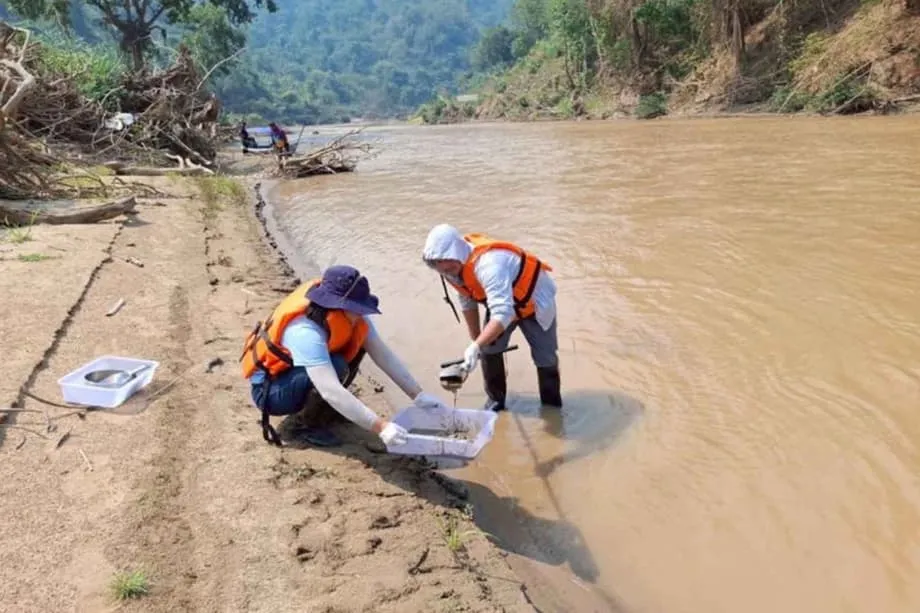
Local monitoring groups already collect samples and publish results online, but they lack equipment and funds. Support for laboratory capacity and community science could expand monitoring coverage and speed up warnings.
Counties and districts could create text alert systems and share risk maps showing where drinking, fishing and irrigation are safe or unsafe under different flow conditions. Such information would connect laboratory findings with the choices residents make each day.
The emergency appeal brings these household concerns into regional decision making. Campaigners are seeking action at several levels at once: stopping pollution upstream, tracking its movement through shared rivers, publishing usable advice and supporting communities while contamination is addressed.
What to Know
- Environmental groups, river protection networks and academics petitioned the MRC at its 32nd Council meeting in Chiang Rai for an emergency response and monitoring across the basin.
- Arsenic measured about 0.025 milligrams per liter at four of five border sampling locations, two and a half times the WHO drinking water guideline of 0.01 milligrams per liter.
- Heavy metal contamination has been detected in the Kok, Sai, Ruak and parts of the Mekong, with illegal upstream mining in Myanmar identified in the petition as a source.
- The MRC has called the situation moderately serious and is working with national agencies on joint monitoring and data sharing.
- Thai agencies are retesting water and fish, while advocates seek unified alerts, shared data, emergency water support and health screening.
- Satellite imagery shows expanding rare earth mining in northern Shan State, linking downstream pollution concerns with global mineral supply chains.
- Pesticides, plastic waste, altered flows and declining fish sizes add to the pressures facing Mekong communities.
- Proposals include stronger MRC planning commitments, environmental assessments with Myanmar, checks on mineral sourcing and an ASEAN pollution information register.