Twelve experiments turn carbon dioxide and water into useful supplies
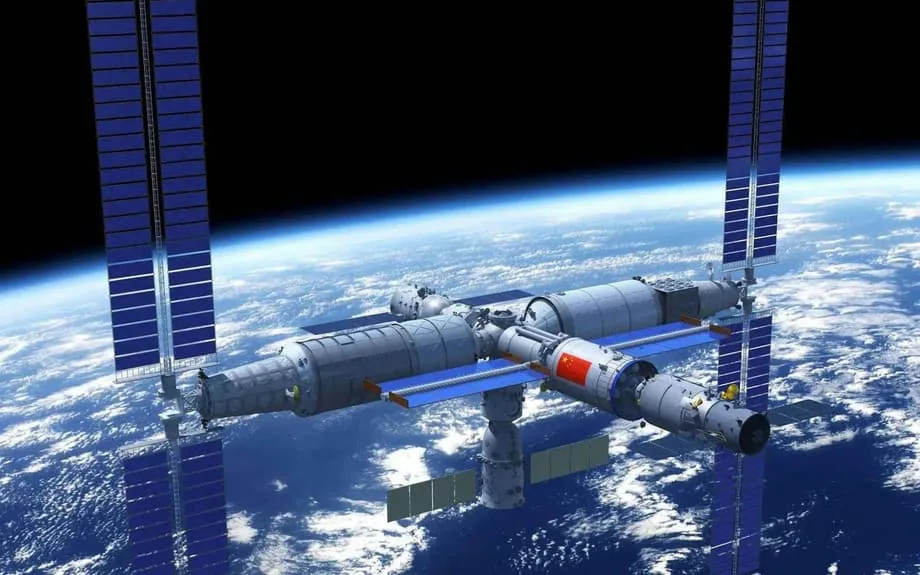
China has claimed a first in space resource production after the Shenzhou-19 crew aboard the Tiangong space station used a compact artificial photosynthesis device to make oxygen and ethylene from carbon dioxide and water. Across 12 controlled experiments, the astronauts tested chemistry that could eventually help spacecraft produce breathable air and ingredients for rocket propellants instead of carrying every supply from Earth.
Contents
- Twelve experiments turn carbon dioxide and water into useful supplies
- How engineered materials copy the work of plants
- What the astronauts tested aboard Tiangong
- A decade of development meets wider space plans
- Why oxygen production matters to crews
- Different catalysts could produce different supplies
- Can ethylene become practical rocket fuel?
- How lunar bases and refueling satellites could connect
- What stands between a demonstration and a working factory?
- How the experiment fits with other space resource projects
- Key Points
The device, housed in a module shaped like a drawer, operated at room temperature and standard pressure. The crew also controlled the movement of gases and liquids in microgravity and recorded the reaction products in real time, confirming oxygen generation and the formation of a hydrocarbon. Hydrocarbons are molecules made from hydrogen and carbon, and many are used as fuels.
Ethylene was the hydrocarbon produced in the trials. It can be used as a fuel or as a starting material for other fuels and useful products. Oxygen has two potential jobs: supporting astronauts inside a habitat and helping fuel burn in a rocket engine.
China has been developing the technology since 2015. Its operation in orbit marks a step toward missions that can replenish some supplies while away from Earth. The wider ambition reaches beyond Tiangong to possible outposts on the Moon or Mars, where water and carbon dioxide are present in frozen or atmospheric form. Turning those resources into usable air and fuel would give crews more flexibility and reduce dependence on cargo deliveries.
How engineered materials copy the work of plants
Artificial photosynthesis follows the basic logic of plants, using energy to turn simple substances into useful chemicals. Instead of leaves, the process relies on engineered materials. One part of the reaction splits water to produce oxygen that could be supplied to a spacecraft cabin. Another takes carbon dioxide and adds electrons and hydrogen to build molecules such as ethylene, methane or formate.
Energy can come from sunlight converted into electricity by a solar panel, or from light that directly activates a semiconductor catalyst inside the device. A catalyst helps a chemical reaction happen. A semiconductor can respond to incoming energy in ways that help drive the reaction.
Inside the Tiangong unit, the semiconductor catalyst provides a surface where carbon dioxide and water interact. As energy arrives, atoms are rearranged: water supplies oxygen and hydrogen, while carbon dioxide supplies carbon. The material chosen for the catalyst helps determine which molecules emerge.
Copper based catalysts tend to join carbon atoms together, producing ethylene. Other materials favor methane or carbon monoxide. Engineers can therefore choose a catalyst according to the product they want, although each choice also affects the mixture that must be separated and collected afterward.
The Tiangong unit appears to use reaction pathways that avoid high temperatures and high pressure equipment. That can reduce the power and equipment demands of a spacecraft, where every watt matters. Operation near cabin pressure could also make integration with air management easier, while allowing hydrocarbons to be stored or sent for further processing without heavy compressors at the reaction stage.
What the astronauts tested aboard Tiangong
The Shenzhou-19 crew began its mission in late October 2024. During the 12 experiments, the astronauts used a module containing catalysts, fluid channels and sensors to manage a reaction involving three phases: gas, liquid and solid. Carbon dioxide, water and the catalyst had to meet under controlled conditions for the chemistry to work.
The crew verified oxygen production and measured the appearance of ethylene, the target hydrocarbon for this propulsion research. Recording the products in real time allowed the team to follow what the device was making as the reaction proceeded.
Fluid management was a central part of the work. On Earth, bubbles rise and liquids settle, helping gases and liquids separate. In orbit, those familiar movements change. Surface tension, the force associated with a liquid's surface, plays a much larger role in determining where fluids go.
The hardware used channels, membranes and flow controls to keep the starting materials in contact with the catalyst and move the products away. The experiment also recorded gas movement and separation behavior, providing information engineers can use when designing larger systems.
Bubbles that cling to a catalyst can reduce output by blocking the reaction surface. Uneven liquid delivery can create dry patches or hot spots. Keeping the flow steady is therefore essential if a demonstration is eventually to become a continuous stream of products feeding a storage tank.
A decade of development meets wider space plans
The Tiangong demonstration sits within a longer effort to understand how familiar processes behave in space. Earlier work aboard the station has included growing lettuce and tomatoes, as well as lighting a match to study flame behavior. Such experiments contribute practical knowledge for future farms, factories and habitats beyond Earth.
China's artificial photosynthesis research also connects with its plans for lunar exploration and separate tests of refueling technology. The main dates and targets are:
- 2015: Development of China's artificial photosynthesis technology began.
- Late October 2024: The Shenzhou-19 crew began its mission.
- 2024: Plans were described for robots to assemble a compact nuclear reactor to supply power for a future lunar base.
- January 2025: China launched the Shijian 25 satellite to test refueling technologies.
- Before 2030: China aims to carry out a crewed lunar landing.
- The early to mid-2030s: China plans an International Lunar Research Station.
The 12 Tiangong trials bring one part of that larger effort into focus: producing useful substances in space. Electricity, resource production and the transfer of fuel between spacecraft would all have to work together for a dependable supply network.
Why oxygen production matters to crews
Oxygen is among the most valuable supplies a spacecraft can make for itself. Every kilogram produced away from Earth reduces the amount that must be launched, saving cost and reducing the risks associated with supply missions. For a crew traveling far from home, longer intervals between deliveries would also allow more freedom in planning operations.
The International Space Station already generates oxygen by splitting water in an electrolysis unit powered by solar arrays. Electrolysis uses electricity to separate a substance into its components. Research has estimated that oxygen generation accounts for roughly one third of the station's life support energy budget.
The ISS approach works, but its power demand is high and it still depends on periodic deliveries of water and consumables. Artificial photosynthesis offers another route: using carbon dioxide exhaled by astronauts together with water to produce oxygen and useful carbon containing molecules in the same device.
Operating at room temperature and cabin pressure is intended to lower electrical demand. A station or surface base that makes more of its own air and propellant could lengthen the time between supply missions and reserve more power for science and other operations. The Tiangong work puts those potential gains behind a functioning orbital experiment.
Integration with existing life support will shape the practical benefits. On the ISS, water electrolysis is paired with a reactor that combines carbon dioxide and hydrogen to make water and methane, closing part of the recycling loop. Future systems could choose between approaches or combine them according to their power supply and needs.
Different catalysts could produce different supplies
Officials have said that changing catalysts can tune the system to make products including methane and formic acid. That flexibility matters because a habitat, a rocket and a manufacturing unit need different chemicals.
Methane is already a favored rocket fuel and is used with liquid oxygen in many modern engine designs, including those intended for reuse. A future version of the Tiangong technology could therefore be directed toward a fuel with a familiar role in propulsion.
Formic acid offers another route. It can store hydrogen chemically for later use and act as a starting material for more complex chemistry. That includes steps toward sugar synthesis in research aimed at food production.
Ethylene, the product demonstrated aboard Tiangong, can be burned directly or processed into other fuels and materials. A system able to turn waste carbon into several useful substances could make better use of the water and sunlight available aboard a station. Its eventual configuration would depend on whether the immediate priority was breathing oxygen, stored fuel or chemical manufacturing.
Can ethylene become practical rocket fuel?
Ethylene is a simple hydrocarbon containing two carbon atoms. It burns readily with liquid oxygen and can serve as a fuel in engines or thrusters. It has been used in research engines and test flights, with performance depending on the engine design. It belongs to the same broad fuel family as methane and propane.
Its attraction for orbital production is that it can emerge directly from carbon dioxide reduction when a copper based catalyst is used. Carbon dioxide reduction means adding electrons to carbon dioxide as part of the process of turning it into another chemical.
Storage introduces a separate engineering problem. Ethylene is a gas at room temperature, so it needs compression or chilling. Many missions prefer methane because it is easier to handle at the very low temperatures used alongside liquid oxygen. Engineers may therefore retune future devices toward methane or formate, depending on the intended use.
Ethylene can also serve as a manufacturing feedstock, meaning a material used to make something else. Further processing can turn it into liquids or plastics useful for manufacturing. Producing it in orbit could therefore support activities beyond propulsion.
Oxygen deserves equal attention in the fuel calculation. It accounts for the heavier share of the propellant load in almost all chemical rockets. Producing oxygen locally could reduce launch mass even if the hydrocarbon fuel initially continued to arrive from Earth.
How lunar bases and refueling satellites could connect
China's target of a crewed lunar landing before 2030 and its planned International Lunar Research Station in the early to mid-2030s create a possible setting for this technology. A base would need reliable power, breathable air and supplies for vehicles returning to orbit.
Plans described in 2024 for robots to assemble a compact nuclear reactor addressed the power requirement. Artificial photosynthesis addresses a different part of the same problem: maintaining a flow of oxygen and fuel without depending entirely on cargo flights.
Shijian 25, launched in January 2025 to test refueling technologies, represents another part of a possible supply chain. Producing a fuel component is useful only if it can be stored and delivered to the spacecraft that needs it.
A future arrangement could involve a crewed or robotic platform converting carbon dioxide and water into oxygen and methane. Tanker satellites could rendezvous with that platform, collect propellant and deliver it to satellites or transfer vehicles needing more fuel. Such a network would connect production with distribution.
On the lunar surface, a similar unit could provide oxygen to habitats while storing methane for a later launch to orbit. Sunlight or nuclear power could drive the chemistry at each location. These are possible applications of the technology, with the Tiangong experiment providing an early foundation for the production step.
What stands between a demonstration and a working factory?
The Tiangong device remains a proof of concept. To support a crew continuously or refuel spacecraft, production would need to increase by orders of magnitude. The account of the experiment gives no production rate or schedule for reaching that scale.
Larger reaction areas, better heat management and catalysts able to operate for months without fouling would be needed. Fouling occurs when unwanted material accumulates on a working surface and makes it less effective. Radiation and temperature swings in space can also degrade materials.
Maintenance would have to be practical. Engineers need systems that can keep working for long periods and allow worn components to be replaced without requiring bulky replacement hardware from Earth.
Separation and storage present equally demanding tasks. Oxygen must reach high purity for breathing and engine use. Hydrocarbons need to be separated from byproducts, then safely compressed or liquefied. Oxygen and fuel inside a spacecraft also introduce fire risks, requiring valves, sensors and strict isolation between supplies.
Future integration could involve capturing carbon dioxide from cabin air, producing oxygen continuously and routing fuel products into storage when surplus power is available. Robotic operation would be essential for routine use. The engineering tasks are substantial, but the Tiangong trials provide information on both the chemistry and the fluid behavior needed to address them.
How the experiment fits with other space resource projects
NASA's MOXIE experiment aboard the Perseverance rover demonstrated oxygen production from the Martian atmosphere. Its achievement showed that a small device could extract a useful resource on Mars, supporting the broader idea of making supplies where a mission operates.
The European Space Agency and many laboratories are studying photocatalysts that convert carbon dioxide using sunlight or electricity. Private companies are also designing methane engines that could be paired with oxygen produced locally. These efforts share a practical aim: use available materials and reduce the mass launched from Earth.
Most orbital life support experiments until now have concentrated on plant growth, biology and electrolysis. The Tiangong demonstration is presented as the first reported system to reduce carbon dioxide into a hydrocarbon while producing oxygen in orbit at room temperature and standard pressure.
Combining those products in one device connects two needs usually considered separately: keeping people alive and supplying propulsion. Potential uses stretch from low Earth orbit to the space between Earth and the Moon and, eventually, surface outposts.
China's lunar and deep space plans give it a reason to increase production and test the equipment for longer periods. The United States, Europe, Japan and others also have active programs focused on using resources available at a mission's destination and may conduct further demonstrations. Competition can accelerate the work, while the practical objective remains equipment that operates dependably for months.
Key Points
- The Shenzhou-19 crew carried out 12 artificial photosynthesis experiments aboard Tiangong.
- The device converted carbon dioxide and water into oxygen and ethylene at room temperature and standard pressure.
- The astronauts tested fluid control in microgravity and recorded reaction products in real time.
- Development began in 2015, and changing catalysts could allow production of methane or formic acid.
- The approach aims to reduce power demand and resupply needs while connecting life support with fuel production.
- Ethylene can be used as fuel or processed into other fuels and materials, but storage requires compression or chilling.
- China launched Shijian 25 for refueling tests in January 2025 and aims for a crewed lunar landing before 2030.
- Large increases in output, durable catalysts, safe separation and storage, and routine automated operation are needed before the technology can support crews or refuel vehicles.