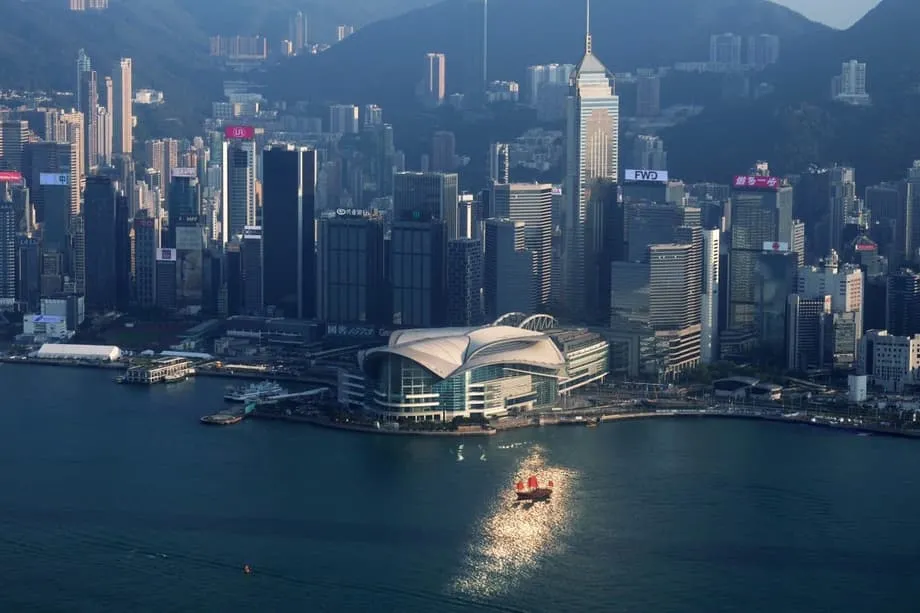
A record cash pile amid global uncertainty
Hong Kong bank deposits reached HK$19.1 trillion in September 2025, rising 1.3 percent from August and taking the total more than 10 percent above its level at the end of 2024. The increase followed growth of 7 percent in 2024 compared with 2023, adding fresh momentum to an already large pool of money.
Contents
- A record cash pile amid global uncertainty
- Why Chan calls Hong Kong a safe haven
- How the currency framework supports confidence
- Stock market activity gathers pace
- New listings attract a wider investor base
- Funds and insurance extend the financial recovery
- Why global uncertainty favours accessible money
- Gold becomes a larger part of portfolios
- Mainland wealth remains closely connected
- Exports and maritime services support the wider economy
- How Hong Kong compares with other banking centres
- What could test the recovery, and what comes next
- Key Points
Financial Secretary Paul Chan Mo po says investors facing geopolitical uncertainty are reviewing their portfolios, spreading their investments and moving cash to Hong Kong. He has linked the deposit growth with a recovery in stock market listings and the depth of the city's wealth management business.
By November 23, the financial recovery was visible across several measures. The Hang Seng Index had risen more than 30 percent since the start of 2025, while 81 companies had listed in the first ten months, raising about HK$216 billion. Merchandise exports also grew 11.3 percent in the first three quarters despite tariff tensions among major trading partners.
Hong Kong's attraction brings together several features: money can move freely, its legal system provides a framework for commercial activity, and its financial institutions connect mainland China with international markets. Its currency link to the United States dollar adds predictability for people and companies holding funds there.
The deposit total includes savings, corporate cash and institutional balances held in Hong Kong dollars and foreign currencies. It therefore captures money used for everyday needs, business operations and investment decisions, rather than a single category of investor activity.
Why Chan calls Hong Kong a safe haven
Chan, the financial secretary of the Hong Kong Special Administrative Region, described the city's role as investors seek stability during a period of geopolitical risk.
Hong Kong has become a safe haven for capital.
Chan pointed to the steady increase in deposits, stronger fundraising and established wealth management services as signs of that appeal. A safe haven is a place investors turn to when they want greater stability and ready access to their money during uncertain times.
Several international financial institutions that attended events in Hong Kong in recent months intend to add staff and expand their operations, according to Chan. Those plans would extend their commitment beyond holding money or buying securities to maintaining a larger business presence in the city.
Chan also highlighted the free flow of capital, a legal system based on rules and Hong Kong's position as a gateway to mainland China. Together, those features allow investors to manage international holdings while retaining close connections with the mainland economy.
How the currency framework supports confidence
The Hong Kong Monetary Authority reported the September deposit total of HK$19.1 trillion and the monthly increase of 1.3 percent. Deposits had already grown by more than a tenth from the end of 2024, extending the previous year's expansion rather than arriving as a single spike.
Hong Kong's monetary framework is another part of its appeal. The Hong Kong dollar is linked to the United States dollar through a currency board, a system that requires the monetary base to be fully backed by foreign reserves. The arrangement has operated for several decades.
The link gives depositors and businesses a predictable framework for exchange rate risk. When the Hong Kong dollar approaches the boundaries of its trading band, the HKMA adjusts liquidity in the banking system through the currency board mechanism.
Local liquidity tightens when the currency weakens toward the edge of the band and expands when it strengthens. In simple terms, the amount of money available between banks changes as the system maintains the currency link. That process can also affect local financing conditions.
Ample foreign reserves and a consistent operating record have supported the framework through previous periods of stress. For people deciding where to hold cash, that history sits alongside the city's legal arrangements and access to international banking services.
Stock market activity gathers pace
The Hang Seng Index rose more than 30 percent during 2025 up to the November account, following an 18 percent gain in 2024. The successive increases marked a recovery in investor appetite alongside the rise in bank deposits.
Average daily stock market turnover exceeded HK$240 billion in 2025, more than double the previous year's level. Turnover measures the value of shares traded, so the increase means substantially more money was changing hands in the market each day.
Higher trading activity helps investors buy and sell securities and gives companies a more active market in which to raise funds. It also supports price discovery, the process through which buyers and sellers establish what a security is worth.
Hong Kong's financial recovery therefore involves both larger cash balances and stronger participation in stocks. Investors can hold readily accessible money while also allocating funds to companies, depending on their needs and willingness to accept risk.
New listings attract a wider investor base
Hong Kong hosted 81 company listings in the first ten months of 2025, about 50 percent more than in the same period of 2024. Those initial public offerings, or IPOs, raised roughly HK$216 billion, putting the city first globally by funds raised from new listings during that period.
An IPO is a company's first sale of shares to public investors. The money raised can support the company's business, while the listing gives investors a market where they can trade its shares.
Officials said several major deals attracted cornerstone investors from Western markets and the Middle East. Cornerstone investors commit to buying shares as part of a listing, often taking a sizeable portion of the shares being sold. Those commitments give a deal a firmer starting point and reduce the risk that the sale will struggle to attract buyers.
Institutions from the Middle East and Europe, joining established investors in Asia, broaden the pool of potential buyers. Their participation also helps build the networks of banks and investors that arrange future listings in areas such as the new economy, biotechnology and consumer technology.
New economy and biotechnology companies now represent a larger share of Hong Kong's market by both number and value. Their increased presence has added depth to the growth sectors available to investors on the exchange.
Funds and insurance extend the financial recovery
By the end of March 2025, the number of registered funds was close to 1,000 and net inflows exceeded US$44 billion. Net inflows describe the money entering after money leaving has been taken into account.
Hong Kong's insurance business was also expanding. About 1.08 million new long term policies were issued in 2024, with premiums close to HK$220 billion. The figures represented a sharp increase compared with 2022.
Officials expect Hong Kong to become a leading centre for managing assets across borders within two to three years if recent trends continue. That expectation links the growth in funds and insurance with the city's wider role in handling international wealth.
Bank deposits, investment funds and insurance serve different financial needs. Their expansion shows that the recovery described by officials reaches across several parts of the financial industry, from accessible cash to investments and longer term financial arrangements.
Why global uncertainty favours accessible money
Wars, sanctions, tariffs and sudden policy changes can push investors toward assets and markets where money is easier to access. During such periods, cash balances can grow and investors may favour liquid markets with stable legal systems and predictable currency arrangements.
The United States dollar continues to anchor global finance despite debate about reducing reliance on it. It dominates foreign exchange turnover, trade invoicing, liabilities across borders and debt issued in foreign currencies.
Reserve managers in emerging markets have gradually diversified into gold. At the same time, the use of dollar deposits remains high in many countries, while China stands out for reducing some reliance on the dollar within its domestic system.
Hong Kong brings access to United States dollar liquidity together with its own currency framework. For investors concerned about sudden changes in trade or politics, the ability to hold and move money within that system is part of the city's attraction.
Gold becomes a larger part of portfolios
Surveys showed affluent investors in Hong Kong increasing their portfolio allocation to gold from about 4 percent in the middle of 2024 to 11 percent in the middle of 2025. That was a rise of seven percentage points, with gold's share growing to more than twice its earlier level.
Gold traded at around US$3,356 an ounce in July 2025, up strongly from previous years. Buying included physical bars and coins, exchange traded funds and digital platforms.
An exchange traded fund allows investors to buy a holding through a stock exchange instead of purchasing and storing physical gold themselves. The different routes give buyers choices about how they gain exposure to the metal.
Inflation concerns, debate about real interest rates, currency risk and regional trade tensions were among the drivers of the shift. Real interest rates describe interest returns after allowing for inflation, which affects how attractive interest bearing assets are compared with gold.
The move toward gold sits alongside the increase in bank deposits. Both reflect efforts to balance investment opportunities with protection against uncertainty, although they play different roles in a portfolio.
Mainland wealth remains closely connected
Private wealth from mainland China has longstanding ties to Hong Kong. The city combines close economic integration with the mainland and separate legal and monetary systems, a combination central to its appeal for wealth protection and international investment.
Hong Kong's independent judiciary, rooted in common law traditions, is seen as providing predictability in commercial disputes. Its separate currency and free movement of capital also allow international diversification that is harder to arrange on the mainland.
Wealth planning structures provide another channel for managing assets. Earlier regulatory surveys counted more than US$3 trillion in assets managed in Hong Kong and hundreds of billions of dollars in trust assets, with a large share linked to clients from Hong Kong and mainland China.
Those historical figures illustrate the scale of private money connected to the city. They help explain why its legal arrangements, currency system and access to international investments matter to families and institutions managing wealth over time.
Exports and maritime services support the wider economy
Hong Kong recorded 19 consecutive months of merchandise export growth compared with the same month a year earlier. Exports increased 11.3 percent in the first three quarters of 2025 despite tariff pressure between major economies.
The performance supports employment in logistics, wholesale and related services. It also provides a stronger economic setting for the financial recovery, as businesses continue to move goods through changing international supply chains.
Officials are seeking to improve port services and logistics to capture that trade. Their priorities include attracting more commodities business and developing services such as ship finance, maritime arbitration and specialty insurance.
Ship finance provides funding for vessels, while arbitration offers a way to resolve commercial disputes. Along with insurance, these activities allow Hong Kong to earn business from the financial and legal needs surrounding shipping, as well as from moving cargo.
The most recent Hong Kong Maritime Week attracted a record crowd of about 18,000 participants. Officials also planned trade and finance outreach in Europe, including stops in London and Milan, to present the city's opportunities to business leaders and investors.
How Hong Kong compares with other banking centres
Investors considering Hong Kong often also assess Singapore, Switzerland, the United Arab Emirates and offshore centres in the Caribbean or Indian Ocean. The choice depends on banking needs, investment structures, market access and account requirements.
Hong Kong and Singapore offer regulatory stability, extensive banking services, accounts in multiple currencies, strong digital platforms and corporate services. Switzerland remains a leader in private banking and services for wealthy families, while the UAE provides access to markets in the Middle East, Africa and South Asia.
The Cayman Islands, Panama and Mauritius offer flexible frameworks suited to certain structures, though documentation and access standards vary. Jurisdictions that place particular weight on privacy require careful documentation to manage compliance risk.
Remote account opening is comparatively accessible in Hong Kong through licensed financial technology providers and intermediaries. Singapore allows parts of the process to be completed remotely, while some banks in Switzerland, the UAE and Panama still prefer verification in person.
Minimum balances also differ widely. Some financial technology platforms in Hong Kong accept small balances, while traditional banks across several centres require deposits ranging from a few thousand to more than US$100,000.
Know your customer and anti money laundering rules are strict across these markets. Clients must provide identity and address documents, explain the source of their funds and meet applicable reporting requirements, including FATCA. These checks help banks establish who is using an account and where the money came from.
Hong Kong and Singapore both provide broad currency support, efficient foreign exchange services and clear tax and regulatory frameworks for international business. Companies dealing with mainland clients and suppliers also value Hong Kong's proximity, organised links to mainland markets and a time zone that aligns with Asia and Europe.
What could test the recovery, and what comes next
Deposit flows can reverse when global conditions change. Higher interest rates in major economies, shifts in investors' willingness to take risks and new trade restrictions can tighten financial conditions. Hong Kong's property market, corporate borrowing costs and relations among major economies can also affect confidence.
The currency board remains central to the Hong Kong dollar's link with the United States dollar. Investors will continue to assess its operation alongside interest rates, economic growth and capital movements.
The recovery has developed across several reporting periods:
- 2024: Bank deposits grew 7 percent compared with 2023, and the Hang Seng Index gained 18 percent.
- End of March 2025: Registered funds numbered close to 1,000, with net inflows above US$44 billion.
- July 2025: Gold traded at around US$3,356 an ounce.
- September 2025: Bank deposits reached HK$19.1 trillion, up 1.3 percent from August.
- First ten months of 2025: 81 company listings raised about HK$216 billion.
Future monthly HKMA deposit figures will show whether balances continue to rise. The IPO calendar, participation by cornerstone investors and share performance after listings will provide further measures of investment appetite.
Hiring and expansion by international banks, asset managers and insurers will indicate how institutional plans translate into a larger presence. Export growth and port throughput will track logistics performance, while gold allocations will show how investors continue to balance risk.
Outreach to Europe and the Middle East may deepen channels for capital and trade. No specific dates were given for the institutional expansion plans or the planned London and Milan visits.
Key Points
- Hong Kong bank deposits reached HK$19.1 trillion in September 2025, rising 1.3 percent in a month and more than 10 percent from the end of 2024.
- Financial Secretary Paul Chan described Hong Kong as a safe haven for capital amid geopolitical uncertainty.
- The Hang Seng Index gained more than 30 percent during 2025, with average daily turnover exceeding HK$240 billion.
- 81 listings raised roughly HK$216 billion in the first ten months, placing Hong Kong first globally by funds raised.
- Registered funds approached 1,000 by March, while insurance premiums on new long term policies were close to HK$220 billion in 2024.
- Merchandise exports grew 11.3 percent in the first three quarters after 19 consecutive months of annual growth.
- Affluent investors increased gold allocations from about 4 percent to 11 percent between the middle of 2024 and the middle of 2025.
- International institutions indicated expansion plans, while interest rates, trade restrictions and changing capital flows remain risks.