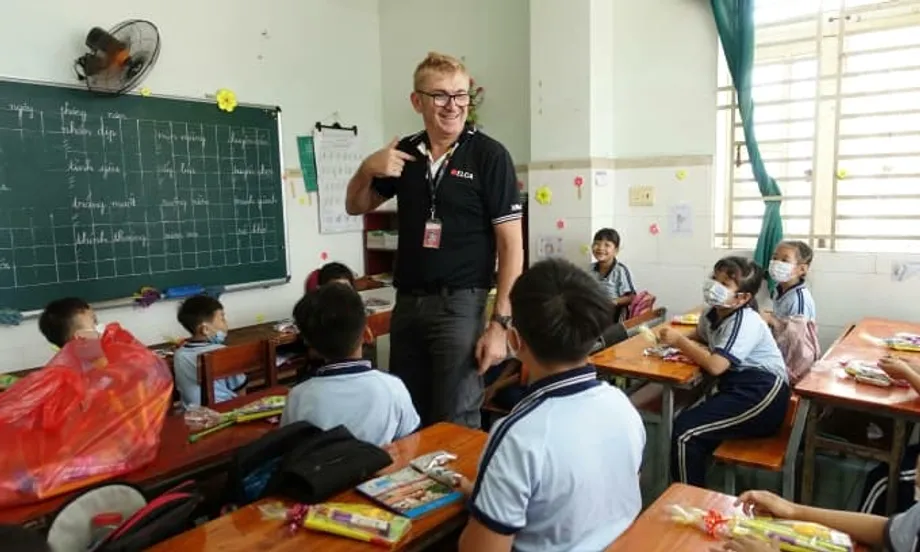
When years of English lessons meet natural speech
Vietnam plans to make English a compulsory second language in all schools by 2035, with mandatory lessons from Grade 1 by 2030 and exposure beginning in preschool. Yet a familiar classroom scene shows how much work lies between that ambition and students being able to use the language comfortably.
Contents
- When years of English lessons meet natural speech
- A long expansion with uneven results
- Why more hours do not automatically bring fluency
- One lesson for about 45 different learners
- The conditions teachers must work around
- Reform has already encountered capacity limits
- Families pay to fill the gap
- What the 2030 and 2035 goals will require
- Key Points
A foreign English teacher enters a public school classroom and speaks at a natural pace. Students who have studied grammar and vocabulary for seven to 10 years suddenly fall quiet. Eyes dart around the room, notebooks remain blank, and pupils avoid being called on. After years of lessons, the encounter can feel like a first day with English.
The difficulty is less a reflection of student ability than of how English is taught. Schools often treat it as a subject to pass rather than a practical skill to use. Students learn to produce correct answers on paper, but many have much less practice following a conversation or responding aloud.
Local teachers often use slow, careful English, while written exercises prepare pupils for examinations. Students do not receive daily exposure to the rhythm, stress, blending of sounds and pace of natural conversation. When speech arrives in a less familiar form, they struggle to keep up.
As of November 23, 2025, Vietnam's challenge is therefore about more than starting lessons earlier or adding years of instruction. It is also about what happens during those lessons, how much each child gets to speak, and whether teachers have the support to turn knowledge of English into the ability to use it.
A long expansion with uneven results
English became compulsory in Vietnam's middle and high schools in the 1980s and spread to primary schools in the 1990s. Interest boomed after Vietnam joined the World Trade Organization in 2006 and has remained high. Millions of students now spend hundreds of hours learning the language.
Results have lagged behind those expectations. English remains one of the weakest subjects for a large share of students in the national high school graduation examination, year after year. International comparisons also place Vietnam in a lower proficiency band. Families can see the gap between effort and results when a classroom falls silent in front of a native speaker.
Vietnam's expansion of English education and its next policy goals span several decades:
- 1980s: English became compulsory in middle and high schools.
- 1990s: English teaching spread to primary schools.
- 2006: Interest boomed after Vietnam joined the World Trade Organization.
- 2022 to 2023 school year: More than 2.9 million students had studied English for at least a decade under official programs.
- 2030: English would become mandatory from Grade 1, while the system could face a shortage of more than 20,000 English teachers.
- 2035: Vietnam plans to make English a compulsory second language in all schools.
- By the middle of the century: English is expected to be widely used across tens of thousands of public schools serving tens of millions of students.
The central problem running through this expansion is the distance between studying a language and using it. A pupil may recognize vocabulary and remember grammar rules while still finding everyday speech difficult to follow.
Why more hours do not automatically bring fluency
Primary school students often attend four English periods each week. Secondary and high school students generally take three. By the 2022 to 2023 school year, more than 2.9 million students had spent at least 10 years studying English through official programs.
B1 proficiency on the Common European Framework of Reference for Languages, known as CEFR, typically requires around 350 to 400 guided learning hours. CEFR provides a common framework for describing language proficiency. Vietnamese students often exceed that amount of learning time through school lessons and extra classes, yet many still struggle to understand everyday speech.
The hours matter, but so does the activity filling them. Memorizing vocabulary, completing written exercises and listening to carefully paced recordings give students a different experience from following natural conversation and finding words for an immediate reply.
Textbook listening tasks are often scripted and slow. Their predictable pace offers limited preparation for speech in which sounds blend together and emphasis shifts across a sentence. Students also fear making mistakes in front of classmates, which can make them reluctant to attempt an answer even when they know some of the language.
Large classes restrict individual speaking time. Teachers carry heavy workloads and have limited time for speaking activities. Rural areas have uneven access to qualified teachers and authentic audio resources. Together, these conditions help explain why years of instruction can leave students with knowledge they find difficult to put into practice.
One lesson for about 45 different learners
Many public school English classes have about 45 students, sometimes more. Pupils are grouped by age rather than ability. A student who speaks comfortably may sit in the same room as one still learning basic phonics, the relationship between letters and speech sounds.
A single lesson must serve both. Teachers often rely on choral repetition, short drills and board work to manage the room. These activities allow a large group to participate together, but individual speaking turns remain limited and real conversation is rare.
Students repeating the same words as a class have a different task from answering a question on their own. In conversation, they must understand what has just been said and decide how to respond. The classroom pattern gives them relatively few chances to practise that process.
Teachers who supplement local curricula often introduce pronunciation work, games and listening to authentic speech. Such activities provide valuable exposure. A short teaching slot, a wide range of abilities and pressure to stay aligned with examination content still restrict the progress possible for every pupil.
Students can therefore receive a taste of practical English during one part of their learning, then return to lessons that reward correct written answers more than uncertain attempts at conversation. The incentives surrounding them continue to favour the skills most directly assessed.
The conditions teachers must work around
Some teachers have a teaching assistant who helps manage groups and translate instructions. Others receive inconsistent support or none at all. That difference affects how much attention can be given to smaller groups and pupils who need help following an activity.
Classroom equipment also varies widely. Some rooms are fully equipped, while others depend on chalk and a speaker that barely reaches the back row. Hot, crowded spaces make concentration harder, adding another difficulty to a lesson that already has to accommodate many learners.
Teachers may travel between several campuses, deal with traffic and adjust to changes in schedules at the last minute. They carry backup activities in case a projector fails. Most handle these conditions with resilience and creativity, but the environment limits how much natural interaction they can create for each student.
Workload and practical support belong alongside teaching methods in any explanation of the gap. A teacher trying to organize speaking practice must also manage the room, keep activities accessible to different ability levels and work with whatever equipment is functioning that day.
Reform has already encountered capacity limits
Vietnam has invested in teacher development and curriculum reform through major language education initiatives launched over the past decade. The National Foreign Language Project 2020, known as NFLP 2020, sought to improve proficiency across the education system.
Results fell short of its ambitious targets. Researchers point to large classes, uneven materials, limited classroom time and shortages of teachers trained in communicative methodology. That approach centres on using language to communicate, giving students practice understanding and responding rather than concentrating mainly on memorization.
English often remains a subject added to an already dense school schedule rather than a skill woven through daily learning. The pressure to prepare pupils for tests further narrows the time available for interaction.
Bui Manh Hung, former chief coordinator of Vietnam's general education reform, has long warned about capacity constraints and classroom practice. Those concerns connect the national ambitions to the everyday conditions that determine whether a pupil gets a meaningful opportunity to listen and speak.
Families pay to fill the gap
English centres have multiplied in Vietnam's major cities, and private tutoring is common. Families turn to these options to supplement what their children receive at school and to seek more opportunities for practical language use.
The private market gives some students greater access to foreign teachers and authentic listening input. Fees can be high relative to household income, however, and quality varies. The additional opportunities do not reach every child.
Income and location therefore affect access to practice beyond the public classroom. Rural pupils already face uneven access to qualified teachers and audio resources, while families able to afford extra lessons can seek more exposure elsewhere.
Parents are likely to continue paying for private classes if school provision falls short of expectations. That risks widening the gap between children with different household resources and between those living in different parts of the country.
What the 2030 and 2035 goals will require
Vietnam's plan to make English a compulsory second language in all schools by 2035 signals a national commitment to language skills as part of human capital, the knowledge and abilities people bring to work and society. Officials connect the goal to global competitiveness and the needs of a modern workforce.
English would become mandatory from Grade 1 by 2030, with exposure beginning in preschool. By the middle of the century, it is expected to be widely used across tens of thousands of public schools serving tens of millions of students.
Teacher supply is a major constraint. Estimates suggest the system could face a shortage of more than 20,000 English teachers by 2030. Recruiting and retaining qualified staff is particularly difficult in rural and remote areas.
Many teachers also need support to move from practice focused on tests toward teaching that gives pupils more opportunities to communicate. Requirements for foreign teachers have tightened, which can make hiring more difficult beyond major cities.
The policy sets out broad milestones, but no detailed implementation timetable or measures for resolving the projected teacher shortage are given. The practical task is to expand access while improving what students experience within each lesson.
Vietnam's classroom silence brings that task into focus. Earlier exposure and more years of study form part of the ambition. Students also need regular contact with natural speech and opportunities to try speaking, while teachers need the time, training, materials and classroom support to make those opportunities possible.
Key Points
- Many students struggle with natural spoken English despite seven to 10 years of study.
- More than 2.9 million students had studied English for at least a decade by the 2022 to 2023 school year.
- Large classes, examination priorities, slow listening exercises and fear of mistakes limit practical communication.
- The National Foreign Language Project 2020 fell short of ambitious proficiency targets.
- Private lessons expand access for some families, but costs and uneven quality leave gaps.
- Vietnam plans mandatory English from Grade 1 by 2030 and a compulsory second language across all schools by 2035.
- The education system could face a shortage of more than 20,000 English teachers by 2030.