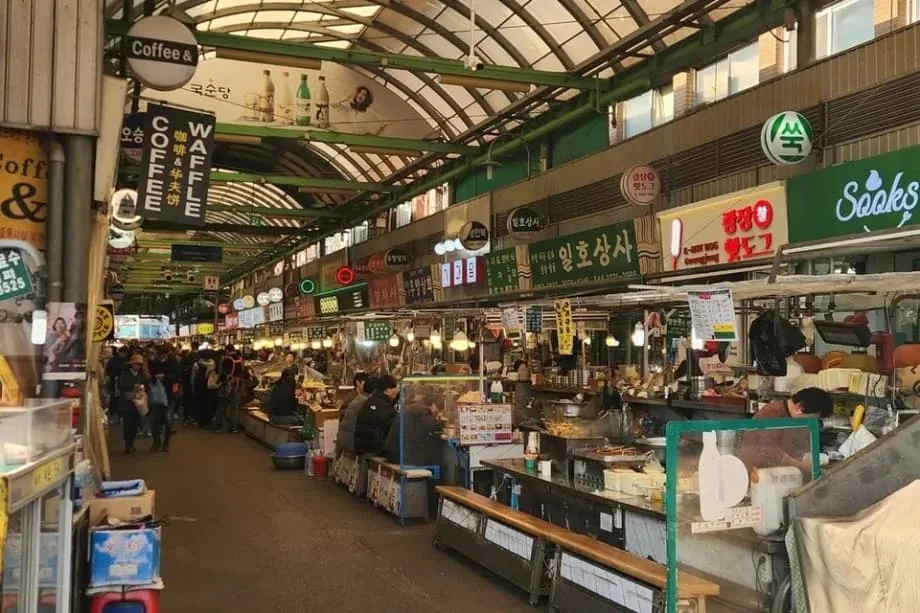
A 2,000 won dispute spreads across a Seoul landmark
A dispute over a dish priced at 8,000 won but billed at 10,000 won has grown into a threatened 300 million won lawsuit between two merchant associations at Seoul's Gwangjang Market. As of November 23, 2025, shop owners in the market's central building say a viral complaint about a nearby food stall has damaged businesses that had no part in the incident.
Contents
- A 2,000 won dispute spreads across a Seoul landmark
- What happened at the sundae stall?
- Two associations share one reputation
- What the proposed lawsuit would need to show
- How identifying stall operators could help
- Clearer menus and payments remain uneven
- Higher prices and disputed charges are different issues
- A historic market shaped by food and fashion
- What visitors can check before ordering
- Key Points
The Gwangjang Market Merchants Association, which represents about 200 stores inside the central building, says it will seek damages from the neighboring Gwangjang Traditional Market Merchants Association. The latter oversees roughly 250 food stalls and small shops around the site, including the stall at the center of the controversy.
More than 200 members signed a compensation demand delivered to the stall association. Their argument is simple: visitors tend to see one Gwangjang Market, even though two organizations manage different parts of it. When anger spread online, the main building's merchants say their customers and sales disappeared along with those of the surrounding stalls.
A popular YouTuber's video, posted on November 4, brought the dispute to public attention. The customer said a vendor selling sundae, a Korean blood sausage dish, charged an extra 2,000 won after adding meat. The vendor said the customer had agreed to the extra serving. The video surpassed 16 million views and prompted other diners to share similar experiences.
Jongno district officials have met both associations. The district says it will not intervene while court action is not active, but it plans to introduce a system identifying stall operators by their real names before the end of 2025. The threatened lawsuit and the district's changes address different parts of the same problem: who is responsible when a customer's complaint harms an entire destination.
What happened at the sundae stall?
The customer in the November 4 video said the menu showed a price of 8,000 won, yet the final bill was 10,000 won because the vendor added extra meat. She also complained about rude service. The merchant disputed her account of the order, saying she had accepted the additional item.
The difference was 2,000 won, or 25 percent of the listed 8,000 won price. The disagreement centered on whether the customer had consented to that increase before receiving the food. Korea's basic pricing rule is that customers should pay the amount shown on the menu unless both sides agree in advance to an extra charge.
The Gwangjang Traditional Market Merchants Association imposed a business suspension lasting 10 days within days of the video's release. The vendor closed for the penalty period. Market leaders said the punishment was intended to calm public anger and establish a clear boundary around posted prices.
Busy food stalls often sell extras and combination plates while handling quick orders and crowded seating. Customers may struggle to understand how much food a listed price covers, especially when a vendor offers additional meat or combines several items. Clear agreement before serving becomes essential when the final plate costs more than the menu item first requested.
The sequence of events and the announced next step are:
- November 4, 2025: A popular YouTuber published the video describing the billing dispute and rude service.
- Within days of publication: The traditional market association imposed a suspension lasting 10 days, and the vendor closed for that period.
- November 2025: The main market association sent a certified compensation demand backed by more than 200 members.
- By the end of 2025: Jongno district plans to introduce real name verification for roughly 250 stalls.
Two associations share one reputation
The central building and surrounding stalls operate under separate merchant associations, but most visitors encounter them as one place to eat, shop and explore. That shared identity helps businesses when food videos attract crowds. It also spreads the cost of a scandal beyond the stall where a complaint began.
The main building's merchants say the sundae stall was outside their association's control. Nevertheless, they describe falling foot traffic, slower sales and angry online comments labeling the wider market an overcharging zone. They want stricter oversight of problem stalls and common standards for pricing and service across the destination.
The Gwangjang Market Merchants Association's leaders framed their certified letter, sent in November, as a defense of a civic landmark. They said the entire market's reputation was at stake and called for stronger discipline and clearer business practices.
Gwangjang Market is the history of Seoul and the pride of South Korea. We will no longer tolerate the tarnishing of the market's name.
One restaurant operator described monthly rent that can reach about 20 million won and said recent sales had fallen to levels last seen during the pandemic. That account illustrates why merchants are concerned about a prolonged decline: rent and other fixed costs continue even when fewer customers arrive.
The merchants' demand also reflects a practical difficulty for visitors. A customer may know the name Gwangjang Market without knowing which association supervises a particular counter. Businesses in the central building say that lack of awareness has made it difficult to keep the dispute's financial damage within the area where it began.
What the proposed lawsuit would need to show
The main market association says it plans to seek 300 million won for economic losses linked to the incident at a stall supervised by the neighboring association. The claim would require it to connect the disputed sale and subsequent backlash to lost revenue at other businesses.
In Korean civil cases, plaintiffs must demonstrate actual loss and causation. Actual loss means showing what financial damage occurred. Causation means showing how the conduct being challenged led to that damage. Here, the association would also need to establish the stall association's legal duty to prevent the harm.
The stall association could argue that online reactions caused the wider decline, or that its response, including the suspension lasting 10 days, was proportionate. Those are possible defenses, rather than positions it has formally announced. As of November 23, it had issued no formal response to the compensation demand, and no date for filing the lawsuit or holding a hearing had been given.
Courts handling disputes of this kind sometimes steer the parties toward a settlement or a detailed code of conduct. Possible terms could include standard menus, mandatory card terminals, a complaint hotline and consistent penalties for violations. Such an agreement would address daily business practices alongside the demand for compensation.
Jongno district says its administrative measures will continue while the associations consider court action. The legal process is likely to take time. For merchants, a lengthy fight would leave the immediate task of rebuilding visitor trust unresolved while their businesses continue paying operating costs.
How identifying stall operators could help
Jongno district's planned real name verification system would cover roughly 250 stalls by the end of 2025. Each stall would be linked to a registered owner, with clear identification required at the point of sale.
A visible, identifiable operator would give customers and administrators a clearer starting point when a complaint arises. The system could make it easier to track complaints, enforce suspensions and collect fines. It is also intended to reduce the chance that a stall quietly changes hands or uses someone else to operate it after trouble occurs.
Visitors would gain a way to check whether the stall they are using operates under proper registration. For officials, the value lies in connecting a location, a transaction and a responsible person, rather than dealing only with the general name of the market.
The district has also started collecting road occupancy fees from stalls in the traditional market area. These fees formalize the use of public space. They address where a stall operates, while the planned identification system addresses who operates it.
Street stalls on public roads cannot obtain ordinary restaurant permits under the Food Sanitation Act. That makes oversight and sanitation enforcement more difficult. Better labeling and a stronger paper trail are intended to help administrators deal with those structural limits.
Clearer menus and payments remain uneven
Market leaders say they are expanding merchant education and complaint handling following the controversy. Earlier pledges included training on service quality and clearer menu displays. Some merchants and other critics argue that voluntary education alone will not resolve problems in a busy market with many independent operators and a constant flow of tourists.
QR menu boards are one attempt to make orders easier to understand. Market leaders have promoted boards that let visitors view photographs and descriptions in several languages. A picture can help a customer understand the portion being sold, while translated text can explain what is included in the stated price.
Association figures indicate that adoption is incomplete. Some food stalls still do not use the QR system. Card payment acceptance is uneven too, with some stalls continuing to rely on cash. Cash transactions can make refunds and record keeping more complicated because customers and vendors may have less documentation of the purchase.
The proposed changes deal with several points where a dispute can become difficult to resolve: an unclear menu, uncertainty about an extra serving, a missing transaction record or confusion about the operator's identity. Merchant education, clearer prices, payment records and operator identification each address a different part of that process.
Higher prices and disputed charges are different issues
Visitors have also questioned the value of some food sold at Gwangjang Market. Recent shopper observations included a plate of tteokbokki costing 3,000 won with only a few rice cake pieces, fish cake skewers priced at 1,500 won compared with 1,000 won at general shops, and a single live octopus sold for 18,000 won, above prices at large seafood markets.
The fish cake comparison amounts to a 500 won difference, or 50 percent above the cited 1,000 won price. The examples explain why portions and prices have become part of the public debate, alongside the specific allegation about an extra charge at the sundae stall.
Stall owners often point to higher rents and the demands of heavy tourist traffic. More customers can require additional staff and preparation, increasing costs. Some vendors sell specialty items or smaller portions at premium prices, while visitors seeking a rare travel experience can keep demand high.
A higher advertised price is different from changing the amount a customer owes after an order. The central issue in the viral case was agreement: whether the customer accepted extra meat and its additional cost. A visible menu lets a diner decide whether an item is worth buying before the transaction begins.
Visitors have shared accounts on social platforms of inconsistent pricing and aggressive attempts to sell additional items late at night, when crowds thin. Those experiences have added to calls for clearer menus and a common approach to service, rather than leaving customers to negotiate the terms of each purchase.
A historic market shaped by food and fashion
Gwangjang Market is more than 120 years old and is known as Korea's first permanent marketplace. It began as a center for fabrics and household goods before becoming famous for mung bean pancakes, noodles cut with a knife, dumplings and assorted jeon, Korean pancakes.
Korean fashion brands have opened stores in and around the complex in recent years, while global chains have introduced themed outlets. The market's Starbucks uses retro design, motifs drawn from fabric shops and a rooftop area for photographs.
Vendors say overseas visitors make up a large share of weekend customers. Many come to eat, film and shop during the same visit. The mix of traditional food, retail and popular culture has made the market a destination whose appeal extends beyond any individual stall.
Longer lines and expectations built through social media place pressure on operators. A successful food video can bring attention to many nearby businesses, while a complaint about service or an unclear bill can travel just as quickly. Responsible shops can lose customers alongside the businesses that prompted the criticism.
The planned lawsuit brings that shared reputation into a dispute between organizations with separate responsibilities. The central building's merchants want compensation for the losses they describe. They also want rules that protect the market's name across association boundaries.
What visitors can check before ordering
Thousands of people enjoy Gwangjang Market each day without incident. Customers can reduce the chance of a disagreement by confirming the price, portion and any extras before food is served.
Korean menus should be visible, card payment is widely available in formal shops, and there is no tipping custom. At stalls where ordering happens quickly, a brief confirmation can help both customer and vendor understand the same purchase.
- Check the displayed menu and prices before sitting down.
- Confirm the portion size and the cost of any extras. State clearly when you do not want additional items.
- Ask for a receipt and pay by card when possible.
- Use QR menus where available to check photographs and descriptions in different languages.
- Decline politely and choose another stall if the quoted price differs from the board or the order remains unclear.
- For a more local atmosphere, consider Namdaemun Market in Seoul or BIFF Square in Busan, which offer clear pricing and varied choices.
A receipt makes a later dispute easier to resolve by recording the transaction. The most useful check still comes before ordering: knowing what the listed amount buys and whether accepting anything extra will change the bill.
Key Points
- The Gwangjang Market Merchants Association plans a 300 million won damages lawsuit against the neighboring Gwangjang Traditional Market Merchants Association.
- The November 4 video alleged a 10,000 won charge for a dish listed at 8,000 won and rude service. The vendor said the customer agreed to extra meat.
- The video surpassed 16 million views, and the stall received a business suspension lasting 10 days.
- About 200 central building stores and roughly 250 surrounding stalls and small shops belong to separate associations but share the market's public identity.
- More than 200 members signed a compensation demand. Merchants describe falling foot traffic and sales, including business levels last seen during the pandemic.
- Jongno district plans real name verification for roughly 250 stalls by the end of 2025 and has begun collecting road occupancy fees.
- QR menu adoption and card acceptance remain uneven. Clear prices, consent for extras and transaction records are central to preventing disputes.