Stone tools reveal a maritime world
Stone tools dating back as far as 40,000 years, together with fishing equipment and the bones of tuna and sharks, point to an early maritime way of life in Island Southeast Asia. Archaeological findings from the Philippines, Indonesia and Timor-Leste suggest that people processed plant fibers into ropes, built durable boats and caught fish in deep water long before written history.
Contents
- Stone tools reveal a maritime world
- Deep channels made boats essential
- How microscopic marks reveal fiber work
- Why ropes mattered to boats and fishing
- Tuna, sharks and the offshore catch
- Navigation depended on learned knowledge
- Shell tools trace a longer maritime network
- Testing ancient boatbuilding methods
- A broader map of Paleolithic innovation
- What further work needs to resolve
- Key Points
The evidence brings together objects that survived and technologies that largely disappeared. Microscopic marks and plant residues on stone cutting edges reveal work with fibers. Fishing hooks, gorges and net weights show how people could catch fish, while the remains of large predators indicate access to species living beyond shallow coastal waters.
Researchers interpret these clues as signs of skilled mariners who planned crossings and sustained offshore fishing. Strong ropes would have helped hold boats together and supplied the lines and nets needed to bring catches back to shore. The findings place Island Southeast Asia among the early centers of maritime innovation and challenge the assumption that Paleolithic technological progress was concentrated only in Africa and Europe.
Wooden hulls, ropes and other organic boat parts rarely survive for tens of thousands of years in tropical conditions. Archaeologists therefore reconstruct this maritime world through the marks left on more durable objects. The emerging picture is of communities whose knowledge of plants, boat construction and the sea supported both movement between islands and everyday survival.
Deep channels made boats essential
Wallacea, the island region east of the exposed continental shelves of Southeast Asia, presented an enduring obstacle to migration. Deep channels between Borneo, Sulawesi and islands east of Java remained even when sea levels fell. Lower seas changed coastlines, but those water gaps did not close.
During the Pleistocene, lower sea levels often exposed Sundaland, the shelf region associated with today's mainland Southeast Asia, Borneo, Java and Sumatra. Wallacea lay beyond it. Reaching the Philippines, Sulawesi, the Moluccas and Timor-Leste required travel across water, rather than an uninterrupted walk from the mainland.
People had also reached Sahul, the landmass comprising Australia and New Guinea, earlier in human history. That movement likewise required sea travel. The evidence from Island Southeast Asia adds another part of the story: communities appear to have used maritime technology for fishing and island life, as well as for crossings.
Repeated journeys through these waters would have required boats that could carry people, tools and supplies while coping with currents and open sea conditions. The combination of fiber processing tools and offshore catches suggests that the skills needed for those journeys were part of a broader maritime economy.
How microscopic marks reveal fiber work
Archaeologists examined stone tools for microscopic polish, scratches and plant residues. These traces can record the material a tool touched and the movements used to work it. The method, known as microwear and residue analysis, is especially useful when the finished wooden or plant object has decayed.
Scraping hard wood leaves a different surface signature from slicing soft fibers. Under high magnification, plant residues may remain attached to a blade edge. Repeated contact with fibers can produce shiny, flattened polish, while parallel scratches, called striations, can indicate the direction in which the tool moved.
Researchers compare those patterns with marks produced in controlled experiments using modern plant fibers. A close match helps identify the work performed by ancient tool users. Some tools also carry sequences of wear consistent with several stages of preparation, from stripping material to finishing fibers.
Making strong cordage, a collective term for cords and ropes, involves more than cutting a plant. People first soften the material, split out fibers, scrape and twist the strands, then ply them together into stronger rope. The archaeological traces match stages in that process.
Fiber processing patterns appear on tools from multiple sites in Island Southeast Asia. Their repeated occurrence, together with evidence of several working stages, suggests an established activity rather than an occasional task. Researchers interpret the sequences as consistent with producing cordage at scale, using methods that could be taught and repeated within a community.
Why ropes mattered to boats and fishing
Plant fiber ropes could serve several purposes on the same boat. They could lash planks together, bind outriggers, stitch seams and secure cargo. Outriggers are structures extending beside a hull to help stabilize it. Cordage could also attach paddles or sails and provide fishing lines and nets.
Boats used offshore place heavy demands on those materials. A failed binding can weaken a hull, while a fishing line must withstand abrasion and the pull of a strong fish. Nets require knots that stay secure under strain. Reliable cordage therefore links the evidence for plant working to both boat construction and fishing.
Tools associated with fiber preparation appear alongside fishing equipment and deep water catches. The same working methods could have supplied ropes for a hull and lines for the crew using it. Consistent production would have depended on planning, repeatable techniques and knowledge shared between people.
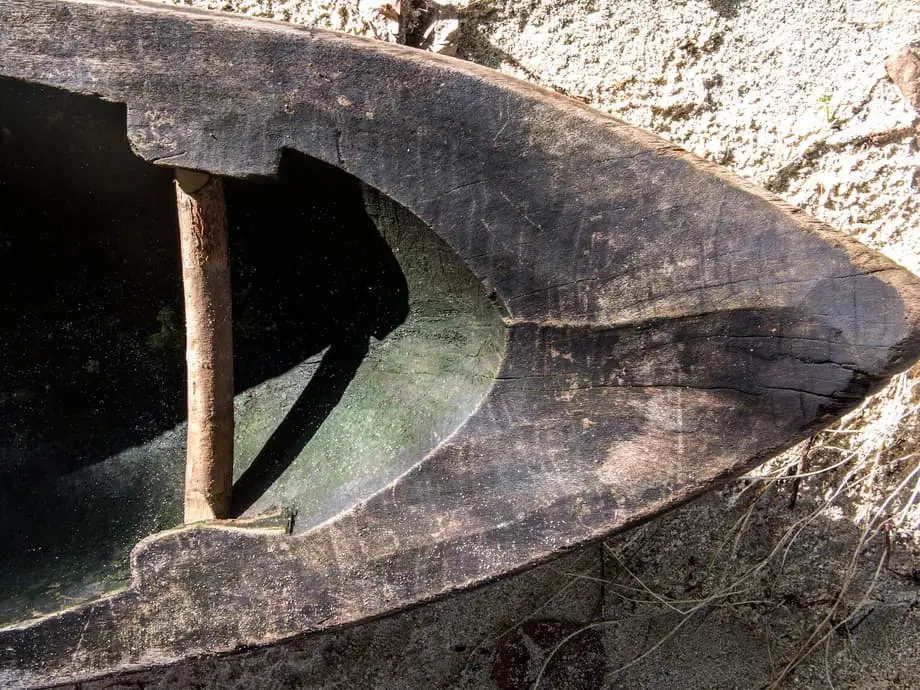
Boat construction may have drawn on tropical hardwoods and plants such as rattan, pandanus and palm. A dugout could be strengthened with side planks and stabilized with outriggers. Fiber could stitch plank edges together, and resins could help seal seams. These are possible ways to combine the available materials into watercraft capable of carrying people and equipment.
Ancient organic boats from this period have not survived, so their exact forms remain uncertain. Researchers reconstruct possible composite craft, meaning boats assembled from several components, through tools, residues and the demands of the journeys and fishing activities recorded at the sites.
Tuna, sharks and the offshore catch
Sites in Mindoro in the Philippines and in Timor-Leste preserve the bones of tuna, sharks and other fish associated with open water. These pelagic fish range beyond shallow coastal zones and can follow seasonal routes. Their presence in caves and rock shelters is interpreted as evidence of fishing trips into deeper water.
Catching such fish would have required capable boats and knowledge of currents, swells, wind and fish behavior. Crews also needed equipment strong enough to manage a catch and return it to shore. The fish remains connect the tools used on land with activities carried out at sea.
Fishing hooks, gorges and net weights add detail to that connection. A gorge is a slender piece of bone or shell that a fish swallows. Once inside its mouth, the piece turns and anchors across it. Like an early hook, it works with a strong line and may be used with bait.
Net weights help keep fishing nets in position. Together, these implements and the bones of large open water predators form a picture of active offshore fishing. Strong lines and nets would have faced substantial strain, making the quality of fiber preparation a practical concern.
Researchers see the different finds as parts of one working system. Plant fibers could hold a boat together, equip its crew and help recover fish from deeper water. Boats capable of repeated fishing trips could also support journeys between islands, extending the same technical knowledge from food gathering to travel and exchange.
Navigation depended on learned knowledge
Mariners needed more than a sound hull and strong rope. Travel offshore also depended on learning how wind, currents and swell behaved, and when conditions made a voyage possible. Knowledge of fish movements and storm seasons would have shaped decisions about when and where to go.
Navigators can read the stars, sun, clouds, waves and color of the water. Seabirds and the directions in which they fly can offer clues to nearby land. Such observations are part of the practical knowledge that makes repeated travel possible, although these skills themselves do not fossilize.
Repeated catches of migratory fish are interpreted as signs of awareness of seasonal opportunities. Settlement across separated islands points to knowledge of routes that people could use reliably. Boat technology and navigation would have developed together: each journey could add experience that was passed on through teaching and practice.
Planned crossings would also allow people to carry raw materials, toolkits and knowledge with them. Returning to an island could maintain family connections and exchanges. The evidence of regular offshore activity, ongoing fiber production and distant social ties supports a picture of purposeful movement, rather than a single accidental arrival.
Shell tools trace a longer maritime network
Archaeology in Mindoro and other island sites records more than fishing and fiber work. Shell tools appear early, while shell adzes became common around 7,000 to 9,000 years ago. An adze is a cutting tool used to shape material such as wood.
Similar shell adze forms occur across Island Southeast Asia and into Papua New Guinea. Shared tool types and burial practices suggest social connections over distance. Early graves form another part of the evidence used to examine contact between communities.
The dates describe different stages of this maritime record:
- Around 40,000 years ago, stone tools and fishing evidence point to fiber processing and offshore activity in Island Southeast Asia.
- Around 9,000 to 7,000 years ago, shell adzes became common, with similar forms appearing across the region and into Papua New Guinea.
These patterns fit a maritime world in which people and ideas moved along sea routes for thousands of years. The earlier tools reveal the practical skills of island life; the later spread of similar implements and shared practices adds evidence of a wider network of contact.
Testing ancient boatbuilding methods
Years of fieldwork on Mindoro and nearby islands helped inspire the First Long Distance Open Sea Watercrafts Project. Launched with naval architects in the Philippines, the project aims to evaluate materials and boat designs consistent with the archaeological evidence.
Teams are examining how plant fibers perform as lashings, how stitched seams respond to swell, and how small hulls move in wind and current. Scaled models can help explore boat behavior. Experimental tool use can also be compared with ancient wear patterns to assess whether the working motions match.
The central practical question is whether composite boats made with stone tools, plant fiber ropes and natural adhesives could safely travel between islands separated by currents and open water. Experimental archaeology addresses such questions by making and using objects with materials and methods suggested by archaeological finds.
Tests can measure how long cords endure exposure to saltwater and sunlight, how secure lashings can be tied without metal fasteners, and how many crew members are needed to balance and move a craft. They can also examine the strength of stitched seams and the handling of different hull designs.
Agreement between experimental results and ancient tool wear would strengthen the proposed reconstruction. Boat performance tests and the microscopic evidence address different parts of the same problem: how people prepared materials, and whether those materials could support the journeys suggested by island settlement and offshore fishing.
A broader map of Paleolithic innovation
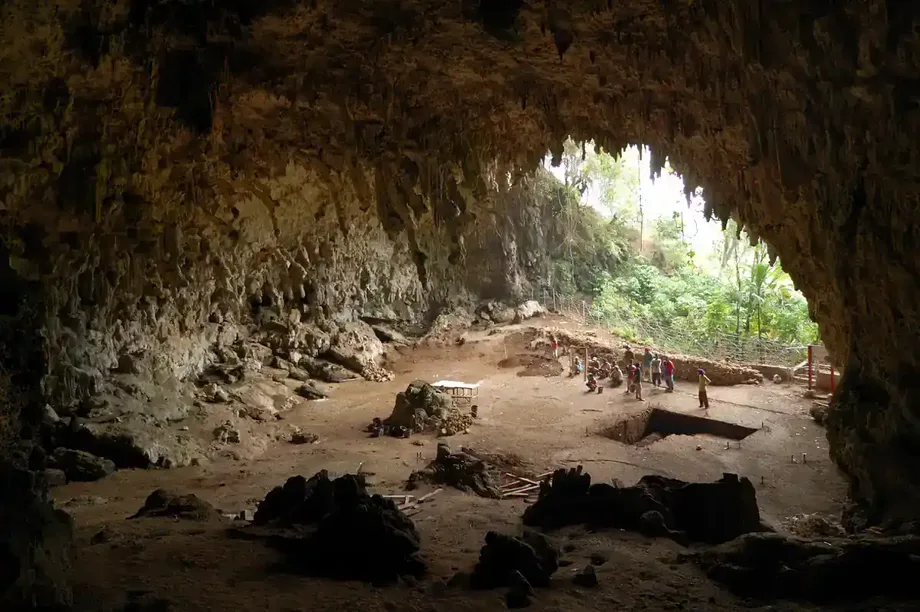
Island Southeast Asia presents a preservation problem for archaeology. Tropical conditions break down wood, fibers and even bone more quickly than more durable materials. When stone survives but ropes and boats vanish, a community's technology can become difficult to recognize.
Microwear and residue analysis help recover some of that missing activity. A stone edge can retain evidence of work on a plant long after the rope made from it has disappeared. Combining that evidence with fishing implements and animal remains gives a fuller account of what people could make and do.
The findings challenge a longstanding focus on discoveries in Europe and parts of Africa when describing Paleolithic innovation. Evidence from several islands points to substantial technical knowledge in a region where many finished objects were unlikely to survive. The archaeological picture becomes broader when those preservation differences are taken into account.
For these island communities, maritime skill would have been central to food, movement and social contact. Reliable cordage, assembled watercraft and knowledge of offshore conditions would have supported daily life in a demanding landscape. The region emerges as an early center for the development and refinement of skills involving fibers, wood and watercraft.
What further work needs to resolve
Microscopic analysis requires careful controls because different tasks can leave similar marks, and residues can be affected by contamination. Fishing equipment can also be reused or moved between sites. Researchers therefore draw on several kinds of evidence from separate locations to reconstruct ancient activities.
The combination of fiber processing tools, offshore fish remains and fishing implements provides a persuasive account of maritime life. Further work can refine the dates of those activities, identify more precisely how particular tools were used, and clarify differences between islands and communities.
Submerged shorelines are one possible focus for future research. Ancient coastal camps may now lie underwater, while botanical remains could help identify which plants supplied useful fibers and how people prepared them. More precise dating of fish bones and tools would tighten the sequence of events.
Experimental voyages using craft built with ancient methods could measure durability, safety and range. Together with laboratory analysis and fieldwork, those tests would help explain how early mariners built, maintained and sailed their boats, and how that knowledge supported both migration and repeated life at sea.
Key Points
- Findings from the Philippines, Indonesia and Timor-Leste point to maritime skills around 40,000 years ago.
- Microscopic wear and plant residues on stone tools match stages of fiber preparation for cordage.
- Tuna and shark remains, hooks, gorges and net weights support an interpretation of active offshore fishing.
- Deep channels in Wallacea persisted during periods of lower sea level, making sea travel necessary.
- Researchers reconstruct possible composite boats from indirect evidence because organic hulls and ropes have not survived.
- Shell adzes common around 7,000 to 9,000 years ago and shared burial practices suggest lasting connections between island communities.
- The First Long Distance Open Sea Watercrafts Project is investigating ancient materials and possible boat designs with naval architects in the Philippines.
- Further dating, submerged shoreline research and experimental voyages could refine the account of early seafaring.