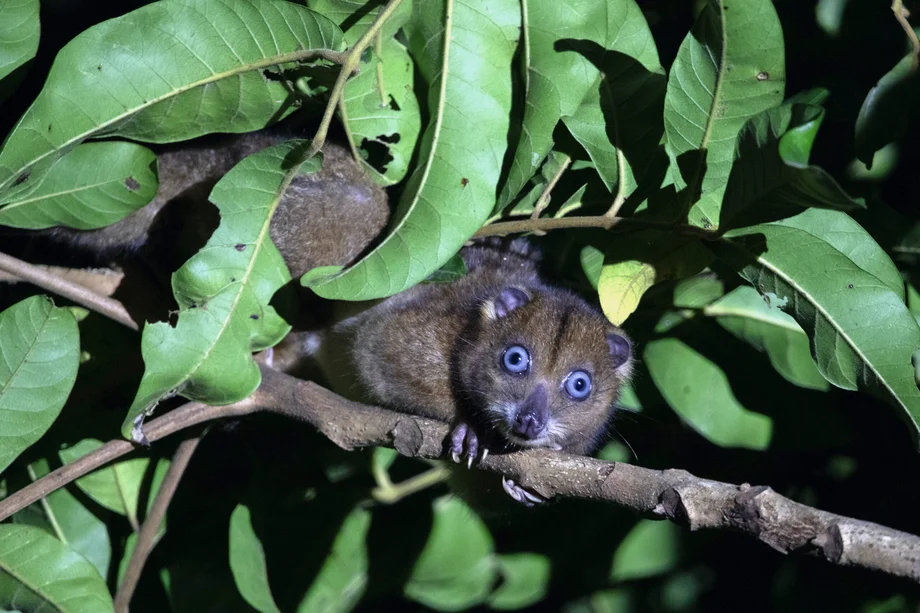
A rare blue gaze on Ternate
On the volcanic island of Ternate in North Maluku, a mammal that lives in trees has striking blue eyes. It is not a Siamese cat or a Siberian husky. It is the blue eyed cuscus, Phalanger matabiru, a marsupial known only from that island. Its scientific name carries Indonesian words: mata means eye and biru means blue.
Contents
- A rare blue gaze on Ternate
- Why blue eyes are unusual in wild mammals
- How the name matabiru entered science
- How the record grew, step by step
- A marsupial, not a cat
- Why Wallacea makes the animal more interesting
- A volcanic home and a very small range
- What the conservation labels mean
- Behind the scientific catalogue numbers
- What scientists still need to learn
- Key Points
The animal was formally described in 1995 by scientists Tim Flannery and Boeadi in Australian Mammalogy. More than three decades after the first known specimen was collected, researchers still cannot give an exact population count. The International Union for Conservation of Nature (IUCN) lists it as Vulnerable, a category for wild species facing a high risk of extinction.
Why blue eyes are unusual in wild mammals
Most wild mammals have brown or dark eyes. The iris, the colored ring around the pupil, usually contains enough melanin, the pigment that also darkens skin and hair, to look brown. Blue eyes in mammals generally form when there is little melanin in the iris and light scatters in the iris tissue, much as sky light can appear blue.
Research by Meyer and colleagues in 2013, published in American Journal of Physical Anthropology, found that blue iris color in some primates arose through different genetic routes. Work by Bradley and colleagues in 2009 on lemurs and humans reached a similar point: the same visible trait can come from different genetic mechanisms.
The blue eyed cuscus is not alone among Indonesian cuscus. The Biak cuscus, Spilocuscus wilsoni, has blue green eyes and lives in the Biak Islands of Papua. The two animals belong to different genera, Phalanger and Spilocuscus, and both have small island ranges. Scientists have not yet shown whether their eye color came from the same genetic route or whether long isolation on islands shaped each case separately.
How the name matabiru entered science
The scientific name Phalanger matabiru is a direct clue to the animal's most famous feature. Tim Flannery and Boeadi described it in 1995 as Phalanger ornatus matabiru, originally treating it as a subspecies of the ornate cuscus, Phalanger ornatus. The full citation is Flannery, T.F. and Boeadi, 1995, "Systematic revision within the Phalanger ornatus complex (Phalangeridae: Marsupialia), with description of a new species and subspecies," Australian Mammalogy 18(1):35-44, DOI 10.1071/AM95035. The 2005 Mammal Species of the World, third edition, pages 46 to 47, treated it as a separate species within the genus Phalanger. The Mammal Diversity Database notes that MSW3 split it from P. ornatus, while CMW and HMW5 treated it under ornatus because of morphological similarities indicated by unpublished data; it includes the species as distinct only tentatively. Its precise scientific position has remained open to further study.
The specimen used for the original description was holotype AM M.23555. It came from Tege-Tege, on the slope of Mount Gamalama on Ternate, and was collected in January 1991. The precise type locality is Tege Tege, Ternate, North Moluccas, at 0°50'N, 127°20'E, 400 meters above sea level. That detail matters because it gives researchers a fixed point in the history of the species, while present field numbers remain missing.
How the record grew, step by step
The known history of Phalanger matabiru is short, but it has clear dates. A timeline helps show how a blue eyed animal known from Ternate moved from specimen to named species and then to a conservation category.
- January 1991: a specimen was collected at Tege-Tege on Mount Gamalama, Ternate, at about 400 meters above sea level.
- 1995: Tim Flannery and Boeadi described Phalanger ornatus matabiru in Australian Mammalogy.
- 2005: the third edition of Mammal Species of the World placed it as a species in the genus Phalanger.
- 2019: the current IUCN Red List assessment by Leary et al., e.T136200A21951146, listed it as Vulnerable, and an Indonesian mammal checklist that year recorded its scientific name, island range and conservation category.
The red list dating needs care. The current assessment is Leary et al. (2019), e.T136200A21951146, rather than a 2008 assessment, and its category is Vulnerable. Some database pages also show the Cebuano label Puydeng mapuo for that category. No survey date or population target appears in the available record.
A marsupial, not a cat
A cuscus may look a little like a cat from a distance, but it belongs to a very different mammal group. Phalanger matabiru is a marsupial, meaning a mammal whose young continue development after birth while attached to a teat, usually inside the mother's pouch. It sits in the family Phalangeridae, superfamily Phalangeroidea and order Diprotodontia, the same order that includes kangaroos and koalas.
The blue eyed cuscus is active at night and spends much of its time in trees. Its tail can grip branches, a feature known as a prehensile tail, which helps it move through the canopy. Cats are meat eaters, while cuscus generally depend heavily on plants. A 2019 study of two cuscus species on Obi Island identified 16 plant foods, with fruit used most often. Some cuscus also eat insects. The specific diet of Phalanger matabiru still needs direct study.
Why Wallacea makes the animal more interesting
Marsupials are often linked in popular thinking with Australia, but Indonesia has its own rich marsupial history. Tree kangaroos live in Papua, and cuscus live in Sulawesi and Maluku. Ternate and Tidore form part of Wallacea, the transition zone between Asian and Australis fauna named for naturalist Alfred Russel Wallace.
Islands in Wallacea have been separated by sea for long periods. That isolation gives animals room to develop traits found nowhere else. The blue eyed cuscus belongs to that wider story of marsupials spreading and changing in eastern Indonesia. Its range in the Halmahera Islands makes it part of North Maluku's natural heritage, not a curiosity borrowed from another region.
A volcanic home and a very small range
The available record identifies Phalanger matabiru as endemic to Ternate, not Tidore, meaning it is recorded naturally from nowhere else. Ternate is volcanic and has Mount Gamalama, an active volcano. Tidore has Mount Kie Matubu as its main landmark, but the available record does not place the cuscus there.
A narrow range raises the stakes of every local threat. A large eruption could damage habitat and reduce food supplies across the whole known range of the species. Hunting for local consumption and invasive species also threaten its survival. With no confirmed population total, conservation workers cannot yet say how many animals remain after such pressures or whether numbers are rising or falling.
What the conservation labels mean
The IUCN category Vulnerable does not mean the blue eyed cuscus is already extinct in the wild. It means the species faces a high risk of extinction unless conditions improve. Endangered and Critically Endangered are more severe categories, while Least Concern is a lower risk category.
Within the same family list, the Biak cuscus, Spilocuscus wilsoni, is Critically Endangered, while the ornate cuscus, Phalanger ornatus, is Least Concern. The list also records the Geb cuscus as Endangered, the Waigeou cuscus as Vulnerable and the black spotted cuscus as Critically Endangered. Against that background, the blue eyed cuscus sits in a middle warning zone, with its entire known population on Ternate.
The family placement is consistent across the scientific record. Phalanger matabiru belongs to Phalangeridae and the genus Phalanger. A 2019 Indonesian mammal checklist also records its name, distribution and category, while the 2005 Mammal Species of the World treatment gives the taxonomic base used by many later references.
Behind the scientific catalogue numbers
Several number tags follow this animal through databases: ITIS 709417, IUCN 136200, MSW 11000052 and iNaturalist 42841. The 2019 Catalogue of Life used TaxonID 35494602. These numbers work like library card labels, helping different systems track the same species name without confusing it with other cuscus.
One broad database label places the species in southern Asia, while the species level record identifies Ternate in North Maluku and gives no range beyond Indonesia and Ternate. The island record is the practical one for conservation because it identifies where the animal is known to live. The number tags also show why a species can appear under several identifiers without representing several separate animals.
What scientists still need to learn
Three gaps stand out. First, no exact population count is available, despite decades passing since the 1991 specimen and 1995 description. Second, the specific foods of Phalanger matabiru have not been documented in the way the Obi cuscus diet has. Third, researchers have not settled whether the blue eyes of Phalanger matabiru and Spilocuscus wilsoni arose through the same genetic route.
No field survey or population estimate for Phalanger matabiru on Ternate or Tidore is given in the available accounts, and the Mammal Diversity Database gives no population figures or survey data. The only field density figure in the available research comes from Obi Island, not from either island: work in the Jikotamo village forest from July to December 2018 recorded 41 cuscus, 14 males and 27 females, over 1.64 hectares, with an average density of 25 individuals per hectare. Those animals were 39 Phalanger ornatus and two P. rothschildi, so the result is not a population estimate for the blue eyed cuscus.
Field surveys would need to focus on night activity in forest on Ternate. Diet work would need to identify the plants and insects used by this species, rather than relying on related cuscus. Genetic comparison could test whether island isolation produced similar eye color in two genera. The record gives no timetable for those tasks.
The blue eyes of this cuscus connect a small island mammal to larger questions about evolution and protection. For Ternate, the practical question is whether forest and food plants remain strong enough to support a population that has never been counted with precision.
Key Points
- Phalanger matabiru is a marsupial in the family Phalangeridae and is known only from Ternate in North Maluku; the available record does not confirm it on Tidore.
- Its scientific name uses Indonesian words for eye and blue, and it was originally described in 1995 as Phalanger ornatus matabiru, a subspecies of Phalanger ornatus, from a specimen collected in January 1991 on Mount Gamalama.
- The species is nocturnal, lives in trees and has a tail that can grip branches, but its own diet has not been studied in detail.
- The 2019 IUCN assessment by Leary et al. lists it as Vulnerable, while the Biak cuscus is Critically Endangered and the ornate cuscus is Least Concern.
- Its small volcanic island range exposes it to eruption risk, invasive species and hunting, and no exact population count or survey timetable is available.