A railway dispute meets a $20 billion mining milestone
Guinea turned back 18 locomotives built in China at the Port of Conakry in September, enforcing a procurement requirement just as its $20 billion Simandou mine, railway and port project approached its first iron ore shipments. The engines, intended for Winning Consortium Simandou (WCS), were returned to China because the agreement governing the shared transport corridor requires locomotives sourced from the United States.
Contents
- A railway dispute meets a $20 billion mining milestone
- Why Guinea sent the locomotives back
- Who owns the mines, railway and port?
- From September's rejection to November's first cargoes
- Why Simandou's ore matters
- A corridor built to overcome decades of delay
- What has to happen before volumes rise?
- Guinea's ambitions extend beyond mining
- What a new supplier means for steel markets
- Chinese partners remain central to the launch
- Key Points
By November 12, 2025, the project was marking its first loads of ore from Morebaya, the new export hub near Forecariah. The initial shipments are small beside the planned capacity of 120 million metric tons a year, but they represent a turning point for a deposit whose development was delayed for decades by the difficulty of getting ore to the coast.
China is expected to buy most of the ore, and Chinese companies are central to financing, building and operating the venture. Guinea's rejection of the locomotives therefore brought a sensitive commercial disagreement into public view at a moment of celebration for both countries.
WCS had already ordered heavy haul locomotives from United States manufacturer Wabtec, with deliveries scheduled to begin in October 2025. The Chinese shipment was intended to accelerate the start of railway operations. Guinea nevertheless insisted on compliance with the co development agreement that governs the common railway and port.
Why Guinea sent the locomotives back
A senior Guinean official involved in overseeing the project said the decision concerned the contract, rather than the nationality of the rejected equipment. The official requested anonymity because the commercial matter was sensitive.
The measure was not about targeting Chinese locomotives. If they had brought in a locomotive made by any other country, we would have made the same decision to cancel the contract.
Guinean authorities blocked entry when the 18 locomotives reached Conakry in September. The units were reloaded and shipped back to China, leaving project managers to meet demanding delivery schedules within the procurement rules.
La Compagnie du TransGuinéen (CTG), the joint venture responsible for the railway and port, continued receiving Wabtec locomotives for the Simfer side of the project. Four arrived in October, with dozens more due under contracts covering both Simfer and WCS.
The accepted locomotives illustrate how the project's supply arrangements cross several borders. Wabtec manufactures the units at its Marhowra plant in India, using engines designed in the United States. The first four units for Simfer arrived at Morebaya as the railway and port moved toward commissioning.
A fleet supplied by one manufacturer makes maintenance, staff training and spare parts management simpler. The procurement arrangement also reflects terms negotiated with partners and lenders. Guinea's leaders have signaled that they want to balance international partnerships while retaining the final say over strategic assets.
The episode offers a model for other sensitive procurement decisions, even as Chinese groups continue to play major roles in construction and mining. Its immediate practical effect was to reinforce the agreed structure of the transport corridor during the demanding start of operations.
Who owns the mines, railway and port?
Simandou is divided into four mining blocks. WCS operates Blocks 1 and 2. Blocks 3 and 4 are being developed by Simfer, a joint venture involving Rio Tinto, the government of Guinea and Chalco Iron Ore Holdings, through which Chinalco participates in the project.
WCS brings together Winning International and China Hongqiao Group. China Baowu Steel Group is another major Chinese participant in the wider venture, alongside Chinalco and the companies involved in WCS. State owned and private Chinese businesses are therefore embedded across the project.
CTG holds the shared railway and port. Simfer owns 42.5 percent, WCS owns 42.5 percent, and the Guinean state owns 15 percent. After an operating period of 35 years, the infrastructure will transfer to Guinea.
Those ownership arrangements make coordination essential. Two mining operations depend on the same route to the Atlantic, while the government has a stake in the infrastructure and expects it to serve purposes beyond mineral exports.
Locomotive orders follow that shared structure. Rio Tinto SimFer placed an order worth $277 million in 2024 for 78 Wabtec Evolution Series locomotives for CTG. WCS signed a separate contract worth $248 million in January 2025 for 65 locomotives from the same platform.
Together, the contracts cover 143 locomotives and total $525 million. They explain why deliveries of the agreed fleet matter so much: the railway's growing workload depends on equipment ordered well before the first export cargoes.
From September's rejection to November's first cargoes
Simandou's launch has involved several overlapping steps rather than one moment when every part of the system reached full capacity. The locomotive dispute, incoming equipment and first port movements all occurred during the transition from construction to operations.
- In 2024, Rio Tinto SimFer ordered 78 Wabtec Evolution Series locomotives for CTG in a contract worth $277 million.
- In January 2025, WCS signed its $248 million contract for another 65 Wabtec locomotives.
- In September 2025, Guinea rejected 18 locomotives built in China at the Port of Conakry and sent them back.
- In October 2025, four Wabtec locomotives for Simfer arrived at Morebaya. WCS deliveries had been scheduled to begin that month.
- In early November 2025, two ships arrived as Guinea prepared the export logistics chain, and initial ore movements began from Morebaya.
- Through 2026 and 2027, thousands of wagons and scores of locomotives are expected to arrive as transport volumes increase.
WCS said a barge carrying about 9,850 tons of ore left the new port and met the bulk carrier Winning Youth offshore. The movement shows how the initial export system works: smaller vessels carry ore from the port to larger ships waiting at sea.
Operators have also unveiled the first wave of locomotives. Thousands of ore wagons are due to arrive, each designed to carry about 81 tons. Trains, loading facilities and shipping arrangements must grow together for the small opening cargoes to become a dependable flow of exports.
Why Simandou's ore matters
Simandou contains one of the world's largest untapped iron ore deposits, with estimated reserves well above 3 billion tons. Its ore has an iron content of around 65 percent, making it attractive to steel mills seeking more productive operations and lower emissions.
Iron ore is the raw material from which steelmakers obtain iron. Ore with a higher iron content supplies more usable iron for the material handled. At Simandou's grade, mills can reduce the amount of coke needed per ton of hot metal, the molten iron produced in a blast furnace.
Coke serves as both fuel and a material that helps remove oxygen from iron ore. Reducing its use is part of the attraction of richer ore. High iron content can also boost output from direct reduction plants, which use natural gas or hydrogen to obtain iron without the conventional blast furnace process.
China's steel industry is a central audience for that supply. Chinese buyers want premium ore as they seek to cut blast furnace emissions, while Chinese investors have helped finance and develop Simandou itself.
China's Vice Premier Liu Guozhong attended the commissioning ceremony, underlining Beijing's interest in securing this source of ore. The project combines a commercial objective, obtaining raw material for steel, with Guinea's ambition to use mining as a basis for wider national development.
The scale is considerable, but production will build gradually. The mine, railway and port are designed as an integrated network capable of handling up to 120 million metric tons a year once operations have fully expanded. No date was given for reaching that full capacity.
A corridor built to overcome decades of delay
Simandou lies deep in Guinea's mountainous southeast. For decades, the central obstacle was infrastructure: a large deposit has limited commercial value without a way to move its ore to ships.
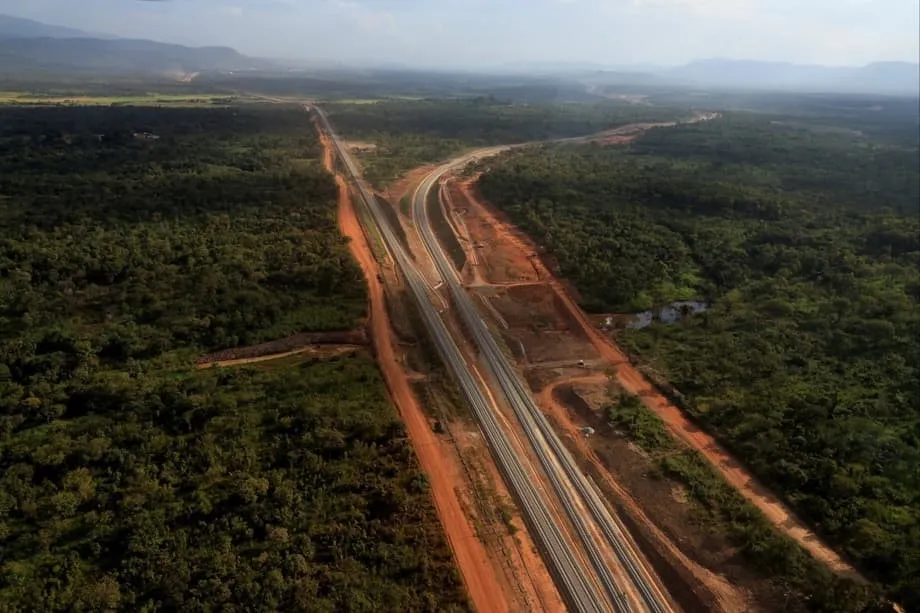
The Trans Guinean Railway, about 650 to 670 kilometers long, connects the mining areas to Morebaya. Its route crosses hills, river valleys and forested terrain, making the railway the essential link between the deposit and the Atlantic export hub.
The decision to build a railway with two tracks increases capacity and helps prevent bottlenecks as Simfer and WCS use the same corridor. CTG will operate the network under a long concession before transferring it to the state.
Morebaya's initial export arrangements use barges to take ore through the channel to deeper water, where large bulk carriers wait. Transshipment means transferring cargo from one vessel to another, allowing the biggest ships to be loaded offshore.
This arrangement lets exports begin while permanent shiploader systems and breakwaters are being completed. Bad weather presents a risk to those movements, but the approach also brings forward the first revenue from shipments.
The railway and port therefore have to be considered together. A train reaching the coast is only one part of the journey; ore must then pass through loading equipment, barges and offshore transfers before a bulk carrier can take it to a customer.
What has to happen before volumes rise?
Operators will progressively add trains, wagons and loading infrastructure. Deliveries through 2026 and 2027 are expected to increase the amount of ore the corridor can handle, with scores of locomotives and thousands of wagons still to come.
Work on signaling, passing loops and maintenance depots will help determine how quickly the railway can safely move large groups of wagons to the coast. Signals manage train movements, while passing loops provide sections where trains can pass. Depots keep the equipment serviced and available.
Project managers face tight schedules and a governance structure involving several partners. The push to move ore soon must be coordinated with the arrangements intended to keep the corridor working for decades.
Guinea also plans passenger trains and general freight services on the same alignment. The railway is intended for several uses, rather than serving only iron ore trains, creating the prospect of better connections for inland communities.
Farmers and traders along the route could gain access to new markets as capacity grows. Stations may also encourage the development of nearby industrial zones. Stable rail services can lower transport costs for domestic commerce.
Authorities will need to manage resettlement, biodiversity and safety along the route. Rivers and protected habitats in the forested terrain require careful planning, alongside the demands of running a large mineral export operation.
Guinea's ambitions extend beyond mining
The International Monetary Fund estimates that Simandou could lift Guinea's gross domestic product by about 26 percent by 2030. Gross domestic product, or GDP, measures the value of goods and services produced in an economy. A change of that size would be unusually large for a single investment in West Africa.
Guinea's longer term prize is steady public revenue and infrastructure that remains useful beyond the mine. Ore levies and royalties can support spending on health, education and power projects, while the transport network can serve businesses outside mining.
Djiba Diakité, minister and chief of staff to the president and head of the Simandou 2040 committee, described the launch from the presidential palace as part of a national project.
Simandou is more than a mining project. It is the driving force behind a national transformation.
That ambition helps explain the government's strict approach to project terms. Guinea wants a transport system that is reliable and can be maintained over decades, including when it carries passengers and ordinary freight.
Chris Aitchison, managing director of Rio Tinto SimFer, called the arrival of the first Wabtec locomotives a landmark for both the railway and the country. He pointed to the benefits expected from connecting communities and opening trade.
The locomotives are a visible sign of the progress being made and the future benefits the Trans Guinean railway will bring by connecting communities, enabling trade, and supporting sustainable development across the country.
The scale of the venture also brings scrutiny of governance, transparency and benefits for communities. Guinea's government has pledged to meet international standards in those areas as it seeks to turn mineral exports into wider economic gains.
What a new supplier means for steel markets
Simandou will introduce a large new source of high grade ore into a market dominated by major producers in Australia and Brazil. As volumes rise, Asian steel mills could have more choice, reducing the bargaining power of established suppliers.
Prices will depend on how quickly the new supply arrives and how reliably the transport system operates. Growing steel demand could absorb additional ore, while richer material may replace lower grade products in customers' purchasing plans.
Iron ore producers have faced volatile prices in recent years, with market cycles influenced by construction activity and stimulus policies in China. Simandou's gradual expansion will give traders time to adjust the mix of ore covered by their contracts.
Rio Tinto chief executive Simon Trott connected the launch with customer demand for steel production that releases less carbon.
Unlocking this new source of high grade iron ore is in demand from customers for low carbon steel making.
China Baowu Group chairman Hu Wangming also stressed the role of Simandou's ore in providing raw materials for cleaner steel production in China and elsewhere.
The stable supply of Simandou premium iron ore resources will provide a solid foundation of low carbon raw materials for the development of China steel industry and the global steel sector.
The commercial opportunity rests on both quality and dependable delivery. High iron content gives the ore its appeal, while the mines, railway and port must work together to supply it regularly at the volumes customers expect.
Chinese partners remain central to the launch
Liu Guozhong, China's vice premier, described Simandou at the launch ceremony as a milestone in a relationship stretching back decades. He linked the project to Guinea's economic plans and the Simandou 2040 strategy.
This project is the result of nearly 70 years of friendship and cooperation. It will contribute to Guinea economic development and the implementation of its Simandou 2040 strategy.
Chinalco president Wang Shilei said the start of operations reflected agreements between the heads of state of the two countries and practical cooperation. He presented the launch as a contribution to Guinea's development.
The start of operations contributes to Guinea industrialization and modernization.
Those statements show the two purposes running through the venture: securing a major source of iron ore and supporting Guinea's national development program. Chinese investment remains central, despite the procurement dispute over the 18 locomotives.
The locomotive rejection occurred within a much larger undertaking involving several companies, dozens of lenders and a long operating horizon. Guinea enforced the transport agreement while the mining, construction and export partnership continued.
As of November 12, the immediate task was to build on the first cargo movements. More equipment, completed loading infrastructure and dependable railway operations will determine the pace at which Simandou moves from a symbolic opening shipment to a major source of iron ore.
Key Points
- Guinea rejected 18 locomotives built in China in September 2025, citing a requirement for United States sourced locomotives, and returned them to China.
- Simfer and WCS ordered a combined 143 Wabtec locomotives under contracts totaling $525 million. Four for Simfer arrived at Morebaya in October.
- Initial exports use barges and offshore transfers. WCS said a barge carrying about 9,850 tons met the carrier Winning Youth at sea.
- The $20 billion mine, railway and port project aims to reach 120 million metric tons a year, using ore with around 65 percent iron content.
- CTG owns the railway and port, with Simfer and WCS holding 42.5 percent each and Guinea holding 15 percent. The infrastructure will transfer to Guinea after 35 years of operation.
- Chinese companies remain major investors, and China is expected to buy most of the ore.
- The IMF estimates that Simandou could lift Guinea's GDP by about 26 percent by 2030.
- Equipment deliveries through 2026 and 2027 will support expansion, alongside plans for passenger trains and general freight.