A mountain railway with stakes beyond transit
Kyrgyzstan is building 29 tunnels and 50 bridges for a railway intended to connect China directly with Uzbekistan, opening a new freight route across Central Asia. The project is estimated to cost $4.7 billion. Its economic test will be whether trains bring enough business to pay for an expensive mountain crossing and support industries along the tracks.
Contents
- A mountain railway with stakes beyond transit
- What the government says is already in place
- Who pays for the $4.7 billion project?
- Why Makmal matters as much as the mountains
- How much faster could freight move?
- Jobs and minerals in Naryn, displacement in Suzak
- Uzbekistan wants factories as well as freight
- Kazakhstan faces competition and opportunities
- Investors are looking at the services around the tracks
- 2030 is a construction milestone, not the operating target
- Key Points
By early November 2026, work was under way on 28 of the tunnels and 47 of the bridges, according to figures attributed to Kyrgyz Temir Jolu, the national railway company. About 22% of construction was expected to be completed by the end of 2026. The operating target is 2031, although President Sadyr Japarov announced a 2030 construction completion target in March 2026.
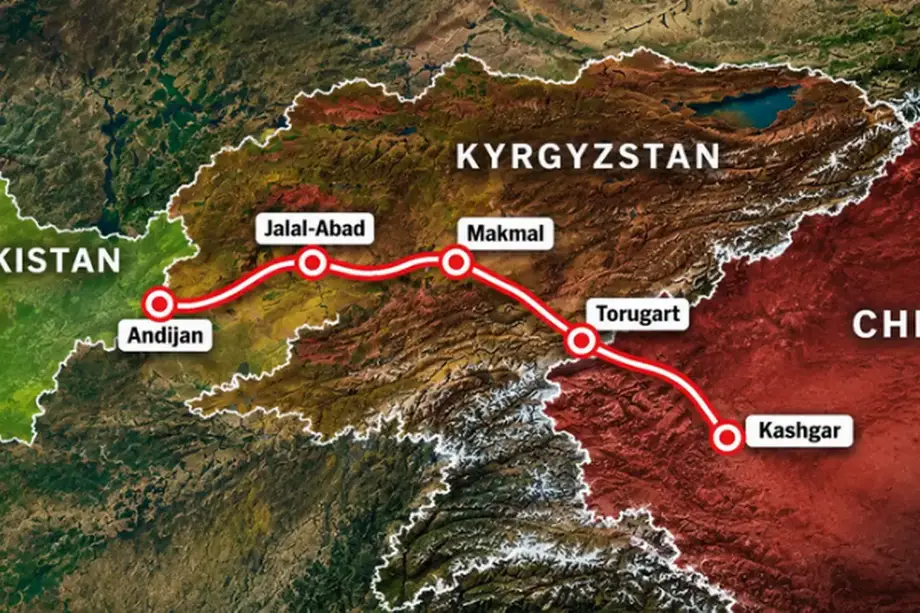
The China–Kyrgyzstan–Uzbekistan railway, known as CKU, would run approximately 530 kilometres from Kashgar in western China through Torugart, Makmal and Jalal-Abad in Kyrgyzstan to Andijan in Uzbekistan. Around 305 kilometres would cross Kyrgyz territory, much of it through difficult terrain.
For Kyrgyzstan, the railway promises transit income and access to markets for minerals and manufactured goods. Uzbekistan wants a stronger position as a trading and industrial centre. Kazakhstan faces a competing route for some cargo, while Tajikistan and Turkmenistan could gain new connections through neighbouring networks.
The benefits will depend on what happens beyond the construction sites: how borders operate, what freight companies charge, how efficiently cargo changes between different track widths, and whether local businesses can sell more goods rather than simply watch foreign containers pass.
What the government says is already in place
Kyrgyzstan's Ministry of Transport and Communications said in its July construction update that the main international and investment agreements had been concluded, a principal contractor selected and financing issues resolved. Tunnel, bridge and other infrastructure work was proceeding.
The statement followed a meeting on July 10, 2026, between Deputy Transport Minister Almaz Turgunbaev and a Chinese delegation led by Wang Jinxi, a board member of China's state railway corporation. Kyrgyz officials called for local workers and domestically produced materials and equipment to be used in construction.
The ministry also called for environmental safeguards, protection of historical and cultural heritage, transparent construction procedures and measures against corruption. Both sides expressed readiness to accelerate work toward the agreed schedule.
The government's earlier chronology sets out the project's main steps:
- June 6, 2024: the three governments held the signing ceremony for their cooperation agreement in Beijing.
- September 28, 2024: the railway company opened in Bishkek.
- December 20, 2024: the investment agreement was signed.
- December 27, 2024: construction was ceremonially launched in Kyrgyzstan.
- April 29, 2025: construction of key facilities was formally launched.
- December 2025: the financing package was reported finalized.
The ministry dates the construction launch to December 27, 2024; a published account of parliamentary remarks gives December 27, 2023. The ministry's chronology provides the documented sequence from the cooperation agreement to the construction ceremony.
Who pays for the $4.7 billion project?
China holds 51% of the joint project company, while Kyrgyzstan and Uzbekistan each hold 24.5%. The financing model divides the cost roughly equally between shareholder capital and borrowing from Chinese financial institutions.
The reported loan package is about $2.3 billion, extends over 35 years and is repayable by the joint venture. Stated capital contributions include approximately $1.1 billion from China and $573 million each from Kyrgyzstan and Uzbekistan.
Kyrgyzstan's contribution creates a substantial financing commitment before regular freight earnings begin. The joint venture must eventually cover railway operations, maintenance and loan repayments, making the number of paying customers and the tariffs they accept central to the business.
Deputy Prime Minister Edil Baisalov has forecast at least $300 million in annual transit revenue. Japarov previously cited $200 million, putting Baisalov's estimate $100 million higher. Baisalov described his projection in these terms:
Even under the most pessimistic scenarios, the cargo loads expected to transit this route could generate at least $300 million in annual revenue, benefiting the country significantly,
Revenue is the money received before expenses. The amount available for shareholders or public budgets would depend on operating costs, maintenance, financing payments and the arrangements for distributing earnings. Freight volumes and final commercial tariffs remain uncertain.
Why Makmal matters as much as the mountains
Kyrgyzstan's transport ministry set out the railway's technical design in a June 2025 presentation. It identifies Makmal as the transfer station between China's track gauge of 1,435 millimetres and the 1,520 millimetres used across much of Central Asia. Gauge means the distance between the two rails.
The presentation lists a combined Torugart–Arpa–Makmal–Jalal-Abad option measuring 311.76 kilometres, compared with approximately 305 kilometres in later project descriptions. The listed option allocates 165.5 kilometres to the narrower gauge between Torugart and Makmal and 146.26 kilometres to the wider gauge between Makmal and Jalal-Abad.
Makmal's planned work includes assembling trains, loading and sorting containers, weighing cargo and transferring wagons between the two gauges. Efficient handling there will be essential: time saved on the journey can be spent waiting at a transfer yard.
Nurbek Satarov, the presidential envoy in Naryn, says roughly 90% of the Kyrgyz route passes through his region. About 70% of Naryn consists of mountain ranges. The tunnels and bridges allow the railway to cross that landscape, while also creating structures that will require inspection, repair and maintenance throughout the railway's working life.
How much faster could freight move?
The transport ministry's presentation projects a route from East Asia to the Middle East and southern Europe that is 700 kilometres shorter, with travel time reduced to 10 days. Baisalov separately predicts savings of at least seven days compared with northern routes using the Trans-Siberian Railway and maritime transport.
Businesses will make their choices using the price and delivery time for a particular journey. A container moving from western China to Uzbekistan has different alternatives from one travelling to Turkey or a European port. The location of the factory, border queues, train frequency and transfers all affect the result.
China's current rail connections to Kyrgyzstan and Uzbekistan depend on transit through Kazakhstan. Important gateways include Dostyk–Alashankou and Altynkol–Khorgos. CKU would add a direct railway crossing from China into Kyrgyzstan, giving shippers another option for destinations farther west and south.
The mountain section and gauge transfer will add costs of their own. A shorter route can attract freight when its total price and reliability suit customers; established routes can retain business through frequent services, dependable terminals and competitive charges.
Jobs and minerals in Naryn, displacement in Suzak
More than 4,000 workers are reported to be employed on the project in Kyrgyzstan. Construction is already creating demand for materials, transport, engineering and energy, which explains the government's push to involve domestic suppliers.
Baisalov also links the railway to Naryn's coal, iron, aluminium and rare earth resources. He argues that better transport could support mineral exports, processing plants and other industrial enterprises. Turning those ambitions into operating businesses would require further investment in factories, utilities and connections to the railway.
Families along the route face more immediate consequences. Turgunbaev told a parliamentary committee on May 18 that 214 homes were scheduled for demolition: 191 in Suzak district in Jalal-Abad region and the remaining 23 in Naryn. Suzak therefore accounts for about 89% of the affected homes.
Turgunbaev said an independent company had completed valuations and the Association of Appraisers had reviewed the methodology. Compensation payments were proceeding, but some residents disagreed with the amounts offered. Specialists were visiting households to seek agreements.
The geography of the costs and benefits is uneven. Naryn contains most of the Kyrgyz route and potential mineral opportunities, while Suzak contains most of the homes scheduled for removal. Compensation and access to local work are concrete parts of how the project affects residents before the first commercial train runs.
Uzbekistan wants factories as well as freight
Andijan would connect the new railway to Uzbekistan's existing network and the industrial economy of the Fergana Valley. Textile, chemical, food processing and engineering businesses could gain another route for importing equipment and exporting finished products.
Koba Gvenetadze, the International Monetary Fund's resident representative in Uzbekistan, cited CKU at a media roundtable on the November 2026 Regional Economic Outlook for the Caucasus and Central Asia. He said Uzbekistan's location and closer regional ties positioned it to become an important trade and logistics centre.
Gvenetadze described the potential gains beyond passing freight:
It's not just about transit. Improved connectivity can lower trade costs, attract investment and expand markets for all countries that are integrating and seeking closer links,
Uzbekistan's manufacturers would also face easier access for competing Chinese goods. Investment in processing, assembly, warehousing and joint ventures could help local firms use the railway to reach customers rather than rely mainly on handling imports.
The transport ministry's plans also look beyond the international line. They list a prospective Balykchy–Kochkor–Makmal connection of 300 kilometres and a Balykchy–Tamchy extension of 50 kilometres. Such additions would expand the domestic network, including the longer ambition of connecting Kyrgyzstan's currently fragmented northern and southern railway sections.
Kazakhstan faces competition and opportunities
Kazakhstan could lose some freight heading from China toward Uzbekistan and destinations farther south. Its established railways, logistics centres, connections to Russia and access to Caspian ports give it several ways to compete.
The Trans-Caspian International Transport Route, commonly called the Middle Corridor, connects Central Asia with the South Caucasus, Turkey and Europe. Cargo on that corridor has reached approximately 4.5 million tonnes, almost five times its level in 2021, while reported transit time has fallen from 18 days to 15 days.
CKU would enter a market where other routes are already improving. It could supply freight to wider regional networks as well as compete for individual shipments. Kazakhstan's PTC Holding has pursued cooperation with International Freight Trains on expanding cross border services, alongside Chinese interest in Uzbekistan's Silkway Central Asia logistics centre.
Turkmenistan could carry additional freight through its rail links with Uzbekistan and Iran. Its Turkmenbashi port offers another possible connection to Caspian shipping. Tajikistan could use terminals in Kyrgyzstan and Uzbekistan to support trade in agricultural goods, textiles and industrial raw materials, with the practical gains depending on roads and border access.
Further routes through Iran, Afghanistan or toward Pakistan would require their own infrastructure, operating arrangements and international agreements. CKU supplies one new connection within a larger transport system.
Investors are looking at the services around the tracks
The Turkic Investment Fund is considering CKU and opportunities along the Caspian transport axis as part of its regional connectivity agenda, according to General Director Ramil Babayev. Its governors identified transport and logistics infrastructure among financing priorities at their October 22, 2026 meeting in Tashkent.
Babayev described possible support for logistics hubs, industrial zones, customs facilities, digital trade systems and reliable energy. The fund has also discussed Caspian transport investments with the Azerbaijan-Uzbekistan Investment Company.
The fund's wider financing arrangements include a framework with the Islamic Corporation for the Development of the Private Sector that could mobilize up to $300 million across five member countries, including Uzbekistan. Its authorized capital is $600 million. These arrangements concern a broader investment programme, while railway related opportunities are being considered.
Warehouses, customs systems and electricity supply matter because a railway operates as a chain of services. An exporter needs space to store goods, predictable border clearance, a train slot and a functioning terminal at the destination. Weakness in any of those services can increase the cost of the whole journey.
2030 is a construction milestone, not the operating target
Japarov's 2030 completion target and Satarov's estimate of completion between 2028 and 2030 reflect ambitions to finish earlier than the 2031 operating target. Construction completion, testing and the start of regular freight services are separate steps.
The Bishkek Investment Forum scheduled for November 25, 2026 offers a near term opportunity to discuss the region's development through 2030. The immediate construction benchmark is the plan to reach about 22% completion by the end of 2026.
Independent Central Asian economic analyst Markus Friedrich Schneider describes three possible outcomes: gradual freight growth after opening; stronger gains if industrial and logistics clusters develop; or weaker results if delays, higher costs and insufficient cargo reduce returns.
The difference between those outcomes will reach beyond transit receipts. Shared tariffs, faster customs, compatible documents and dependable transfers can help firms sell to new customers. Factories and processing plants along the route could create additional trade. If most traffic simply shifts from an existing corridor, income would move between routes with a smaller gain for the region as a whole.
Key Points
- CKU is an approximately 530 kilometre railway connecting Kashgar with Andijan through Kyrgyzstan, at an estimated cost of $4.7 billion.
- China owns 51% of the project company; Kyrgyzstan and Uzbekistan each own 24.5%.
- Work was under way on 28 of 29 tunnels and 47 of 50 bridges by early November 2026.
- The operating target is 2031, while Kyrgyz officials have announced earlier construction completion ambitions.
- Makmal is planned as the transfer point between China's 1,435 millimetre gauge and Central Asia's 1,520 millimetre gauge.
- Officials plan to remove 214 homes, including 191 in Suzak district; some residents dispute compensation valuations.
- Regional gains depend on freight demand, competitive charges, efficient borders and investment in businesses along the route.