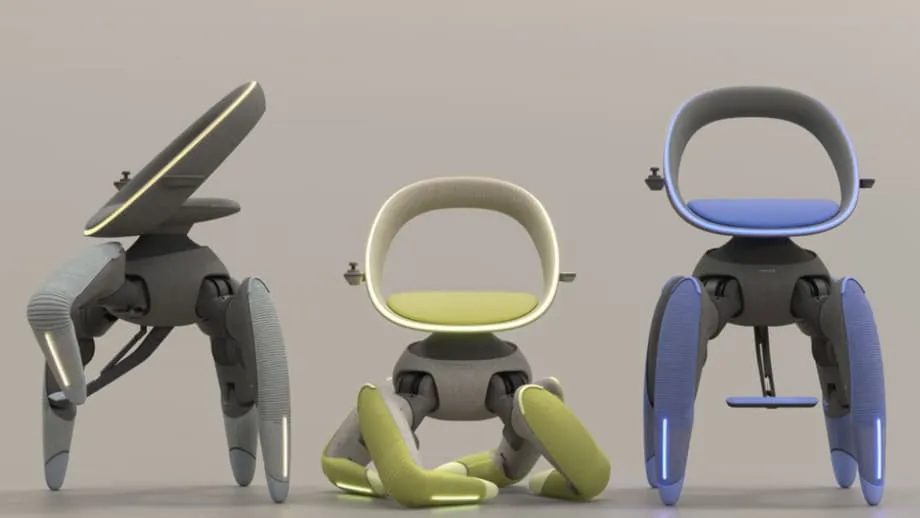
Four robotic legs take mobility beyond wheels
Toyota's Walk Me concept replaces wheelchair wheels with four articulated robotic legs, aiming to carry users over stairs, gravel, raised entrances and other obstacles that can interrupt an everyday journey. Presented at the Japan Mobility Show (2025) in Tokyo, the compact mobility chair also folds itself for storage and travel.
Contents
- Four robotic legs take mobility beyond wheels
- How the legs keep the rider steady
- Sensors watch the floor and the rider
- Steering through handles, buttons and voice
- Stairs reveal the difference between legs and wheels
- Folding for travel and adjusting for transfers
- A chair shaped around Japanese homes
- Toyota's mobility work reaches beyond cars
- What a commercial chair would need
- The Bottom Line
As of November 5, 2025, Walk Me remains a prototype, with no public launch date or price. Its proposed capabilities reach beyond moving from one room to another: the chair can change height for a transfer into a car, lower its seat toward a tatami floor and pack down to roughly the size of a small carry on bag in about thirty seconds.
Toyota has brought robotics, artificial intelligence and seating design together around a familiar idea: a supported seat with a curved backrest and armrests. Beneath it, independent legs bend, lift and place their feet as conditions change. Soft coverings hide motors and sensors, give the machine a friendlier appearance and reduce places where clothing or nearby furniture might catch.
Walk Me's central challenge is keeping the person seated above those moving parts comfortable and balanced. Its software uses information about the surrounding space, the ground and the rider's weight to adjust the legs and seat. The intended result is steady, predictable movement, whether the chair is crossing a living room or passing through a busy public space.
The design addresses a practical limit of conventional wheelchairs. Wheels work well on level floors, but a staircase, loose gravel, a high threshold or the step into a vehicle can require a ramp, another device or someone's assistance. Walk Me approaches those barriers by stepping over or onto them.
How the legs keep the rider steady
Walk Me is, at its core, a robot built around a human seat. Each of its four limbs can lift, bend and place a foot independently. A constant stream of sensor information allows the controller to check weight distribution, look ahead and adjust both the base and the tilt of the seat.
Developers studied animals that move confidently across steep or irregular ground. The gait draws on goats for movement on slopes and crabs for stable movement sideways. Those references translate into practical actions: choosing a foothold, changing stance and shifting support while another leg moves.
On stairs, the front legs first test the height of a step. They then hook and pull the chair upward while the rear legs push and provide support. Repeating that sequence is intended to keep the chair centered and reduce sudden movements that could unsettle its rider.
Gravel, garden stones, worn thresholds and uneven pavement require a different response. Each leg can shorten or lengthen its stride as the system checks footing, slipping and changes in height. The legs move underneath the rider while the controller works to maintain a level seat.
Balance also depends on where the combined weight of the chair and rider rests. That balance point is called the center of mass. Shifting it sideways can help the chair stay stable on a slope while its legs reach uphill. A wider stance provides another way to support the seat when the ground becomes difficult.
Legs also allow precise placement. A foot can step over a cord or land on a small patch of suitable ground. Coordinating those movements requires the computer to manage dozens of joint movements, read load and tilt continuously, and recover from minor slips without alarming the person aboard.
Sensors watch the floor and the rider
Walk Me combines lidar, cameras and radar to scan its surroundings. Lidar measures distance using light, while the combined sensing system helps identify obstacles such as rug edges, toys and door thresholds. Its perception system also looks for cables, low objects and ridges that could interfere with a planned movement.
Weight sensors check whether the rider is centered before major moves. If tilt or load readings approach a limit, the controller can widen the stance or shift the seat to reduce the risk of tipping. These adjustments are intended to make movement feel smooth rather than jerky.
Collision radar provides another layer of protection. When a person or object crosses the chair's path, it triggers an immediate stop. Sensors inside the joints monitor temperature and electrical current, and the chair pauses and alerts the user if a joint overheats so it can cool before continuing.
The system's task is to combine those signals into a usable picture of what is happening. A change in floor height, an obstacle ahead and a shift in the rider's position may all require different responses at the same moment. The controller must coordinate the feet, base and seat around that information.
Steering through handles, buttons and voice
The side handles serve as armrests and physical controls. Riders can twist them to turn, while buttons provide direction changes and adjustments to speed. Keeping those controls close to the seated user makes steering part of the chair's familiar shape.
Voice control adds an option that does not require using the hands. Commands such as "kitchen" can set a destination, while "faster" can request a change of pace. A small display on the armrest shows the battery level and distance traveled, giving the rider information for planning the day.
The battery is designed to cover a full day of typical use and recharge overnight from a standard wall outlet. Stair climbing places heavier demands on the machine, making battery performance during those movements an important consideration for everyday use.
Stairs reveal the difference between legs and wheels
Walk Me takes a different approach from existing chairs that use tracks or advanced wheel arrangements to climb stairs. Tracked chairs can ascend steps, although they are often heavy and bulky. Self balancing chairs such as the iBOT can climb stairs with training and support, while advanced wheel sets such as those on the Scewo chair can lift and stabilize the rider on steps.
Toyota's concept instead places each foot where it can find grip. The front legs probe and pull, the rear legs push and support, and the stance can widen when needed. That flexibility offers ways to negotiate irregular ground while keeping the seat level.
Legged movement comes with costs in energy and control. Moving on legs can consume more energy than rolling on wheels at the same speed, particularly along a flat corridor. Efficient motors and careful planning of each gait are therefore important to preserving range.
The control problem is also more demanding. Each planted foot contributes to balance, while a moving foot temporarily changes that support. The chair must make those transitions predictable for a person who may depend on it for many hours each day.
Walk Me's intended advantage is the ability to select individual footholds and adjust its shape around obstacles. Its steady sequence on stairs, checks for slipping and changes to stride length all serve the same practical aim: moving the rider without abrupt shifts.
Folding for travel and adjusting for transfers
Walk Me can compact itself with a single command. Its legs retract telescopically, meaning sections slide into one another, and its knees tuck inward. The folding sequence takes about thirty seconds and reduces the chair to approximately the size of a small carry on bag.
That smaller form is intended to make storage easier in a car trunk, beside a couch or in a closet. When the user is ready to travel again, the chair extends its legs, checks its balance and resumes normal operation without extra setup.
Vehicle transfers receive attention too. The chair can rise on tiptoes to bring its seat into alignment with a car seat, tilt toward the doorway and hold steady while the rider shifts across. Changing height and angle addresses a task that often requires assistance.
A chair shaped around Japanese homes
Traditional Japanese interiors present another set of everyday needs. Walk Me can lower its seat close to floor level for sitting on tatami floors. That ability extends the concept beyond clearing obstacles to helping a rider use the spaces reached at the end of a journey.
Japanese housing commonly includes narrow corridors, sharp turns and a raised entrance separating the area for outdoor shoes from indoor floors. Walk Me was shaped with those spaces in mind. Its legs can squat to lower the chair beneath door frames, then stretch to reach across the entry step.
Cluttered rooms demand attention to smaller hazards. Cables, threshold ridges and low objects can snag or obstruct a machine moving through a home. Walk Me's perception system plans movements around those objects, while its soft leg coverings reduce the chance of scraping furniture.
Gentle starts and stops are intended to make the chair more comfortable to share space with family members and caregivers. Its compact footprint also aims to reduce the feeling that the user occupies a large area in a crowded room.
Appearance and behavior matter in public as well as at home. Soft covers and pastel colored finishes suggest comfort rather than industrial machinery. A quiet gait matters in libraries, offices and classrooms, while a readable display and handles that double as controls can make the chair easier to learn.
Friendly design and predictable movement can also affect acceptance among building owners, transit operators, neighbors and coworkers. The ambition is to keep the complicated robotics beneath the surface, allowing the rider to concentrate on the trip.
Toyota's mobility work reaches beyond cars
Walk Me belongs to Toyota's broader effort to develop accessible mobility for people of different ages and abilities. The company has spent years working on assistance robots, including the Human Support Robot used in research settings and the Welwalk system for gait training.
Toyota is also building Woven City as a test community for exploring how autonomous technology, robotics and connected services can support everyday life. Together, those projects extend its mobility work from travel across town to movement and assistance within a home.
At the same Japan Mobility Show, Toyota displayed Kids Mobi, a playful electric pod designed for supervised travel by children within a geofenced area. A geofence is a defined boundary that limits where a device can operate.
Walk Me applies related ideas about sensing and planning to a different user need. Sensor fusion, the process of combining readings from different sensors, and planning methods used in advanced driver assistance and robotics can help guide a chair through a living room.
Carrying a person introduces demands on how that technology is packaged and controlled. Walk Me combines machine perception with simple physical controls and a seat designed for comfort during long periods of sitting. Its familiar seat, covered joints and voice commands are intended to make a complex machine straightforward to use.
What a commercial chair would need
A production version of Walk Me would require rigorous testing, certification and a support network. Any machine carrying a person on stairs must respond safely to unusual conditions, including wet steps and incorrectly read edges.
Redundant braking and safe backup behavior would be vital. Redundancy means providing another protective measure if the first one fails. Joint monitoring already forms part of the concept, while a commercial chair would need multiple layers of protection and clear alerts for the user.
Daily ownership would also depend on service access, warranty support and readily obtainable replacement parts. A full day of battery use is valuable only when it fits the rider's actual journeys, including the extra demands of climbing stairs. Charging and maintenance would become part of the routine.
Training would matter for riders and caregivers alike. They would need to understand when autonomous features can handle a task and when to switch to manual control. Comfortable seating and simple commands would sit alongside that practical knowledge.
Cost and insurance coverage would shape access in many countries. Advanced chairs from other manufacturers that can climb stairs often cost tens of thousands of dollars. For Walk Me, eventual pricing, financing arrangements and repair services would strongly influence adoption.
Toyota's concept brings those practical questions together with a specific design proposal: legs that tackle obstacles, a seat that changes height, and a folding mechanism that makes the chair easier to store. Turning those capabilities into dependable everyday independence is the work between the show presentation and a public release.
The Bottom Line
- Toyota presented Walk Me at the Japan Mobility Show (2025) in Tokyo as a mobility chair with four robotic legs.
- The concept is designed for stairs, gravel, uneven surfaces, narrow spaces and raised entrances.
- Lidar, cameras, radar and weight sensors guide obstacle detection, foot placement and balance.
- Controls include twisting handles, buttons and voice commands, with an armrest display for battery level and distance traveled.
- The battery is designed for a full day of typical use and overnight charging from a standard wall outlet.
- The chair folds to roughly the size of a small carry on bag in about thirty seconds and can adjust its height for car transfers and tatami floors.
- As of November 5, 2025, Walk Me remains a prototype without a public launch date or price. Testing, certification, training and service arrangements would be needed for commercial use.