A historic gathering brings crowds to Gyeongju
Gyeongju National Museum is limiting admission to 150 people per session after bringing all six surviving gold crowns from the Silla Kingdom together for the first time. The exhibition, Silla Gold Crowns: Power and Prestige, runs through December 15, 2025, in the kingdom's ancient capital, with weekday attendance capped at 2,550 visitors.
Contents
- A historic gathering brings crowds to Gyeongju
- Why the museum is controlling admission
- Six crowns, six distinct designs
- Geumgwanchong and Cheonmachong show a changing royal style
- Gyo dong and the clues carried by other crowns
- How the crowns returned to view
- What gold communicated about Silla's rulers
- The demanding craft behind delicate goldwork
- A royal reunion becomes a diplomatic showcase
- What visitors need to plan
- Key Points
Numbered tickets are distributed at the museum from 9:20 a.m., ahead of its 10 a.m. opening. Visitors enter at intervals of 30 minutes, with additional sessions on weekends. Long lines formed before the doors opened on the exhibition's first morning, and some people arrived before dawn to secure an early slot.
The reunion gathers crowns normally held by different institutions around Korea, alongside six gold belts, earrings, bracelets and rings. Twenty artifacts are on display, and 14 carry state designation as Treasures or National Treasures. That means 70 percent of the objects have one of those designations.
The crowns came from royal tombs in and around Gyeongju during the 20th century. Bringing them into one gallery creates an opportunity for visitors and researchers to compare their construction, decoration and symbolism directly, something that has never previously been possible across the complete set.
The exhibition is a cultural centerpiece of the APEC 2025 schedule in Gyeongju and marks a milestone anniversary year for the museum. Its public profile has also grown following President Lee Jae Myung's presentation of a replica of the Cheonmachong crown to United States President Donald Trump during APEC week. The original remains in Gyeongju, among masterpieces that rarely occupy the same room.
Why the museum is controlling admission
Gyeongju National Museum introduced the limits to keep the galleries safe and comfortable while maintaining a clear view of the crowns. Staff are pacing entry to prevent congestion around the glass display cases, and routes for the special exhibition and the permanent collection have been separated.
The museum apologized for the inconvenience caused by the restrictions. The demand reflects the rarity of this gathering, described as an occasion that comes once in a century. With visitors arriving well ahead of opening, a place in the queue has become part of the experience.
Groups of no more than 150 allow most visitors to approach the cases without jostling. The system also helps manage the environment around the objects. Gold and jade tolerate controlled lighting and stable indoor conditions, while heavy foot traffic can raise temperature and humidity. Spacing admissions helps keep those conditions steady.
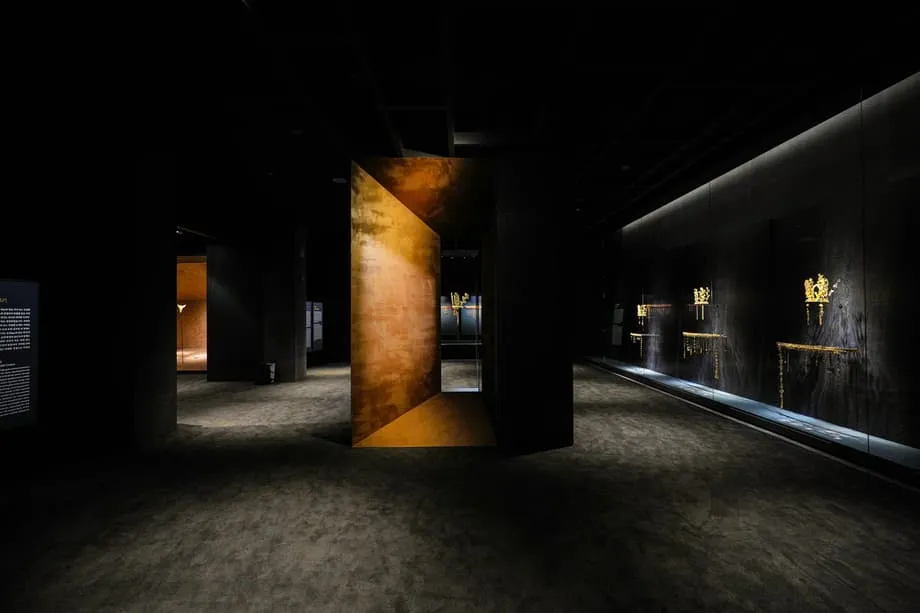
The gallery uses low lighting to protect the metal and jade, which also brings out the shimmer of the crowns. The viewing arrangements serve two connected purposes: protecting fragile objects and giving people enough room to see the fine details that make each crown different.
Six crowns, six distinct designs
The crowns come from Geumgwanchong, Geumnyeongchong, Seobongchong, Cheonmachong, Hwangnamdaechong and Gyo dong. Together, they trace changes across roughly a century of Silla craftsmanship, from relatively simple forms to taller and wider crowns with dense pendants and elaborate surface decoration.
Silla's crown makers followed a recognizable tradition without producing identical objects. Some crowns have restrained outlines and sparse ornaments. Others carry many dangling pieces and jade beads. Seeing them side by side makes those differences easier to follow than viewing each crown separately in a different institution.
The associated belts and other adornments extend that comparison beyond the headpieces. Earrings, bracelets and rings show how gold was used across royal dress, while the six belts help place the crowns within a larger display of rank, wealth and ceremonial authority.
Geumgwanchong and Cheonmachong show a changing royal style
Geumgwanchong yielded the first Silla gold crown discovered in modern times. It came to light in 1921 during construction work in Noseo dong. Made in the fifth century, the crown is often regarded as the most representative example of its kind.
Its headband supports three upright ornaments shaped like tree branches and two shaped like deer antlers. These forms are widely understood as expressions of transcendence and sovereignty, linking the earthly realm with the heavens. Jade gogok, beads shaped like commas, add another recognizable feature of Silla goldwork.
The tomb also provides a striking measure of the wealth committed to royal burial. About 7.5 kilograms of gold were recovered from Geumgwanchong. The crown was therefore part of a much larger investment in objects placed with the dead.
Cheonmachong's crown, excavated in 1973, belongs to the early sixth century. A National Treasure, it is one of the largest and widest crowns in the exhibition. Numerous jade beads and dangling pendants shaped like leaves give it a particularly rich appearance.
Its tall uprights and delicate chains show the movement from earlier, simpler patterns toward a more imposing ceremonial form. Archaeologists also recovered earrings, bracelets, rings and belts from the same tomb, revealing the court's taste for bright metal at the height of royal ceremony.
The Cheonmachong design now has a further connection to the exhibition's diplomatic setting. President Lee's gift to President Trump reproduced this celebrated crown, directing attention back to the original and to the wider Silla tradition represented in the gallery.
Gyo dong and the clues carried by other crowns
The Gyo dong crown reached the museum after it was confiscated from a looter in 1969. Its appearance differed from typical Silla crowns, and the absence of a clear excavation context led to years of debate about its authenticity. Excavation context means knowing where an object lay and what was found around it, information that helps explain its age and use.
Later excavations at Bokcheon dong in Busan uncovered similarly shaped headpieces made from bronze covered with gold. Those discoveries helped scholars recognize the Gyo dong crown as an early, simpler form within the Silla tradition. It has not been designated as cultural property because of its illegal excavation, yet it remains invaluable for understanding the origins of the crown type.
Seobongchong's crown has a different distinguishing feature: an inner cap shaped like a dome and topped with small bird ornaments. None of the other crowns in the exhibition shares that detail.
Geumnyeongchong's crown is smaller and lighter, without the heavy strings of jade seen on more elaborate examples. Those features suggest it may have been made for a younger member of the royal family.
The Hwangnamdaechong crown is often associated with a queen. Part of that interpretation comes from its paired gold belts, including a piece inscribed as a lady's belt. Each of these objects gives researchers a different clue about the people who used royal regalia and the choices made by the artisans who produced it.
How the crowns returned to view
The modern history of the crowns stretches across several decades. Their discoveries and recovery brought buried royal objects into museum collections, eventually making the present reunion possible.
- 1921: The first Silla gold crown came to light at Geumgwanchong during construction work in Noseo dong.
- 1969: The Gyo dong crown entered the museum after being confiscated from a looter.
- 1973: Archaeologists excavated the Cheonmachong crown and other royal adornments.
- 2025: Gyeongju National Museum reunited all six surviving crowns in Silla Gold Crowns: Power and Prestige, alongside the APEC schedule.
- December 15, 2025: The exhibition is scheduled to end.
The circumstances of discovery still shape how the crowns are studied. Geumgwanchong and Cheonmachong supplied objects associated with royal tombs, while Gyo dong's missing excavation record made comparisons with scientifically excavated headpieces in Busan especially valuable.
What gold communicated about Silla's rulers
Silla's royal regalia conveyed authority, prosperity and spiritual sanction. The upright branches can be understood as sacred trees connecting sky and earth, a motif known across ancient Northeast Asia. The antler shapes suggest shamanic power and the ability to move between worlds.
The pale green and blue comma shaped beads, also described as gokok, signaled life force and status. Gold belts completed the royal outfit. Tools and ornaments attached to them suggested the wearer's rank and function at court, giving the objects a meaning beyond their brightness or monetary value.
Early Silla rulers used the title maripgan before adopting kingly titles. Their material splendor provided visible evidence of their standing. A crown's height, its moving pendants and the gold worn elsewhere on the body helped turn political and sacred authority into something people could see.
Historical descriptions also help explain Silla's reputation as the Golden Kingdom. UNESCO has noted that the Persian geographer Ibn Khordadbeh wrote about Silla's abundant gold and trade in the ninth century.
Silla unified the peninsula in 668, and the court at Gyeongju entered a period of vigorous cultural exchange. Buddhism flourished, artisans refined their techniques, and goldwork achieved extraordinary precision. The kingdom lasted nearly a millennium, from 57 BCE to 935 CE, with Gyeongju's tombs and temples still anchoring that history in the landscape.
The demanding craft behind delicate goldwork
Silla's artisans generally made crowns from thin sheets of gold. They cut and incised the metal, and sometimes cut openings through it, to create patterns resembling leaves, branches and antlers. Tiny chains, leaf pendants and jade beads were then added to catch the light as they moved gently.
The apparent lightness of the finished objects depended on careful work. Fine parts had to form a coherent pattern while supporting their attached ornaments. Geometry, symmetry and repeated shapes gave the crowns a visual rhythm across both restrained and richly decorated designs.
Specialists also used granulation, sometimes called filigree granulation. This involves attaching tiny gold granules and fine wires to create intricate surface patterns. The heating must be precise enough to bond the small pieces without collapsing the thin sheet beneath them.
Pure gold bends easily, so crown makers mixed it with silver to strengthen bands and uprights. The balance between the metals varied by object and over time as crowns became taller and more ornate. Their changing forms therefore involved decisions about strength as well as appearance.
Headpieces made from bronze covered with gold, found in Busan and elsewhere, show that artisans also worked with other materials. Those objects may represent earlier forms or different ranks. Across the range, the craftsmanship combined technically demanding construction with a delicate visual result.
A royal reunion becomes a diplomatic showcase
Gyeongju's role in APEC 2025 gives the exhibition an audience beyond the usual museum visitors. The museum has framed the gathering as a platform for cultural exchange, connecting the ancient capital with the wider world during a major diplomatic week.
President Lee Jae Myung's presentation of the Cheonmachong replica to President Donald Trump reinforced that message. The gift drew fresh global attention to Silla's gold tradition while the original crown remained available to view in Gyeongju.
For visitors from abroad, the collection offers a direct introduction to a long history. Six crowns and their associated adornments bring together evidence of art, religion and court life in one room, while the surrounding city retains the tombs and temples connected with that past.
The reunion also gives scholars an unusual chance to refine the sequence of design changes and examine ideas about rank and ritual. They can compare the number and height of uprights, the shapes of leaf pendants, the density of jade beads and the presence of inner caps. The acceptance of Gyo dong as an early type, supported by the Busan discoveries, is one connection that visitors can now consider alongside the other crowns.
Buddhism's growing influence in the middle of the sixth century helps explain why these crowns eventually disappeared from use. Royal patronage shifted toward temples and religious images, and gold increasingly went into reliquaries, ornaments and statuary. Reliquaries are containers for sacred remains or objects. The crowns preserve an earlier moment when sacred and political power was expressed through gold worn on the body, before a new religious visual language took hold and the regalia remained buried until modern discovery.
What visitors need to plan
Admission is free, with numbered tickets available only on site from 9:20 a.m. The museum opens at 10 a.m., and each session admits 150 visitors at intervals of 30 minutes. The weekday ceiling is 2,550 people; more sessions are scheduled on weekends, although a weekend attendance limit was not specified.
Visitors seeking a preferred slot have the best chance by arriving before ticket distribution begins, particularly given the early queues. Allowing extra time between sessions is also sensible in case another room requires a wait.
Separate routes for the permanent galleries and the special exhibition help reduce bottlenecks once visitors are inside. Photography rules, bag policies and controls on movement can change with crowd conditions, so those arrangements need attention on arrival.
The quieter pace encouraged by timed entry also suits the objects. Details such as tiny chains, cut patterns, jade beads and surface decoration are easiest to appreciate at close range. With the exhibition scheduled to finish on December 15, the admission system is central to managing access to a gathering that has never happened before.
Key Points
- All six surviving Silla gold crowns are together for the first time at Gyeongju National Museum.
- Silla Gold Crowns: Power and Prestige runs through December 15, 2025.
- The exhibition contains 20 artifacts, including six gold belts; 14 objects are designated Treasures or National Treasures.
- Free numbered tickets are distributed on site from 9:20 a.m., ahead of the museum's 10 a.m. opening.
- Entry is limited to 150 visitors per session at intervals of 30 minutes, with a weekday cap of 2,550 and additional weekend sessions.
- The crowns come from Geumgwanchong, Geumnyeongchong, Seobongchong, Cheonmachong, Hwangnamdaechong and Gyo dong.
- President Lee Jae Myung gave President Donald Trump a replica of the Cheonmachong crown during APEC week; the original remains in the exhibition.
- The reunion supports direct comparisons of royal design, craftsmanship, rank and ritual while visitor controls protect safety and viewing conditions.