Chinese capital moves deeper into Brazil's economy
Chinese investment in Brazil reached about $4.18 billion across 39 confirmed projects in 2024, rising 113 percent from 2023, according to data compiled by the Brazil China Business Council. Electric power, oil, manufacturing and mining are drawing capital as an economic relationship built around soybeans and iron ore spreads into factories, transmission lines, electric vehicles, batteries and digital services.
Contents
- Chinese capital moves deeper into Brazil's economy
- Trade growth has political support
- Farm exports anchor a widening trade basket
- Electricity and oil attract the largest shares
- Vehicle tariffs strengthen the case for factories
- Batteries, solar equipment and new fuels extend the shift
- Transport determines how much exporters can gain
- Brazilian brands seek customers and technology gains
- Currency and tax arrangements support transactions
- Tariff uncertainty adds urgency and domestic pressure
- The next phase depends on delivery
- The Bottom Line
Brazil ranked as the third largest destination worldwide for Chinese productive investment in 2024 under one benchmark, behind the United Kingdom and Hungary. Productive investment means capital directed into business operations and assets, such as factories or electricity infrastructure. The projects are smaller on average than those of a decade ago, but their growing number points to a wider range of activities, including renewable energy and critical minerals.
Brazilian businesses are seeking a corresponding expansion in China. They want to sell more products with greater value added, meaning goods whose processing, technology or branding earns more than the raw materials alone. Their ability to do so depends partly on removing obstacles in transport, distribution and market access.
Christian Gogola, director of Brazilian drink maker Legendaria, described China as a major growth opportunity at the China International Import Expo in Shanghai. He argued that Brazilian brands could expand faster by entering the Chinese consumer market directly.
China can and should be Brazil's largest export market for every product category. 'Go to China' will be the natural strategy for many Brazilian businesses.
As of November 5, 2025, the relationship combines that commercial ambition with a practical challenge: turning larger trade and investment flows into reliable transport, stronger domestic production and broader access to customers.
Trade growth has political support
China is Brazil's largest trading partner, while Brazil ranks among China's top ten partners. Figures citing China Customs put trade between the countries at $181.53 billion in 2023, an increase of 6.1 percent from the previous year, and about $188.17 billion in 2024. The latter represents a further rise of $6.64 billion, or roughly 3.7 percent.
President Luiz Inacio Lula da Silva's return to office in 2023 brought warmer diplomatic relations and dozens of agreements covering different sectors. An April 2023 package covered trade, logistics, services, e commerce, energy and agribusiness. Both countries also belong to BRICS, providing wider political channels and regular dialogue between senior leaders.
Lula presented the relationship as central to Brazil's growth ambitions during a meeting with Chinese President Xi Jinping in Beijing in May. He expressed a desire for a partnership able to withstand political shocks.
We want our relationship with China to be indestructible.
Several steps have supported the expansion:
- 1991: Brazil and China signed a double taxation agreement.
- 1994: The countries signed an investment protection agreement that has not been ratified in Brazil.
- 2022: The double taxation agreement was amended.
- 2023: Lula returned to office, the countries agreed to settle trade in their own currencies, and an April package widened cooperation across several sectors.
- 2024: Bilateral trade reached about $188.17 billion, while Chinese investment in Brazil rose to about $4.18 billion.
- 2025: United States tariff changes added uncertainty for exporters and investors, increasing interest in diversifying markets.
Farm exports anchor a widening trade basket
Brazil shipped $58.6 billion in agricultural goods to China in 2023, including soybeans, corn, beef, sugar and coffee. Brazil is China's largest supplier of soybeans, chicken and sugar, giving agriculture a central place in the relationship even as other businesses grow.
Brazilian coffee has expanded quickly in China as new retail chains and e commerce platforms build demand. Coffee producers are exploring that market after facing a 50 percent tariff in the United States. A recent snapshot cited 183 Brazilian companies selling into China, with soy, iron ore, meat, cars and coffee among the leading items.
Brazil's purchases from China include machinery, electronics, vehicles, chemicals, plastics, steel and fertilizers. Those imports supply consumer markets and businesses, while also creating competitive pressure for some Brazilian manufacturers.
Food and beverage businesses are building further connections. Mixue and other chains are sourcing Brazilian fruit for ice cream and tea drinks. Chinese delivery company Meituan plans investment over several years to expand operations under its Keeta brand, extending the relationship into services as well as physical goods.
Industrial firms such as WEG, which operates in electrical equipment, illustrate another route into the Chinese market: competing in specialized technology segments. For Brazilian exporters, the opportunity spans both familiar agricultural products and businesses that depend more heavily on engineering, processing and brand recognition.
Electricity and oil attract the largest shares
Electric power assets and grids accounted for about 34 percent of Chinese investment in Brazil in 2024, while roughly 25 percent focused on oil. Together, those shares amount to about 59 percent, showing how strongly energy continues to shape the flow of capital.
State Grid Brazil Holding has become a major operator, supplying about 10 percent of Brazil's electricity through transmission lines with high capacity. The company has said it plans to invest another $3.5 billion over the next four years.
Many projects use transmission at ultra high voltage. This allows large amounts of electricity to travel long distances with lower losses, helping connect hydroelectric, wind and solar resources far from the cities and businesses that need the power.
Ramon Haddad, vice president of State Grid Brazil Holding, described continued investment in transmission as part of the company's commitment to Brazil.
Brazil is part of our long term strategy, and we will keep investing in transmission to support reliable supply.
CGN has committed funds to wind and solar projects in northeastern Brazil. Chinese offshore oil producers have also taken positions in Brazil's pre salt fields, oil deposits beneath layers of salt below the seabed. One major oil company invested nearly $1 billion in 2024, reflecting continued interest in the basin.
Grid upgrades, renewable generation and oil investment are linking the countries' energy businesses more closely. In Brazil, these activities support more reliable supply and can reduce exposure to price volatility by strengthening generation and the infrastructure that carries energy to consumers.
Vehicle tariffs strengthen the case for factories
Chinese electric vehicle shipments to Brazil surged in early 2024 as new brands gained customers. An 18 percent tariff on imported electric cars later slowed arrivals, encouraging manufacturers to consider local assembly and a larger production presence. BYD, Chery and Great Wall are among the brands active in Brazil.
During the 12 months to August 2024, Brazil received about 73 percent of the Chinese battery electric and plug in hybrid vehicles exported to continental Latin America. A battery electric vehicle runs on electricity stored in its battery. A plug in hybrid combines a battery that can be charged externally with an engine.
Brazil's large share of those shipments makes its tariff policy particularly relevant to Chinese manufacturers. Producing locally offers a way to serve Brazilian demand while building a base for sales elsewhere in the region.
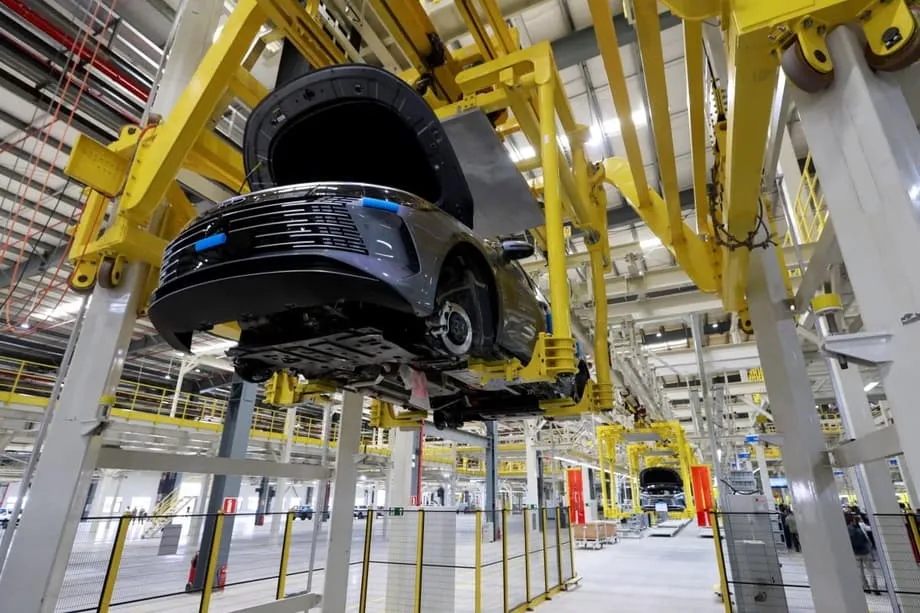
Chinese investment in Brazilian factories reached hundreds of millions of dollars across a record number of projects in 2024. Activities included electrified vehicles, automotive parts, household appliances, and equipment for electricity generation and transmission. Great Wall Motors committed about 6 billion reais, while other automakers were exploring local assembly.
The increase in manufacturing projects, alongside a fall in average deal size, suggests investors are adapting to Brazil's policy mix through a larger number of smaller investments. Brazil wants foreign capital while also protecting jobs and helping domestic industry undertake more valuable stages of production.
Batteries, solar equipment and new fuels extend the shift
Latin America's imports of Chinese solar panels and lithium ion batteries rose sharply between 2019 and 2023. Brazil accounted for the majority by value and remains the region's largest destination for those imports by that measure.
Solar photovoltaic equipment converts sunlight into electricity, while batteries store energy for vehicles and other uses. The growth in both products connects Brazil's energy transition with Chinese manufacturing, distribution and investment.
A battery supply chain is beginning to form around vehicle production in Brazil. Solar photovoltaic producers are also expanding distribution and service networks. These activities extend the commercial relationship beyond the arrival of finished equipment to the businesses that supply components, sell products and maintain them.
Envision Group has announced up to 5 billion reais for a complex intended to produce sustainable aviation fuel and green hydrogen. Sustainable aviation fuel is an alternative fuel for aircraft, while green hydrogen is hydrogen made using renewable electricity. The planned complex could anchor new industrial clusters, bringing related production activities together.
Vehicle assembly, batteries, solar equipment and the proposed fuel complex show the range of industrial ambitions now attached to Chinese investment. Their development also connects with Brazil's effort to become a producer of technology rather than depending mainly on exports of raw materials and imports of finished goods.
Transport determines how much exporters can gain
Brazil's agricultural regions and mines are often far from the coast. Congested highways, limited rail coverage and uneven port performance make the journey to export terminals a central concern for companies seeking more business in China.
Meat and fruit require a cold chain, a continuous system of refrigerated storage and transport that keeps products in suitable condition. Exporters also need efficient container back hauls, meaning return journeys that make better use of containers, and modern customs clearance to reduce delays at borders.
These practical requirements affect how quickly Brazilian goods reach Chinese buyers and how much delivery costs. A wider export basket increases the importance of reliable handling because different products have different storage, transport and delivery needs.
Officials and investors are revisiting rail corridors linking agricultural and mining regions with export terminals. Brazil's transportation ministry has described stronger interest from Chinese partners in rail projects as the governments align their development plans.
Rail development depends on project financing, environmental licensing and coordination between federal and state agencies. Currency movements also influence the timing of deals. A weaker real can make Brazilian assets cheaper when measured in dollars, while making imported equipment more expensive for buyers paying in Brazil's currency.
Brazilian brands seek customers and technology gains
The China International Import Expo has become a platform for Brazilian companies to test products, establish distribution relationships and learn about consumer preferences. As Chinese multinationals expand across Brazil, Brazilian businesses are seeking more opportunities in the opposite direction.
Gogola's argument for entering China directly reflects that ambition. Selling into the consumer market requires more than supplying a commodity: companies must develop routes to customers and find products that buyers want. Better logistics and market access remain central to scaling those sales.
Uallace Moreira, secretary of industrial development at Brazil's Ministry of Development, Industry and Foreign Trade, said the government wants new capital to help upgrade domestic industry and move businesses into activities with greater value.
We aim to channel capital so Brazil becomes a producer of technology and an investor in partner economies. Companies on both sides need to move into more branches of the production chain.
Ricardo Martins, chief economist at Planner Investimentos, identified several sectors that could gain from investment moving in both directions. His assessment connected China's position as Brazil's main trading partner with opportunities for broader commerce.
With China as Brazil's main trading partner, two way investment opens doors for greater trade flows. Agriculture, renewable energy, infrastructure, and aerospace all stand to benefit.
Moreira's industrial goal and Martins' assessment share a focus on expanding the relationship beyond the exchange of bulk commodities for manufactured imports. The businesses already active in food, electrical equipment, energy and services provide different routes toward that goal.
Currency and tax arrangements support transactions
Brazil and China agreed in 2023 to settle trade in their own currencies. Local currency settlement allows firms to pay through arrangements using the real and the yuan, offering a way to reduce transaction costs and exposure to changes in the dollar.
The arrangement can make contracts easier to price, payments faster and costs more manageable, especially for small and medium sized exporters. As banks and payment platforms expand these services, smaller businesses may find it easier to enter the Chinese market.
The double taxation agreement, signed in 1991 and amended in 2022, provides tax certainty for business across borders. Such agreements address situations in which income could otherwise face taxation in both countries.
The investment protection agreement signed in 1994 has not been ratified in Brazil. The governments have nevertheless signed a variety of sector agreements intended to reduce obstacles in services and trade facilitation, the procedures that help goods and transactions move more efficiently.
Brazil's wider policy framework combines those measures with electric vehicle tariffs, trade remedies in sectors such as steel, and requirements for local content in energy projects. Local content rules require some goods or work to come from domestic suppliers. Together, these policies reflect the government's effort to attract investment while supporting Brazilian employment and industrial production.
Tariff uncertainty adds urgency and domestic pressure
United States tariff changes in 2025 generated uncertainty for exporters and investors. That volatility encouraged some companies to diversify markets and sourcing, strengthening the appeal of stable Chinese demand.
During periods of tariff friction, some beef and soy orders shifted from the United States to Brazil, while Chinese companies adjusted their investments in Latin America. Brazilian coffee producers' search for demand in China after facing a 50 percent United States tariff forms part of the same pressure to find alternative customers.
Inside Brazil, the debate concerns how to benefit from Chinese capital without becoming excessively dependent on it. Some steel and vehicle manufacturers face pressure from imports, making the balance between cheaper imported products and domestic production politically and economically important.
Regulators are weighing digital security concerns involving vehicles connected to the internet and critical infrastructure. Environmental and social safeguards also affect the pace of projects, particularly in sensitive biomes and indigenous territories.
These issues call for careful oversight and consistent enforcement as engagement expands. Brazil's task is to connect investment with reliable infrastructure and stronger local businesses while applying the rules that protect communities, the environment and essential services.
The next phase depends on delivery
Rail concession decisions will help determine whether agricultural regions and mines gain better connections to ports. Progress on large transmission projects will show how much additional renewable generation can reach consumers.
In oil, pre salt tenders and investment plans by Chinese companies will shape production and export flows. In manufacturing, announcements concerning electric vehicle assembly, battery plants and solar equipment factories will indicate how far local production develops. No dates were given for those next decisions or announcements.
Companies planning expansion need to account for logistics, taxation and local content requirements, while beginning environmental licensing work early. The interaction of those practical steps will determine how quickly proposed investments become operating businesses.
Brazil and China already have larger trade flows, a broader set of investment projects and payment arrangements intended to lower costs. If infrastructure and policy align, the next phase could contain more finished goods, cleaner energy and a denser network of industrial partnerships. The central issue is how much of that ambition becomes production, reliable delivery and sustained access to customers.
The Bottom Line
- Chinese investment in Brazil reached about $4.18 billion across 39 confirmed projects in 2024, up 113 percent from 2023.
- Bilateral trade rose from $181.53 billion in 2023 to about $188.17 billion in 2024.
- Electric power accounted for about 34 percent of investment, with oil taking roughly 25 percent.
- Brazil received about 73 percent of Chinese electric and plug in hybrid vehicle exports to continental Latin America during the 12 months to August 2024.
- An 18 percent tariff on imported electric cars slowed arrivals and encouraged interest in local manufacturing.
- State Grid, CGN, Great Wall, Meituan, Mixue and Envision are among the businesses expanding investment or commercial links.
- A recent snapshot cited 183 Brazilian companies selling into China, with coffee growing alongside established commodity exports.
- Rail links, ports, refrigerated transport and customs procedures remain central to export growth.
- Local currency settlement and tax arrangements support transactions, while industrial, security and environmental policies shape new projects.