A strange face became the Expo's familiar welcome
By October 27, 2025, two weeks after Expo 2025 Osaka, Kansai closed, Myakumyaku had achieved a transformation almost as unusual as its appearance. The mascot introduced in 2022 to complaints that it looked creepy and scary had become a character visitors queued to hug, photograph and take home as a plush toy. Official merchandise sales were extended through March 2026, giving its popularity a life beyond the exhibition.
Contents
- A strange face became the Expo's familiar welcome
- The apology that captured a change of heart
- Cells, water and a name that means continuity
- Why the odd appearance began to work
- A mascot encountered before the gates opened
- Myakumyaku House became a fan gathering place
- Limited goods gave collectors reasons to return
- The financial stakes behind the crowds
- Another mascot won a late popularity vote
- Japan's taste for friendly and unusual characters
- A character with a life beyond October
- At a Glance
The event ran from April 13 to October 13 on Yumeshima in Osaka. Organizers aimed for 28.2 million visitors over those six months. Attendance had reached 18.54 million by the middle of September, and the tally was reported to have exceeded 22 million by closing day. Against that vast gathering, an improbable creature became one of the Expo's most recognizable attractions.
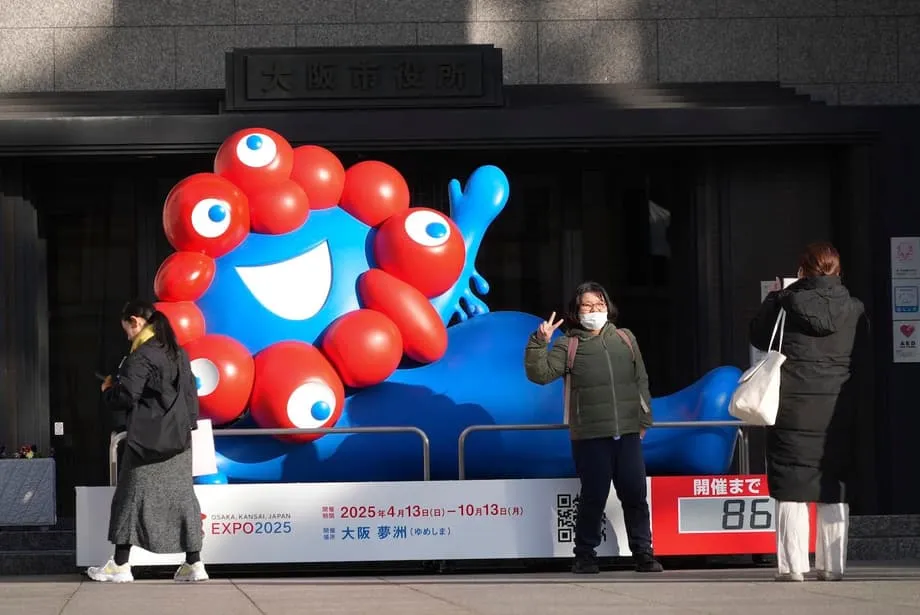
Myakumyaku has a red ring of eyes around a smiling hollow center, a bright blue body, flipper arms and a tiny red tail. Its stubby, soft appearance initially prompted gasps and jokes on social media. By spring 2025, families were lining up to meet it, and children sometimes tugged at adults' sleeves because they did not want to leave.
The character greeted visitors at Myakumyaku House, filled shop shelves and appeared on manhole covers. Its journey from unsettling drawing to cheerful host involved more than a clever design: moving performances, repeated encounters, a growing merchandise business and Japan's established affection for unusual mascots all played a part.
The apology that captured a change of heart
A visitor's handwritten message inside Myakumyaku House put the reversal into plain language. Addressing the mascot on a message board, the visitor wrote:
I'm sorry I said you looked terrifying when I first saw you. I like you a lot now.
Visitors who had disliked the original image often reacted differently when they saw the character move. Its waving arms, moving eyes, energetic gestures and steady smile gave the unusual shape a personality. What had seemed alien in a still picture became funny and approachable during an encounter.
A woman from Osaka, aged 25, recalled her first response when the design was revealed:
Why did this get picked?
Seeing Myakumyaku in motion changed her impression. Similar reactions accompanied the mascot's dancing, waving and swiveling ring of eyes. People who had once questioned the choice joined the photo queues with smiles.
The progression was often simple: shock became curiosity, and curiosity became affection. Visitors began to recognize a delighted host rather than concentrating on the number of eyes or the unfamiliar outline. Myakumyaku's willingness to pose again and again made that change possible through ordinary encounters.
Cells, water and a name that means continuity
The Japan Association for the 2025 World Exposition presents Myakumyaku as a mysterious creature born from the fusion of cells and water. Its red parts represent cells that divide and multiply. Its blue body represents pure water, able to flow, adapt and change shape.
The creative group mountain mountain, led by picture book author and designer Kohei Yamashita, designed the mascot. The ring of eyes draws on the Expo 2025 logo, while the water element connects with Osaka's longstanding association with water. Together, those features link the character to the event's theme of a future society designed for life.
Myakumyaku's name comes from myaku, meaning pulse. The reference brings together the heartbeat of life and the continuous passage of knowledge, culture and technology from one generation to the next. Its story gives a playful form to the Expo's themes of saving lives, empowering lives and connecting lives.
The organizer's official character profile places Myakumyaku's birthplace at a small spring in Kansai. It gains energy from sunlight and enjoys rainy days because it can absorb the rain. The creature can change form and sometimes forgets what it looked like a moment earlier, making change part of its personality as well as its appearance.
The Expo organizer describes that personality in the profile:
Personality: Friendly but goofy, often making silly mistakes.
Why the odd appearance began to work
Myakumyaku reverses familiar cartoon rules. Instead of a rounded head with a small, neatly arranged face, it has a hollow center surrounded by eyes. Its deliberately clumsy, soft body makes the design strange and comic at the same time.
People often prefer symmetry in faces and objects because it matches familiar ideas of beauty. Too much symmetry, however, can also seem bland. A slight tilt or a detail away from the center can hold attention, something designers and models use to make an appearance more distinctive. Myakumyaku goes much further from conventional symmetry than most characters.
Tamami Nakano, a researcher in cognitive neuroinformatics, described the novelty that made the mascot so striking:
We had never seen anything quite like Myakumyaku.
Novelty creates a strong first impression; affection develops through what follows. Myakumyaku's warmth, availability and silly behavior gave visitors new memories to attach to the image. The costumed character's little stumbles, oversized waves, repeated photo poses and blinking eyes directed at toddlers brought the official personality into view.
The Expo's early months also included complaints about heat, queues and problems with online reservations. Amid those frustrations, Myakumyaku offered a friendly point of contact. A familiar smile could become part of a visitor's enjoyable memories even when other parts of the day were difficult.
The transformation depended on the difference between looking at concept art and meeting a performing character. Once people associated the red and blue figure with a happy encounter, the same odd features could seem goofy and cute.
A mascot encountered before the gates opened
Myakumyaku's familiarity grew well before April 2025. By the end of March 2024, 107 companies had signed licensing agreements, and roughly 800 official products were on sale. The range included plush toys, stickers and household goods, placing the mascot in everyday settings as well as promotional displays.
Dedicated shops opened in Tokyo, Osaka and Kyoto, followed by outlets in other regions. Exclusive goods and lotteries gave shoppers reasons to return. Appearances in Melbourne and Ho Chi Minh City also introduced the character to audiences outside Japan, making it an Expo ambassador before opening day.
Transport brought Myakumyaku into daily view. Trains carrying its designs began running on the Osaka Loop Line and JR Yumesaki Line in November 2023. High speed services in western Japan joined the campaign in April 2024, with a Shinkansen design continuing through the end of the Expo.
A special JAL Myakumyaku Jet debuted in late 2023 and flew through spring 2025. For commuters, students and travelers, repeated sightings on trains and aircraft made the character more familiar. Temporary shops and appearances at events inside and outside Japan added further opportunities to see it.
The main stages of its public journey stretched across several years:
- 2022: Myakumyaku debuted, drawing jokes and complaints about its unsettling appearance.
- November 2023: Trains with Myakumyaku designs began operating on the Osaka Loop Line and JR Yumesaki Line.
- Late 2023: The special JAL Myakumyaku Jet debuted.
- End of March 2024: Licensing agreements covered 107 companies and roughly 800 official products.
- April 2024: High speed train services in western Japan joined the transport campaign.
- April 13 to October 13, 2025: Expo 2025 Osaka, Kansai welcomed visitors on Yumeshima.
- After closing: Official merchandise sales were extended through March 2026.
Myakumyaku House became a fan gathering place
On the Expo's opening weekend, visitors queued to enter Myakumyaku House for photo sessions and to browse plush toys and accessories. Red and blue decorations echoed the mascot's colors, while attendants managed the steady stream of families wanting a picture.
Myakumyaku House gave fans a dependable destination. Scheduled appearances elsewhere on the grounds created additional crowds, with visitors gathering for selfies as the character moved through the site. The combination of a dedicated meeting place and encounters around the Expo kept it visible throughout a visit.
A small pavilion's missing display plush showed how attached some visitors had become. After the pavilion reported that its Myakumyaku toy had been stolen, people brought replacement plush toys and other gifts within days. The donations filled the counter with mascot items for the next guests to see.
Pavilion staff thanked the public and displayed the gifts. The response turned the loss of one toy into a larger collection, reflecting visitors' desire to keep the mascot present as a welcoming face.
Limited goods gave collectors reasons to return
Myakumyaku's merchandise range continued expanding during the Expo. By the middle of 2025, official products numbered in the thousands, compared with roughly 800 at the end of March 2024. Fashion collaborations, new T shirts and limited releases kept the retail selection changing.
Late in the run, a collaboration with Labubu, a figure known globally for its creepy cute styling, went on sale through a lottery at an official store inside the venue. The pairing brought together two characters whose appeal includes an appearance that is unusual rather than conventionally pretty.
A plush lottery also attracted queues. Every participant received a Myakumyaku toy, with several possible sizes available. Exclusive shop goods and other lotteries made shopping another way to participate in the mascot's popularity.
Some limited products were quickly resold online, reflecting demand among committed collectors. Train and aircraft designs, fashion partnerships and special releases created fresh moments of interest rather than relying on a single launch.
After October 13, the organizer extended official Myakumyaku merchandise sales through March 2026 to meet continuing demand. For fans, the character could remain present in household goods, travel cards and collectibles after the gates had closed. For organizers, that interest prolonged the commercial life of the Expo's most recognizable figure.
The financial stakes behind the crowds
The Expo's operating budget was about 116 billion yen. Most revenue was expected to come from tickets, with merchandise, food and beverages contributing a meaningful share. Licensing income from character goods flowed to the Japan Association for the 2025 World Exposition to help cover costs.
Organizers calculated that around 18.4 million tickets would be needed to break even. Ticket sales were reported at about 15.54 million by early July. By closing day, the reported attendance tally had passed 22 million entries. Ticket sales describe purchases, while entries count visits, so the two figures describe different parts of the event's business.
The broader attendance ambition was 28.2 million visitors over six months. The planning account put the required daily average at roughly 150,000, creating pressure on queue management and programming at night as organizers sought to attract and accommodate large crowds.
Myakumyaku helped bring people into retail areas and supplied memorable meetings that visitors shared online. Those photos and stories encouraged word of mouth while giving the event a cheerful, easily recognized face.
The reported total of more than 22 million entries was still below the 28.2 million attendance target. By October 27, a precise final attendance figure and a final operating result were not given in the account. The mascot's popularity was visible in queues and demand for goods, while the Expo's finances depended on the wider mix of ticket and commercial revenue.
Another mascot won a late popularity vote
Myakumyaku did not win every contest for visitors' affection. Late in the Expo schedule, the Osaka Healthcare Pavilion hosted a festival featuring dozens of mascots from across Osaka Prefecture and from overseas pavilions.
A popularity poll at the festival put Circular, the German Pavilion's bubblelike cherub, in first place. Circular represented a circular economy, an approach centered on keeping resources in use rather than simply discarding them. Its victory surprised visitors who had expected the Expo's official mascot to win comfortably.
Some insiders suggested that Myakumyaku's constant presence had left room for a fresher face to succeed in the vote held that day. The festival still offered fans music, parades and selfies with Myakumyaku and the other characters.
The result added variety to a mascot culture that extended beyond the Expo's official representative. Visitors could enjoy the familiar red and blue character while also choosing a favorite from a particular pavilion.
Japan's taste for friendly and unusual characters
Japan's municipalities, police departments, companies and prefectures have long used mascots to promote public services, tourism and local foods. The colloquial term yuru chara suggests characters with relaxed, easygoing personalities. Kumamon from Kumamoto Prefecture and Rilakkuma, the relaxed bear, reflect the appeal of friendly figures that give institutions and brands an approachable face.
Myakumyaku also fits the taste for kimo kawaii, or ugly cute. This style moves away from conventional prettiness toward something odd or mildly grotesque, then invites affection through humor and warmth. Its many eyes, soft wobbling body and small tail supply the strangeness; its gestures and behavior supply the friendliness.
A visitor might first laugh, then look more closely, then take a photo and eventually buy a plush toy. Repeated appearances on transport, at shops and in promotional events helped turn that sequence into familiarity across Kansai. A plane in the mascot's colors or a lottery for a special figure extended the relationship beyond the Expo grounds.
The character's ability to change shape also suited an event asking visitors to imagine how they wanted to live. Its flowing water and multiplying cells connected that playful story to life and change. Even its habit of forgetting its original form made those ideas accessible without a technical explanation.
Osaka's waterfront reinvention provided the setting: an island venue on Yumeshima and the Grand Ring plaza, where visitors gathered beneath a sweeping structure. Myakumyaku gave that large physical setting a small, portable symbol that could leave with visitors in a photograph or a shopping bag.
A character with a life beyond October
Myakumyaku's rise brought together design, performance and business. An image that first unsettled people became a familiar presence through train journeys, shop visits, overseas appearances and encounters at the Expo. Its oddness remained part of its attraction, while its behavior gave people reasons to feel warmly toward it.
The visitor's apology inside Myakumyaku House captured that change more directly than any sales figure. The character had become someone people wanted to greet, defend and keep nearby, whether by donating a replacement toy to a pavilion or buying a collectible after the event.
The extended merchandise period through March 2026 was the next dated stage of that story as of October 27, 2025. Visitors could also explore archives of designs and programs through the international body governing Expos, the Bureau International des Expositions, whose Expo 2025 overview preserves the event's wider context.
The exhibition had ended, but its mascot remained in everyday objects and memories. For a creature built around cells, flowing water and the continuity suggested by a pulse, that was a fitting continuation of the role it had played in Osaka.
At a Glance
- Myakumyaku debuted in 2022 to uneasy reactions and became a popular attraction during Expo 2025 Osaka, Kansai.
- The Expo ran from April 13 to October 13, 2025, on Yumeshima, with a target of 28.2 million visitors.
- Attendance reached 18.54 million by the middle of September and was reported to exceed 22 million by closing day.
- Kohei Yamashita's creative group mountain mountain designed the mascot around cells, water and the Expo logo.
- Myakumyaku's name draws on myaku, meaning pulse, and the passing of knowledge, culture and technology between generations.
- By the end of March 2024, 107 companies held licensing agreements and roughly 800 official products were available; the range reached thousands by the middle of 2025.
- Train designs, a Shinkansen campaign and a JAL jet helped make the character familiar before and during the Expo.
- Myakumyaku House, merchandise lotteries, fashion collaborations and a limited Labubu release attracted fans.
- Circular from the German Pavilion won a popularity poll at a late mascot festival.
- Official Myakumyaku merchandise sales were extended through March 2026.