A guarded bridge with a lasting reach
Between 1641 and 1847, 606 Dutch ships called at Nagasaki to trade through Dejima, an artificial island covering roughly 15,000 square meters at its Edo period peak. Behind fences, checkpoints and a single guarded bridge, merchants exchanged silk, sugar and scientific books for Japanese copper, porcelain and other goods. The small trading post became a major channel through which Western knowledge reached Japan.
Contents
- A guarded bridge with a lasting reach
- Why Japan built an island for foreigners
- Who controlled the trading post?
- Daily life behind the gates
- What the ships carried
- How Dutch learning spread
- The people behind the exchange
- Foreign pressure ended Dejima's special role
- Rebuilding a vanished island
- What visitors can see today
- Japan's other channels to the world
- The Essentials
Dejima was built for control. The Tokugawa shogunate, the military government that had united Japan after civil war, wanted the benefits of foreign commerce while keeping Christianity and foreign political influence at a distance. Portuguese residents were its first occupants. Dutch merchants later accepted the restrictions that allowed them to remain.
For more than two centuries, the island linked Japan with the West under close supervision. Japanese officials inspected cargo, interpreters managed conversations, and foreign residents needed permission to leave. Books, plants, instruments and medical techniques nevertheless moved through this tightly regulated space in both directions.
Dejima helped prepare Japan for the changes of the nineteenth century. Its influence reached beyond trade accounts to anatomy, astronomy, botany and the ways Japanese scholars understood the wider world. European visitors also carried home observations that shaped knowledge of Japan.
Today, reconstructed residences, warehouses, clerks' quarters, gates and stone walls recover parts of that history in central Nagasaki. Japanese joinery and tatami rooms appear alongside glazed windows, Western furniture and brick storage buildings. The modest scale makes the island's importance especially striking: business, diplomacy and scientific exchange once shared a very confined address.
Why Japan built an island for foreigners
Portuguese ships reached Japan in the middle of the sixteenth century, bringing firearms, international trading connections and Jesuit missionaries. Christianity spread quickly in parts of Kyushu with the support of influential warlords. After unification, the Tokugawa government took a harder position toward missionary activity.
The shogunate placed Nagasaki under direct control and issued a series of seclusion edicts restricting foreign contact and the movement of Japanese people. Dejima gave those policies a physical form. Construction began in 1634, and the island was completed in 1636 to confine Portuguese residents and supervise their dealings.
The Shimabara-Amakusa Uprising of 1637 to 1638, which involved many Christian participants, strengthened official fears of Catholic influence. The Portuguese were expelled in 1639. In 1641, the Dutch East India Company transferred its trading post from Hirado to Dejima.
Dutch merchants were acceptable because they did not proselytize, meaning they did not seek to convert Japanese people to their religion. They accepted strict trading conditions, while Chinese commerce continued separately under close controls. Direct Western contact narrowed to the island, its guarded bridge and a small number of ships each year.
The main dates trace Dejima's changing purpose:
- 1634: Construction began on the artificial island in Nagasaki Bay.
- 1636: Dejima was completed to house and control Portuguese residents.
- 1637 to 1638: The Shimabara-Amakusa Uprising reinforced government fears about Christianity.
- 1639: The shogunate expelled the Portuguese.
- 1641: The Dutch East India Company moved its trading post from Hirado to Dejima.
- 1859: The trading post was abolished and converted into a consulate.
Who controlled the trading post?
The Dutch trading chief, known as the Opperhoofd, answered for transactions, discipline and compliance with Japanese rules. Violations could bring fines, expulsion or the loss of permission to trade. The shogunate limited the number of Dutch vessels allowed to enter Nagasaki.
The chief also led formal tribute journeys to the shogun in Edo. These elaborate visits expressed loyalty and provided a diplomatic channel. After 1790, the requirement was reduced to once every four years.
Scientific instruments and sometimes animals accompanied the processions as gifts. Their appearance entertained people in the capital and gave Japanese officials and scholars opportunities to inspect unfamiliar objects firsthand. Ceremony became another route for knowledge to travel.
Even symbols were subject to scrutiny. At Hirado, Dutch warehouses carried a stone inscription displaying a year from the Christian calendar. The shogunate ordered the buildings torn down. Japanese authorities intended to retain control over both commercial activity and the public signs of foreign influence.
Despite these constraints, Dejima produced steady profits for the Dutch. For the shogunate, the arrangement supplied imported goods and news from abroad while restricting missionary activity.
Daily life behind the gates
Fences and walls enclosed Dejima, and checkpoints guarded the narrow bridge to Nagasaki. Sea gates regulated boat traffic. Japanese officials lived on the island to monitor and record activity, while interpreters stood between the Dutch residents and the people with whom they did business.
Incoming letters, books and packages were inspected. Searches of luggage and living quarters could take place at any time. Leaving required written permission and an escort. Contact was limited to approved Japanese officials, merchants, interpreters and licensed entertainers, and the ban on Christianity was strictly enforced.
Most foreign residents were men, with little opportunity for family life. Between sailing seasons, their work included planning shipments, repairing warehouses and keeping accounts. Paperwork and maintenance filled the intervals between the arrival and departure of ships.
Residents also cultivated gardens containing clover, cabbage and other plants new to Japan. They shared beer and coffee and introduced billiards and badminton to their hosts. Such exchanges gave daily life a cultural reach beyond the formal trade in cargo.
Banquets brought customs together in visible ways. Western chairs and tables stood on tatami mats, with Japanese dishes served alongside imported treats. The mixture reflected an island where close supervision coexisted with repeated encounters between different habits and tastes.
What the ships carried
The 606 Dutch ships recorded between 1641 and 1847 connected Japan with markets in China, Southeast Asia and Europe. Traffic varied substantially: some years brought only one vessel, while better years saw as many as seven. Officials and interpreters watched cargoes being counted and taxes assessed.
Imports included Chinese raw silk and finished textiles, along with cotton, sugar and spices from Asia. Merchants also brought materia medica, the substances used in traditional medicines, as well as books, maps and scientific instruments. Coffee, chocolate and beer were among the unfamiliar food and drink reaching Japan through the trading post.
Japanese exports included copper and silver for international commerce, camphor used in medicine and industry, and porcelain and lacquerware made to suit European tastes. Rice and other staples could leave in limited quantities when permission was granted.
Dutch captains carried information as well as merchandise. Their reports described wars, inventions and changing prices across Asia and Europe. The shogunate could follow developments abroad through this restricted channel, while interpreters and scholars copied, translated and discussed what arrived.
Commerce and learning were closely connected. A book could become a teaching text, an instrument a demonstration, and a conversation material for further study. Dejima's reach extended well beyond the value entered into its ledgers.
How Dutch learning spread
Rangaku, or Dutch learning, was Japan's study of European science through the Dutch connection. The government retained its prohibition on Christianity while gradually allowing greater access to secular Western knowledge, meaning subjects outside religion.
In 1720, the shogunate lifted the blanket ban on Western books, retaining restrictions on religious texts. Works on medicine, astronomy, physics, mapmaking and military engineering could circulate more freely. Dutch traders sold more than 10,000 foreign books in the late eighteenth and early nineteenth centuries.
Japanese interpreters became translators and teachers. Samurai and scholars traveled from across the country to Nagasaki to study and exchange ideas. Their work carried knowledge beyond the port, so that learning acquired through a small island could reach people who never visited it.
Anatomical texts helped inspire Kaitai Shinsho, the landmark Japanese translation published in 1774. Globes, telescopes and electrostatic generators became teaching tools, while ideas from chemistry and botany were adapted to local study. An electrostatic generator offered a way to demonstrate electricity rather than encounter it only in a book.
Dejima also introduced paint pigments, pianos, photography and diving bells. The island combined restrictions with opportunities for observation: scholars could examine objects, question visitors through interpreters and turn imported texts into lessons for others. That process helped Japan develop knowledge used during its modernization in the nineteenth century.
The people behind the exchange
Engelbert Kaempfer, a German physician who lived on Dejima from 1690 to 1692, studied Japanese administration, religion and natural history. His later published account helped shape Europe's early understanding of Japan.
Carl Peter Thunberg, a Swedish botanist who served as a physician in the 1770s, collected plants and taught Japanese students contemporary medical techniques. His work connected natural history with the practical exchange of medical knowledge.
Philipp Franz von Siebold established a clinic and school outside Dejima with special permission in the nineteenth century. He trained Japanese doctors in European methods and produced influential works on Japanese plants and society. In 1829, officials discovered prohibited maps among his possessions, and he was exiled. He was later pardoned and returned to Japan.
Siebold's case showed where the government drew a boundary: medical and botanical exchange could receive permission, while maps remained sensitive state information. Access depended on the subject as well as the person seeking it.
Hendrik Doeff, a Dutch chief who served for many years in the early 1800s, managed the post during the upheaval surrounding the Netherlands' annexation by Napoleonic France. For a time, Dejima continued to fly the Dutch flag when it had disappeared from much of the world.
In 1817, Titia Cock Blomhoff arrived with her husband, the chief factor. Her brief, contested stay was the island's first visit by a Western woman, and government orders required her to leave. Prints and paintings preserved an arrival that had caught the public imagination.
Japanese interpreters and officials were central to all these encounters. Their daily work made communication possible and helped move knowledge beyond the foreign residents' quarters.
Foreign pressure ended Dejima's special role
Russian, British and American ships tested Japan's defenses during the first half of the nineteenth century. In 1808, the British frigate Phaeton entered Nagasaki disguised as a Dutch ship. The incident shocked local officials and prompted a reconsideration of security.
Pressure intensified in 1853, when Commodore Matthew Perry arrived with American warships and demands. Treaties in the 1850s opened Japanese ports to foreign trade and residence, replacing the narrow arrangement that had sustained Dejima's special position.
The Dutch and Japanese signed their Treaty of Amity in Nagasaki in 1855. The Ansei Treaties of 1858 brought broader commitments. In 1859, Dejima's trading post was abolished and converted into a consulate.
Foreign residents moved into designated settlements around treaty ports, including Nagasaki. As the city expanded, land reclamation and redirected canals weakened the island's physical separation. By the early twentieth century, water no longer surrounded Dejima, and some buildings had been altered or lost.
The trading post's closure changed both its function and its setting. A place designed to concentrate Western contact within guarded boundaries became part of a growing city with foreign settlements beyond those boundaries.
Rebuilding a vanished island
Dejima was designated a national historic site in 1922. After the Second World War, Nagasaki and the national government began projects to excavate, document and reconstruct the site.
A major restoration plan launched in 1996 drew on archaeology, Edo period documents and models preserved in the Netherlands. Those records helped guide the rebuilding of the island's streetscape rather than leaving its history visible only through surviving foundations.
By 2021, 16 buildings had been restored. Work included the Chief Factor's Residence, warehouses, walls and the Main Gate Bridge. Reconstructed interiors reproduce details such as wallpaper patterns and paint colors, placing domestic and commercial spaces alongside excavated remains.
English and Japanese exhibits explain the rules, routines and cultural exchanges of the trading post. Costumed staff help animate the setting, while further reconstruction continues to recover its appearance during the period of restricted Western contact.
Nagasaki's larger ambition is to restore Dejima's water boundaries by digging canals and rerouting the Nakashima River, making it an island again. No completion date is given for that goal. The reconstructed streetscape can already be explored, while the recovery of the surrounding water remains part of the continuing project.
What visitors can see today
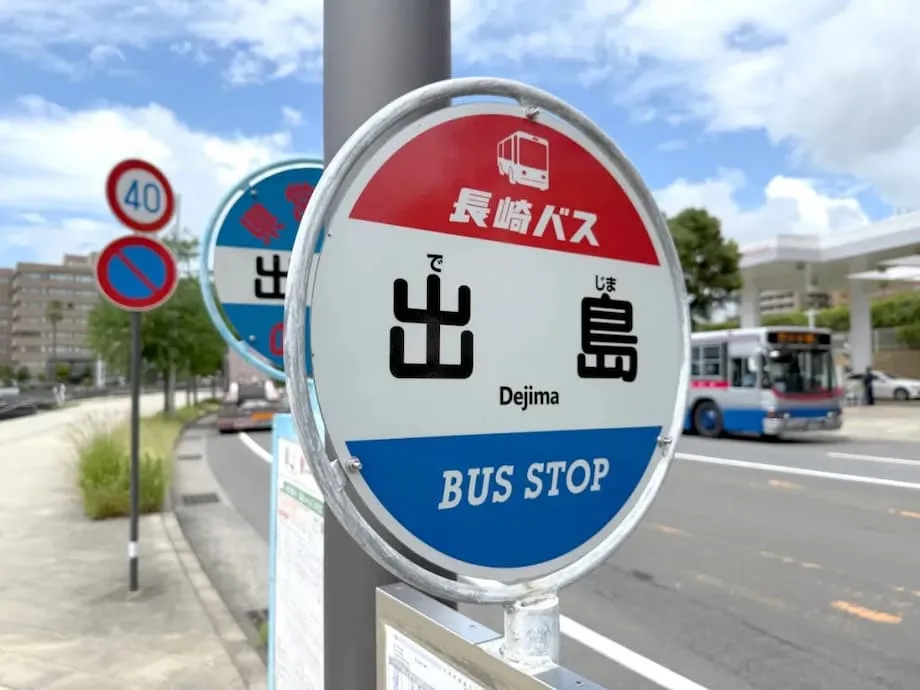
Dejima is a short tram ride from Nagasaki Station. Line number 1 serves the Dejima stop beside the entrance. As of September 23, 2025, the stated opening hours are 8:00 to 21:00, with last admission at 20:40, and there are no regular closing days. Standard admission is 520 yen.
Hours, prices and special events can change. The official English visitor website provides a starting point for checking arrangements before a visit.
More than a dozen restored structures can be explored inside the grounds. The Chief Factor's Residence combines tatami rooms with Western furniture. Warehouses recall the storage of silk and copper, while the Sea Gate and clerks' quarters show the physical and administrative controls that governed trade.
Display cases contain books and instruments connected with rangaku. A banquet hall presents chairs, tables and cutlery above woven mats, illustrating the meeting of dining customs. Street scenes explain the work of interpreters, guards and official inspectors on whom Dutch merchants depended.
The compact, well signposted site can be combined with visits to Nagasaki's Chinatown and churches reflecting the city's Christian heritage. Modern cafes stand only minutes from the reconstructed streetscape. That proximity places the historic trading enclave within the everyday life of the city that grew around it.
Japan's other channels to the world
Dejima was the only place where Westerners lived inside Japan during the Edo period, but the country maintained other controlled connections abroad. Nagasaki's Dutch trading post formed one part of a wider system of limited contact.
The Tsushima domain managed diplomacy and commerce with Korea. Satsuma oversaw relations with the Ryukyu Kingdom, whose missions appeared as foreign delegations in ceremonies at Edo. In the north, the Matsumae clan traded with Ainu communities.
These routes supplied goods and information while allowing the shogunate to regulate relations beyond its borders. Dejima's particular role was its status as the only legal Western window, giving Nagasaki a distinctive position among Japan's ports.
Nagasaki's broader history remains visible in festivals and food. The Lantern Festival fills the streets during Lunar New Year each winter, and the city's Chinatown is Japan's oldest. Sugar imports helped develop a regional taste for sweets and shaped dishes along the old Sugar Road.
Dutch and Chinese traces sit alongside Shinto shrines and Catholic churches. Dejima anchors that history of encounter: a small place built to restrict contact became a durable route for goods, practical skills and ideas.
The Essentials
- Dejima was completed in Nagasaki in 1636 after construction began in 1634, initially to confine Portuguese residents and limit missionary influence.
- The Portuguese were expelled in 1639, and the Dutch East India Company moved from Hirado to Dejima in 1641 under strict Japanese supervision.
- From 1641 to 1847, 606 Dutch ships traded through Nagasaki, carrying goods including silk, sugar, books and instruments and exporting Japanese metals, porcelain and lacquerware.
- The easing of restrictions on secular Western books in 1720 helped rangaku spread through translators, teachers and scholars.
- Kaempfer, Thunberg, Siebold, Doeff and Japanese interpreters contributed to exchanges whose influence reached beyond the island.
- Dejima's trading post closed in 1859, and later reclamation absorbed the island into Nagasaki.
- A major restoration program began in 1996; by 2021, 16 buildings had been restored, with the longer ambition of recovering the island's water boundaries.
- Stated visitor hours are 8:00 to 21:00, with last entry at 20:40 and standard admission of 520 yen. The Dejima tram stop is beside the entrance.
- Japan also maintained controlled connections with Korea, Ryukyu and Ainu communities, while Dejima served as its legal channel for Western contact.