An artist who challenged Japan's image of itself
In 1952, Japanese artist Taro Okamoto urged artists to look beyond the quiet restraint of wabi sabi and rediscover the fierce shapes of prehistoric Jomon pottery. In 1970, his Tower of the Sun brought that argument into public space at Osaka's world fair. More than 60 meters tall, the sculpture joined ancient imagery with a vision of the future, giving millions of fairgoers an encounter with art built around contradiction.
Contents
- An artist who challenged Japan's image of itself
- What polarism asks of art
- Why quiet beauty became a target
- What Okamoto saw in Jomon objects
- How contradiction becomes a working method
- Mexico widened the conversation
- Why a national style can hide other traditions
- Ireland and Mexico reveal different layers
- The Tower of the Sun made polarism public
- What Osaka's new fair brings into focus
- What to Know
A spirited retrospective in Paris this summer has brought the Japanese avant garde pioneer back into international discussion. His central idea, polarism, proposed that art gains energy when opposing forces remain active together. Rather than smoothing differences into a pleasing whole, he wanted artists to preserve friction, surprise and vitality.
That argument reaches beyond painting and sculpture. Okamoto believed a nation could contain sharply different ways of seeing, even when its public image suggested a single shared taste. Japan, in his account, held both the refinement associated with wabi sabi and the exuberance of Jomon vessels and mysterious dogu figures. Giving one tradition priority could hide the other.
Osaka's Expo 2025 gives this debate a current setting. The fair runs from April 13 to October 13, 2025, and organizers expect more than 28 million visits across six months. Its focus on designing life brings Japan's presentation to international audiences into view again. As the event continues, Okamoto's work at Expo 70 offers a way to consider how a country can show its competing cultural inheritances.
What polarism asks of art
Okamoto set out polarism in a lecture in 1950. He rejected the expectation that an artist should reconcile different influences into gentle agreement. Opposing elements could occupy the same work, with each keeping the other alive. The goal was not balance for its own sake, but a tension that could generate new forms.
His thinking drew on Surrealism in Paris and his studies of anthropology. Surrealism helped inform his interest in unexpected combinations, while anthropology directed attention toward the ways people make meaning through culture. Modern life, he understood, brings different speeds, technologies and memories into contact. Art could turn those collisions into something visible instead of making them disappear.
Polarism was an argument for vitality rather than nihilism, the rejection of meaning or value. Okamoto wanted art to engage opposing forces with conviction. A work could contain roughness and refinement, old symbols and modern materials, without requiring one side to defeat or absorb the other.
Why quiet beauty became a target
Wabi sabi, the taste associated with tea ceremony aesthetics and Zen practice, values irregularity, the marks left by age and a quiet presence. In Japan during the middle of the twentieth century, this appreciation of restraint also became a familiar shorthand for national character. Okamoto worried that a distinctive aesthetic had hardened into a rule about what Japanese art should look like.
His challenge in 1952 was to break its spell, not to dismiss it as weak or false. He argued that its dominance had crowded out other native energies. When artists and institutions selected only objects that suited a preferred mood, they lost sight of the wider range of their inheritance.
Okamoto contrasted a quieter classical lineage, linked to Yayoi era ceramics, with the much older Jomon tradition. On one side stood refinement and repose. On the other were vessels crowded with cords, flame shapes and swelling forms. Both belonged to the cultural past he wanted artists to examine.
His proposal gave artists a practical response to a narrow national label: study the parts of the past that feel unfamiliar, even alien, and let them disturb established habits. The aim was renewal, not a return to prehistoric life. An artist working under expectations about what looks Japanese, Irish or Mexican could find creative room in traditions that those expectations left out.
What Okamoto saw in Jomon objects
Jomon pottery offered Okamoto an especially forceful example. Thick ropes of clay curl across vessels, openings flare like flames, and surfaces carry knots and ridges. Their shapes can suggest living creatures rather than containers made to sit quietly on a shelf.
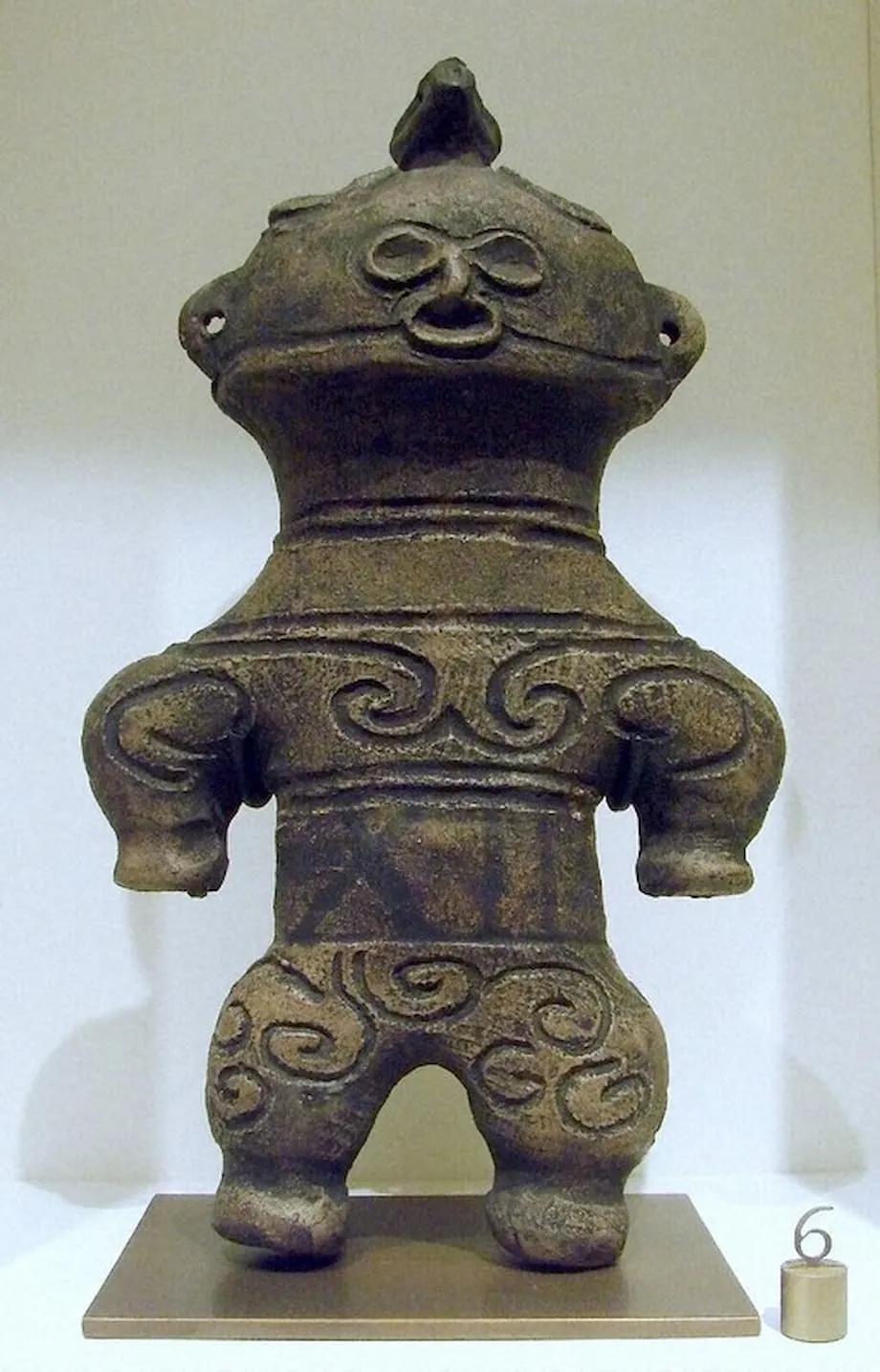
Dogu, the small figures associated with this prehistoric tradition, added another kind of intensity. Often taking female or animal forms, they can appear to stare through large, goggle shaped eyes. For Okamoto, the pottery and figures carried memories of ritual and the earth alongside a powerful inventiveness.
Okamoto saw that inventiveness as close to modern desires for spontaneity and shock. Treating Jomon objects as modern in spirit was a radical position in the 1950s, when restrained beauty offered a familiar route for presenting Japanese art. His argument opened another route, through forms that were rough, noisy and full of heat.
The past, in this view, offered more than one possible future. Museums that place Jomon objects beside contemporary installations reflect a curatorial approach that owes much to his argument. The older work becomes an active participant in a conversation about form, rather than merely an object separated from present artistic life.
How contradiction becomes a working method
Okamoto's paintings and sculptures put his ideas into practice through abrupt colors, twisting forms and faces that can suggest menace or joy. He believed such collisions could produce new myths for Japanese society after the war. Art could give a changing society images powerful enough to hold its conflicting experiences.
A studio application of polarism might bring two visual languages into one composition, place a ceremonial motif beside the traces of an industrial accident, or allow one material to scar another. These examples describe a method: keep unlike elements active long enough for their friction to shape the work.
Artists following that approach would search for neglected lineages in their own fields, study them carefully and bring them into contact with the parts of their training that seem unquestionable. Resolving the difference too quickly would remove the tension that interested Okamoto. New structure could emerge through the slower process of letting unlike parts work on each other.
The same thinking helps explain why he resisted treating tradition as a museum rulebook. He looked for creative energy in forms that had been dismissed as marginal or primitive. Their distance from approved taste was part of what made them valuable to his project.
Mexico widened the conversation
In 1967, Okamoto traveled to Mexico, exploring ancient cities and museum collections. He began tracing affinities between prehistoric Japan and Mesoamerica, the cultural region associated here with Mexico's ancient civilizations. Ritual sculpture, the force with which a figure occupies space, and the appeal of composite beings attracted his attention.
His interest centered on shared energies rather than a direct historical line of influence. A figure could combine the sacred with the playful, or the human with the animal. For an artist drawn to opposing states, such combinations offered another way to think about forms that carried more than one identity at once.
Mexico also placed his research within a broader change in art after the war. Artists were increasingly working and arguing across national boundaries. Figures around the sculptor and thinker Mathias Goeritz were examining how history and emotion could shape public space.
Across Asia and Latin America, artists resisted a single account of modern art that moved from Paris to New York. Okamoto's interest in Mexico belonged to that wider effort to build a modern visual language from many cultural archives. Prehistoric Japan and ancient Mesoamerica became resources for invention alongside the European experiences that had helped shape his thinking.
Why a national style can hide other traditions
Japan's debates about how to present a shared culture to its neighbors and the wider world extend from Meiji public policy through the years after the war and into the present. A simple national image is easy to communicate. For artists, however, it can become a narrow script defining what their work is expected to express.
Okamoto challenged the form of cultural nationalism that turns one aesthetic into a national badge. His objection was rooted in the variety already present in Japanese culture: courtly poetry, theater, Buddhist images, tea houses, merchant humor and folk festival imagery. Those traditions pull in different directions rather than delivering one consistent mood.
A country can favor one set of values while others remain available for rediscovery. Okamoto treated that layered condition as a strength. Cultures, like individuals, carry competing drives, and art can make those conflicts visible without forcing them into a single approved identity.
His argument remains relevant to discussions of identity in galleries, online spaces, classrooms and public squares. When the expected image of a culture becomes too restrictive, neglected traditions offer more than decoration. They can change what artists make and what audiences recognize as part of their shared inheritance.
Ireland and Mexico reveal different layers
Ireland offers another example of the competing identities within a nation. For much of its modern life, the state presented a conservative, Catholic and agrarian image, reinforced by public institutions and popular media. Beneath that image were pagan stories, radical politics and a desire for urban sophistication.
In the 1970s, Seamus Heaney wrote poems about bodies from the Iron Age recovered from bogs. Their presence brought a distant past into contemporary writing. Those images also pointed toward changes that would become visible in the 1990s as the Church's grip loosened. The comparison with Okamoto lies in the return of an older inheritance that unsettles a more familiar public identity.
Mexico's cultural layers followed a different history. Octavio Paz described the country as a fusion born from conquest, where the ordered power of the Aztec world met the intense Catholic fervor of Counter Reformation Spain. Within the Spanish inheritance itself were conflicting currents: a drive to expel Islam alongside the absorption of learning and styles from Muslim courts.
Mexico consequently carried different cultural codes, from ceremonial order to carnivalesque release, and from a public face to a private mask. Okamoto saw the ability to move between such legacies as a kind of preparation for modern life. The point connecting these examples is that a national image can be much narrower than the experiences and traditions within it.
The Tower of the Sun made polarism public
Okamoto reached his widest audience through the Tower of the Sun at Expo 70 in Osaka. Rising more than 60 meters, the sculpture carries faces associated with the past, present and future. Inside it, a monumental Tree of Life climbs through the central space.
The tower is a statement in concrete and steel that refuses a single mood. Primal symbols meet futuristic optimism and a carnival sense of spectacle. Its imagery gives public form to Okamoto's conviction that opposing currents can exist together with force.
Okamoto, the artist who created the tower, often expressed his credo publicly in a phrase that entered popular culture:
Art is explosion.
The phrase captured his preference for energy over decorum and his demand for artistic courage. As a symbol of reinvention after the war, he urged people to break stale habits of taste and embrace contradiction. The Tower of the Sun still stands at the former Expo site, preserving that challenge in a work of public art.
The main stages of this argument stretch across several decades:
- 1950: Okamoto set out polarism in a lecture about opposing forces within art.
- 1952: He urged artists to look beyond the dominance of wabi sabi and reconsider Jomon forms.
- 1967: His visit to Mexico brought prehistoric Japan and Mesoamerica into his exploration of cultural affinities.
- 1970: The Tower of the Sun brought his ideas to a broad audience at Osaka's Expo 70.
- April 13 to October 13, 2025: Osaka's new expo places the presentation of Japan to international audiences in focus again.
What Osaka's new fair brings into focus
Expo 2025 occupies an artificial island in Osaka and centers on how people shape life. Designers have discussed prototypes of flying cars, while organizers expect more than 28 million visits during the fair's six months. Those expectations form part of an event taking place after years of pandemic anxiety and debate about large international gatherings.
Many older residents remember Expo 70 as their first encounter with people from dozens of countries in one place. The new fair brings another opportunity for international contact, while the memory of Okamoto's tower connects it to an earlier moment of Japanese reinvention.
Okamoto's ideas offer museums, festivals and educators a concrete way to approach such cultural presentation. Museums and festivals can place overlooked lineages beside familiar works. Critics can explain differences without reducing them to exotic flavor. Teachers can show how arguments within a culture continue across centuries.
The result would be a wider account of national art, with room for quietness and excess, inherited ritual and modern experimentation. Okamoto's lasting challenge is to keep those differences visible. His work asks audiences to find vitality in a culture's competing traditions rather than accepting one style as the whole story.
What to Know
- Okamoto developed polarism in a 1950 lecture, arguing that opposing elements could generate energy within one artwork.
- His 1952 challenge to the dominance of wabi sabi directed attention toward the exuberance of Jomon pottery and dogu figures.
- Surrealism in Paris and anthropology helped shape his approach to cultural difference and artistic invention.
- A 1967 visit to Mexico led him to explore affinities between prehistoric Japan and Mesoamerica.
- His Tower of the Sun, created for Expo 70 in Osaka, rises more than 60 meters and contains a monumental Tree of Life.
- Examples from Ireland and Mexico illustrate how a national image can conceal competing cultural inheritances.
- Expo 2025 runs from April 13 to October 13, with organizers expecting more than 28 million visits.
- Okamoto's approach encourages artists and institutions to bring neglected traditions into contact with familiar ones.