AI lessons arrive with the new school year
China is bringing artificial intelligence into primary and secondary classrooms from September 2025, with Beijing requiring at least eight class hours of AI instruction each academic year and Hangzhou setting a minimum of ten hours across every grade. Students in cities and counties will receive structured lessons that become more demanding as they move through school.
Contents
- AI lessons arrive with the new school year
- What eight or ten hours means for schools
- Learning grows from recognition to invention
- Homework rules keep responsibility with the student
- Classroom assistants and faster feedback
- Why education is part of China's AI ambitions
- Universities show how widely AI is already used
- Privacy concerns accompany classroom experiments
- Teacher training tests the reach of the reform
- How China's rollout compares with other efforts
- What families can expect this school year
- At a Glance
The nationwide curriculum is part of the national AI plus initiative, a policy push to bring artificial intelligence into everyday life and industry, including education. Its purpose is to build digital fluency early and prepare students for a job market in which employers already value AI skills.
The Ministry of Education has outlined a broader approach that brings AI into teaching methods, textbooks and school platforms. The near term goal is universal access to AI education by 2030, with model cities and provinces testing approaches that can then spread across the country. The effort also connects to the national ambition to build a strong education system by 2035.
For children, the change means learning both about intelligent systems and with them. Lessons will explain how machines recognize patterns, where their answers can go wrong and how students can use them without handing over their own thinking. Schools are also experimenting with tools that support teachers, from automated marking to classroom assistants.
The minimum teaching hours provide a starting point, while local authorities retain room to organize lessons and train staff. Beijing allows schools to teach AI as a separate subject or include it within science and information technology. Hangzhou is pairing its higher minimum with a formal program to improve teachers' skills.
What eight or ten hours means for schools
Beijing's eight hours is a minimum, and schools can provide more instruction. Many already extend learning through clubs, laboratories and programs after regular classes. Hangzhou's ten hours annually places a higher requirement on schools and reflects the city's intention to become a leading testing ground for AI education.
Hangzhou's minimum is two hours higher than Beijing's, a difference of 25 percent. Both cities allow the wider effort to develop through classroom practice and teacher preparation, rather than relying only on a new timetable entry.
A primary school could include image classification in a science unit. In that activity, children would explore how a computer sorts pictures into categories. A high school literature class could examine how a large language model generates text and why its output can be misleading. A large language model is an AI system that produces language by drawing on patterns learned from data.
Beijing's education commission has worked with a digital learning center to compile dozens of lessons for schools to adopt, adapt and share through a citywide platform. Early figures indicate broad interest, with the content reportedly being used by students across many provinces.
Hangzhou is developing training centers and networks connecting schools, universities and technology companies. The aim is to help teachers learn practical classroom methods as well as the theory behind the technology.
Learning grows from recognition to invention
The Ministry of Education's approach matches lessons to students' maturity. Primary school children begin with concrete activities and familiar examples, including voice assistants and image recognition. They learn that computers depend on data and rules, and that a prediction from a model can be wrong.
Junior high students move toward applying AI to tasks in school and daily life. Lessons introduce basic machine learning, meaning the process through which a computer learns patterns from examples. Students examine common errors, check generated answers against trusted information and learn to identify bias.
Senior secondary students take on more advanced work involving innovation, design thinking and practical problem solving. They can build and refine simple models, use AI tools for research and develop projects combining knowledge from different subjects. Privacy, transparency, fair use of data and the limits of automation become more central.
The intended progression is from awareness to application and then more independent work. Officials want AI literacy to become a common competency, alongside reading and numeracy, that students carry into further education or employment. Confidence with the tools is meant to develop together with judgment about when and how to use them.
Homework rules keep responsibility with the student
Chinese guidelines encourage students to use AI to brainstorm, organize information and receive feedback. They also prohibit students from submitting content generated by AI as their own academic work or using generative systems to produce final answers for homework and tests.
Teachers are expected to demonstrate responsible use, explain how to verify AI output and create assignments that reward original thinking. Officials describe a model combining teacher, student and machine, with AI serving as a learning assistant.
A student may use an AI tool to identify gaps in understanding or obtain practice problems. The student must still do the work of solving those problems. Checking information, explaining a line of reasoning and recognizing an error remain part of learning.
Schools are therefore being asked to teach more than the operation of software. Their task includes helping children decide when assistance is useful, when an answer needs checking and how to keep their work authentic. Guidelines also warn against excessive dependence and call for time for open discussion, creative exploration and reflection.
Classroom assistants and faster feedback
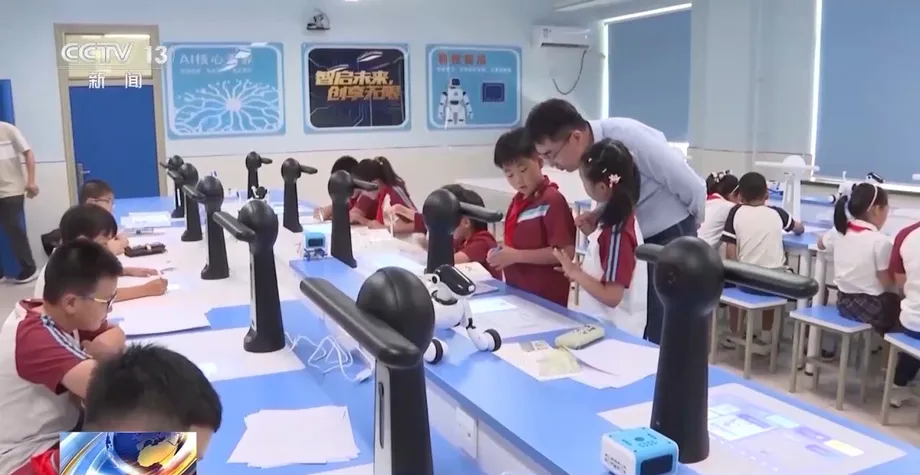
Some schools are experimenting with compact AI assistant robots or agents accessed through tablets that help teach selected lessons. These tools can engage students, quiz small groups and provide hints when needed, while the teacher remains responsible for the class.
Smart platforms that analyze large amounts of student work are spreading too. They can mark routine assignments, identify common mistakes and suggest exercises suited to a student's needs. This can give teachers more time to speak with children who need help.
High school physics teachers are using AI to generate dynamic simulations, allowing students to visualize concepts before laboratory sessions. In rural junior high schools, tools that assist with marking help teachers identify mistakes shared across a class and adjust their instruction.
Universities have introduced learning companions that provide practice and feedback around the clock. These pilots offer a preview of features that are likely to reach upper school grades in the years ahead. AI is also changing how teachers prepare lessons and assess progress.
Yuan Wen, president of Shanghai Normal University, has argued that a teacher's human presence remains essential, particularly in teaching values and supporting social and emotional development. She described the role of a teacher in literature:
There will always be a need for a living presence on the podium who can convey the charm of literature with heart and soul.
Many educators welcome help with routine tasks while keeping that human role at the center of education. The idea is to use time saved on repetitive work for conversations, projects and mentoring, while giving students more opportunities to practice.
Why education is part of China's AI ambitions
China has set a goal of becoming a global AI leader by 2030 and has supported it with funding for research, computing infrastructure and local laboratories. A national program launched in 2025 committed billions of dollars to projects related to AI, including talent development.
Export controls on advanced chips have also pushed Chinese institutions to find ways to train models and deploy applications with limited access to the most advanced hardware. Computing resources matter because training and running AI systems require machines to process large amounts of information.
The education effort fits a policy approach that seeks to expand uses of AI across the economy while developing domestic talent to reduce bottlenecks. Officials want students to think independently, solve problems and work in teams, and identify these as abilities that classroom AI tools can help develop.
Public interest has risen following the emergence of domestic models that lowered computing costs and attracted attention. Job advertisements in many fields now describe AI literacy as an advantage. Giving every student basic knowledge is intended to improve the starting point for the next generation while supporting those who go on to more advanced work.
Fang Kecheng, a communications professor at the Chinese University of Hong Kong, connected public enthusiasm to a longer cultural belief in science and technology:
There is a long tradition in China of believing in technology as a driver of national progress.
Universities show how widely AI is already used
Surveys report near universal exposure to AI tools among Chinese university students. Many institutions now offer formal AI literacy classes to students whose degrees are outside technical subjects.
The curriculum for primary and secondary schools is intended to create continuity with that university experience. Students would encounter AI before reaching higher education or entering employment, with lessons becoming more demanding as their knowledge grows.
Universities also report student anxiety about AI detection and academic integrity. That experience points to the need for clear rules and transparent checks, so students understand the boundaries between permitted assistance and work they must complete themselves.
Privacy concerns accompany classroom experiments
Some classrooms are piloting headbands that sense brain activity and use AI analysis to help teachers understand attention patterns and adjust the pace of instruction in real time. Advocates say the data can improve teaching. Critics worry about surveillance and the pressure such monitoring could place on children.
Privacy and dependence on technology remain concerns as schools expand AI use. Chinese guidance acknowledges those risks and asks educators to protect opportunities for discussion, creativity and reflection alongside the use of digital tools.
Meifang Zhuo, a researcher who studies student use of AI in higher education, has argued for guidance rather than either a ban or unrestricted use. She described the educational goal:
The goal should not be preventing students from using AI but guiding them to harness it for effective learning and higher order thinking.
That approach carries into the new school rules. Students are expected to develop judgment about using AI, while teachers must make sure that help from a machine still leaves children doing the thinking and learning.
Teacher training tests the reach of the reform
The Ministry of Education is promoting shared resources and online platforms so schools with fewer teachers or laboratories can obtain teaching materials. Beijing's shared collection provides units that teachers can adapt, reducing the amount of preparation each school has to do alone.
Zhejiang and other provinces are building training hubs and identifying experimental schools to test teaching methods before they spread. Data platforms help local districts locate shortages in staffing and skills and decide where investment is needed.
Earlier digital education pilots reached millions of educators with AI literacy sessions and produced hundreds of tools to support teaching and professional development. The new plan expands that work through more detailed training tied to everyday classroom practice.
Gaps between urban and rural schools remain. Shared lessons, remote training and online support can lower the barrier for schools with fewer resources, but the effectiveness of the curriculum depends heavily on teachers being able to use those materials in class.
How China's rollout compares with other efforts
Education authorities in places including California and Japan have directed schools to consider AI in their curricula. European education systems are testing classroom tools and setting boundaries for student use.
A growing share of students worldwide use AI for study help at least weekly. Teachers are experimenting with it to prepare lessons, tailor practice and track progress, although training and policy support lag in many regions.
China's rollout brings together a national framework organized by school stage, local minimum teaching hours and shared banks of lessons. Its speed and scope stand out, supported by public enthusiasm and universities already teaching AI literacy on a large scale.
The plan seeks to combine easier access to technology with originality, accuracy and human guidance. Students are being introduced to tools they may use throughout their education, while schools are setting rules intended to preserve the work of learning.
What families can expect this school year
Primary school lessons are expected to include practical activities explaining how pattern recognition works and why computers need examples. Junior high students are likely to encounter AI within existing subjects, such as a science module about sensors collecting data or a civics lesson about spotting misinformation in generated text and images.
High school students may undertake small projects, such as adjusting a simple model using a classroom dataset, evaluating the results and writing about what improved and what did not. These are examples of how the curriculum's progression could appear in practice.
Families can ask what lessons aim to teach at each grade, how student data will be handled, how teachers check the accuracy of AI output and what rules apply to homework. Programs are expected to develop students' ability to question answers, check reliable information and explain their reasoning.
The changes described for September 2025 sit within a longer timetable. The key stages are:
- 2025: A national program commits billions of dollars to AI projects, including talent development.
- September 2025: Structured AI instruction begins across primary and secondary education, with Beijing requiring at least eight hours annually and Hangzhou at least ten.
- 2030: The near term education target is universal access to AI learning. China also aims to become a global AI leader by this year.
- 2035: The education reforms connect to the national goal of building a strong education system.
For students, success will mean more than polished homework. The practical test is whether they can describe the steps they took, identify mistakes and explain what they changed. The curriculum aims to make intelligent tools familiar while keeping responsibility for understanding with the learner.
At a Glance
- China is introducing structured AI lessons in primary and secondary schools from September 2025 under its national AI plus initiative.
- Beijing requires at least eight class hours each academic year; Hangzhou requires at least ten across every grade and is developing teacher training.
- Lessons progress from basic awareness in primary school to application in junior high and advanced projects and ethics in senior secondary school.
- Students may use AI for support but are prohibited from submitting generated content as their own work or using it to produce final homework and test answers.
- Schools are testing classroom assistants, automated marking and simulations. Some are also piloting headbands that analyze attention patterns, prompting privacy concerns.
- Shared resources, training hubs and remote support are intended to help schools with fewer staff and facilities.
- The education target is universal access to AI learning by 2030, within broader plans to build a strong education system by 2035.