A teenage survivor finally wins acquittal
For 61 years, Choi Mal ja lived with a criminal conviction for the force she used to escape an assault. In September 2025, the Busan District Court acquitted the woman, now 79, finding that biting off about 1.5 centimeters of her attacker's tongue in 1964 was lawful self defense.
Contents
- A teenage survivor finally wins acquittal
- What happened in Gimhae in 1964
- A trial shaped by prejudice against women
- How the case returned to court
- Why the judges accepted self defense
- The injury finding that weakened the original charge
- Prosecutors acknowledge the harm they caused
- The social changes behind the campaign
- How a final conviction can be reopened
- The personal cost and a possible compensation claim
- What the decision changes
- The Bottom Line
The court also found insufficient evidence that the man suffered a permanent disability from the injury. That finding challenged a central part of the original conviction for grievous bodily harm, a charge involving a particularly serious injury. The decision ended a rare retrial and corrected a judgment that had treated a victim of sexual violence as a criminal for most of her life.
Choi had received a suspended sentence of 10 months. Her attacker received a lighter suspended term for trespass and intimidation after prosecutors dropped the attempted rape charge against him. A suspended sentence means a court imposes a prison term but allows the person to avoid serving it subject to conditions.
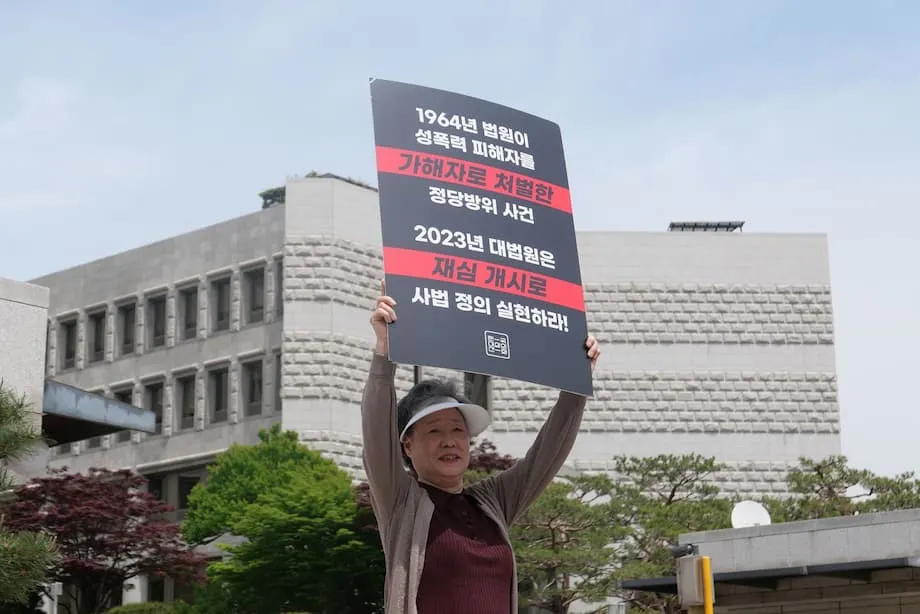
Outside the courthouse, Choi raised a fist as supporters cheered and gave her bouquets. Activists held a placard reading "Choi Mal ja did it." After years of petitions, rallies and legal advocacy, she told those gathered: "We won."
The acquittal followed an unusual apology from prosecutors, who acknowledged that the state had failed to protect her and instead caused decades of suffering. Choi's victory also changed the legal meaning of an act long discussed in classrooms: the bite that once made her a defendant was now recognized as the force she needed to break free.
What happened in Gimhae in 1964
Choi was in her late teens when the assault occurred in Gimhae, a southern town near Busan. Court records described a man pinning her to the ground and forcing his tongue into her mouth. At one point, he blocked her nose, preventing her from breathing.
Restrained and struggling for air, Choi bit down on his tongue. About 1.5 centimeters was severed, and she escaped. The circumstances of that moment would become the central issue in two very different judgments separated by six decades.
Choi reported the attack. The man brought a bodily harm complaint against her, and she filed complaints against him for attempted rape, trespass and intimidation. Instead of receiving protection solely as a victim, she found herself facing prosecution for the injury inflicted during her escape.
The first court held that her response exceeded the reasonable bounds of self defense. Prosecutors dropped the attempted rape count against the man, leaving him with convictions for trespass and intimidation and a lighter suspended sentence than hers.
For Choi, the result meant that the legal record centered on the damage to her attacker rather than the danger she had faced. The retrial returned to the same physical circumstances: a teenager held down, her breathing obstructed, using her teeth to end the assault.
A trial shaped by prejudice against women
South Korea in the mid 1960s was rebuilding after war and colonial occupation. Women who experienced violence often had little protection or public voice. Domestic violence was so routine that there was not even a widely used term for it in public conversation, while sexual assault proceedings could focus on a survivor's chastity rather than the attack.
Choi has described being handcuffed and compelled to undergo a test intended to establish whether she was a virgin. She said the result was made public. The process exposed intimate information while placing her character under scrutiny.
Prosecutors and judges also asked whether she would marry the man to resolve the case. The suggestion treated marriage to her attacker as a possible way to compensate for his injury, even though she had accused him of trying to rape her.
Wang Mi yang, president of the Korea Women Lawyers Association, has argued that the original judgment reflected social prejudice and distorted attitudes toward victims of sexual violence. In her assessment, those attitudes turned a survivor's effort to escape into a crime and punished the wrong person.
Choi's case later entered legal textbooks and teaching as an example of courts misunderstanding self preservation during sexual violence. Its importance extended beyond her own record: generations of students encountered a judgment that drew the boundary of self defense around the attacker's injury rather than the victim's immediate danger.
How the case returned to court
Choi built a life while carrying the conviction, then sought to reopen the case decades later. Women's rights campaigns helped encourage that decision, including the movements for women forced into sexual slavery by the Japanese military and South Korea's #MeToo movement in 2018.
In 2020, she petitioned for a retrial. Lower courts initially rejected her request. Choi and her supporters continued their campaign through legal advocacy, public rallies and repeated efforts to secure a fresh hearing.
South Korea's Supreme Court agreed in 2024 that the retrial could proceed in Busan. When the proceedings opened, prosecutors apologized in court and asked for her conviction to be overturned.
The key stages stretched across more than six decades:
- 1964: Choi escaped an assault in Gimhae by biting off about 1.5 centimeters of the attacker's tongue. She was subsequently convicted of grievous bodily harm.
- 1990s: Campaigns for women forced into sexual slavery during World War II helped bring survivors' rights and dignity into public debate.
- 2018: South Korea's #MeToo movement added momentum to demands for better treatment of victims of sexual violence.
- 2020: Choi applied for a retrial, but lower courts initially rejected her petition.
- 2024: The Supreme Court authorized a retrial in Busan.
- September 2025: The Busan District Court acquitted Choi, recognizing lawful self defense.
During the retrial process, Choi described the burden of the conviction and expressed hope that future generations would live happily without sexual violence. Her account made the length of the injustice plain.
For 61 years, the state made me live as a criminal.
Why the judges accepted self defense
The Busan District Court concluded that Choi used the force necessary to escape an unlawful assault. The attack threatened both her bodily integrity and her sexual self determination, meaning her right to decide what happens to her body and whether she takes part in sexual activity.
South Korea's Criminal Act recognizes self defense against an immediate, unlawful attack when the response is necessary and proportionate. In simple terms, a court asks what danger a person faced and whether the force used was reasonable in those circumstances.
Judges examine the nature of the threat, whether escape was possible and what was needed to stop the danger. Choi's circumstances included being pinned to the ground and prevented from breathing. The retrial treated the bite as a reasonable means of getting free.
The original judgment had described the bite as excessive. The new judgment evaluated the incident from the position of the teenager under attack. It found an immediate unjust assault and a necessary response to repel it.
The injury finding that weakened the original charge
Medical records and testimony also mattered to the acquittal. The court found that the evidence did not sufficiently show that the man suffered a lasting disability because of the bite.
The original charge of grievous bodily harm depended on the seriousness of the injury. The absence of sufficient evidence of permanent disability undercut a central element of that charge, alongside the court's finding that Choi acted in lawful self defense.
The two findings addressed different parts of the case. One concerned whether Choi's conduct was justified by the attack. The other concerned whether the evidence supported the severe injury allegation on which she had been convicted.
Together, they reversed the reasoning that had governed her legal status for decades. The court recognized the immediate threat to Choi and reconsidered the medical basis for treating her escape as a serious criminal offense.
Prosecutors acknowledge the harm they caused
Busan Chief Prosecutor Jeong Myeong won addressed Choi by name rather than referring to her as a defendant, a departure from past practice. He accepted responsibility for the suffering caused by the original prosecution.
We sincerely apologise. We have caused Choi Mal ja, a victim of a sex crime who should have been protected as one, indescribable pain and agony.
Public apologies from prosecutors are rare. In this case, the apology was accompanied by a request for acquittal, making the change more than a difference in courtroom language. The prosecution acknowledged that authorities had failed to protect a victim and had prolonged her suffering by pursuing the wrong charge.
Choi said after an earlier hearing that she struggled to believe the acknowledgment had finally come. She connected the admission of error with renewed faith in the justice system.
I still cannot believe it," Choi said. "But if the prosecution is admitting its mistake even now, then I believe justice is alive in this country.
Advocacy groups that supported her through petitions and protests viewed the acquittal as a message to survivors afraid that reporting violence might turn them into the accused. The prosecution's response also reflected years of public criticism of how sexual violence cases had been handled.
The social changes behind the campaign
Women's rights activism helped create room for Choi's case to be reconsidered. In the 1990s, grassroots campaigns demanded justice for women forced into sexual slavery by the Japanese military during World War II. Those campaigns placed survivors' dignity and rights closer to the center of public discussion.
South Korea's #MeToo movement gained force in 2018. Accusations against powerful men led to court cases, while street protests demanded better policing and stronger penalties for sexual crimes.
Lawmakers increased punishments for hidden camera violations. Courts and legislators also reconsidered practices and expectations that had discouraged victims from reporting abuse. The Constitutional Court's decision to strike down the criminal ban on abortion reflected the broader push to respect bodily autonomy, or a person's control over their own body.
Choi's campaign developed within that changing public conversation. A case once taught as an example of the supposed limits of self defense could be reconsidered as an example of judicial error and its correction.
The new decision gives legal teachers a second judgment to place beside the first. Students can compare how the same act was understood when attention centered on the man's injury and when judges gave proper weight to the woman's experience of restraint, suffocation and escape.
How a final conviction can be reopened
Choi sought the retrial herself to challenge a conviction she believed was unjust. The process allowed a court to reopen the record, hear the case again and replace the guilty judgment with an acquittal.
Many legal systems have a rule commonly called double jeopardy, which protects people against repeated trials for the same offense after a final judgment. They also provide ways to correct miscarriages of justice. A retrial requested by a convicted person serves that corrective purpose.
South Korea permits defendants to seek retrials through procedures addressing new evidence or serious defects in the original proceedings. Reconsideration can also involve legal understanding that could change the result. In Choi's case, the Supreme Court authorized the new proceedings after her earlier applications had failed.
The Busan District Court then reconsidered the charge and issued an acquittal. The result cleared the conviction and restored her legal status, ending the judgment that had labeled her a criminal since the original case.
The process illustrates why a fresh hearing can matter even after many years. Medical evidence, the circumstances of an attack and the treatment of a defendant can all require closer examination when someone challenges an unjust conviction.
The personal cost and a possible compensation claim
Choi has described living with resentment and a sense of unfairness for decades. In a letter to the Supreme Court, she wrote that the country must make amends for violating her human rights.
A criminal record can affect employment, social standing and other people's trust. Those pressures can be especially strong for a generation in which reputation shaped major life decisions. An acquittal clears the legal judgment, but it cannot return the years spent carrying it.
The indignities of the first proceedings also remained part of Choi's experience: the handcuffs, the compulsory virginity test, publication of its result and the suggestion that she marry her attacker. Her supporters say those details help explain why many survivors stayed silent at the time and why some still hesitate to report violence.
Choi's lawyers have said they plan to seek compensation from the state. No amount or timetable was given. South Korean law allows compensation for wrongful conviction, including time in custody and harm caused by a faulty judgment. Courts can also order measures to restore a person's honor by making their acquittal known.
The details of a claim would depend on her detention, the harm recognized by a court and evidence of lasting effects on her life. Compensation would provide another form of redress after the criminal case, while any measures to restore her reputation would address the public consequences of the conviction.
What the decision changes
Choi's acquittal brings together three concrete changes: a conviction overturned, a finding of lawful self defense and an admission by prosecutors that the state harmed someone it should have protected. For her, the central result is that the criminal judgment no longer stands.
The case also gives police, prosecutors and judges a reason to reconsider how they assess a victim's response during an assault. A successful compensation claim could add pressure for training that better accounts for how attacks happen and how people react while trying to survive.
Law schools can now teach the early judgment alongside the retrial decision. The contrast shows how evaluating force in the circumstances of an attack can produce a different result from focusing narrowly on the injury sustained by the attacker.
Public reaction to the acquittal reflects a South Korea reassessing past treatment of survivors. The apology, the self defense finding and the sustained work of advocacy groups show how institutions can correct an old judgment when victims' experiences receive proper weight.
Each self defense claim still depends on its circumstances, and reopening a conviction requires a legal process. Choi's case places the immediate danger and the choices available to a person under attack at the center of that assessment. For survivors who fear being blamed for fighting back, that is the concrete importance of the ruling.
The Bottom Line
- The Busan District Court acquitted Choi Mal ja, now 79, in September 2025, clearing a conviction arising from a 1964 assault.
- Choi bit off about 1.5 centimeters of her attacker's tongue while escaping restraint and suffocation in Gimhae.
- The court recognized lawful self defense and found insufficient evidence that the attacker suffered a permanent disability.
- Her original punishment was a suspended sentence of 10 months. The attacker received a lighter suspended term for trespass and intimidation after the attempted rape charge was dropped.
- Choi sought a retrial in 2020. After initial rejections, the Supreme Court authorized new proceedings in 2024.
- Prosecutors apologized for the harm caused to her and asked for acquittal.
- Women's rights activism helped sustain a campaign that changed the outcome of a case long discussed in legal education.
- Her lawyers plan to seek state compensation, with no amount or timetable announced.