Budget Cuts and Parliamentary Benefits Fuel Street Anger
About $19 billion in government budget cuts and parliamentary housing allowances of up to 50 million rupiah a month have helped drive a wave of protests across Indonesia in August 2025. In Jakarta, demonstrations led by students have grown into a broader movement bringing together people angry about economic hardship, government spending priorities and the direction of the country's democracy.
Contents
- Budget Cuts and Parliamentary Benefits Fuel Street Anger
- Why Spending Priorities Have Become a Flashpoint
- What the Dark Indonesia Movement Wants
- Jakarta's Clashes and the Risks to Journalists
- Why Young Indonesians Feel Economically Excluded
- A Student Movement With Memories of 1998
- Why a One Piece Pirate Flag Became a Protest Symbol
- Military Law Changes Deepen Democratic Concerns
- Concessions, Police Force and Market Pressure
- Key Points
President Prabowo Subianto's administration introduced the cuts to help fund ambitious programs, including a $4.3 billion initiative providing free school meals and the creation of Danantara, a sovereign wealth fund. Such a fund manages state assets and investments. Protesters fear that redirecting money toward these priorities will weaken essential services, including education and healthcare.
Parliamentary benefits have sharpened that anger. Members of parliament receive housing allowances worth about $3,200 a month, roughly 20 times the minimum wage in some regions. For citizens struggling to cover everyday expenses, the contrast has become a concrete example of the distance between political leaders and the people they represent.
The demonstrations also challenge revisions to the Armed Forces Law, which allow active military officers to hold more civilian government posts and raise retirement ages for generals. Students and civil society groups see the spending decisions and military changes as connected concerns: who controls public resources, whose needs receive attention and how much influence ordinary citizens retain.
As of August 27, 2025, the movement has combined street protests, social media campaigns and creative symbols of resistance. Clashes with police, concerns about press freedom and government promises to review student demands have made the unrest a defining moment for a generation that grew up after Indonesia's democratic reforms.
Why Spending Priorities Have Become a Flashpoint
The government's austerity measures are the immediate trigger identified by protesters. Austerity means reducing public spending. In this case, the administration is seeking to free money for new programs while students and other citizens worry about the services affected by those reductions.
Education and healthcare sit at the center of those concerns. Students fear for university funding, scholarships and their future opportunities. Families facing economic pressure have reasons to worry about public services becoming less accessible or receiving fewer resources.
Herianto, a student leader in Jakarta, described the uncertainty surrounding the cuts and linked student anger to the free meals program:
Indonesia is dark because there are many policies that aren't clear to our society. The cuts are designed to plug a hole in the free meal programme expenses. Education is one of the things that could be impacted. Students are so angry.
The $4.3 billion meals initiative and Danantara represent major ambitions for Prabowo's government. The conflict concerns the way those ambitions are funded and the consequences for other priorities. A government can redirect spending toward a new program while leaving people who depend on existing services worried about what they will lose.
What the Dark Indonesia Movement Wants
The #IndonesiaGelap movement, whose name translates as "Dark Indonesia," has become a focal point for dissatisfaction. Organized by the Student Executive Board–All Indonesia (BEM-SI) and other youth groups, it expresses pessimism about the country's direction and has trended widely on social media.
Protesters often wear black, carry placards and chant demands for change. Demonstrations have spread from Jakarta to other major cities across the archipelago, with Indonesians living overseas also taking part. A movement that began with students now draws support from a broader coalition of citizens.
The demands bring together concerns about household finances, public accountability and political freedom:
- Repeal of controversial laws and budget cuts.
- Greater transparency in government spending.
- Protection of democratic principles and civil liberties.
- Less military influence in civilian affairs.
- Reform of police practices and an end to corruption.
Transparency means making decisions and spending clear enough for the public to examine. Civil liberties include the freedoms people use to express opinions, organize and challenge those in power. For the demonstrators, these demands connect the immediate effects of government policy with their ability to influence future decisions.
Social media gives the movement a way to organize protests, circulate messages and reach people beyond a single city. Its online presence also carries a shared sense of frustration among young Indonesians who believe their economic prospects and political voice are under pressure.
Jakarta's Clashes and the Risks to Journalists
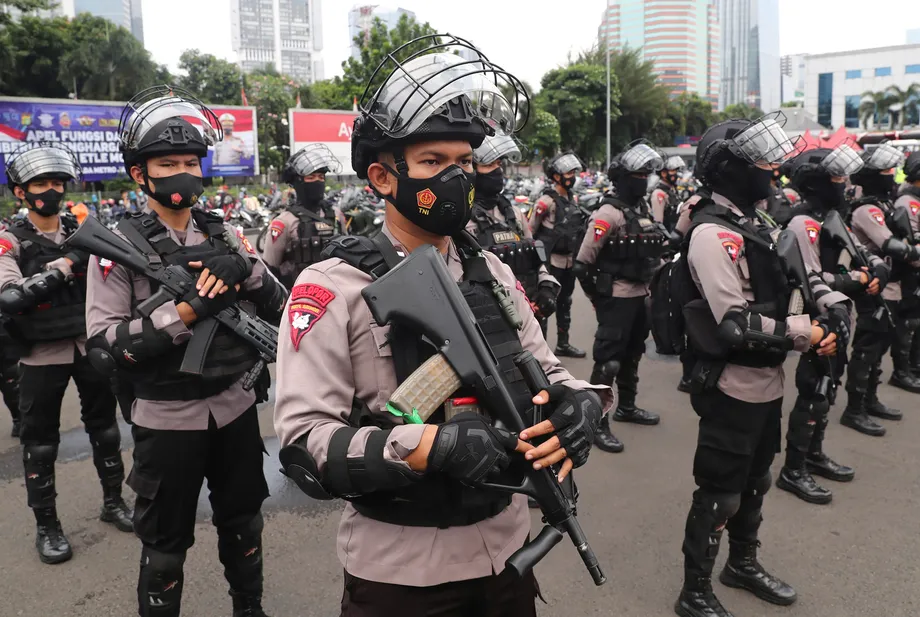
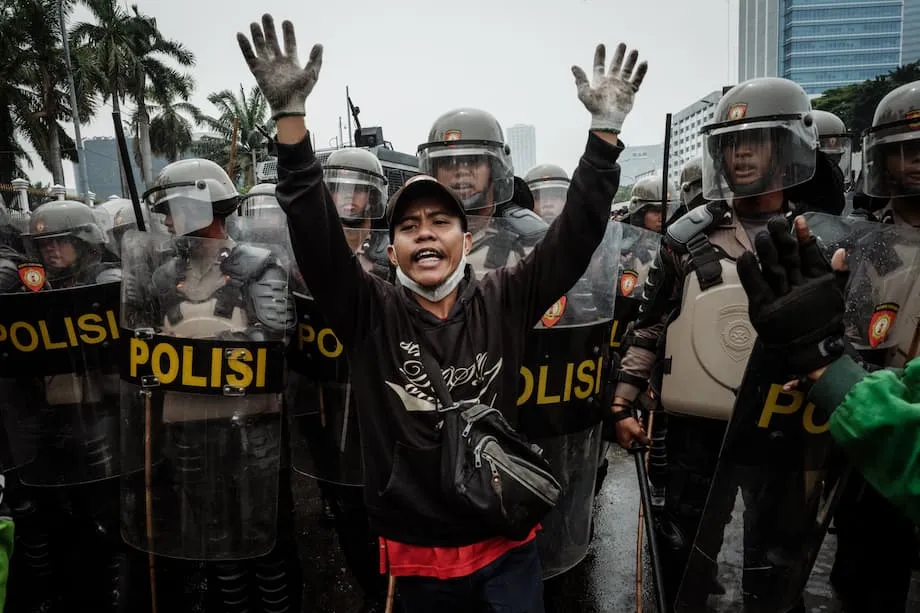
Jakarta has seen some of the most intense confrontations. Protesters have thrown rocks, hurled tear gas canisters back toward riot police, set fires and built makeshift barricades using concrete road barriers. Police have responded with tear gas, water cannons and large deployments.
More than 1,200 officers were stationed around the parliament building at the height of the unrest. One striking image showed a protester throwing a tear gas canister back at authorities, capturing the defiance that has become associated with the demonstrations.
Graffiti and protest art have appeared across the capital, giving visible form to both anger and creativity. Alongside those expressions, the street confrontations have brought violence, arrests and concerns about censorship.
Journalists documenting the unrest have also faced danger. According to the Committee to Protect Journalists, several reporters were assaulted or forced by police to delete footage while covering clashes. Press freedom advocates have condemned those incidents and stressed the role of independent reporting in holding authorities accountable during a political crisis.
For the public, footage and reporting provide a record of what happens between demonstrators and security forces. Pressure on journalists affects access to that record at the same time that competing claims about the protests demand scrutiny.
Why Young Indonesians Feel Economically Excluded
Indonesia has more than 44 million young people, and youth are at the heart of the movement. Their discontent reaches beyond the latest spending cuts. Youth unemployment stands at around 16 percent, more than double the rate in neighboring Thailand and Vietnam.
Many young graduates struggle to find stable jobs that pay well despite having completed their education. Some move into the informal sector, where work can lack the security of regular employment, while others return to their family homes.
A mismatch between education and available jobs, rigid labor laws and a lack of effective vocational training contribute to the frustration. Vocational training teaches practical skills for particular occupations. When education and training do not match employment opportunities, qualifications can leave graduates waiting for work rather than opening a clear route into it.
Surveys show that only 58 percent of Indonesian youth express optimism about the government's economic plans, compared with a regional average of 75 percent. That is a gap of 17 percentage points, giving a measure of how much more doubtful Indonesian respondents are than their Southeast Asian peers.
The #kaburajadulu trend, translated as "Just Flee First," reflects that disappointment by encouraging young people to seek opportunities abroad. The idea of leaving sits alongside the decision to protest: both express frustration with the opportunities available at home.
Economic concerns have merged with political grievances. Young people who feel excluded from economic growth also want greater control over the public decisions that shape education, jobs and civil freedoms. That combination helps explain why a protest against budget priorities has become a wider challenge to the government.
A Student Movement With Memories of 1998
Indonesia's student activists draw on a powerful political history. Mass demonstrations led by students helped end Suharto's dictatorship in 1998 after three decades of rule. Student activism has continued since then as a force challenging government overreach and corruption.
The current protests evoke that history while using the tools of a different generation. Social media allows messages, images and calls to demonstrate to travel across the archipelago and among the Indonesian diaspora.
The main developments described in this period connect an older democratic turning point with the current confrontation:
- 1998: Student demonstrations played a crucial role in ending Suharto's three decades of authoritarian rule.
- 2025: Budget cuts and revisions to the Armed Forces Law became central grievances for students and civil society groups.
- August 2025: Protests in Jakarta and other cities brought together anger over spending, parliamentary benefits and democratic freedoms.
Today's protesters are challenging decisions made within the political system that emerged after Suharto. Their concerns about military influence and freedom of expression explain why memories of the earlier authoritarian period remain part of the debate.
Why a One Piece Pirate Flag Became a Protest Symbol
The Jolly Roger flag from the Japanese anime series One Piece has become one of the movement's most recognizable symbols. Featuring a skull and crossbones wearing a straw hat, it has appeared at rallies, on vehicles and in homes across Indonesia.
For many young Indonesians, the flag expresses opposition to authoritarianism and a desire for freedom. Its connection to popular culture gives protesters a shared image through which to communicate political frustration.
A university student in Riau province explained his decision to fly the pirate flag instead of Indonesia's national flag:
"The national flag is too sacred to be raised in a corrupt country," said a university student in Riau province, explaining his decision to fly the pirate flag instead.
Government officials have threatened legal action against people who display the pirate flag alongside the national flag. Some regard that response as excessive, while rights groups argue that creative expressions of this kind are protected by the constitution.
The dispute brings a generational divide into view. A symbol familiar to younger citizens has become a point of conflict with authorities. It also allows frustration to be expressed indirectly in an environment where direct criticism can carry risks.
Military Law Changes Deepen Democratic Concerns
The revised Armed Forces Law expands the range of civilian government positions that active military officers can occupy and raises retirement ages for generals. Critics fear that these changes will weaken civilian supremacy, the principle that elected civilian authorities should direct the armed forces.
Military influence in politics and business recalls Suharto's New Order era for opponents of the changes. Their concern is that allowing more serving officers into civilian positions could give the armed forces greater influence over decisions outside their military responsibilities.
Activists and scholars have also objected to the way the law was advanced, saying it was rushed through parliament without adequate public consultation. Andreas Harsono of Human Rights Watch described the bill as a threat to Indonesia's democracy. Novelist and sociologist Okky Madasari warned that it could further erode freedom of speech and democratic institutions.
The government says the reforms are needed to adapt to new security challenges and maintains that democratic values will be upheld. The continuing demonstrations show that those assurances have left many citizens unconvinced.
Concern about the law forms part of a wider anxiety about the past decade. Observers have pointed to declining civil and political rights, rising corruption and increasing military involvement in civilian affairs. New laws restricting freedom of expression and minority rights have added to fears that democratic protections are weakening.
Concessions, Police Force and Market Pressure
Prabowo's administration has combined efforts to address grievances with security operations to maintain order. State Secretary Prasetyo Hadi met student leaders and promised to review their demands.
Prabowo has also reshuffled his cabinet, replacing the higher education minister in an apparent effort to respond to concerns about scholarship cuts and university funding. These steps place education among the issues receiving a direct political response.
Police have continued using force to disperse crowds, while reports of violence, arrests and censorship have drawn criticism from human rights organizations. Those organizations warn that repression could intensify tensions and damage Indonesia's international reputation.
The promised review has not yet settled the movement's demands, and no date has been given for its outcome. Protesters continue to seek changes to spending decisions, military influence and policing, extending well beyond a change of minister.
Investors have also reacted to the unrest. The stock market has experienced substantial drops amid fears of instability and uncertainty about government policy. Budget reductions intended to release money for new programs have created additional concern about lasting effects on essential services and social support.
Prabowo nevertheless remains broadly popular, with recent polls putting his approval near 80 percent. Strong presidential support and visible street opposition exist at the same time. Continued unrest and dissatisfaction among the middle class could weaken that support if grievances go unanswered.
For students and families, the immediate stakes remain concrete: scholarships, university resources, healthcare, access to secure work and the freedom to challenge decisions. The persistence and creativity of the protests show a civil society determined to retain a voice in those choices and resist a return to authoritarian rule.
Key Points
- August 2025 protests in Jakarta and across Indonesia have united anger over about $19 billion in budget cuts, parliamentary benefits and military law changes.
- Parliamentary housing allowances reach 50 million rupiah a month, about $3,200 and roughly 20 times the minimum wage in some regions.
- The #IndonesiaGelap movement demands transparent spending, democratic protections, reduced military influence and police reform.
- Youth unemployment is around 16 percent, while optimism about government economic plans stands at 58 percent against a regional average of 75 percent.
- Police have used tear gas and water cannons, and the Committee to Protect Journalists has reported assaults on reporters and forced deletion of footage.
- The One Piece pirate flag has become a symbol of resistance, prompting threats of legal action from officials.
- The government has promised to review student demands and replaced the higher education minister, while Prabowo's approval remains near 80 percent.