Nearly 13,000 Satellites and a Strategic Ambition
China's Guowang satellite network is taking shape around a plan for 12,992 satellites in low Earth orbit, bringing broadband expansion, military communications and the struggle for influence in space into a single vast project. By mid-2025, China had completed at least eight launches for the constellation, with deployment accelerating in recent months.
Contents
- Nearly 13,000 Satellites and a Strategic Ambition
- What China Is Building
- A Manufacturing and Launch Effort Across China
- Why US Defense Officials Are Watching
- Connectivity, Sovereignty and the Digital Silk Road
- China's Wider Constellation Push
- The Work Needed to Reach Global Coverage
- More Satellites Mean More Collision Risks
- Secrecy Adds to Strategic Suspicion
- What Is at Stake Beyond Internet Service
- Key Points
Managed by the state-owned China SatNet, Guowang is intended to provide global broadband coverage and a secure communications backbone for China and its allies. Its development has drawn concern from US defense officials and space specialists who see the potential for a network that could support military operations as well as civilian internet users.
The project places China in direct competition with SpaceX's Starlink while raising practical questions about rocket production, satellite manufacturing and the growing amount of equipment orbiting Earth. As of August 22, 2025, Guowang remains in an early stage compared with Starlink, which has already deployed more than 8,000 satellites and serves millions of users worldwide.
China's ambition extends beyond matching an internet service. Guowang is part of a wider effort to reduce dependence on foreign technology, protect national data and build communications infrastructure that can remain available during a crisis. The same network that connects a remote community could also help military units exchange information across great distances.
What China Is Building
Guowang means "national network." The project was formally launched in 2021 with the creation of China SatNet, and its intended users include both civilian customers and the military. Low Earth orbit, or LEO, is the region relatively close to Earth in which these satellites will operate.
China has filed plans with the International Telecommunications Union, or ITU, for 12,992 satellites, a figure slightly above Starlink's authorized total described in the project plans. Guowang is designed to use several orbital altitudes rather than placing every satellite at the same height.
The satellites are described as carrying equipment for broadband communications, laser data links, synthetic aperture radar and advanced optical sensors. Laser links allow satellites to exchange data with one another. Synthetic aperture radar produces images using radar signals, while optical sensors gather images using light. Together, communications and observation equipment could make the network useful for both connectivity and surveillance.
Two milestones show the project's progression:
- 2021: China established China SatNet and formally launched the Guowang project.
- By mid-2025: China had completed at least eight launches, with the pace accelerating in recent months.
The ultimate aim is global coverage. Achieving it requires more than placing satellites in orbit: China also needs ground infrastructure and systems that can manage a large network reliably.
A Manufacturing and Launch Effort Across China
China is using a different industrial arrangement from SpaceX. Starlink is built and launched by one company, while Guowang satellites come from a group of state-owned and private Chinese manufacturers and travel aboard several types of rockets.
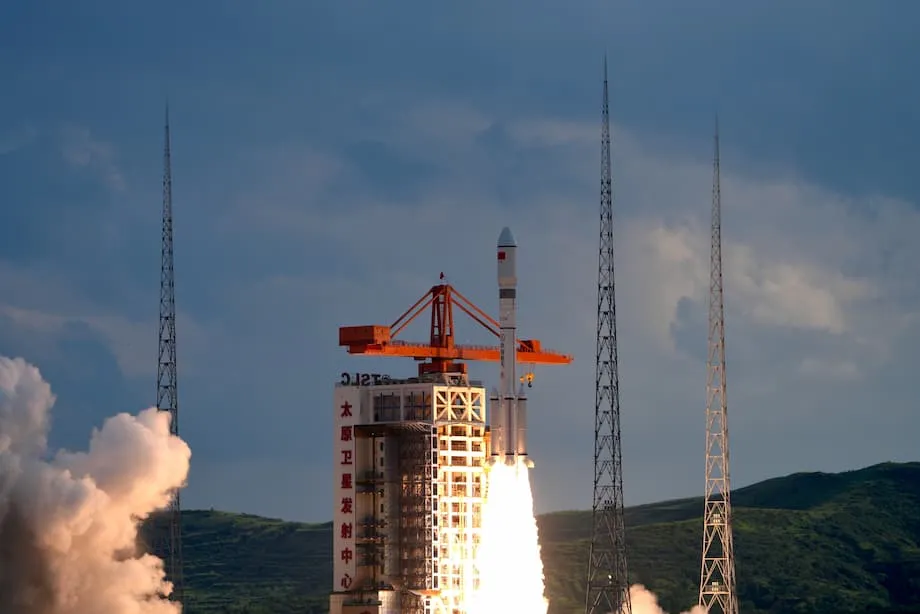
The launch vehicles include the Long March 5B, Long March 6A and Long March 8A. Using several manufacturers and rocket families is intended to increase deployment speed and make the program more resilient, rather than tying its progress to a single production line or launch system.
A Guowang launch typically carries eight to ten large satellites. Each mission currently carries fewer satellites than a Starlink launch, partly because Guowang's satellites are larger and more complex. Reaching a planned fleet of nearly 13,000 therefore requires a sustained increase in launch activity.
China Aerospace Science and Technology Corporation, known as CASC, and other aerospace groups are increasing satellite production and developing reusable rockets to support that demand. Local governments are also investing in space industry parks and launch centers. Rocket production, launch frequency and satellite management must all expand together for the constellation to grow at the intended pace.
Why US Defense Officials Are Watching
US defense officials are concerned that Guowang could give China's military capabilities resembling those available to the United States through Starlink and classified military satellite networks. A large constellation could provide communications across a wide area while making the service difficult to disrupt completely.
Guowang's combination of laser communications, radar imaging and optical sensors could support a "kill web": a network that connects the detection of an adversary with tracking, targeting and a possible strike. In simple terms, information gathered in one place could be passed rapidly to forces operating somewhere else.
US defense analysts have warned about that potential military role:
Guowang could give China a head start in building a space-based kill chain for targeting and striking adversaries.
The architecture resembles more than a commercial internet network. Comparisons also extend to Starshield and the US Space Development Agency's planned satellites for tracking missiles. Guowang's global reach and resilience could create particular difficulties for US and allied forces in a future conflict in the Western Pacific.
China's progress has prompted calls within the US military for counter-space capabilities, meaning tools intended to prevent an opponent from using space systems effectively. Those calls include electronic warfare and anti-satellite weapons that could deny China access to such a network during a crisis.
Connectivity, Sovereignty and the Digital Silk Road
China's reasons for building Guowang combine national security, commercial development and international influence. Digital sovereignty, in this context, means maintaining control over important communications services and data rather than depending on networks controlled abroad.
Guowang is intended to help keep China's military and critical infrastructure independent of foreign communications providers. It also fits into the Digital Silk Road, through which China seeks to extend connectivity and influence to developing countries and strategic partners.
China presents the project as a peaceful development effort that can help close gaps in internet access. State media highlight possible benefits for rural communities, disaster response and economic modernization, while giving less attention to military uses.
The planned commercial applications include fast internet access in underserved regions, smart cities, autonomous vehicles and the Internet of Things. The last term refers to connected devices that exchange information, rather than people alone using phones or computers.
Guowang's proposed phased-array antennas and laser links between satellites mirror technologies used by Starlink. Phased-array antennas steer signals electronically, while links between satellites can carry data through the network. The goal is broadband with high capacity and low latency, meaning a short delay between sending information and receiving a response.
China's Wider Constellation Push
Guowang is one part of a broader Chinese effort in satellite internet. Qianfan, meaning "Thousand Sails," and Hongyan are also being developed with similar ambitions. Together, these projects reflect China's determination to compete for a leading position in low Earth orbit.
The projects connect industrial policy with security objectives. Satellite factories, launch centers, reusable rockets and communications equipment all contribute to the ability to build and maintain large networks. China's large industrial base and state direction could help Guowang accelerate from its present stage.
Starlink nevertheless has an established advantage in deployment. Its fleet of more than 8,000 satellites, millions of users, frequent launches and advanced technology have set the pace for broadband constellations. Guowang is launching fewer satellites per mission and has so far expanded more slowly.
China's approach combines commercial and military purposes with the Digital Silk Road's international goals. Amazon's Project Kuiper and other proposed networks are also competing for a share of satellite internet services, adding to the number of operators seeking access to an increasingly crowded orbital environment.
The Work Needed to Reach Global Coverage
Guowang's scale creates connected technical and logistical demands. China needs a larger and sustained flow of rockets, enough satellites to fill them, ground infrastructure capable of handling the service and management systems that can coordinate thousands of spacecraft.
Launching eight to ten satellites at a time means that even repeated successful missions add only a small part of the planned 12,992 spacecraft. Larger and more complex satellites also make increasing the number carried on each mission a challenge.
China may need new launch vehicles capable of flying more frequently, alongside increased rocket production. Reusable rockets are part of the industrial response, but the deployment effort also depends on factories, launch facilities and operations on the ground working at a matching pace.
The project's final global coverage depends on those capabilities developing together. Guowang's exact launch schedule, detailed payload information and the full scope of its objectives have not been publicly set out in official announcements.
More Satellites Mean More Collision Risks
Guowang's growth adds to concern about space debris, including spent rocket stages left after launches. Such stages can remain in orbit for decades, creating objects that other spacecraft must avoid.
China has faced international criticism over uncontrolled rocket reentries and limited transparency about measures to reduce debris. Some newer rockets can remove themselves from orbit, while older models can leave spent stages at higher altitudes for long periods.
Space sustainability specialists have warned about the danger of a chain reaction:
The growing number of satellites and debris increases the risk of Kessler Syndrome, where collisions create a cascade of further debris.
Kessler Syndrome describes a process in which one collision creates fragments that strike other objects, producing still more fragments. A sufficiently serious cascade could make parts of low Earth orbit unusable.
Starlink and other large constellations also contribute to congestion. More spacecraft complicate scientific observations and increase the risk of accidents. The shared problem has brought calls for international cooperation and stronger regulation to protect the long term use of Earth's orbital environment.
Secrecy Adds to Strategic Suspicion
China's limited public detail about Guowang has increased concern abroad that the constellation's capabilities could extend well beyond civilian broadband. Official announcements often omit information about payloads, objectives and launch schedules.
A Western space policy analyst described the concern over information sharing:
Transparency is a major issue, with China often criticized for not sharing trajectory information and for not adhering to international best practices.
Trajectory information describes where an object is traveling. Sharing it helps operators understand the movements of spacecraft and rocket stages, an increasingly important task as more satellites enter orbit.
The United States and its allies are watching Guowang closely, with some officials calling for more investment in counter-space technology and stronger space situational awareness. That means knowing what is in orbit, where it is moving and whether it could threaten another object.
The wider space community is also urging China to improve debris mitigation and share trajectory information more openly. Beijing's emphasis on development and connectivity sits alongside foreign concern about surveillance, military communications and the difficulty of disrupting a large satellite network during conflict.
What Is at Stake Beyond Internet Service
Guowang brings together three forms of competition: the commercial contest to connect customers, the strategic contest to control vital communications, and the shared challenge of keeping orbit usable. Progress in one area affects the others because civilian services and military operations can rely on similar technologies.
For China, a resilient communications network could support economic growth, technological independence and military coordination. For US and allied forces, a Chinese constellation with worldwide reach could complicate operations and reduce the advantage provided by their own space networks.
Control of low Earth orbit is increasingly treated as part of national security and technological leadership. Secure communications and intelligence delivered rapidly from space could influence the outcome of future conflicts. At the same time, a growing population of satellites and debris increases risks for every country using the same orbital environment.
Guowang's next challenge is to turn an enormous planned fleet into reliable coverage while increasing manufacturing and launch capacity. Its expansion also strengthens the need for shared rules, better information about spacecraft movements and measures that limit the debris left behind.
Key Points
- China's Guowang plan calls for 12,992 satellites in low Earth orbit under the management of China SatNet.
- The project began formally in 2021, and at least eight launches had been completed by mid-2025.
- Guowang aims to provide global broadband, secure communications and services for civilian and military users.
- US defense concerns center on the potential to connect surveillance, tracking, targeting and military communications.
- Typical launches carry eight to ten large satellites, creating major demands for production, rockets and ground infrastructure.
- Starlink has already deployed more than 8,000 satellites and serves millions of users, while Guowang remains at an earlier stage.
- Debris, orbital congestion and limited public information about Guowang remain central concerns as satellite networks expand.