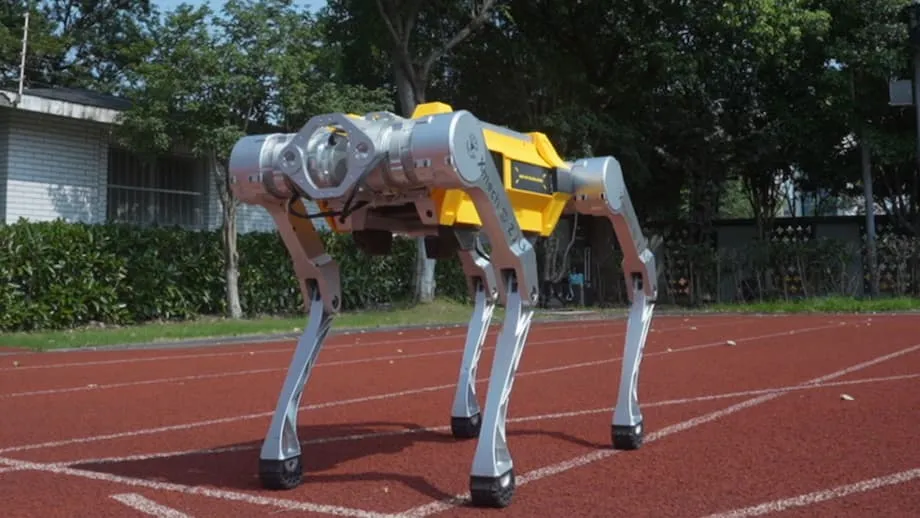
A record sprint in Hangzhou
A robot with four legs developed at Zhejiang University in eastern China has completed a 100-metre sprint in 16.33 seconds, beating the previous quadruped robot record of 19.87 seconds held by South Korea's Hound. Named White Rhino, the machine made its record run at a test site in Hangzhou, Zhejiang Province, on May 27, 2025.
Contents
The achievement, recognised by Guinness World Records, puts a precise number on progress in legged robotics. White Rhino covered the distance 3.54 seconds faster than Hound, cutting the previous time by about 17.8 percent. Across the full 100 metres, its average speed was approximately 6.12 metres per second.
White Rhino also has a maximum carrying capacity of 100 kilograms, or about 220 pounds, according to its development team. Speed and carrying capacity are central to the project's ambition: to build a machine that can move quickly and perform demanding work.
Professor Wang Hongtao led the project, bringing together researchers from Zhejiang University's Center for X-Mechanics, its School of Aeronautics and Astronautics, and the Hangzhou Global Scientific and Technological Innovation Center. Their work combined the design of the robot's body, powerful joints and control software from the beginning.
The 100-metre result is still slower than Usain Bolt's human world record of 9.58 seconds, set in 2009. For the Zhejiang team, however, the sprint provides a way to test several engineering problems at once: generating force, moving the legs quickly, staying balanced and controlling each step.
What the 100-metre test demands
A robot sprint requires more than motors capable of turning quickly. Every push against the ground must move the body forward while keeping it stable enough for the next foot to land. Small errors become harder to correct as speed rises.
White Rhino's sprint tested its explosive power, sustained speed, stability and precise control together. The machine had to coordinate rapid movement while responding to small disturbances, making the distance a useful benchmark for the whole system.
Wang Hongtao, the professor leading the project, described what the result meant for the team's engineering approach:
The 100-meter sprint tests the robot's explosive power, speed, stability, and precise control. Achieving this record validates our technological direction and opens new possibilities for real-world applications.
The project's key dates and comparisons place that achievement in context:
- 2009: Usain Bolt set the human 100-metre world record of 9.58 seconds.
- Before White Rhino's run: South Korea's Hound held the quadruped robot record at 19.87 seconds.
- May 27, 2025: White Rhino completed 100 metres in 16.33 seconds at a test site in Hangzhou.
- August 15, 2025: The project is focused on turning its sprinting and carrying capabilities into practical utility.
The result also demonstrates why a familiar sporting distance can be useful in robotics. A single finishing time brings together the effects of the machine's structure, motor performance and movement control, allowing progress to be expressed in a way readers can readily understand.
Designing the whole robot together
Zhejiang University's team used what it calls a robot forward design approach. Instead of taking an existing robot and adjusting individual parts, the researchers began from scratch, using computer simulations to model the movement of every joint and actuator.
An actuator is a component that turns energy into movement. In White Rhino, the joint actuators perform a role comparable to muscles: they supply the force that moves the legs and pushes the body forward. Their performance depends on how they fit into the rest of the machine.
The simulations allowed the researchers to optimise the robot's geometry, motor specifications and reduction systems together. Geometry concerns the shape and arrangement of the body and legs. Reduction systems adjust how motor movement is delivered at the joints, affecting the balance between speed and turning force.
The team described this process as producing a globally optimal design. Rather than improving one component in isolation, the approach seeks the best combined result across the machine. A motor, joint and leg structure must work well together for their individual strengths to translate into a faster sprint.
This integrated design method is one of the project's central lessons. Hardware determines what movements are physically possible, while software determines how effectively the robot uses those capabilities. White Rhino's development treated both as parts of the same engineering problem from the outset.
The joints supplying the power
The Center for X-Mechanics built White Rhino's custom joint actuators. These components have high power density, meaning they can deliver substantial power for their size or weight. They also provide high torque and a rapid response.
Torque is turning force. At a robot's joint, it helps determine how forcefully a leg can push or change position. Rapid response allows the joint to act quickly when the controller requests a movement or a correction.
White Rhino needs both properties to sprint. A forceful push helps drive its body forward, while a quick leg swing prepares the next step. The actuators must also respond to adjustments that keep the machine balanced as its feet repeatedly leave and meet the ground.
The developers compared this hardware to a racing-grade muscular system, drawing a parallel with the explosive muscle power of elite athletes. The comparison explains the actuators' role: they supply the physical effort, while the control system coordinates when and how that effort is used.
How the robot learns to run
White Rhino's movement is controlled by a strategy developed through reinforcement learning, a branch of artificial intelligence in which a system improves through trial and error. The team used simulation to let the robot learn effective movement patterns.
In simple terms, the software tries ways of moving in a computer model and learns which actions produce better results. This gives the researchers a method for developing coordinated motion across multiple joints, rather than specifying every movement separately.
The resulting control strategy coordinates powerful pushes, rapid leg swings and continual balance corrections in real time. The robot must perform those actions as a connected sequence: pushing hard is useful only if the next leg movement and foot placement keep the run under control.
White Rhino's software and custom actuators therefore address different parts of the same task. The hardware supplies force and speed. The learned controller organises those capabilities into stable motion, supporting fast running even under challenging conditions.
The project also uses multi-objective optimisation, which means tuning several design goals together. For White Rhino, that includes geometry, motor specifications and reduction systems, with the aim of balancing speed, power and stability across the complete robot.
Speed alongside a 100-kilogram capacity
White Rhino's developers point to its maximum load of 100 kilograms as another important feature. Carrying tools, supplies or equipment requires strength as well as the balance needed to move the combined weight.
Cheng Shaowen, a member of the development team, described the combination of capabilities:
Most notably, its maximum load is 100 kilograms, making it a quadruped robot capable of both high-speed running and heavy-load performance.
The load carried during the record sprint was not specified. The 16.33-second time is the sprint result, while 100 kilograms is the maximum carrying capacity stated by the team.
Many research robots are designed primarily for agility or for carrying loads. White Rhino's developers seek to combine both, giving the machine a role beyond speed demonstrations. A robot intended to transport equipment needs enough strength to carry it and enough control to move reliably.
Other prominent quadruped robots, including Boston Dynamics' Spot and MIT's Cheetah, have attracted attention for agility and movement through complex environments. White Rhino's defining combination is its sprint performance and capacity for heavy loads, capabilities the team sees as useful for demanding work.
How its speed compares
Hound's previous record of 19.87 seconds gives the clearest direct comparison for White Rhino's 16.33-second run. Both figures describe a quadruped robot covering 100 metres, with White Rhino reducing the time by more than three and a half seconds.
Usain Bolt's 9.58-second human record remains 6.75 seconds faster than White Rhino's result. The animal comparison given for the project is a cheetah, which can cover about 100 metres in six seconds.
- White Rhino: 16.33 seconds over 100 metres.
- Hound, the previous quadruped robot record holder: 19.87 seconds.
- Usain Bolt: 9.58 seconds, the human world record set in 2009.
- Cheetah: approximately six seconds over 100 metres.
White Rhino's improvement narrows the speed gap between legged machines and biological runners. Further advances in actuators, structure and control could allow robots to rival or surpass biological counterparts in certain tasks. The practical purpose of the Zhejiang project is to connect that progress in movement with useful work.
Where the team wants White Rhino to work
The Zhejiang University team envisages applications in search and rescue, logistics, military and security work, and industrial automation. Each would draw on a different combination of the robot's speed, strength and stability.
In disaster response, the aim would be to reach people quickly in places inaccessible to wheeled vehicles. For logistics, the robot could carry supplies, tools or sensors across rough or hazardous terrain. Its capacity for heavy loads is especially relevant to those transport tasks.
Military and security uses could include moving equipment or conducting reconnaissance in dangerous areas. Industrial uses could involve tasks where stable movement and speed are important, while infrastructure inspection is another possible role for increasingly capable legged machines.
Wang described the ambition as moving from "running fast" to "running usefully." That means connecting performance demonstrated in testing with the demands of an actual job: reaching a location, carrying what is needed and operating reliably in the surrounding environment.
Industry observers see advances in speed, agility and carrying capacity as factors that could encourage wider adoption of legged robots. For White Rhino, the team's development priorities centre on making those capabilities practical in disaster zones, industrial sites and other demanding settings.
The work beyond the sprint
Zhejiang University's researchers are working on robustness, energy efficiency, autonomous navigation and environmental awareness. Robustness means reliable operation when conditions are unpredictable. Energy efficiency means using less power so the robot can operate for longer and travel farther.
Autonomous navigation would allow White Rhino to make movement decisions and find its way through complex terrain without continuous human intervention. Better perception systems would help it detect and understand its surroundings before choosing where to move.
These priorities connect directly to the proposed jobs. A rescue robot needs to cope with uncertain surroundings. A machine carrying supplies needs sufficient operating time and range. An industrial robot needs dependable movement through the place where it works.
White Rhino also reflects China's investment and growing expertise in robotics and artificial intelligence. China has made robotics a strategic priority, with universities and research centres developing machines intended to extend the capabilities of existing designs.
The record places the Zhejiang team among prominent quadruped robotics developers, challenging established work in the United States, South Korea and elsewhere. Competition and collaboration across countries could drive further advances, while White Rhino's immediate challenge is to turn its combination of speed, strength and control into reliable service.
Key Points
- White Rhino ran 100 metres in 16.33 seconds in Hangzhou on May 27, 2025, earning recognition from Guinness World Records.
- The Zhejiang University robot beat South Korea's Hound, the previous record holder, by 3.54 seconds.
- Professor Wang Hongtao led a team combining expertise from three university research organisations.
- The design combines custom joint actuators, computer simulation, reinforcement learning and joint optimisation of hardware and software.
- The team states a maximum carrying capacity of 100 kilograms, or about 220 pounds.
- Proposed applications include rescue, logistics, military and security tasks, industrial automation and infrastructure inspection.
- Further work focuses on reliability, energy efficiency, environmental awareness and autonomous navigation.