Foshan Faces a Rapidly Growing Mosquito Outbreak
More than 8,000 chikungunya cases were reported in Guangdong province in about a month during the summer of 2025, prompting Chinese authorities to deploy hospital quarantine, mass insecticide spraying, home inspections and penalties for failing to remove mosquito breeding sites. Most infections were concentrated in Foshan, a manufacturing hub where the outbreak began with an imported case on July 8.
Contents
- Foshan Faces a Rapidly Growing Mosquito Outbreak
- What Chikungunya Does to the Body
- Why the Virus Spread So Quickly in Guangdong
- Hospital Isolation Targets the Mosquito Transmission Cycle
- Spraying, Drones and Biological Controls
- Household Orders Came With Penalties
- Residents Weigh Protection Against Intrusion
- What Health Specialists and Officials Said
- Travel Alerts and a Wider Global Threat
- How People Can Reduce Their Risk
- Containment and Consent Remain Central
- Key Points
By August 9, the outbreak had become the largest ever recorded in mainland China. Authorities were drawing on methods familiar from the COVID-19 pandemic, including intensive community monitoring and compulsory measures, while also using drones, artificial intelligence and biological mosquito control.
The disease presents a different containment problem from COVID-19. Chikungunya does not spread directly from person to person. An infected mosquito passes the virus to a person through a bite, and another mosquito can pick it up by biting that infected person. Breaking that cycle means keeping mosquitoes away from patients as well as reducing the insects around homes, workplaces and public spaces.
Guangdong's response brought that distinction into daily life. Patients were placed in hospital wards behind mosquito nets and screens, residents were told to empty containers holding water, and workers sprayed streets and parks. Some people accepted the intervention as necessary. Others described intrusive inspections, forced entry and health checks that revived memories of the zero-COVID period.
The immediate challenge was to stop a fast outbreak in a densely populated region with little prior immunity and no widely available vaccine in China. The wider debate concerned how far authorities should go when controlling a disease that can cause lasting pain but rarely kills.
What Chikungunya Does to the Body
Chikungunya is a viral disease carried mainly by Aedes aegypti and Aedes albopictus mosquitoes. It was first identified in Tanzania in 1952. Its name comes from the Kimakonde language and means "that which bends up," describing the bent posture of people suffering severe joint pain.
Symptoms usually begin three to seven days after an infected mosquito bites someone. They include high fever, intense joint pain, headache, muscle pain, rash and fatigue. Most people recover within a week, although joint pain can continue for months or even years in some patients.
Newborns, older people and those with underlying health conditions face a greater risk of severe illness. Serious complications and deaths are rare, but complications can affect the eyes, heart or nervous system. A low death rate therefore exists alongside the possibility of prolonged suffering.
An infected person can pass the virus to mosquitoes for about a week after becoming ill. Those mosquitoes can then infect other people. This explains why mosquito protection around patients matters: a mosquito that reaches an infected person can become the next link in the chain of transmission.
Why the Virus Spread So Quickly in Guangdong
Foshan's imported case on July 8 was followed by a rapid increase in infections. Heavy rainfall, high temperatures and a population lacking immunity helped the virus spread. Rain creates pools and fills containers with water where mosquitoes can breed, while warm conditions favour the insects.
Guangdong's outbreak also reflected broader risks associated with urban expansion, international travel and climate change. Travel can carry the virus into a new place through an infected person. Local transmission can then develop where the mosquitoes capable of carrying it are present.
The outbreak's key stages were:
- July 8, 2025: An imported case in Foshan marked the beginning of the outbreak.
- During the following month: More than 8,000 cases were reported in Guangdong, primarily in Foshan.
- By August 9, 2025: Authorities had launched extensive mosquito control and patient isolation measures, while new cases were described as plateauing.
China's lack of prior population immunity helped make a newly introduced virus a substantial public health challenge. The combination of susceptible residents and favourable mosquito breeding conditions gave authorities reason to act quickly.
Hospital Isolation Targets the Mosquito Transmission Cycle
Infected people were quarantined in hospital wards, often protected by mosquito nets and screens. They remained there until they tested negative or had stayed for at least a week. Although chikungunya does not pass directly between people, keeping mosquitoes away from infected patients can interrupt onward transmission.
The hospital measures were among the clearest reminders of China's pandemic response. They placed people under institutional control during an infection, even though the route by which this virus spreads differs from that of COVID-19.
Guangdong did not introduce citywide lockdowns. Most people were not subject to strict quarantine unless they were infected. Community workers concentrated on spraying insecticide, distributing repellents, registering residents and other supporting measures, rather than enforcing widespread isolation.
The difference mattered for residents trying to continue ordinary life. The response was less severe than the zero-COVID controls, yet hospital quarantine and close neighbourhood supervision still brought back fears of renewed restrictions.
Spraying, Drones and Biological Controls
Soldiers and workers sprayed insecticide across parks, streets and residential areas. Community workers inspected homes and ordered residents to remove standing water, aiming to reduce both adult mosquitoes and the places where a new generation could develop.
Drones equipped with sensors using artificial intelligence scanned neighbourhoods for stagnant water. Finding mosquito hotspots quickly allowed authorities to direct interventions towards areas where the insects were likely to breed.
Authorities also released thousands of fish that eat mosquitoes into city ponds. Another biological measure involved laboratory bred "elephant mosquitoes," which do not bite humans. Their young prey on the larvae of mosquitoes that can carry viruses, helping reduce the population of potential carriers.
These methods worked at different stages of mosquito development. Spraying targeted insects already present, removing water reduced breeding opportunities, and biological controls attacked mosquitoes through predators. Together, they formed a broader campaign than insecticide spraying alone.
The combination of drones, artificial intelligence and laboratory bred mosquitoes offered a possible model for future responses to diseases spread by mosquitoes. Their use in Guangdong also showed how technology could be paired with routine work such as checking ponds, emptying containers and cleaning residential areas.
Household Orders Came With Penalties
Residents who failed to comply with mosquito control orders could face fines of up to 10,000 yuan, about $1,400, electricity cutoffs or even criminal charges. Pharmacies tracked purchases of medicines for fever and pain, bringing privacy concerns into the public health response.
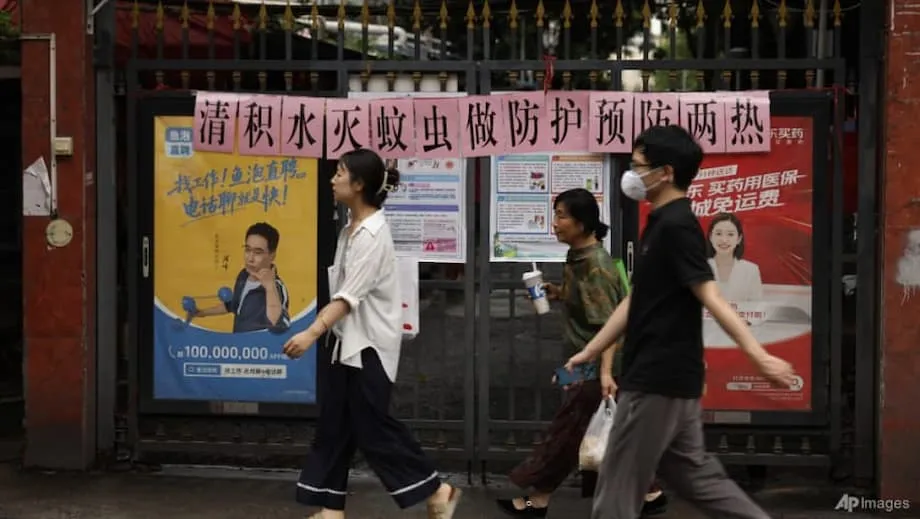
Authorities urged people to join a "patriotic health campaign" by cleaning homes and workplaces every day to eliminate mosquito breeding sites. Skyscrapers displayed health messages, while government employees were required to check for standing water before leaving work.
For households, the campaign meant that containers, plants and other places capable of collecting water became subjects of official attention. Some residents described officials or landlords forcing their way into homes and destroying plants suspected of holding water.
A widely reported incident involved community workers forcibly taking a blood sample from a child with a fever after the parents initially refused. The episode prompted complaints about overreach and became an example of how efforts to find infections could turn into a dispute over consent.
The campaign's strength lay in its ability to mobilize large numbers of people quickly. Its pressure on households also brought questions about privacy and civil liberties into a response centred on mosquito control.
Residents Weigh Protection Against Intrusion
Some residents supported strict measures, particularly after experiencing chikungunya themselves. Severe joint pain and fever made the threat tangible, and reducing mosquitoes offered a practical way to protect families and neighbours.
Other residents worried about forced entry, surveillance and intrusive health checks. Social media discussions drew comparisons with COVID-19 controls, with users expressing anxiety about the possible return of lockdowns and mass quarantine.
Some residents and specialists questioned whether the scale of compulsory intervention matched a disease with low mortality and no direct transmission between people. They favoured more targeted measures, including public education and environmental management, with less reliance on legal penalties and mass mobilization.
Guangdong's experience placed two concrete needs alongside each other: controlling mosquito breeding across entire communities and maintaining residents' willingness to cooperate. Inspections and cleaning orders could reach places where mosquitoes were multiplying, while coercive encounters risked deepening resistance to the campaign.
What Health Specialists and Officials Said
Dr. César López-Camacho of the University of Oxford described the scale of the outbreak as unprecedented in China, though larger epidemics have occurred elsewhere. He stressed mosquito control, surveillance and public education, particularly as climate change expands the range of Aedes mosquitoes.
Public health specialists were divided over the necessity and effectiveness of China's response. Rapid spread, dense populations, little prior immunity and limited vaccine availability in China supported urgent containment. Others regarded mass mobilization and intrusive measures as disproportionate for an illness that is rarely fatal.
The World Health Organization and the United States Centers for Disease Control and Prevention recommend prevention through repellents, protective clothing and removing mosquito breeding sites, rather than mass quarantines. These measures address the insects that carry the virus and the places where they reproduce.
A spokesperson for the Science Media Centre described the outbreak as a warning about preparedness and identified surveillance, vaccines and mosquito control as continuing priorities:
The outbreak in China is a reminder of the importance of preparedness for mosquito-borne diseases. Ongoing surveillance, vaccine access, and vector control are essential as climate change and urbanization increase risks.
China's National Health Commission, led in this response by Deputy Director Shen Hongbing, called for rapid containment, better sanitation and public mobilization. The government's broader system for managing viruses carried by mosquitoes included risk warnings in real time and community participation. It was presented as a potential template for other developing countries confronting similar challenges.
Vector control means controlling the organism that carries a disease between people. In this outbreak, the vector is the mosquito. That puts preventing bites and reducing mosquito numbers at the centre of both individual protection and the government's campaign.
Travel Alerts and a Wider Global Threat
The United States CDC issued a Level 2 travel advisory for the outbreak, urging travellers to take extra precautions and consider vaccination when visiting affected areas. Canada and other countries updated their travel advice. Hong Kong and Macao reported their first cases linked to travel or local transmission.
More than 240,000 chikungunya cases had been reported worldwide in 2025, with the highest numbers in Brazil, Bolivia, Argentina and Peru. Guangdong's outbreak was a record for mainland China, while the disease was already affecting much larger populations internationally.
Climate change creates warmer and wetter conditions that can favour mosquito breeding. Urban expansion and greater international travel add opportunities for viruses to reach new communities and circulate there. Aedes mosquitoes have expanded into new regions, including parts of Europe and North America, putting previously unaffected populations at risk.
The risk of a global pandemic remained low because transmission requires the appropriate mosquito species. The practical concern was repeated outbreaks in places where those mosquitoes are present, particularly when residents have little immunity.
Guangdong's experience therefore mattered beyond southern China. It illustrated how an imported infection, suitable weather and local mosquito populations could combine to create a large outbreak within weeks.
How People Can Reduce Their Risk
No specific antiviral treatment exists for chikungunya. Care focuses on rest, fluids and medicines to ease symptoms, including acetaminophen. Most patients recover fully, although persistent joint pain can extend the impact long after the initial fever has passed.
Aspirin and other nonsteroidal anti-inflammatory drugs should be avoided until dengue fever has been ruled out because they can increase the risk of bleeding. That precaution matters when choosing medicine for an illness involving fever and pain.
The WHO and CDC recommend several practical ways to prevent mosquito bites and reduce breeding:
- Use insect repellent containing DEET, picaridin or IR3535.
- Wear shirts with long sleeves and long pants.
- Stay in accommodation with screens or air conditioning.
- Remove standing water in and around homes.
- Use mosquito nets, particularly for infants, older people and those with chronic illnesses.
Two vaccines, IXCHIQ and VIMKUNYA, were approved in the United States, Canada and parts of Europe, primarily for travellers and groups at higher risk. They were not yet widely available in China or many of the countries most affected by chikungunya.
For residents of Guangdong, prevention combined personal protection with work around the home. Repellent and clothing reduced the chance of being bitten, while emptying standing water reduced places where mosquitoes could breed near other people.
Containment and Consent Remain Central
Guangdong's aggressive response likely contributed to the plateauing of new cases. It showed the capacity of centralized public health mobilization to bring hospitals, community workers, government employees and households into a common campaign.
The same response revived debates about privacy, proportionality and whether mass mobilization is sustainable for diseases with low mortality. Hospital quarantine, pharmacy monitoring and forced inspections carried consequences beyond mosquito control, particularly for residents who felt they had little choice.
Drones, artificial intelligence and biological controls offered new tools, while daily cleaning and removing water remained basic parts of prevention. The experience placed community engagement and transparent communication alongside technology as central parts of outbreak management.
As of August 9, Guangdong was confronting both an immediate outbreak and the longer challenge of preparing for diseases whose mosquito carriers are reaching more places. Its response brought older methods of intensive public mobilization to a new threat, with continuing debate over the boundary between necessary intervention and overreach.
Key Points
- Guangdong reported more than 8,000 chikungunya cases in about a month, mainly in Foshan, in mainland China's largest recorded outbreak.
- The outbreak began with an imported case on July 8, 2025, and spread amid heavy rainfall, high temperatures and little population immunity.
- Authorities used hospital quarantine, insecticide spraying, home inspections, drones, fish and laboratory bred mosquitoes.
- Failure to follow mosquito control orders could bring fines of up to 10,000 yuan, electricity cutoffs or criminal charges.
- No citywide lockdowns were imposed, but intrusive checks and forced entry drew complaints and comparisons with zero-COVID controls.
- Chikungunya spreads through infected mosquitoes, causes fever and sometimes lasting joint pain, and has no specific antiviral treatment.
- Travel alerts, mosquito protection and limited vaccine access formed part of the wider response as cases rose internationally.