A new rehabilitation study moves into clinical testing
A clinical study in Tianjin will test whether reading a stroke patient's intention to move, stimulating spinal nerve circuits and supporting steps with a robotic exoskeleton can work together safely. The project completed registration with China's National Health Commission on November 5, becoming the first noninvasive brain interface study registered under biomedical technology regulations that took effect in May 2026.
Contents
- A new rehabilitation study moves into clinical testing
- Who the treatment is intended to help
- How the brain, spine and legs are connected
- Why timing and active participation matter
- What registration changes
- Patient screening remains essential
- What other patients' experiences reveal
- Costs and access extend beyond the device
- What the Tianjin research must answer
- Key Points
The study targets people whose leg movement remains impaired long after a stroke and whose progress with conventional rehabilitation has slowed. Its immediate task is to examine the safety and feasibility of combining these technologies in a supervised clinical setting.
Researchers at Tianjin University's Haihe Laboratory of Brain Computer Interaction and Human Machine Integration developed the core system, called Shengong-Shenchi. Tianjin Huanhu Hospital will conduct the clinical research, with devices prepared jointly by Suishi (Tianjin) Intelligent Technology and Beijing PINS Medical.
The study's title describes its scope: an exploratory investigation of spinal cord stimulation combined with a noninvasive brain controlled hybrid exoskeleton for lower limb movement difficulties after chronic stroke. Spinal cord stimulation is commonly shortened to SCS.
For patients and families, the central goal is concrete: make rehabilitation respond to a person's own attempt to move, while coordinating assistance through the spinal cord, leg muscles and walking equipment. Whether this particular combination can produce lasting improvements in walking is a question for the clinical research.
Who the treatment is intended to help
A stroke occurs when a blood vessel supplying the brain becomes blocked or ruptures, damaging brain tissue. Depending on the location of that damage, a survivor may have difficulty moving an arm or leg, speaking or managing everyday tasks.
The National Center for Neurological Disorders' China Neurological Disease Report 2024, released in 2025, identifies stroke as China's leading cause of death and disability among adults. It says 70% to 80% of survivors have some degree of disability. Expressed simply, that is roughly seven or eight out of every 10 survivors.
The Tianjin project focuses on a narrower group: people with chronic stroke who have persistent difficulty moving their legs and have reached a rehabilitation plateau. A plateau means that improvement has slowed or levelled off despite continued treatment.
Some of these patients have hemiplegia, meaning paralysis affecting one side of the body. Difficulty controlling one leg can make standing, keeping balance and walking much harder, increasing dependence on another person or a mobility aid.
The researchers hope that coordinating several forms of assistance will help patients whose existing rehabilitation has delivered limited further progress. Their planned approach places the patient's movement intention at the beginning of each assisted action.
How the brain, spine and legs are connected
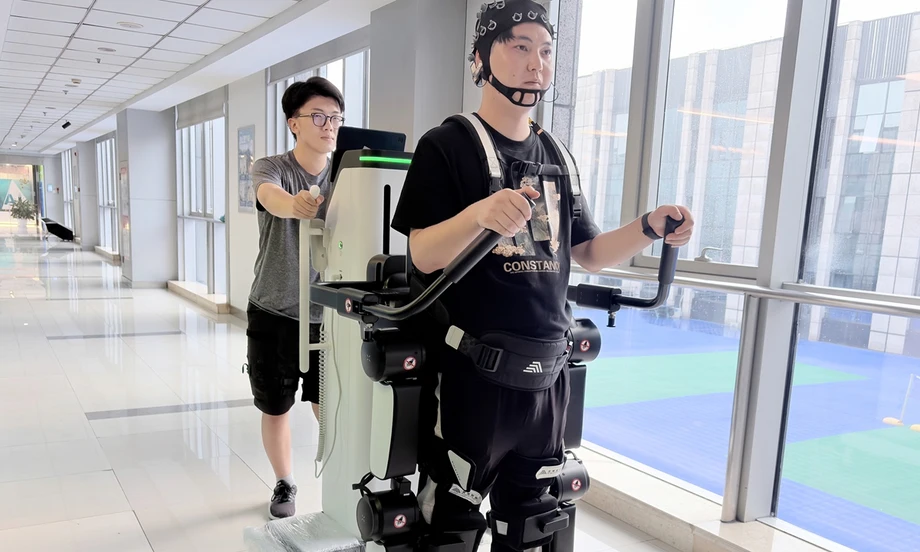
Shengong-Shenchi combines a noninvasive brain interface, spinal cord stimulation, a hybrid exoskeleton and functional electrical stimulation of a leg muscle. Each component has a different job within the same rehabilitation sequence.
The brain interface decodes signals associated with imagining a movement. In this type of rehabilitation, a patient actively imagines moving rather than simply waiting for a machine to move a limb. A noninvasive brain interface records brain activity without implanting electrodes in the brain.
Spinal cord stimulation then changes how readily spinal nerve circuits respond to signals. The exoskeleton, a wearable mechanical frame, helps carry out the stepping movement. Functional electrical stimulation also activates the tibialis anterior, a muscle at the front of the lower leg that helps lift the foot during walking.
The team describes this arrangement as a chain linking brain driven intention, spinal transmission and movement in the limbs. Its engineering challenge is to synchronize intention decoding, spinal stimulation and assisted stepping with timing measured in milliseconds.
The noninvasive description applies specifically to the brain interface. The project announcement does not specify how the spinal stimulation equipment will be placed, so patients will need the clinical team's explanation of the procedures involved in the complete intervention.
Why timing and active participation matter
A walking movement involves messages travelling in both directions. The nervous system sends instructions toward the muscles, while information about limb position and movement travels back toward the brain. This returning information is called proprioception, the sense that helps someone know where a leg is without looking at it.
The Tianjin team aims to bring these outgoing and returning signals into close alignment. When a patient imagines a step and receives coordinated movement assistance and sensory feedback, the researchers hope repeated practice will encourage neuroplasticity, the nervous system's capacity to change its connections and activity.
Ye Xiangming, director of rehabilitation medicine at Zhejiang Provincial People's Hospital, described the role of active participation in noninvasive brain interface rehabilitation:
Brain computer interfaces have completely changed rehabilitation principles, turning passive training into genuinely active training.
Ye explained that these devices require the patient to imagine movement before an action can be generated. That requirement changes the patient's role during a session: attention and an attempt to move become part of operating the system.
The Tianjin researchers are adding coordinated spinal stimulation to that approach. Their proposed benefit is a closer connection between the patient's intention, the responsiveness of spinal circuits and the assisted movement that follows.
What registration changes
The project was registered under the Regulations on the Administration of Clinical Research and Clinical Translation Applications of New Biomedical Technologies, issued through State Council Decree No. 818. The regulations took effect in May 2026.
Before registration, the team completed scientific review, an assessment of the technical approach's feasibility and a preliminary assessment of ethical risks. Its preparation covered brain signal collection, interventions intended to influence neuroplasticity and participants' psychological safety.
Tianjin's health commission provided registration services. The municipal medical products administration also established a dedicated brain interface service team, providing early guidance, support tailored to individual companies and coordination between research and regulatory review.
The sequence places the November filing within a wider development of clinical practice and payment arrangements:
- March 2025: China's National Healthcare Security Administration established separate medical service pricing items related to brain interfaces.
- August 2025: Zhejiang included the noninvasive brain interface adaptation fee in medical insurance payment.
- February 2026: An expert consensus recommended considering motor imagery based EEG brain interface closed loop training for movement impairment after stroke.
- May 2026: The new national biomedical technology regulations took effect.
- November 5: The Tianjin combined rehabilitation study completed registration under that framework.
The next step is clinical research at Tianjin Huanhu Hospital according to the registered plan. The team intends to continue assessing safety and feasibility while refining rehabilitation arrangements for individual patients.
Patient screening remains essential
Brain interface rehabilitation requires more than placing a recording cap on a patient's head. The person must be able to understand instructions, imagine a movement and sustain enough attention for the system to detect useful signals.
Li Lin, a chief physician in rehabilitation medicine at Zhejiang Hospital, said severe cognitive impairment can prevent a patient from producing the movement imagery needed for training. Poor heart and lung function, unstable vital signs and uncontrolled epilepsy can also make a patient unsuitable.
Li described the need for selection in direct terms:
Brain computer interfaces also have their indications; they are not suitable for everyone.
Clinical experience in Zhejiang also points to the importance of the injury's location and duration. Doctors assess whether relevant nerve pathways retain enough capacity to respond, as well as whether the patient can manage the demands of repeated training.
The February 2026 expert consensus supports the use of motor imagery based EEG brain interface closed loop systems in rehabilitation after stroke. EEG records electrical activity from the brain, while closed loop means that the system links detected activity to a response and feedback during training. The Tianjin study brings spinal stimulation and assisted walking into that cycle.
What other patients' experiences reveal
A 53 year old stroke survivor identified as Lao Zhou began brain interface training after a stroke in autumn 2023 left him with almost no strength in his left arm. Wearing an EEG cap, he practised connecting the intention to move with feedback displayed on a screen.
His early sessions were demanding. The first lasted 20 minutes and left him sweating, while feedback was inconsistent during the first two weeks. After two months, his left index finger moved slightly. He later regained enough movement to perform some everyday tasks with that hand, although its control remained unsteady.
A different rehabilitation experience involved Xiaolu, who suffered a spinal cord injury in 2024 and received a closed loop spinal neural interface at the Second Affiliated Hospital of Zhejiang University School of Medicine in August 2025. After about a year of rehabilitation, she could walk with a walking aid, covering around 100 to 200 metres in daily activity and about 300 metres during training.
Zhu Junming, a chief neurosurgeon at the hospital, explained that her device provides assistance and that recovering her own function requires prolonged rehabilitation. Her walking ability declines when stimulation is switched off.
These experiences show the practical work involved in rehabilitation: repeated sessions, variable progress and continued reliance on assistance. For the Tianjin study, researchers will need to assess both how patients perform during supported training and how their movement changes over time.
Costs and access extend beyond the device
Noninvasive systems account for 86% of China's brain interface market, with rehabilitation departments described as the main clinical setting. Zhejiang has 1,058 valid invention patents related to brain interfaces, more than 90% of them in Hangzhou, illustrating the concentration of development in a major medical and technology centre.
Payment arrangements have also started to develop. The national medical service pricing framework introduced in March 2025 included invasive implantation service fees of approximately 6,000 to 6,600 yuan and a noninvasive adaptation fee of about 960 yuan.
Zhejiang brought the noninvasive adaptation fee into medical insurance payment in August 2025, with patients initially responsible for 10%. Related invasive surgical fees entered coverage in June 2026. Those service items cover specific parts of care; a patient's expenses also depend on devices, rehabilitation and applicable insurance arrangements.
Xiaolu's family described rehabilitation as their largest expense. As an early trial participant, she was not charged for the device, but her mother said rehabilitation costs became entirely their responsibility after insurance coverage for her rehabilitation period ended.
Travel and time can create further demands. Brain interface rehabilitation services in Zhejiang are concentrated in leading hospitals, and treatment may require frequent attendance over consecutive weeks. For someone with impaired walking, reaching those sessions can itself require family support.
What the Tianjin research must answer
Tianjin Huanhu Hospital's study will examine whether the combined intervention is safe and practical for people with chronic stroke and impaired leg movement. The announcement gives no participant number, recruitment timetable, treatment schedule or date for results. It also gives no price or insurance arrangement for this particular combination.
The research team's proposed advance is the coordination of several actions around one intention to move. Brain signal decoding must work alongside spinal stimulation, muscle activation and exoskeleton assistance in a way that patients can tolerate and clinicians can deliver consistently.
For a patient, the useful outcome would be easier movement in daily life, such as standing more securely or needing less help to walk. Establishing how much improvement the system can deliver, how long any gains last and which patients benefit will require clinical measurements over time.
Registration now gives the team a defined framework for conducting that work. Patients who have reached a rehabilitation plateau are the intended participants, and safety and feasibility are the immediate priorities.
Key Points
- The Tianjin study completed national registration on November 5 under biomedical technology regulations effective from May 2026.
- Shengong-Shenchi combines a noninvasive brain interface, spinal stimulation, an exoskeleton and muscle stimulation.
- The study targets persistent leg movement difficulties after chronic stroke, especially when rehabilitation progress has slowed.
- Tianjin Huanhu Hospital will assess the combined approach's safety and feasibility.
- Patient screening, repeated training, costs and access remain practical concerns.
- Participant numbers, recruitment dates and a timetable for results have not been announced.