A minerals proposal reaches a region already at war
The Trump administration was reportedly considering proposals in July 2025 to gain access to rare earth deposits in Myanmar's Kachin State, where control of valuable mining territory has become part of the country's civil war. Options included talks with the Kachin Independence Army (KIA), an attempt to broker peace between the armed group and the military junta, and cooperation with India to process the minerals.
Contents
- A minerals proposal reaches a region already at war
- Why Kachin's minerals attract international interest
- China controls much more than the buying
- What Washington and India were considering
- Roads, borders and diplomacy complicate access
- How extraction damages water and farmland
- Mining income also pays for the war
- Global manufacturers are connected to Kachin's mines
- What residents and campaigners want changed
- A strategic opportunity with competing political goals
- Key Points
As of August 9, 2025, the prospect brought together three urgent problems: US dependence on China for critical materials, armed groups seeking revenue, and communities living with polluted rivers and damaged farmland. No agreement or timetable for a US mining partnership was given.
Kachin, in northern Myanmar along the Chinese border, supplies heavy rare earth elements used in advanced technologies. Myanmar had become China's largest external supplier of these materials by 2024, accounting for about 40% of its imports of key elements such as dysprosium and terbium. The trade was estimated to be worth $1.4 billion annually, although local communities rarely received its benefits.
The KIA seized the Chipwe-Pangwa mining belt in late 2024. That change put an ethnic armed group fighting for autonomy at the centre of discussions about access to minerals that mostly travel to China for processing.
US involvement could create another buyer and another route into international markets. Kachin residents and environmental activists, however, fear that competition for supplies could expand damaging extraction and bring more money into the conflict. The central challenge is how a new supply arrangement would change conditions for people living beside the mines.
Why Kachin's minerals attract international interest
Rare earth elements are a group of 17 chemically similar metals with magnetic, conductive and thermal properties useful in modern equipment. They are used in smartphones, MRI machines, electric vehicles, wind turbines and advanced military technologies. Permanent magnets, which retain their magnetism, are particularly important in electric car motors and wind turbines.
Dysprosium and terbium belong to the especially prized heavy rare earth group. Their value comes from their role in high performance magnets and batteries, making access to them a concern for both industrial manufacturers and governments responsible for defence supplies.
Kachin has emerged as one of the world's most significant sources of heavy rare earths. Mining expanded after Myanmar's military coup in 2021, often through operations described as illegal and largely unregulated. Local militias, the military junta and Chinese companies have all sought access to the region's deposits.
Global Witness's rare earth trade findings described Myanmar's heavy rare earth exports to China as more than doubling between 2021 and 2023. Chinese customs data showed a 70% rise in rare earth imports from Myanmar in 2023, when shipments exceeded 34,000 metric tons.
The export figures help explain why Kachin has attracted attention beyond Myanmar. A region where communities struggle with war and weak regulation has become an important source of materials used by manufacturers around the world.
China controls much more than the buying
China controls nearly 90% of global rare earth processing capacity. Extracting minerals is only the first stage of supplying manufacturers: material from a mine must also be processed before it can be incorporated into components and finished products. Access to Kachin's deposits would therefore address only part of the US supply problem.
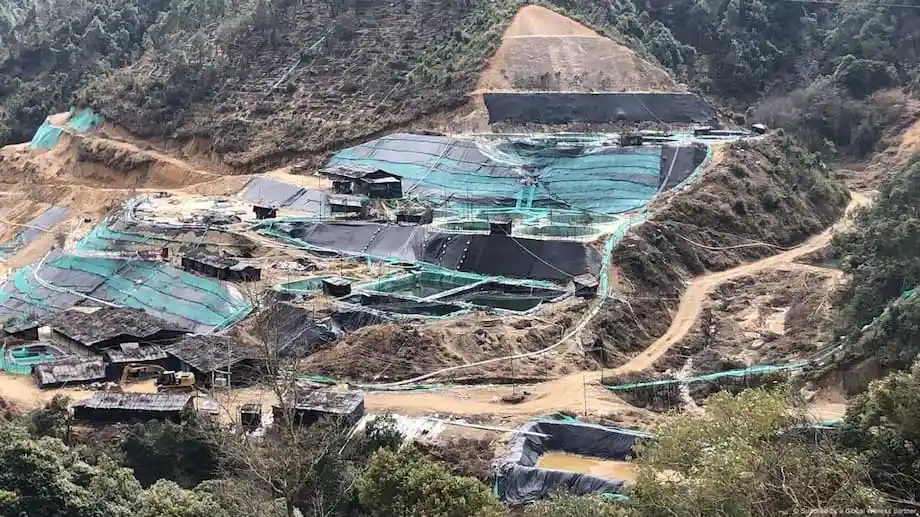
Chinese companies, often working through local proxies, have expanded mining operations in Myanmar by more than 40% in recent years. Forests have been replaced by pits, chemical ponds and areas of barren soil as some of the most environmentally damaging extraction has shifted across the border.
Myanmar's position near China connects the mines to an established processing and manufacturing system. China combines mining, processing and manufacturing within its supply chain, giving it substantial power over global markets. Nearly all US rare earth imports are processed in China, leaving American defence and technology industries dependent on a strategic rival.
Analysts have warned that China is stockpiling minerals imported from Myanmar for possible use in geopolitical disputes or sanctions battles with the West. The reported accumulation adds a strategic concern to an already concentrated market.
New mines are being developed in the United States, Canada and Australia, but they face environmental and regulatory obstacles of their own. US and allied efforts to build independent supply chains have struggled to match China's scale and efficiency.
What Washington and India were considering
The July 2025 access proposals included direct engagement with the KIA, mediation between the KIA and the junta, or cooperation with regional allies such as India. The stated objective was to reduce US dependence on China, secure a stable supply and potentially weaken China's control of the market.
Adam Castillo, the former head of the US Chamber of Commerce in Myanmar, urged Washington to cooperate with the KIA. He described Kachin's mineral deposits in terms of their value to China:
China's golden goose
Indian companies were also exploring access. IREL (India) Ltd. visited Kachin in late 2024 to investigate possible mining deals. India consequently appeared in the discussion both as an interested participant and as a possible location for processing material outside China.
The sequence of developments shows how the proposals followed changes in both mining activity and territorial control:
- 2021: Myanmar's military coup was followed by a surge in rare earth mining in Kachin.
- 2021 to 2023: Myanmar's heavy rare earth exports to China more than doubled.
- 2023: Chinese customs data recorded imports from Myanmar exceeding 34,000 metric tons, up 70% that year.
- 2024: Myanmar became China's largest external supplier of heavy rare earths, with about 40% of imports of key elements such as dysprosium and terbium.
- Late 2024: The KIA seized the Chipwe-Pangwa mining belt, while IREL visited Kachin to explore mining deals.
- July 2025: Proposals for US access included KIA talks, a possible peace arrangement and cooperation with India.
Roads, borders and diplomacy complicate access
Kachin's infrastructure presents an immediate difficulty. Roads are limited, and most mines are near the Chinese border. Moving material to India or another destination would require a workable transport route as well as a processing arrangement.
Bertil Lintner, a Swedish author and Myanmar expert, argued that China could easily block attempts to transport the minerals overland to India or elsewhere. His description of the proposed approach was blunt:
totally crazy
Washington also faces a political problem. The United States has avoided direct engagement with Myanmar's military junta since the 2021 coup, citing human rights abuses and continuing violence. A proposal involving peace negotiations with the junta would operate within that strained relationship.
Recent US moves to lift sanctions on some junta allies attracted scrutiny. US officials said those decisions did not signal a broader policy shift. Any attempt to arrange mineral access would still have to contend with the conflict, the identity of the groups controlling mines and the country's tangled alliances.
The KIA's seizure of the mining belt changed who could negotiate over resources there. It also made access dependent on an armed organisation's position in a war, rather than simply on a commercial agreement between a mine and a buyer.
How extraction damages water and farmland
Kachin's rare earth mining commonly uses a process called in-situ leaching. Chemicals including ammonium sulphate and oxalic acid are injected into the ground to dissolve rare earth elements, which are then pumped to the surface. The method is cheap and efficient, but it leaves toxic waste, contaminated water and damaged landscapes.
Local activists and watchdog groups have documented rivers and streams turning red or milky blue from chemical runoff. Water affected by mining has become unsafe for drinking, fishing or irrigation, bringing the consequences directly into village life and farming.
Soil contamination has reduced crop yields and killed livestock, threatening food security. Forest clearance has destroyed habitats and areas rich in biodiversity. Workers and villagers have also faced reported increases in skin diseases, respiratory problems and organ damage.
Seng Ja, a Kachin activist aged 24, described the immediate income from mining alongside the lasting damage. She referred to the military junta as the SAC, or State Administration Council:
Rare earth mining brings instant income, but it destroys our land when done wrong," said Seng Ja. "Kachin has suffered from war for years, and the SAC [military junta] lets Chinese businesses take our resources, leaving polluted rivers and empty fields. We need assistance that protects our environment and people.
Seng Ja also called on the United States to make environmental protection and local welfare part of any involvement:
The U.S. must not follow the SAC's destructive path. If they want to help Kachin, they should support responsible mining, follow minimum environmental standards, and push for sustainable solutions—not just take our resources and leave a wasteland.
Mining income also pays for the war
The KIA imposes a 20% tax on mining operations in its territory to fund its resistance against the junta. The military and allied militias also use mining revenues to purchase weapons and maintain control. Income from extraction therefore reaches armed groups on opposing sides of the conflict.
Most mining takes place in territory controlled by the KIA or military aligned militias. Competition over those areas connects the value of the deposits to the ability of armed organisations to finance their operations.
A local resident, whose name was not given, described the pressure to turn resources into money despite the environmental costs:
Every group is forced to use resources to survive. The SAC and Kachin rebel leaders know the environmental damage but don't care—the war costs are too high, and rare earth money is too tempting to ignore.
Mining sites have also become centres of gambling, drug use and crime. Workers often lack protective equipment and suffer frequent injuries and illnesses. An influx of outside labourers and the rapid movement of money have disrupted traditional communities and deepened inequality.
For residents, the consequences extend beyond the mine boundary. Lost crops, unsafe water, injured workers and social disruption affect the same communities that rarely receive much of the profit from the mineral trade.
Global manufacturers are connected to Kachin's mines
Rare earths extracted in Kachin are exported, mostly illegally, to China. After processing, they enter products made for global brands including Tesla, Volkswagen, Toyota and Siemens. Germany is a major importer of permanent magnets made with Myanmar's rare earths.
Many companies say they use recycled materials or depend on supply chains whose origins are difficult to trace. The journey from a mine through processing and component manufacturing makes identifying the original source of a material difficult for companies buying farther along the chain.
Global demand for electric vehicles, wind turbines and other technologies keeps creating incentives to mine. International boycotts of Myanmar's junta have had little effect on the rare earth trade, while Chinese firms have operated with impunity and Western companies have struggled to trace their supplies.
A US arrangement would change the destination or handling of some minerals only if it included a viable route beyond the existing Chinese system. The environmental outcome would depend on how extraction was conducted, while the benefits for Kachin residents would depend on how income and decisions were shared.
What residents and campaigners want changed
Environmental groups and local activists are calling for unregulated mining in Myanmar to stop until effective safeguards are established. Their demands address both the way minerals are extracted and the responsibility of companies that buy them.
The measures they seek include:
- Stricter government regulation and enforcement of environmental standards.
- Supply chain due diligence, meaning checks by companies on where their rare earths come from and the conditions in which they are mined.
- International sanctions on firms involved in environmental destruction and human rights abuses.
- Support for alternative technologies and recycling to reduce demand for newly mined rare earths.
- A role for indigenous and local communities in decisions about mining projects.
These proposals connect international purchasing decisions to practical needs in Kachin: protecting water, maintaining farmland, reducing risks to workers and giving residents a say over extraction near their homes.
Environmental campaigners warn that mines will continue to expand without such measures, leaving damaged landscapes and communities unable to sustain their livelihoods. Responsible sourcing would require attention to the conditions at the mine, as well as the origin of the shipment.
A strategic opportunity with competing political goals
The United States, China, India and the European Union are competing for critical minerals needed for advanced technologies and the transition to cleaner energy. Kachin places that competition inside a civil war, where mineral access, territorial control and local welfare are closely connected.
Supporters of cooperation with the KIA argue that backing Kachin independence could secure supplies for the United States, weaken Chinese influence and bring economic benefits to Kachin people. Others warn that such an approach could further destabilise Myanmar and finance more conflict.
A US policy argument holds that Washington's support for Myanmar's territorial integrity may inadvertently prolong the civil war and strengthen China's mineral monopoly. That position brings a broader disagreement into the mining debate: whether maintaining Myanmar's existing borders or supporting Kachin independence would better serve US objectives and local interests.
Kachin remains caught between a junta seeking revenue, ethnic armed groups fighting for autonomy, Chinese companies seeking resources and possible US and Indian partners looking for alternatives to China. Local communities continue to face the effects of extraction and war while those interests compete.
For governments seeking secure supplies, the practical test is whether mineral access can be combined with transparency, accountability, environmental protection and respect for affected communities. Replacing one buyer with another would leave the same local needs: safe water, productive land, safer work and a meaningful role in decisions about resources.
Key Points
- As of August 9, 2025, US proposals for Kachin rare earth access included talks with the KIA, possible peace mediation and cooperation with India.
- Myanmar's heavy rare earth exports to China more than doubled between 2021 and 2023; Chinese customs recorded more than 34,000 metric tons of rare earth imports from Myanmar in 2023.
- Myanmar became China's largest external supplier of heavy rare earths by 2024, with about 40% of imports of key elements such as dysprosium and terbium.
- China controls nearly 90% of global rare earth processing capacity, making processing and transport central to any alternative supply plan.
- The KIA seized the Chipwe-Pangwa mining belt in late 2024 and taxes mining operations in its territory at 20%.
- Mining has polluted water, damaged farmland and forests, harmed workers and helped finance opposing armed groups.
- Local activists seek enforceable safeguards, responsible sourcing, recycling and community participation before extraction expands further.