Japan targets a legal gap in the cleanup of Earth's orbit
Japan is seeking international rules for removing space debris, with plans to bring concrete proposals to the 2026 meeting of the United Nations Committee on the Peaceful Uses of Outer Space (COPUOS). Its initiative tackles a problem that cleanup technology alone cannot solve: a country or company may be able to reach an abandoned satellite, yet still lack permission to remove it.
Contents
- Japan targets a legal gap in the cleanup of Earth's orbit
- How much debris is circling Earth?
- Breakups in orbit and debris on the ground
- Why existing space treaties leave cleanup questions open
- Who owns an abandoned satellite?
- Japan combines diplomacy with a commercial strategy
- From photographing debris to capturing it
- Satellite services put economic and security interests at stake
- Transparency and accountability are central to proposed rules
- Designing spacecraft for reuse and safer disposal
- Key Points
The Japanese Cabinet Office is working with experts and industry representatives to identify the legal and procedural challenges involved. The government's timetable calls for that work to be completed by the end of March, with advice from an expert panel shaping Japan's position in international discussions.
The effort comes as satellites, discarded rocket stages and fragments from earlier accidents crowd the space around Earth. These objects threaten working satellites, scientific missions and astronauts. Debris that survives its fall through the atmosphere can also reach populated areas.
Japan is combining diplomacy with practical experiments. It is building cooperation with countries including the United Kingdom and New Zealand, while Japanese companies and the Japan Aerospace Exploration Agency (JAXA) develop ways to inspect, capture and remove objects from orbit.
The aim is to protect the continued use of space while giving governments and businesses clearer rules for cleanup missions. A growing commercial market, dependence on satellites for everyday services and concerns about military competition make the question more urgent. Japan's proposal brings those interests together around a basic challenge: deciding who can move an object in space, under whose authority, and who is responsible if something goes wrong.
How much debris is circling Earth?
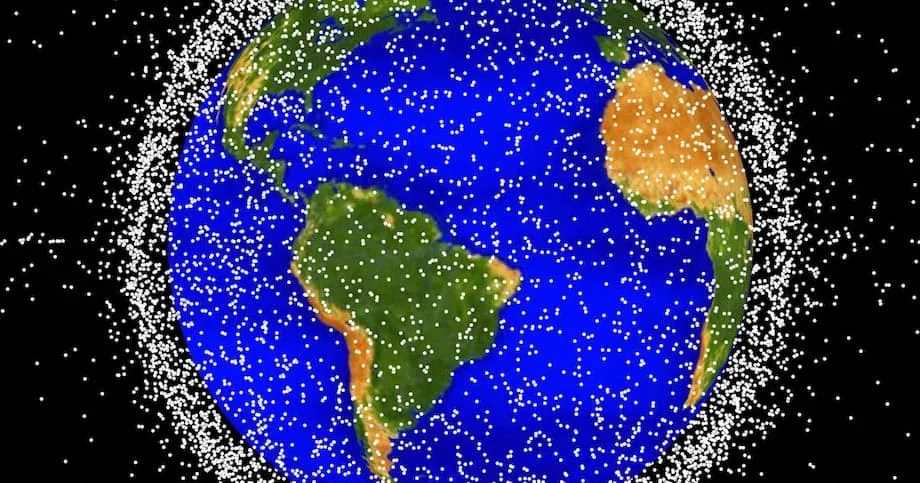
The European Space Agency's figures put the number of defunct satellites in orbit at nearly 3,000, alongside around 2,000 rocket parts. Including debris larger than 1 millimeter brings the estimated total to more than 100 million pieces.
Space debris includes satellites that no longer work, spent rocket stages and fragments produced by collisions or explosions. These objects travel at speeds of 7 to 8 kilometers per second. At such speeds, even a tiny piece can cause catastrophic damage when it strikes a working satellite or the International Space Station (ISS).
The danger grows when an impact breaks an object into more pieces. Each new fragment can become another collision threat. This process is known as the Kessler syndrome: collisions create debris, which increases the chance of further collisions, potentially leaving Earth's orbit unusable for future generations.
Commercial space activity is accelerating, adding to the number of objects sharing orbital routes. A satellite that has stopped working can remain a hazard, while fragments are much harder to manage than a single intact object. Removing existing debris and preventing new debris therefore address different parts of the same problem.
Breakups in orbit and debris on the ground
In June 2024, a defunct Russian satellite broke into nearly 200 pieces, forcing astronauts aboard the ISS to prepare for an emergency evacuation. The incident showed how the failure of an unused spacecraft can quickly affect people working elsewhere in orbit.
Falling debris has also reached inhabited areas on Earth. A large metal ring from a rocket landed in a Kenyan village, while fragments from a SpaceX capsule were found on a Canadian farm. These incidents connect the management of objects in orbit with safety on the ground.
Japan's planned work spans several stages, from inspection missions to proposals for international rules:
- June 2024: A defunct Russian satellite broke into nearly 200 pieces, prompting emergency preparations aboard the ISS.
- 2024: An inspection satellite operated by Astroscale Holdings Inc. successfully approached space debris and captured images.
- End of March: Japan's timetable calls for identifying the legal and procedural challenges of debris removal.
- 2026: Japan aims to present concrete proposals at COPUOS.
- Fiscal year 2027: The next phase of Astroscale's experiment is scheduled to attempt the capture and removal of debris.
Why existing space treaties leave cleanup questions open
The 1967 Outer Space Treaty provides the central framework for international space law. It establishes that outer space is free for exploration and use by all states, prohibits national appropriation and makes states responsible for activities conducted under their jurisdiction.
Two other agreements address related responsibilities. The Liability Convention makes launching states liable for damage caused by their space objects. The Registration Convention requires states to register objects launched into outer space.
These treaties were drafted decades ago and do not directly address the particular challenges of removing today's space debris. COPUOS issued guidelines in 2007 encouraging countries to design satellites and probes in ways that minimize the creation of debris. Those guidelines are voluntary.
There are no binding international rules for removing existing debris. Governments and private companies therefore face uncertainty about how cleanup missions should proceed, even as the technical ability to carry them out develops. Preventing a new satellite from becoming debris is one task; authorizing a spacecraft to capture an object already in orbit is another.
Who owns an abandoned satellite?
Space equipment remains the property of its state of registration even after it stops operating. An abandoned satellite is therefore still tied to an owner, and removing another country's debris without permission could be considered a violation of sovereignty.
Legal scholar Zhuang Tian argues that responsibility for cleanup should rest with those who leave debris behind, while describing the risk involved when another state tries to act:
Whoever leaves debris behind should take responsibility for cleaning it up. But right now, it's risky for one state to clean up another state's debris, because the equipment remains the property of the state of registration.
An international mechanism could provide a way to secure permission and clarify liability if a removal operation causes an accident. These questions matter to both the state associated with the debris and the government or company undertaking the mission.
Cleanup technology also has a dual-use character, meaning the same equipment can serve civilian and military purposes. A spacecraft capable of capturing debris could be perceived as capable of disabling or capturing an active satellite. That possibility creates concerns about trust and military escalation alongside the practical challenge of making an operation safe.
Japan combines diplomacy with a commercial strategy
The Japanese government is seeking a coalition of countries willing to develop shared practices for debris removal. Cooperation with the United Kingdom and New Zealand forms part of its effort to build agreement before presenting proposals through the United Nations.
The Cabinet Office's work with experts and industry is intended to identify the decisions a cleanup mission would require. Japan envisions countries sharing information about debris, granting permission for removal and following agreed safety procedures. Those steps would give an operator a clearer basis for planning a mission.
Japan's initiative also fits a broader strategy to secure space activities and expand the commercial space market. Its diplomatic efforts take place amid growing competition from countries including China, with maintaining a balance of power among the considerations shaping its approach.
International rules would connect these diplomatic and commercial goals. Businesses developing removal systems need an agreed way to operate across national interests, while governments need confidence about what those systems will do near their spacecraft. Japan is advancing the technology and the discussions over its use together.
From photographing debris to capturing it
Astroscale Holdings Inc., a startup based in Tokyo, is developing active debris removal technology. Active removal means sending a spacecraft to deal with an object already in orbit, rather than relying solely on measures intended to prevent new debris.
The company's inspection satellite successfully approached space debris and captured images in 2024. The next phase of the experiment, scheduled for fiscal year 2027, will attempt to capture and remove debris using robotic arms and other tools. Inspection and removal are distinct stages: approaching an object allows it to be observed, while removal requires physically managing it.
JAXA is supporting research and demonstration work through programs including the Commercial Removal of Debris Demonstration (CRD2). The program works with private businesses on the removal of large debris, linking government research with commercial capabilities.
JAXA's Space Tracking and Communications Center also uses radar and optical telescopes to monitor debris and predict possible collisions. Those predictions allow satellites to make timely maneuvers to avoid danger. The agency is working on international standards for debris mitigation, drawing on frameworks from the Inter-Agency Space Debris Coordination Committee (IADC) and the International Organization for Standardization (ISO).
Satellite services put economic and security interests at stake
The global space industry is projected to be worth nearly $800 billion by 2027. Telecommunications, navigation, weather monitoring and national security all depend on activities in space. Damage to the infrastructure supporting those services would affect people and organizations far beyond the space industry itself.
Military operations increasingly rely on satellites for communications, navigation and surveillance. Debris therefore threatens national security as well as the investments of countries and companies. More participants and more spacecraft bring opportunities for growth, but also greater congestion and collision risk.
Governments are encouraging private sector innovation through partnerships. Examples include NASA's Commercial LEO Destinations program, which concerns low Earth orbit, and India's technology transfer agreements. These approaches connect public activity with the development of commercial capabilities.
Emerging markets include servicing, assembly and manufacturing in orbit, alongside space traffic management and debris remediation. In simple terms, these activities involve maintaining or building things in space, coordinating spacecraft movements and dealing with debris. Their expansion brings a need for governance and international cooperation to support safe operations.
Transparency and accountability are central to proposed rules
Japan's proposed framework would give countries a way to exchange debris information and coordinate permission for cleanup. Agreed safety procedures could reduce collision risks while helping states understand the purpose of missions operating near their equipment.
Legal expert Zhuang Tian argues that transparency and international commitments must accompany technical standards:
Transparency in space missions and addressing concerns is more effective than technical requirements alone.
Zhuang also describes a role for voluntary measures alongside treaties:
Soft law instruments can fill gaps in binding treaties, and increased commitment to multilateral agreements is essential.
Soft law refers to guidelines and practices that are not legally binding. Proposals call for using these measures alongside binding international agreements to address gaps in existing treaties. The United Nations is viewed as the main forum for this work because of its history of multilateral cooperation and its existing space treaty framework.
Other suggestions include an international hotline for registering spacecraft and coordinating responses to imminent collision threats. A proposed polluter pays principle would hold operators accountable for the debris they create. In the United States, the Federal Communications Commission has fined a company for failing to retire a satellite, providing an example of enforcement against an operator.
Designing spacecraft for reuse and safer disposal
A circular space economy would put reuse, repair, recycling and environmentally conscious design at the center of space activity. The idea is to consider what happens to equipment throughout its useful life, rather than treating disposal as a problem to address only after a satellite stops working.
Innovations discussed in this approach include wooden satellites made from biomaterials. Such designs could reduce the impact of collisions and allow debris to burn up more easily in the atmosphere. They form part of the effort to reduce the lasting burden left by space missions.
The estimated economic value of reusing space debris ranges from $600 billion to $1.2 trillion. That estimate points to possible business models built around material already in space, alongside the growing market for removing hazards.
Japan's initiative brings together these design ambitions, current monitoring work and planned removal experiments. The immediate legal task is to establish how countries authorize cleanup and assign responsibility. The proposals intended for 2026 and the removal experiment scheduled for fiscal year 2027 are the next dated steps in that effort.
Key Points
- Japan aims to present proposals for international debris removal rules at the 2026 meeting of COPUOS.
- European Space Agency figures put debris larger than 1 millimeter at more than 100 million pieces.
- Existing treaties address state responsibility, registration and liability, while binding international rules for removing existing debris are absent.
- Ownership, permission, accident liability and the potential military use of cleanup equipment complicate removal missions.
- Astroscale photographed debris in 2024 and plans a capture and removal experiment in fiscal year 2027.
- Japan is combining cooperation with countries including the United Kingdom and New Zealand with commercial technology development.
- Proposed measures include information sharing, safety procedures, voluntary guidelines, binding agreements and greater operator accountability.