A Rare Fabric Takes Shape in Bangladesh's Wetlands
Bangladesh is developing a luxury textile from the stems of the pink lotus, Nelumbo nucifera, combining a demanding craft with the prospect of new income for rural women. Lotus silk sells for between $2,500 and $4,000 per kilogram, but producing just one meter of fabric requires fibers from approximately 40,000 stems.
Contents
- A Rare Fabric Takes Shape in Bangladesh's Wetlands
- What Lotus Silk Is Made From
- From Harvested Stems to Handwoven Cloth
- Women Gain Access to a Premium Textile Trade
- An Asian Tradition Meets International Luxury
- Research Focuses on Fiber Yield and Plant Growth
- Local Materials Could Support a New Industry
- High Costs Make Expansion Difficult
- Sustainability Claims Shape the Fabric's Appeal
- Key Points
As of July 6, 2025, the country's work on the material brings together Bengal Plants Research and Development (BPRD), rural artisans and textile industry bodies. The first lotus silk scarf produced in Bangladesh, described as a six-yard masterpiece, is now at the Bangladesh National Commission for UNESCO, where it represents the country's ambitions in textile innovation and sustainability.
The opportunity is substantial, though production remains slow. A single scarf can take up to two months to complete, and a full garment may require as many as 120,000 stems. Those demands help explain why the fabric belongs to the luxury market and why expanding production will require more than an abundant supply of lotus plants.
Bangladesh's initiative draws on its wetland resources and weaving heritage, including Dhaka Muslin and Jamdani. It also joins an existing Asian craft: Myanmar, Cambodia, Vietnam and Thailand have traditions of making lotus fiber textiles, often for Buddhist monks and sacred ceremonies.
The central question for Bangladesh is how to turn this rare material into a lasting source of skilled employment while protecting the wetlands that supply it. Research, artisan training and access to international buyers all feature in the effort. The immediate promise is a premium fabric made through careful handwork, with rural communities taking part in an industry usually associated with distant luxury markets.
What Lotus Silk Is Made From
Lotus silk comes from the fine, sticky filaments inside the plant's petioles, the stalks described in production as lotus stems. Conventional silk comes from silkworms. Lotus silk is entirely derived from a plant and is made through a meticulous process described as free of chemicals.
Artisans turn those delicate filaments into a fabric that is soft, glossy, breathable and naturally resistant to wrinkles. Its feel is often described as a combination of silk and linen, bringing together qualities associated with both familiar textiles.
The material's appeal also rests on its environmental profile. The production method is described as using no water, chemicals or fossil fuels. Harvesting takes the stems without uprooting the plants, allowing them to regenerate. Leftover plant material is biodegradable and is often used as organic fertilizer or cattle feed.
Using the residue in this way follows a circular economy approach: material left after one activity becomes useful in another instead of being discarded. The project presents lotus silk as completely biodegradable and its production as a process in which nothing is wasted.
These qualities are central to the fabric's proposed role as an alternative to textiles associated with pollution and heavy resource use. Bangladesh's effort connects the search for less damaging fashion materials with a craft that depends on the plants continuing to grow.
From Harvested Stems to Handwoven Cloth
Artisans collect lotus stems from Bangladesh's beels, haors and rivers. These wetland areas supply the raw material, and harvesting is carried out without uprooting or damaging the plants.
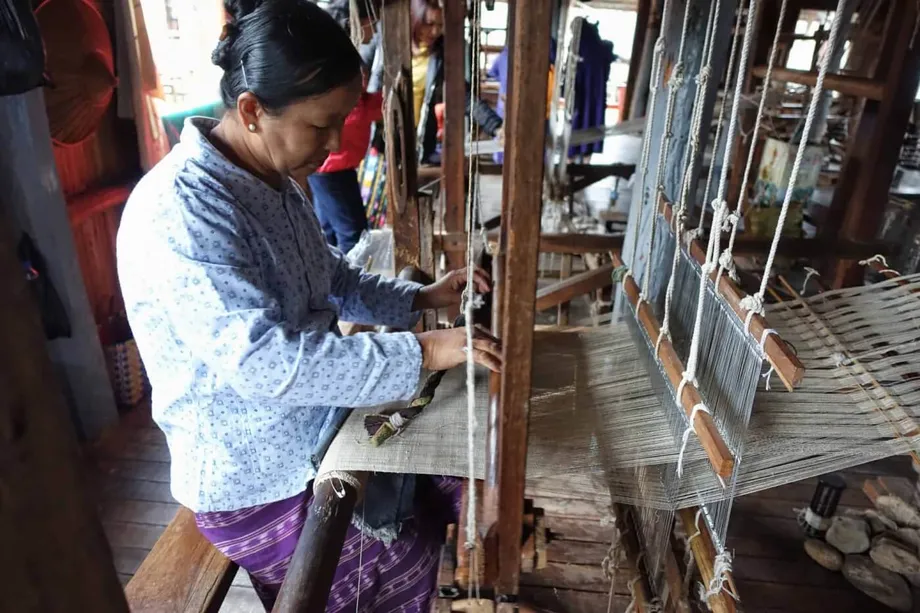
Inside each stem are natural filaments that become fine threads when exposed to air. Workers gently draw out and roll the fibers by hand, dry them and spin them into yarn. Traditional spinning wheels are used, sometimes made with recycled bicycle parts.
The work requires both patience and practiced hands. Extracting fragile fibers and turning them into usable yarn is a skill that takes months of practice and mentorship. The large number of stems needed for even a short length of cloth adds another constraint.
The figures show the scale of the task: approximately 40,000 stems for one meter of lotus silk, up to two months for a scarf and as many as 120,000 stems for a full garment. Each finished piece carries the accumulated work of harvesting, extraction, rolling, spinning and weaving.
Bangladesh's approach links these methods to its historic muslin production. From extracting fiber to weaving cloth, the emphasis is on fine material and skilled manual work. The first scarf's place at the Bangladesh National Commission for UNESCO gives that connection between craft and innovation a tangible form.
Women Gain Access to a Premium Textile Trade
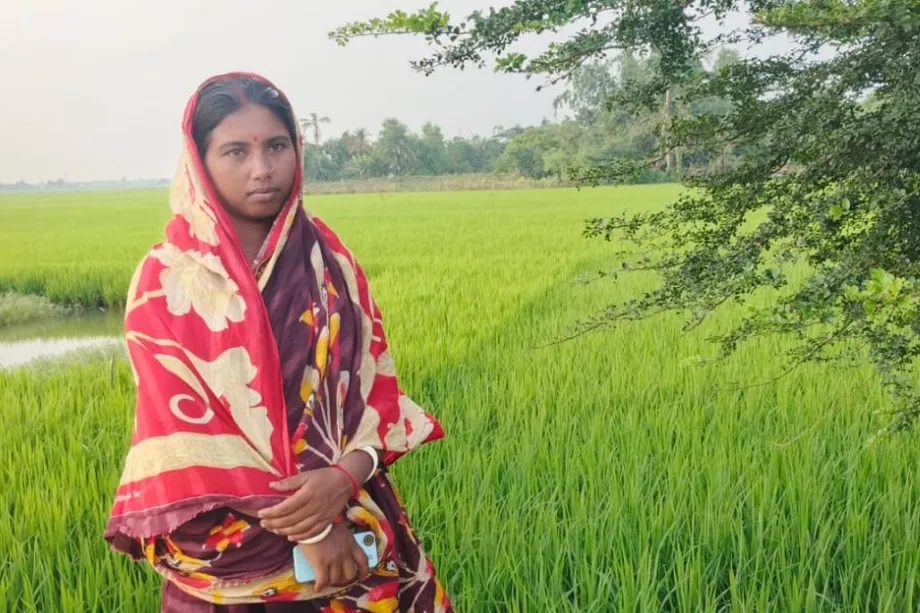
Women in villages such as Ronkoil in Faridpur are being trained to extract lotus fibers and spin yarn. The initiative aims to provide sustainable employment, greater economic independence and recognition for women who previously had limited access to industries producing expensive goods.
Sikdar Abul Kashem Shamsuddin, chairman of Bengal Plants Research and Development and lead researcher on the lotus silk project, describes the work as a change in opportunity as well as textile production:
This is not just about textiles—it's about transforming lives. Women who never imagined working in a high-value global industry are now skilled artisans of a premium fabric.
The training places rural workers near the beginning of a production chain that can end in international luxury markets. Their contribution is the skilled handling of the fibers, a stage that helps determine whether harvested stems become yarn suitable for weaving.
The social and environmental goals are closely connected. Jobs based on wetland plants give communities an economic interest in keeping those plants productive. The initiative presents sustainable harvesting as a way to maintain biodiversity while creating work.
Bangladesh's wetlands face pressure from urbanization and industrial agriculture. Lotus silk production is being promoted as an activity that can preserve their ecological richness while supporting livelihoods. Its success therefore depends on both the quality of the cloth and the continued health of the places where the lotus grows.
An Asian Tradition Meets International Luxury
Bangladesh is entering a small but established field. Lotus textiles have long been made in Myanmar, Cambodia, Vietnam and Thailand, with some cloth reserved for Buddhist monks and religious ceremonies.
Myanmar's tradition includes the story of Daw Sa Oo, who is credited with first weaving lotus cloth after noticing threads inside a lotus stem. Her story connects the material's origins to the simple observation of a plant's hidden fibers.
In Cambodia, Samatoa Lotus Textiles has gained international recognition, won UNESCO awards and supplied luxury markets around the world. Its experience offers Bangladesh an example of how a specialized craft can reach buyers beyond its place of production.
Italian luxury house Loro Piana has introduced lotus silk jackets priced at more than $5,000. Indian brands are also developing lotus shirts that resist stains through advanced nanotechnology. These products show different ways companies are bringing the material into clothing, from costly jackets to fabrics with additional treatments.
Bangladesh's entry is recent. Its extensive wetlands offer a supply of lotus stems, while its skilled workforce provides a foundation for expanding the craft. International examples suggest a market exists for the material, although Bangladesh's own expansion depends on research, sustainable harvesting and effective international marketing.
The opportunity is to establish a distinctive textile within the market for ethical luxury. The same slow work that gives lotus silk its exclusivity also limits how much can be produced, making the relationship between price, labor and supply central to any business plan.
Research Focuses on Fiber Yield and Plant Growth
Lotus silk's properties come from a special type of cellulose in the plant's petioles. Cellulose is the material within the stalks that provides the fibers artisans extract and turn into yarn.
Researchers have found that the quality and quantity of this cellulose depend on the depth of the water in which the lotus grows. For producers, that connects the conditions in a wetland directly to the amount and quality of textile fiber it can supply.
Modern plant breeding, tissue culture and biotechnology are being considered as ways to improve fiber yield and quality. The aim is to obtain more useful material and make production more efficient while retaining the qualities that make the fabric valuable.
Bangladesh's work combines these scientific possibilities with traditional textile methods. The Bangladesh Handloom Board and the Bangladesh Garment Manufacturers and Exporters Association (BGMEA) are actively involved, seeing potential for lotus silk to strengthen the country's position in the ready-made garment sector.
Ayub Ali, chief of planning and implementation at the Bangladesh Handloom Board, points to the fineness of the yarn and the possibility of repeated harvesting:
The yarn obtained from lotus plants is extremely fine and strong—arguably even better than silk. One of the biggest advantages is that you can extract thread from a lotus plant up to four times a month without harming it.
Repeated harvesting would allow the same plants to continue contributing to production. Keeping them healthy and productive is central to the project's proposed balance between industry and ecology.
Local Materials Could Support a New Industry
Mahmud Hasan Khan, president of BGMEA, sees Bangladesh's canals and wetlands as an advantage in developing a domestic source of textile material. He links the opportunity to the country's reliance on supplies from abroad:
Bangladesh has an abundance of canals and wetlands, so this can be done without major investment. At present, all materials are imported from abroad. If we can source the raw materials locally, that would be fantastic.
His comments place lotus silk within a wider industrial ambition: making more use of local resources while building on Bangladesh's textile skills. The initiative connects raw material collection in wetlands with spinning, weaving, research and the search for international customers.
Bangladesh's existing traditions offer a cultural foundation for that effort. Dhaka Muslin and Jamdani demonstrate the country's association with fine weaving, while lotus silk introduces a different plant material into that story.
Investment, policy support and international collaboration are proposed as ways to develop the industry. The objective is to create centers of production and employment around wetland resources, with scientific work supporting artisans rather than replacing the craft's identity.
High Costs Make Expansion Difficult
Lotus silk's price of $2,500 to $4,000 per kilogram reflects a production process that demands large quantities of stems and extensive handwork. Those costs restrict access largely to luxury buyers and make affordability a central challenge.
Training is another requirement. Workers need months of practice and guidance to handle the fibers, and production cannot expand simply by collecting more stems. More skilled extractors, spinners and weavers are needed to turn that supply into finished cloth.
Policymakers and industry leaders are calling for several measures to support development:
- Expanded training for rural artisans, especially women.
- Investment in modern plant breeding and biotechnology to improve fiber yield.
- Development of natural dyeing techniques to maintain the material's environmental credentials.
- Stronger marketing to establish lotus silk as a flagship product in sustainable luxury.
Research, infrastructure and international promotion are also part of the proposed investment. Together, these address different stages of the business, from improving the plant material to finding buyers willing to pay for the finished fabric.
Growing consumer interest in ethical and environmentally responsible products offers a possible market. Bangladesh still faces the practical task of increasing output while managing costs and preserving the skills and harvesting methods on which the fabric's appeal rests. No timetable for that expansion has been given.
Sustainability Claims Shape the Fabric's Appeal
Lotus silk is part of a wider movement toward materials derived from plants and designs inspired by nature. Pineapple, banana and abaca fibers are also gaining attention in Asia, including through the Philippines' tropical fabric movement and textile cooperatives in Vietnam.
The lotus plant has another connection to textile development through the fixed term "lotus effect." Its leaves strongly repel water and dirt, a property called superhydrophobicity. That behavior has inspired fabrics designed to repel water and clean themselves.
The industry also faces greenwashing, meaning environmental claims that promise more than production practices deliver. Some materials described as natural or biodegradable contain synthetic additives or require processing that uses substantial resources.
Bangladesh's lotus silk initiative presents a different model, centered on a transparent process, a traceable supply chain, production without chemicals, complete biodegradability and the reuse of plant residue. Those features form the basis of its claim to minimal environmental impact.
The country's ambition brings together three linked goals: a valuable textile, skilled rural employment and productive wetlands. Turning that ambition into a larger industry requires continued investment in research and training, alongside responsible harvesting and access to luxury buyers. Lotus silk's appeal begins with the plant, but its commercial future depends on the people and production systems that turn its delicate fibers into cloth.
Key Points
- Bangladesh is developing lotus silk from the stems of the pink lotus, linking wetland resources with its textile heritage.
- One meter requires approximately 40,000 stems. A scarf can take up to two months, and a full garment may require 120,000 stems.
- The fabric commands between $2,500 and $4,000 per kilogram, placing it in the luxury market.
- Women in Ronkoil, Faridpur, are receiving training in fiber extraction and spinning.
- The production method is described as free of water use, chemicals and fossil fuels, with plant residue reused as fertilizer or cattle feed.
- Bangladesh's first lotus silk scarf, measuring six yards, is at the Bangladesh National Commission for UNESCO.
- Research, artisan training, natural dyes and international marketing are priorities for expanding production.
- High labor demands and costs remain the main constraints on making lotus silk more widely available.