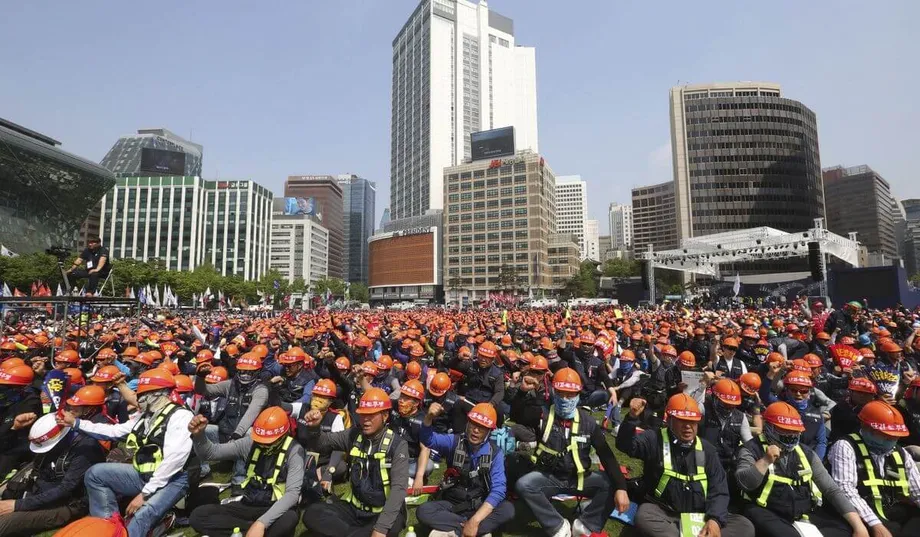
A shorter week, with a difficult choice over hours
South Korea's debate over a 4.5-day workweek turns on a concrete choice: reduce the standard working week from 40 hours to 36 without cutting pay, or rearrange the same 40 hours so employees can leave early on Friday. President Lee Jae-myung's campaign pledge has brought that choice to the centre of a national argument about wages, productivity and time outside work.
Contents
- A shorter week, with a difficult choice over hours
- Why workers want more time back
- Two political approaches to a 4.5-day week
- Employers question how to maintain output
- Unions argue that working standards must change
- What major companies are already doing
- Gyeonggi tests options for smaller firms
- What international experiments offer Korea
- A divided labour market complicates reform
- What a workable transition would require
- Key Points
As of June 18, 2025, national legislation remains under debate, while companies and local governments are already testing different schedules. Gyeonggi Province has launched a pilot supporting 83 companies. Samsung Electronics, POSCO and businesses within SK Group offer arrangements that give eligible employees some Fridays off while retaining their required working hours.
Workers see a chance to recover from exhausting schedules and spend more time with their families. Employers, particularly smaller businesses, worry about meeting orders and paying for extra staff. The same policy could feel very different to an office employee able to rearrange meetings and a factory worker whose output depends on time spent operating machinery.
South Korea's long working hours explain much of the pressure for change. In 2022, people worked an average of 1,901 hours, 149 hours more than the OECD average. Yet the country's relatively low output per hour also helps explain business resistance: working less while keeping wages unchanged requires companies to find ways to maintain production or absorb higher costs.
The debate reaches beyond the working calendar. It concerns an economic model built around long hours, changing expectations among younger generations, and a labour market that gives some employees far more security and bargaining power than others.
Why workers want more time back
Employee surveys show strong interest in shorter working weeks. A 2024 poll by business networking platform Remember found that 70% of salaried workers preferred a four-day week. A Saramin survey put support at 86.7%, with more than 60% willing to accept lower pay in exchange for fewer hours.
Those findings also expose a central question for policy: whether extra free time comes with the same salary. The Democratic Party's proposal promises no pay cut, while the surveys suggest that many employees value time away from work enough to consider a financial sacrifice.
Kim Ji-eun, a 39-year-old office employee in Seoul, described how the current schedule affects her rest and family life:
Right now, I leave work exhausted every Friday evening and have barely enough time to rest, let alone enjoy life or take care of my kids. Just half a day more would mean a real chance at balance.
South Korea's culture of excessive working hours has given rise to the term gwarosa, meaning death from overwork. Burnout remains widespread, especially among younger workers who are increasingly vocal about protecting their health and personal lives.
The group commonly called the MZ generation, combining Millennials and Generation Z, is less willing to put economic success ahead of personal wellbeing. Dale Whelehan, chief executive of 4 Day Week Global, described that generational change:
This younger generation is rejecting the trade-off their parents and grandparents were often forced to make: sacrificing wellbeing, health, and personal fulfillment for the sake of economic success.
Two political approaches to a 4.5-day week
Both the liberal Democratic Party and the conservative People Power Party have included versions of a shorter working week in their platforms. Their proposals differ over whether employees should work fewer hours or distribute existing hours differently.
The Democratic Party proposes cutting the legal working week from 40 hours to 36 without reducing pay. It supports a phased transition, substantial government assistance for participating companies and, eventually, movement toward a four-day week. Its stated goal is to bring South Korea's average annual working hours below the OECD average by 2030.
The People Power Party proposes a flexible arrangement in which employees work an extra hour from Monday through Thursday and take half of Friday off. Total weekly hours would remain at 40. It argues that individual businesses should decide whether to adopt such schedules, rather than face a legal requirement.
Lee has said the transition should be gradual and based on discussion with those affected. His pledges also include incentives for companies adopting the new schedule, expanded vacation support and a review of the inclusive wage system, which often leads to unpaid overtime.
The inclusive wage system bundles compensation for overtime into pay arrangements. Reviewing it matters alongside a shorter standard week because employees seeking more free time also want limits on work that stretches beyond their scheduled hours. No date for a nationwide transition was given.
Employers question how to maintain output
Business opposition centres on productivity, meaning how much economic value workers produce in a given amount of time. According to the Korea Labor Institute, South Korea ranked 33rd among 38 OECD countries in 2023, with hourly productivity of $44.4. That was 57% of the United States level and 65% of Germany's.
Employers argue that reducing hours without raising productivity would increase labour costs and weaken competitiveness. A company paying the same wages for fewer hours must maintain output in less time, accept lower production or find another way to cover the work.
Sohn Kyung-shik, chairman of the Korea Employers Federation, said the ability to make that adjustment varies across businesses:
Some pioneering firms might adopt a four-day or 4.5-day workweek to attract talent. But for many companies, this change would be a serious strain.
Small and medium-sized enterprises are especially concerned. Many already struggle to meet deadlines within the current maximum working week of 52 hours, consisting of 40 standard hours and up to 12 hours of overtime. Labour shortages and orders that change unexpectedly can make staffing difficult even before hours are reduced.
A small auto parts manufacturer employing 50 people described the choice it expected to face:
We will have to either cut order volumes or hire more staff to finish work within the reduced hours. The former hampers growth, while the latter increases labor costs.
The Korea Federation of SMEs says 42.4% of small businesses report difficulties with the current system, citing staff shortages, unpredictable orders and higher costs. Business leaders warn that a uniform national requirement could widen the gap between large companies able to absorb extra costs and smaller firms with less room to adjust.
Unions argue that working standards must change
The Federation of Korean Trade Unions and the Korean Confederation of Trade Unions support the 4.5-day week. Both see shorter hours as a response to excessive work and a way to improve employees' quality of life.
Unions point to pilot programmes in Iceland, France, the United Kingdom and the United States, where reduced working weeks have improved job satisfaction and, in some cases, productivity. Their argument is that a shorter schedule can encourage changes in how work is organised, rather than simply remove time from an unchanged working routine.
Worker advocates also cite automation, artificial intelligence and labour organised through digital platforms as reasons to reconsider traditional schedules. A union statement expressed the case for changing accepted working hours:
If work is changing, then the standard of what we consider acceptable labor hours must also evolve.
Supporters connect shorter working weeks with wider social goals, including better mental health, higher birth rates and a more active domestic economy. More time outside work, they argue, could give people greater scope for family life and spending. These are among the benefits advocates hope the policy will deliver.
What major companies are already doing
Several large South Korean companies have introduced schedules that offer additional days away from the workplace. Their arrangements generally depend on employees completing their required hours, making them different from the Democratic Party's proposed reduction to 36 hours.
POSCO has introduced a four-day week every other week for office employees. Workers put in longer hours on some days in exchange for a Friday off every two weeks, while maintaining a working week of 40 hours.
Samsung Electronics has allowed eligible employees to take a four-day week once a month since June 2023, provided they complete their required hours. The arrangement was agreed during salary negotiations and is intended to improve morale and attract staff.
SK Telecom and SK hynix offer similar options. Depending on the hours they have worked, employees can qualify for a Friday off every two weeks or once a month. These experiments show how businesses can change the distribution of working time while keeping their existing hours requirements.
The developments span several years:
- 2022: South Korea recorded average annual working hours of 1,901, while the United Arab Emirates introduced a 4.5-day week for federal employees.
- June 2023: Samsung Electronics began allowing eligible employees a four-day week once a month after completing their required hours.
- 2024: Remember's survey found that 70% of salaried workers preferred a four-day week.
- June 18, 2025: National legislation remains under debate as corporate experiments and Gyeonggi Province's pilot offer different models.
- 2030: The Democratic Party aims to bring average annual working hours below the OECD average.
Gyeonggi tests options for smaller firms
Gyeonggi Province's pilot offers subsidies to 83 companies adopting flexible schedules. Participating businesses can choose arrangements including a four-day week every other week, a working week of 35 hours or half of every Friday off.
About half of the participating companies have fewer than 40 employees. Their involvement shows interest among smaller businesses when financial support is available, even as other small employers warn about the cost of reducing hours.
The range of schedules also reflects different business needs. A company might find an occasional full day off easier to manage than a shorter Friday every week. Another might choose to reduce total hours rather than concentrate them into fewer days.
Kim Jong-jin, director of the Korea Worker Institute and Union Center, has pointed to South Korea's earlier transition from a six-day to a five-day working week. That change in the early 2000s took four years, suggesting that another reduction may also require a gradual transition.
What international experiments offer Korea
Iceland's public sector trial reduced working time without cutting pay and recorded better wellbeing alongside productivity that was maintained or increased. Its experience gives supporters an example of shorter hours working in practice, although its small population and different economic structure limit direct comparisons with South Korea.
The United Arab Emirates adopted a 4.5-day week for federal employees in 2022 and received positive feedback. Its oil wealth and different labour market provide a setting unlike South Korea's, where the debate involves a broad range of private businesses as well as public employment.
Belgium, the United Kingdom, Japan and New Zealand have also conducted trials or offered flexible options. Participation often drops when shorter schedules involve lower wages, underscoring the importance of pay arrangements to workers deciding whether a change is worthwhile.
South Korea's labour market presents particular challenges because secure permanent jobs sit alongside unstable employment outside regular contracts. International experiences offer practical examples, while Korean businesses and policymakers still have to account for the country's own differences in productivity, wages and job security.
A divided labour market complicates reform
Large corporations and the public sector tend to offer secure, well paid employment. Smaller businesses and service industries rely more heavily on workers with lower pay and unstable jobs. This division, often called a dual labour market, means employees can have very different working lives within the same economy.
A reduction in hours could therefore bring the greatest immediate benefits to employees whose companies can afford it, while leaving others facing pressure on income or job security. Business concerns about unequal costs and union demands for better working conditions meet at this problem: who receives the extra time, and who carries the expense.
Productivity also varies by sector. Manufacturing productivity exceeds the OECD average, while the service sector's value-added productivity stands at only 64% of that average. Value added measures the economic value created through production or services, allowing comparisons of how much different sectors generate.
Kim Seong-hee, a labour professor at Korea University, linked difficulties in changing schedules to employment rules and workplace culture:
Shaped by decades of regulations that prioritize employment stability over labor market agility, rigid legal frameworks and cultural norms make it difficult for companies to reward excellence or address underperformance. This makes it risky for businesses to experiment with reduced work hours.
The proposed transition therefore extends beyond reducing hours on a timetable. It also involves improving productivity, supporting smaller employers and addressing the needs of workers outside regular employment, including people working through digital platforms.
What a workable transition would require
The proposals and experiments point toward several practical requirements. A phased rollout would allow voluntary adoption and testing first in companies and sectors best placed to adjust. Flexible arrangements would let employers and employees choose schedules suited to their work rather than impose the same pattern everywhere.
Investment in automation, digital systems and training could help companies maintain output in fewer hours. Subsidies, tax credits and other government incentives could help smaller businesses and vulnerable sectors meet transition costs and change how they operate.
Labour reform would also need to address the divide between secure and insecure employment, improve protection for workers outside regular contracts and update legal rules to support flexibility and fairness. Without productivity improvements, workers in lower productivity sectors could face pressure on earnings and employment.
Park Ji-soon, a labour expert at Korea University, said companies needed to prepare for changes reaching beyond the weekly calendar:
From redesigning work environments and staffing plans to ensuring fair compensation levels, the private sector must begin preparing for structural transformation.
South Korea's decision will affect how families organise their time, how companies compete and whether improvements in working life reach employees across the economy. Supporters see possible gains for mental health, the country's low birth rate and weak domestic demand. Critics warn of higher costs, lost competitiveness and wider inequality.
Lee's gradual approach, corporate experiments and Gyeonggi's subsidised pilot offer different ways to test the change. The central task for government, businesses, unions and civil society is to agree on how fewer working hours can be matched with sustainable output, fair pay and protection for employees with the least secure jobs.
Key Points
- President Lee Jae-myung pledged to reduce the standard working week from 40 hours to 36, with a gradual transition.
- The Democratic Party supports fewer hours without lower pay; the People Power Party favours rearranging 40 hours to allow half of Friday off.
- South Koreans worked an average of 1,901 hours in 2022, 149 hours above the OECD average.
- Worker surveys show strong support, while employers warn about productivity, staffing and costs.
- Samsung Electronics, POSCO, SK Telecom and SK hynix offer arrangements tied to completing required hours.
- Gyeonggi Province is subsidising flexible schedules at 83 companies, about half with fewer than 40 employees.
- Unions support shorter hours, while the debate also concerns unequal job security and weaker productivity in services.
- The Democratic Party aims to bring annual working hours below the OECD average by 2030; no nationwide transition date has been given.