Three Goals in Five Minutes Flip the Final
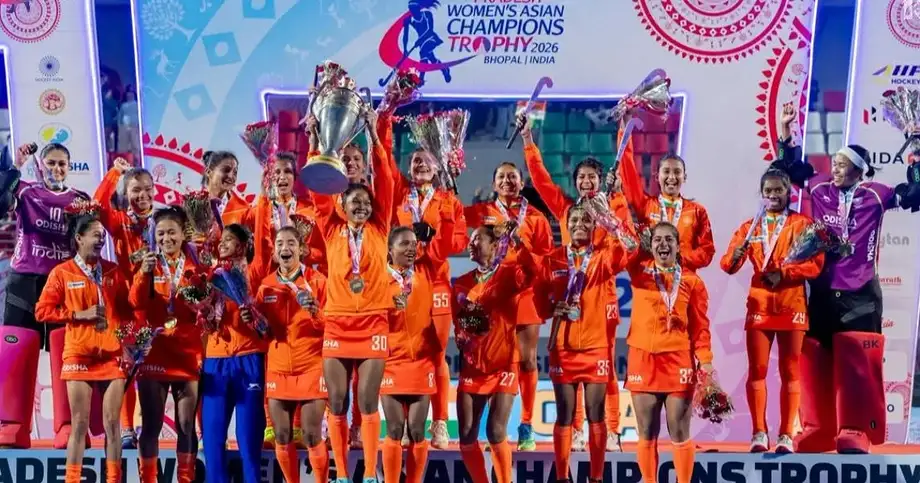
Deepika dragged India level from a penalty corner in the 38th minute, Ishika finished a move from open play in the 42nd and Deepika struck again from another corner in the 43rd, turning a 1-0 half-time deficit into a 3-1 win over China in the final of the Madhya Pradesh Women's Asian Champions Trophy at the International Sports Complex in Nathu Barkheda, Bhopal, on Saturday, November 28.
Contents
- Three Goals in Five Minutes Flip the Final
- China's Half Hour of Control
- The Switch After the Break
- Deepika's Tournament, and What a Drag-Flick Is
- The Record That Separates India From South Korea
- Marijne's First Season Back
- A Year Unlike Any Other for Indian Women's Hockey
- The Road to the Final: Two 6-2 Wins
- Rs 1 Crore, and a Bid for the World Cup
- Japan's Bronze and the Awards Across Asia
- What to Know
It was the first time in the tournament that India had gone into the interval behind, and the answer came in a burst of three goals across five minutes early in the third quarter that China never matched. India finished the match with 52% of possession and 15 entries into the shooting circle against China's eight, numbers that describe a second half played almost entirely in the visitors' half.
The trophy is India's fourth in the competition, after 2016, 2023 and 2024, and their third in a row following wins in Ranchi and Rajgir. No other side has four. South Korea, the previous leader with three, drops to second on the roll of honour, and the defeat was China's fourth as runners-up in the tournament.
Deepika, who converted two of India's penalty corners and was named Player of the Match, ended the night with the Top Scorer award and the Madhya Pradesh Player of the Tournament award in front of a home crowd in a city hosting its first international hockey event.
China's Half Hour of Control
China arrived in Bhopal as the Olympic and Asian Games silver medallist and played the first half like a side that had learned from its 6-2 defeat by India in the round robin earlier in the week. Set up in a 4-3-3 formation, the visitors circulated the ball across the back and committed players forward whenever space opened, forcing India to defend deep and denying the hosts the long attacking sequences that had carried them through the tournament.
The pressure produced a penalty corner in the second minute. Sunelita Toppo read the set piece early and cleared the danger, and Nikki Pradhan held India's defensive shape through the opening quarter as China kept the greater share of territory. The first quarter ended goalless.
India's own chances were scarce and costly to waste. From the team's first penalty corner in the 10th minute, captain Salima Tete missed a close-range attempt off the rebound. China then earned two penalty corners in quick succession in the 22nd minute, and goalkeeper Bichu Devi Kharibam saved both to keep the hosts level.
The breakthrough came three minutes later. Dandan Zuo pushed the ball into the circle from the right and Yujun Chen, who had already done useful work at the back, deflected it past Kharibam to make it 1-0 in the 25th minute. India won another corner in the 27th, and Deepika's flick was saved.
China went into half-time with the lead and the initiative. Xue Zhang kept intercepting in midfield and Wei Qixiao, later named the JSW Rising Star of the Tournament, helped the visitors hold their shape while protecting the advantage.
The Switch After the Break
India returned pressing higher up the pitch, aiming to win the ball back before China could settle into the rhythm that had worked so well in the first half. The equaliser arrived from India's third penalty corner in the 38th minute, which Ishika Chaudhary helped to earn. Deepika's drag-flick took a deflection off a Chinese defender on its way in.
Four minutes later India had the lead. Neha Goyal and Navneet Kaur worked the ball into a promising position on the left, Ishika reacted first to a loose ball inside the circle and drove it beneath the goalkeeper. A minute after that, India won another corner and Deepika placed a low flick to the goalkeeper's left.
- 25th minute: Yujun Chen deflects Dandan Zuo's ball into the circle to put China 1-0 up.
- 38th minute: Deepika converts a penalty corner, the drag-flick deflecting off a defender. 1-1.
- 42nd minute: Ishika turns in a loose ball after the build-up from Neha Goyal and Navneet Kaur. India lead 2-1.
- 43rd minute: Deepika's low flick from another penalty corner makes it 3-1.
India had a fourth corner with 34 seconds left in the third quarter and wasted it on a variation, then sent another flick wide in the 53rd minute. The final quarter belonged to the defence. Baljeet Kaur kept working the left flank, and the back line held China to no clear route back into the game through the closing stages.
Deepika's Tournament, and What a Drag-Flick Is
Deepika finished as the tournament's top scorer with 12 goals, nine of them from penalty corners, a tally that other counts put at 10. Her specialty is the drag-flick, the technique that decided the final.
A penalty corner is awarded for certain offences inside the shooting circle. One attacker pushes the ball in from the backline and a stopper traps it for a striker, who has a few seconds to shoot from the top of the circle. The drag-flick is a low, whipping sweep rather than a full swing, which lets the striker place the ball hard and flat toward a chosen corner while the goalkeeper is still moving. Deepika used it for the equaliser and again for the third goal.
Her first half had been frustrating. She said afterwards that India had not executed their plans well before the break, but that the players trusted their natural game and believed the goals would come once the ball moved faster.
Salima Tete made the same point from the captain's perspective. She credited the team's belief and discipline for the turnaround, saying the players knew a full half remained and focused on carrying the ball into attack rather than protecting what they had.
The Record That Separates India From South Korea
Before this edition India and South Korea were level on three titles each. The fourth puts India alone at the top of the competition's history, and it comes with a third successive crown, a run that began in Ranchi in 2023 and continued in Rajgir in 2024.
India also reached the final for the sixth time and went through the tournament unbeaten, including that 6-2 win over China in the round robin. The two sides had met in the finals of 2016 and 2024 as well, and India won both. China's semifinal, by contrast, was decided in the 60th minute, when Zhang Heyang scored the only goal against Japan.
The pattern across the week mattered. China had been beaten heavily once already, then returned with a more compact block and a plan to slow India's ball movement. For 35 minutes in the final it worked, and the tournament's most decorated team had to solve a puzzle it had not faced in the earlier rounds.
Marijne's First Season Back
The title is also the first piece of silverware in the return of coach Sjoerd Marijne, who took charge in January after Harender Singh resigned in December 2025. Marijne inherited a squad that had already won at the Asian Games and had spent a year building combinations around a settled core of drag-flickers, midfielders and defenders such as Sunelita Toppo, Nikki Pradhan and Ishika Chaudhary.
The final showed the value of that depth. India's goals came from two different sources, a set piece and a field goal, and the winning margin was protected by players who had spent most of the second half defending a two-goal cushion rather than chasing another.
A Year Unlike Any Other for Indian Women's Hockey
The Bhopal title closes the most successful year the team has had. At the Asian Games in Aichi Nagoya, India won gold and ended a wait of 44 years, beating China 1-0 in the final, a result that also secured direct qualification for the 2028 Los Angeles Olympics.
The team lifted the FIH Nations Cup, finished fifth at the Women's World Cup for its best placing in 52 years, and climbed to a highest-ever world ranking of fourth on November 25, after a 4-0 win over Japan during this tournament. Hockey India described the Bhopal win as a fitting conclusion to that run.
The year's results change what the team is measured against. India now arrives at continental events as the side to beat rather than the challenger, and its ranking of fourth means it will be seeded among the top group at global tournaments, where the draw and the quarterfinal path shift accordingly.
The Road to the Final: Two 6-2 Wins
India's semifinal against Malaysia on Friday was settled long before the last quarter. Mumtaz Khan scored in the 10th minute, Navneet Kaur in the 18th, Deepika converted penalty corners in the 25th and 30th, Sunelita Toppo scored in the 33rd and Ishika completed the scoring in the 57th for a 6-2 win. Nur Azhar pulled one back for Malaysia in the 27th minute and Nuramirah Zulkifli scored a reverse-stick goal in the 52nd.
China's path was narrower. The semifinal against Japan was still goalless until Zhang Heyang scored in the 60th minute. Earlier in the day South Korea beat Thailand 4-1 to finish fifth.
Rs 1 Crore, and a Bid for the World Cup
Madhya Pradesh chief minister Mohan Yadav presented the trophy at Nathu Barkheda on Saturday night and announced a reward of Rs 1 crore for the team, or 10 million rupees. Each player will receive Rs 5 lakh (500,000 rupees) and each member of the support staff Rs 2.5 lakh. Yadav said the money was meant to encourage the players to keep performing and to bring more honours to the country.
Yadav, who watched the final with governor Mangubhai Patel and state sports minister Vishwas Sarang, framed the night around the state as much as the team.
It's a moment of double joy: we hosted our first international sporting event in Madhya Pradesh, and India triumphed.
He also asked International Hockey Federation president Tayyab Ikram to give Madhya Pradesh the chance to stage the World Cup, which is scheduled for January and February. Yadav said the state was ready to host the tournament and would use its existing resources and facilities to do so.
Hockey India added its own awards: Rs 3 lakh for every player and Rs 1.5 lakh for every member of the support staff, separate from the state's payments. No date has been given for the FIH's decision on the World Cup venue.
Japan's Bronze and the Awards Across Asia
Japan took bronze earlier on Saturday with a 5-2 win over Malaysia, Risa Sasaki scoring a hat-trick. Japan's Kudo Yu was named Best Goalkeeper of the Tournament, and China's Wei Qixiao took the JSW Rising Star award.
Deepika collected both the Top Scorer prize and the Madhya Pradesh Player of the Tournament award. The spread of individual honours across three countries reflects how tight the top of the Asian game has become, with India winning on home turf while China, Japan and South Korea all left with something to show for the week.
What to Know
- India beat China 3-1 in the Women's Asian Champions Trophy final in Bhopal on Saturday, November 28, 2026.
- Deepika scored in the 38th and 43rd minutes from penalty corners and Ishika scored in the 42nd, after Yujun Chen had put China ahead in the 25th.
- The title is India's fourth, in 2016, 2023, 2024 and 2026, moving the team ahead of South Korea on three.
- India went unbeaten, beating China 6-2 in the round robin and Malaysia 6-2 in the semifinal.
- Deepika was Player of the Match, tournament top scorer and Madhya Pradesh Player of the Tournament.
- Madhya Pradesh chief minister Mohan Yadav announced Rs 1 crore for the team, Rs 5 lakh per player and Rs 2.5 lakh per support staff member, and asked the FIH to consider the state for the World Cup.
- Hockey India announced separate awards of Rs 3 lakh per player and Rs 1.5 lakh per support staff member.
- Japan beat Malaysia 5-2 for bronze, with a hat-trick from Risa Sasaki.