Journalists Bring Their Case to the Door of the Party in Power
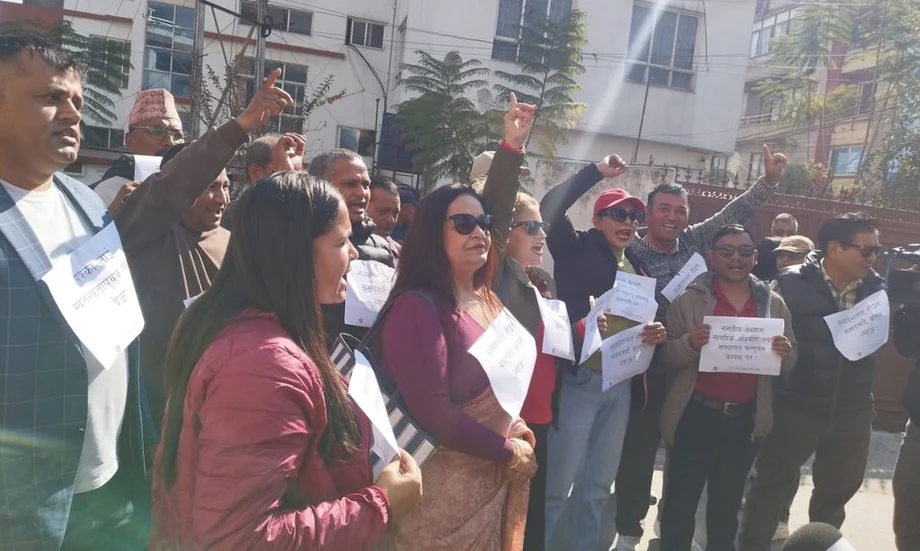
The Federation of Nepali Journalists opened the second phase of its protest campaign at 11 am on Sunday, 29 November, with a sit-in lasting one hour outside the central office of the Rastriya Swatantra Party at Chhamati in Kathmandu. President Nirjara Sharma, other office bearers and working journalists held placards through the hour and stopped at noon.
Contents
- Journalists Bring Their Case to the Door of the Party in Power
- What the Federation Is Asking For
- Detentions in the Newsroom That Set the Tone
- A Ruling Party, an Ordinance and an Opposition That Stayed Quiet
- Three Ordinances Now Wait at the President's Office
- A Week of Sit-ins and a Day in Black
- Why the Parties Are Now the Target
- The Protest Reaches the Districts
- What Is Still Open
- Key Points
The address carried its own argument. The Rastriya Swatantra Party leads the government, so the federation took its complaint about police behaviour and a new press law to the door of the party that runs the administration rather than to a ministry. Placards read: "Press freedom and freedom of expression: the RSP government did not listen, may the ruling party listen." Others demanded "Bring laws through Parliament, not ordinances" and "Withdraw the cuts in public welfare advertisements."
Four grievances sit behind the campaign, as set out in the federation's statement. Journalists object to police entering newsrooms and taking reporters into custody, to an ordinance tied to the Press Council Act that they say is meant to bring coverage under control, and to unauthorised interference in media outlets. The federation also alleges that journalists have been pushed out of Gorkhapatra and other outlets run by the state as well as private organisations, that labour rights are being violated, and that advertising is handed out in a way that discriminates between outlets.
General secretary Ram Prasad Dahal issued the call for the second phase on 10 Mangsir in the Nepali calendar, three days before the Kathmandu sit-in. The federation said its first phase had been completed across the country and that the government had shown no interest in answering the demands. The stated aim of the new round is to put more pressure on the government and to bring the parties represented in the federal parliament around to the federation's position.
What the Federation Is Asking For
The demands mix a legal argument about how media law is written with complaints about how journalists are treated from day to day. In the federation's framing, the list runs as follows.
- Repeal the ordinance amending the Press Council Nepal Act, 2048, and take the changes through Parliament instead.
- Stop police from entering newsrooms and detaining journalists.
- Act against those who obstruct media work.
- End forced departures at Gorkhapatra and other outlets, and respect labour rights.
- Pay public welfare advertising dues owed to newspapers, as recommended by the Press Council of Nepal.
- Bring media laws through Parliament after consulting the federation and other stakeholders.
An ordinance in Nepal is a measure the cabinet sends to the president, who can issue it on the recommendation of the Council of Ministers. It lets the executive put a rule into force without a vote in Parliament, which is why the federation's placards insist that legislation come through the House. The Press Council Nepal Act, 2048, dates from the early 1990s in the Nepali calendar, and the Press Council itself is the body that oversees newspapers and allocates public welfare advertising, government advertising placed in papers as support for the industry.
Detentions in the Newsroom That Set the Tone
Plainclothes police entered the offices of Nepal Press and took reporter Bishwamani Subedi into custody. Officers then detained Shobharaj Baral, editor of Motive News, and Dhiraj Basnet, editor of DNA Khabar. All three were released after a short period, but the pattern of officers walking into media offices and taking journalists away set the terms of the dispute that followed.
The federation has repeatedly asked the government to explain police visits to media organisations, obstruction of newsroom work and what it describes as mounting pressure on reporters. On 5 November, at an interaction with media stakeholders that the federation convened to discuss a proposed Media Council Bill, wider mass communication legislation and the protection of press freedom, its current and former office bearers argued that the bill would give the government a hand in how newsrooms operate.
Dharmendra Jha, a former federation president, said the organisation was in a protest movement not only for journalists but for democracy and the public's right to information. He pointed to a court order that the government resume subsidies it had stopped.
"The government stopped public-interest advertising subsidies, and the court ordered it to resume them. Yet the bill includes provisions that would allow the government to withhold such support, contrary to the court's order," he said.
Jha also asked who would answer for the police action of the preceding Friday, and what would happen if groups outside the state copied the example. Vice president Nitu Pandit said the legislation should guarantee in explicit terms the press freedom the constitution promises, and that the federation had argued it was wrong to shrink the Press Council sharply in the name of streamlining while enlarging its directive committee.
"Some of the terms used in the bill are vague," she said.
A Ruling Party, an Ordinance and an Opposition That Stayed Quiet
Suresh Acharya, another former federation president, said the debate needed to settle whether it was about correcting the ordinance or about the conduct of the government and the role of the media in present conditions. He accused the government of creating an atmosphere of fear across sectors, not only in the press, and said the federation should demand an explanation for why security personnel were entering newsrooms.
"The state has directly interfered with media freedom," he said.
Bishnu Nisthuri, who also led the federation in the past, described a government testing the reactions of journalists, judges and political leaders through a mix of open and quiet measures, including the detentions and the posting of security personnel at media offices.
"The present government is operating both openly and covertly. It is feeling everyone's pulse," he said.
Jha added a complaint that runs through the federation's campaign: neither the parties in government nor those in opposition appeared willing to defend press freedom in public. That charge explains why the second phase targets party offices rather than ministries alone.
Three Ordinances Now Wait at the President's Office
The ordinance the journalists want withdrawn is one of a set. On 3 November the cabinet decided to introduce two ordinances and forwarded them to the President for approval: one amending the Press Council Nepal Act, 2048, and another amending several Nepal laws, including those on culture, tourism and civil aviation. A third ordinance, to establish a commission that would investigate incidents from the Gen Z protests, provide compensation and reparations and deal with related cases, reached the President's Office on Sunday. That brought the number of ordinances awaiting a decision to three, and the President's Office said the texts it had received were under review.
The Gen Z unrest of September 2025 left at least 19 people dead on its first day and a toll that later reached 77, and the question of who authorised lethal force remains open, as investigations into the Gen Z protest shootings have shown. Tying a compensation commission to the same batch of ordinances as the press law places the two disputes on one desk.
A Week of Sit-ins and a Day in Black
The federation published its programme in the Nepali calendar, from Mangsir 13 to Mangsir 20, which corresponds to 29 November through 6 December. Each party sit-in is set for one hour, from 11 am to noon, and is meant to be held at the party's central, provincial and district offices at the same time.
- Sunday, 29 November (Mangsir 13): Rastriya Swatantra Party central office, Chhamati, Kathmandu.
- Monday, 30 November (Mangsir 14): Nepali Congress, the main opposition party.
- Tuesday, 1 December (Mangsir 15): CPN-UML, the Communist Party of Nepal (Unified Marxist-Leninist).
- Wednesday, 2 December (Mangsir 16): Nepal Communist Party.
- Thursday, 3 December (Mangsir 17): Shram Sanskriti Party, also known in English as the Labour Culture Party.
- Friday, 4 December (Mangsir 18): Rastriya Prajatantra Party.
- Sunday, 6 December (Mangsir 20): demonstrations at Maitighar in Kathmandu and at district headquarters outside the Kathmandu Valley, with participants in black clothes, black armbands and black masks.
Two slogans were fixed in advance. At the ruling party's office, the line was "Press freedom and freedom of expression in crisis: the RSP government did not listen, may the ruling party listen." At the other party offices, the line is "Press freedom and freedom of expression in crisis: why is the opposition silent?" The reference to a crisis, rather than the plural demands on the list, is deliberate: the federation is asking the parties to treat the state of press freedom itself as the issue on the ballot.
Why the Parties Are Now the Target
Parliament is where the federation wants media law decided, and the parties it is picketing are the ones that can put a commitment in writing. The federation has said it will cancel the sit-in at any party's office if that party declares written solidarity with its demands and its commitment to press and expression freedom. The condition turns each sit-in into a small test of the party's position rather than a fixed ritual.
A third phase has been threatened if the current round produces nothing. The federation has not said what that phase would involve or when it would begin, and it has not announced whether any party has so far offered the written commitment it is asking for.
The Protest Reaches the Districts
In Nawalparasi, the federation's district chapter held its own sit-in for one hour in front of the Rastriya Swatantra Party's district office in Parasi on the same Sunday, with journalists from outlets across the district taking part. Bikas Adhikari, the chapter's acting president, said journalists had to stay united against interference with press freedom and asked media workers to make the announced programme succeed. Ravi Pandey, the party's district chairman, told the gathering that the demands were justified and should be addressed, and said the party would study the matter, including what journalists need to earn a living from the profession.
The district turnout matters to the federation's arithmetic. A movement built only in Kathmandu can be answered with a press release from the capital; one that appears outside the offices of six parties in the districts is harder for those parties to describe as a metropolitan complaint.
What Is Still Open
None of the central questions had an answer by the time the first sit-in ended. The President's Office has not said when it will decide on the three ordinances before it. The government has not said whether it will withdraw the Press Council measure or send a revised version to Parliament. No date has been set for a third phase of the agitation, and no party has publicly confirmed signing the written commitment that would cancel its sit-in.
The federation's own account of the dispute names the same core facts each time: police in newsrooms, an ordinance on the Press Council Act, departures forced on journalists at Gorkhapatra and other outlets, unpaid advertising dues and laws written outside Parliament. The coming week will show whether the parties the federation is picketing answer on any of them, with sit-ins scheduled daily until 4 December and the black clad demonstrations on 6 December.
Key Points
- The Federation of Nepali Journalists held a one hour sit-in outside the Rastriya Swatantra Party central office at Chhamati, Kathmandu, from 11 am on Sunday, 29 November.
- President Nirjara Sharma led the protest, which demanded repeal of the ordinance amending the Press Council Nepal Act, 2048.
- Placards called for laws through Parliament, not ordinances, and for the withdrawal of cuts in public welfare advertisements.
- Grievances include police entering newsrooms, the detention of reporters Bishwamani Subedi, Shobharaj Baral and Dhiraj Basnet, forced departures at Gorkhapatra, labour rights violations and unpaid advertising dues.
- The cabinet sent the Press Council ordinance and a second ordinance on culture, tourism and civil aviation to the President on 3 November; a third, creating a commission on the Gen Z protest incidents, arrived on Sunday.
- Sit-ins follow daily at the offices of the Nepali Congress, CPN-UML, Nepal Communist Party, Shram Sanskriti Party and Rastriya Prajatantra Party from 30 November to 4 December.
- Demonstrations in black clothes, armbands and masks are set for Maitighar and district headquarters on 6 December.
- Any party that gives written support to the demands will be spared its sit-in, and a third phase has been threatened if the government does not respond.