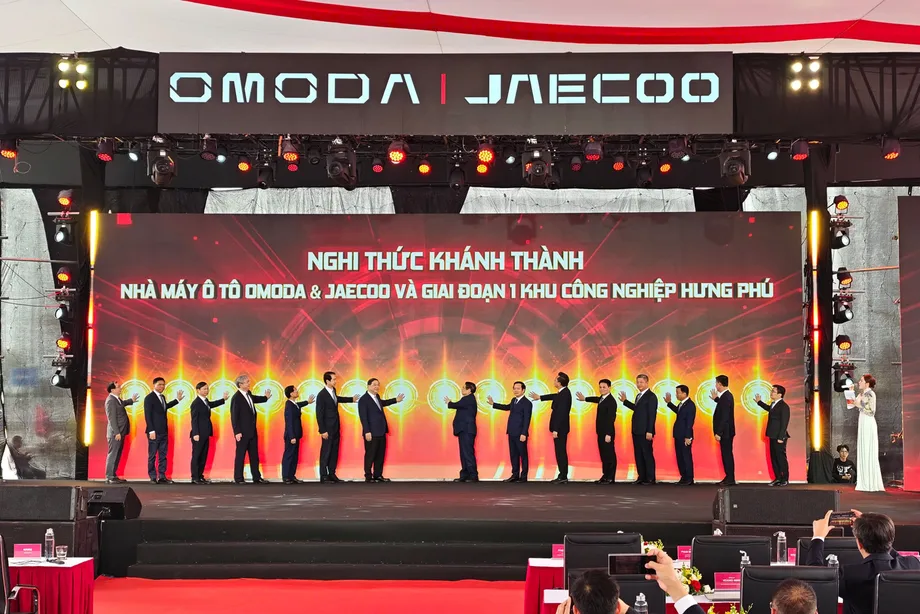
A car factory, a chip plant and a robot line on one morning
On the morning of 29 November 2026, Omoda & Jaecoo Vietnam inaugurated the first phase of its car plant in Hung Phu Industrial Park in the northern province of Hung Yen, thirteen months after breaking ground in October 2025. The joint venture of Vietnam's Geleximco Group and China's Chery Group has committed $319 million to the first two phases, which are designed to build 120,000 vehicles a year on a site of more than 380,000 square metres.
Contents
- A car factory, a chip plant and a robot line on one morning
- What the Hung Yen lines will build first
- Nearly 1,000 Jaecoo J5s in the first month of sales
- Three phases, one industrial park
- Assembly is a start, not a finish line
- Chips and robots to feed the car lines
- A research centre asked to keep the engineers
- What the group says it wants to leave behind
- Why a Chinese brand building here stands out
- What has not been settled
- Key Points
The ceremony drew Deputy Prime Minister Pham Gia Tuc, a Politburo member who holds the permanent deputy post, along with former Prime Minister Pham Minh Chinh, former standing member of the Party Secretariat Tran Quoc Vuong, Hung Yen Party Secretary Pham Quang Ngoc, officials from the Chinese embassy in Hanoi and Chery executives. Geleximco founder and chairman Vu Van Tien led the host side.
The same morning brought two more milestones inside the same park: the opening of a product research and development centre, and the start of construction on two factories, one to assemble, package and test semiconductor chips and one to build robots. Figures released by the partners put the combined initial investment in the three manufacturing projects at about $410 million.
Chery has been China's largest car exporter for 23 consecutive years, a standing the partners cite as the reason they expect technology transfer rather than simple kit assembly. The plant will build models from three Chery owned brands, Omoda, Jaecoo and iCaur, with new energy vehicles placed at the centre of the plan.
What the Hung Yen lines will build first
Two models were named as the first to be assembled at Hung Yen: the Jaecoo J5, a city SUV already on sale in Vietnam, and the iCaur V27, an off road styled SUV that uses an extended range electric drivetrain, known as EREV. In that layout an electric motor turns the wheels while a petrol engine works only as a generator to recharge the battery, which stretches the distance the car can cover between charging stops.
The Jaecoo J5 is offered in four versions with three drivetrain choices: a petrol engine, a hybrid system Chery labels SHS-H, and a fully electric option. Prices run from 599 million to 749 million dong. The car uses a multi link rear suspension and driver assistance technology. The iCaur V27 is sized against large SUVs such as the Hyundai Palisade and the Volkswagen Teramont Pro.
Buyers can place early orders for the iCaur V23 and V27 from 29 November 2026 until the official launch, which has no announced date. A deposit of 10 million dong brings a package of benefits the brand values at up to 150 million dong.
The assembly list is set to widen. The company names the iCaur V23, iCaur V25, Omoda O4 and Omoda C7 as the next candidates, all leaning on electrified powertrains.
Nearly 1,000 Jaecoo J5s in the first month of sales
The Jaecoo J5 went on sale in Vietnam in mid August 2026 and about 1,000 were delivered to customers nationwide that September, according to figures released by Omoda & Jaecoo Vietnam. For a new nameplate that is a solid opening, and the disclosure itself is unusual: VAMA members, VinFast and Hyundai Thanh Cong publish monthly totals as a routine, while most Chinese brands do not. The numbers come from the company and are not independent registration or sales statistics.
Rivals in the B segment show the size of the task. In the first eight months of 2026 the Toyota Yaris Cross sold 10,847 units, an average of 1,355 a month, and the Mitsubishi Xforce sold 8,133, an average of 1,016 a month. Both are imported from Indonesia. The Hyundai Creta (6,000), Kia Seltos (5,957) and Honda HR-V (3,225) all averaged fewer than 1,000 a month over the same period.
The segment also holds Geely Coolray, Lynk & Co 06, MG ZS, BYD Atto 2 and the Omoda C5 from the same group. One month of deliveries cannot settle who is winning, and long term standing will depend on how sales hold up, how the dealer network grows, how after sales service performs and what resale values look like.
Three phases, one industrial park
The car plant covers 38.1 hectares inside a park of 209.08 hectares. Hung Phu Industrial Park, developed by Geleximco Hung Phu Industrial Park JSC under a policy approved in 2024, carries total investment of 2,300 billion dong, and its first phase opened on the same day. Geleximco has described the initial outlay on the car plant as more than 8,000 billion dong, the same commitment the partners report in dollars as $319 million.
Phase three, planned for after 2029, is meant to lift total investment to $875 million and design capacity to 200,000 vehicles a year. At full scale the project is expected to support about 5,000 direct jobs and 20,000 indirect ones in Hung Yen, and to pull in local suppliers of parts, logistics and technical services.
- October 2025: groundbreaking at Hung Phu Industrial Park
- Mid August 2026: Jaecoo J5 launched in Vietnam with prices announced
- September 2026: about 1,000 Jaecoo J5s delivered nationwide
- 29 November 2026: car plant phase one opened, R&D centre opened, chip and robot plants begun
- November 2027: robot factory due to start operating
- February 2028: chip factory due to begin mass production
- After 2029: phase three, with capacity of 200,000 vehicles a year
Assembly is a start, not a finish line
Deputy Prime Minister Pham Gia Tuc used the ceremony to set tests for the investors that go beyond the size of the cheque. Vietnam assembled about 468,000 vehicles in the first ten months of 2026, up 25 per cent from the same period a year earlier, while the industry still leans heavily on imported parts.
The question is how much of the value in each product leaving the line is created by Vietnamese companies, engineers and workers, how much technology is transferred and mastered in Vietnam, and how far prices, quality and design suit Vietnamese consumers, not simply how many plants the country has.
He asked Geleximco, Chery and the joint venture to publish a localisation roadmap with deadlines, targets and a method for judging results at each stage, starting with parts Vietnamese firms can already make and moving towards higher technology content. The research centre, in his account, should train engineers and managers until Vietnamese staff hold key posts in production, engineering, quality control and plant management.
Assembly is a starting point, not a destination.
The government side also asked for transparent warranties and after sales service and for compliance with green manufacturing, energy use, environmental protection and workplace safety commitments. Export sales, officials said, will be the yardstick for whether the plant and its Vietnamese suppliers are genuinely competitive. Hung Yen was told to keep supporting the investors after the ribbon cutting, to connect the park by road to ports and airports, to prepare housing for workers, and to set aside land and power, water and waste treatment capacity for the chip and robot factories.
Chips and robots to feed the car lines
Construction began on the two technology plants the same day, with the partners putting about $91 million into the first stages. The semiconductor site covers 10.3 hectares and is designed for assembly, packaging and testing rather than wafer manufacturing at the outset. Phase one carries about $75 million and capacity for nearly 200 million products a year, with phase two planned to reach 2 billion products a year. Mass production is scheduled for February 2028. A third phase is meant to add a plant making silicon wafers measuring eight inches across.
Output is aimed at consumer electronics, industrial controls, robots, new energy vehicles, solar power, energy storage and servers running artificial intelligence. Deputy Prime Minister Pham Gia Tuc asked the investors to move beyond basic assembly towards chip design and product validation, and to meet the specific safety demands of the sector, including chemical handling, water use, cleanroom control and specialised waste treatment.
The robot factory covers about 50,000 square metres and is due to run from November 2027. Phase one carries about $16 million for 6,000 humanoid robots and 6,000 four legged robots a year, doubling to 12,000 of each in phase two. The machines are intended for logistics, retail, education and industry, with research, staff training and technology transfer attached.
A research centre asked to keep the engineers
The R&D centre opened at Hung Phu is tasked with studying Vietnamese driving conditions, climate and buyer habits, running product tests, localising components and adapting smart vehicle technology to local roads. It is also the channel for absorbing transferred technology and for training Vietnamese engineers, a step that determines whether the country moves past assembly into design and engineering work.
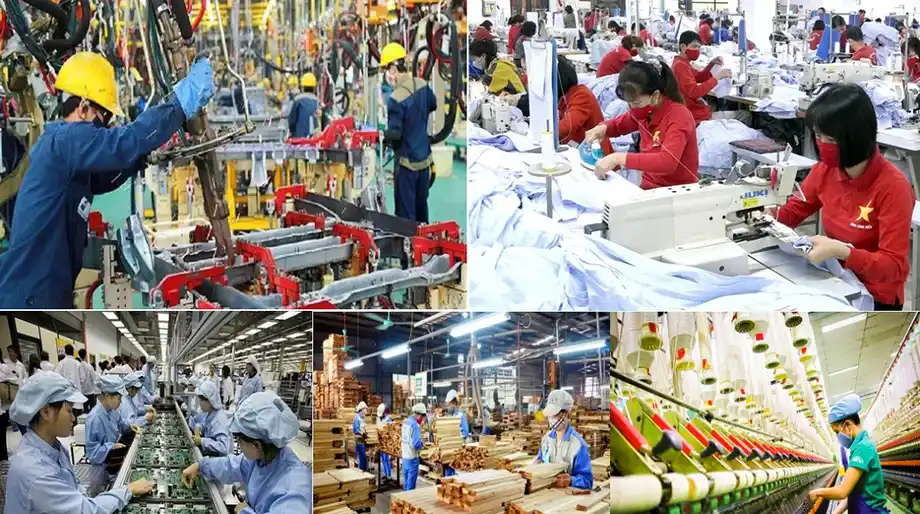
For the group, the three projects are meant to work together. Cars provide a market for chips and electronic modules, robots and automation raise output and quality on the vehicle lines, and the research centre links both to the factory floor. Officials framed the cluster as part of a wider industrial push along the coastal belt of the Red River delta.
What the group says it wants to leave behind
Geleximco's founder and chairman Vu Van Tien described the plant as the work of the joint venture team and tied it to the province and the country rather than to a single factory.
We hope this is more than an industrial facility. It is a foundation that lifts national production capacity, step by step turning Vietnam into a centre of car manufacturing and export with a reach across the region and the world.
He set a similar test for what the investment should leave in place once the buildings are finished.
A successful investment project leaves behind more than factories and modern equipment. What matters more is the technology, knowledge, workforce and production capacity it leaves the country.
Geleximco and Chery describe a programme of 16 projects in Vietnam with total planned investment of $12 billion to $17 billion across cars, semiconductors, robots, high technology and supporting industry. The car plant, the chip line and the robot line at Hung Phu are the first pieces of it.
Why a Chinese brand building here stands out
Vietnam already assembles vehicles for VinFast, TC Motor and Thaco, and produces Toyota, Hyundai, Mazda, Kia and Skoda models alongside Mercedes-Benz and BMW cars. Within the Chinese group of brands, the Hung Yen plant is the first manufacturing site of this scale in the country. Geely has spoken of a plant with partner Tasco Auto that has not been built, and Li Auto, on confirming its entry into Vietnam, promised to assemble cars locally.
The new plant is comparable in size to the Toyota and Honda factories in Phu Tho, formerly part of Vinh Phuc province, and to Ford's site in Hai Duong, which are built mainly around combustion engines. The difference at Hung Yen is a line configured from the start for petrol, hybrid and electric models together, a flexibility that only pays off if domestic sales, local content and exports all grow.
What has not been settled
No localisation roadmap has been published yet, and the share of parts to be bought in Vietnam remains open. The launch dates for the iCaur V23 and V27 have not been given, nor has the date of the first export shipment. Construction dates are firmer: the robot plant from November 2027, the chip plant from February 2028, and the third phase of the car plant after 2029.
How quickly the lines reach their rated output will decide whether Hung Yen becomes the technology cluster its backers describe or a large assembly site with imported content. The Deputy Prime Minister's instructions, including a published roadmap with deadlines and targets, give the next set of checkpoints to watch.
Key Points
- Omoda & Jaecoo Vietnam opened its Hung Yen car plant on 29 November 2026, thirteen months after breaking ground
- The plant covers more than 380,000 square metres and has design capacity of 120,000 vehicles a year
- Investment for phases one and two is $319 million, rising to a planned $875 million and 200,000 vehicles a year after 2029
- Jaecoo J5 and iCaur V27 are the first models assembled, with iCaur V23, V25, Omoda O4 and Omoda C7 to follow
- About 1,000 Jaecoo J5s were delivered in September 2026, against a monthly average of 1,355 for the Toyota Yaris Cross over the first eight months of 2026
- A 10.3 hectare chip plant with $75 million in phase one is due to produce from February 2028
- A 50,000 square metre robot plant with $16 million in phase one is due to run from November 2027
- The project is expected to create 5,000 direct and 20,000 indirect jobs
- Deputy Prime Minister Pham Gia Tuc asked for a published localisation roadmap with deadlines and targets