Five Years Without Wages, and a Deadline the Party Will Not Move
South Korea's statutory retirement age is 60, fixed in Article 19 of the Act on Prohibition of Age Discrimination in Employment and Elderly Employment Promotion. National Pension payments begin at 63 this year and reach 65 in 2033, and everyone born in 1969 or later waits until 65 for the full amount. A worker who leaves a job at 60 therefore faces up to five years with neither wages nor a pension, the stretch Korean policy debate calls the income crevice.
Contents
- Five Years Without Wages, and a Deadline the Party Will Not Move
- What the Mediation Plan Actually Does
- One Hundred Minutes and No Agreement
- The President's Own Reservation
- Employers Say the Eight Year Clock Really Runs Four
- The Wage Rule Exception Neither Side Wants
- Young Workers Caught Between Two Fears
- Who Actually Works Until 65?
- Where the Bill Goes Next
- Key Points
Raising the retirement age to 65 was a campaign promise by President Lee Jae-myung, carried into government as a national policy task after his June 2025 election win. The Democratic Party created a special committee on the retirement age, chaired by lawmaker So Byeong-hun, to write that promise into law this year. The committee held its first session with labor and business in 10 months on 27 November and will end its work at a plenary meeting on 2 December at 10 a.m.
Two pressures brought the committee back to the table. The Korean Confederation of Trade Unions and the Federation of Korean Trade Unions held a press conference outside the main National Assembly building on the morning of 25 November demanding legislation before the year ends. Three days earlier, Employment and Labor Minister Kim Young-hoon warned the two sides that the government would step in.
The government will announce its position if an agreement is not reached.
The ministry has kept to a narrower line since then. Officials say their job is to support an agreement and that legislating belongs to the National Assembly, and they have declined to publish a government bill of their own.
What the Mediation Plan Actually Does
The proposal on the table is the committee's own mediation draft, first presented in June and rejected by both sides at the time. It raises the statutory retirement age to 61 in 2029, then adds one year every two years in four steps until it reaches 65 in 2037. From 2028, one year earlier, employers must rehire workers who reach the retirement age before the legal age catches up with them for a single year.
Rehiring is written as a right for the worker, not a favour from the employer. Every applicant is covered in principle, and an employer can refuse only on grounds set by presidential decree, such as poor health, the loss of a qualification the job requires, or a serious breach of duty. Adjusting pay and conditions within a reasonable range for rehired staff is carved out as an exception to the ban on age discrimination in employment.
The schedule leaves one group outside. Workers born in 1967 turn 60 next year, before the rehiring system starts, and labor groups are asking for them to be brought in. The committee had also weighed slower timetables that would have finished the climb to 65 in 2039 or 2041, and had earlier considered 2036. Business groups asked for 12 years beginning in 2030, with employers allowed to choose whom to keep on. Neither request survived.
Park Myeong-jun, a senior research fellow at the Korea Labor Institute, argues the process itself needs daylight.
To set consistent principles for the retirement age and apply them at workplaces, we need social dialogue in which the process is open to the general public.
One Hundred Minutes and No Agreement
The 27 November meeting began at 10 a.m. behind closed doors and ran one hour and 40 minutes. It was the first gathering of its kind since January, when the party pushed the legislative timetable back until after the 3 June local elections and the Federation of Korean Trade Unions walked out of the room. Talks had been frozen since.
Both umbrella unions and the Korea Enterprises Federation, along with the Korea Federation of SMEs, spent the session restating positions that have not moved in a decade. Han Seong-gyu, a vice chairman of the Korean Confederation of Trade Unions, opened by criticising the delay.
I express regret that the social agenda of extending the retirement age has been neglected for such a long time.
Lee Dong-geun, standing vice chairman of the Korea Enterprises Federation, answered in kind, complaining that the sudden push for a bill within the year, after labor took its campaign outside the building, had left employers with little room.
As labor's outside demands gained traction, the direction suddenly shifted toward passing legislation within the year, and regarding the fact that today's meeting was arranged, the business community expresses deep concern and regret.
Kim Joo-young, the lawmaker who serves as the committee's liaison, told reporters afterwards that the gap had not narrowed and that more talk would produce the same arguments. Labor wants the age raised quickly and without pay cuts. Employers want to keep the age at 60 and rely on rehiring retirees instead, with wages redesigned at the same time. On method, business wants a gradual climb and labor wants one jump.
Neither side agrees with the other's arithmetic. Lee of the Korea Enterprises Federation said pushing the change through without measures for young jobseekers is too harsh on the next generation. Han of the trade unions rejected the framing that older workers are the cost.
I cannot agree with describing the small cost of extending the retirement age as the biggest cost burden on businesses.
He added that companies receive extensive government support yet do not expand jobs.
The President's Own Reservation
On 29 November, President Lee Jae-myung was asked about the bill and gave an answer that cut against his own party's timetable. Extending the retirement age, he said, helps regular workers a great deal while young people and non-regular workers gain nothing from it, and because interests clash the matter needs discussion.
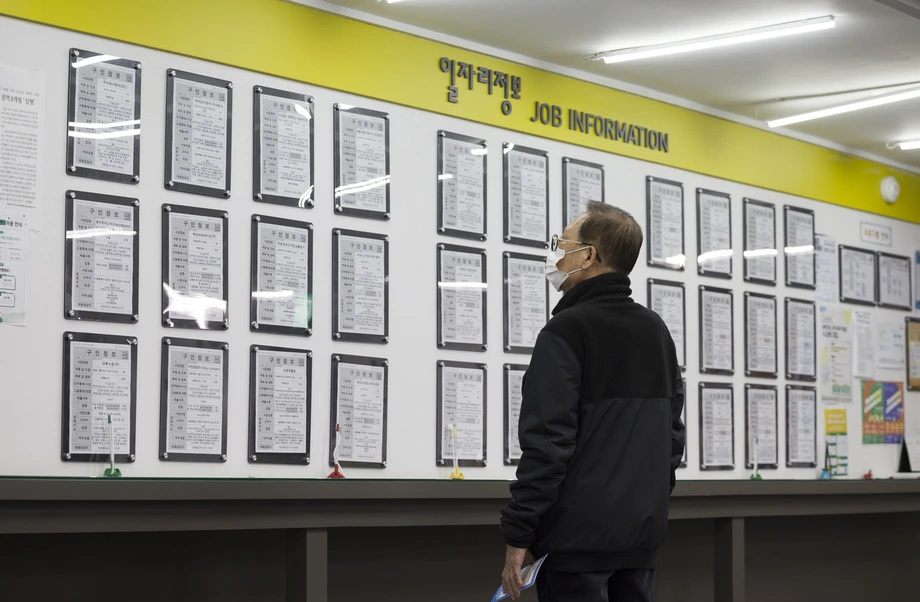
His remark lands on a structural fact. Only around one in five workplaces in South Korea operates a fixed retirement age at all, and those are mostly large companies and public institutions where permanent staff on pay that rises with years of service are concentrated. For a delivery rider, a contract worker at a small supplier, or a 53 year old who was pushed out through a voluntary redundancy programme, the legal age is a number in a statute book that never shaped their working life.
Employers Say the Eight Year Clock Really Runs Four
The Korea Enterprises Federation published a detailed objection on 29 November, titled Problems With the Democratic Party Special Committee's Retirement Age Extension Plan and the Views of the Business Community. Its central claim is arithmetic. The law would write eight years of transition, but each step upward also catches workers who are still employed and already past 60.
The federation works through it. A worker born in 1977 turns 60 in 2037 and would be the first to retire at 65 if the age applied once, in the year a person turns 60. Under the committee's approach, someone born in 1973 turns 60 in 2033 when the age is 63, works to 2036, sees the age rise to 64 that year and to 65 the next, and finally retires in 2038. On that reading the first cohort guaranteed 65 is the one born in 1973, four years earlier than the law's headline number suggests.
The result, the federation says, is five years between 2029 and 2037 in which no one reaches the retirement age at all: 2029, 2031, 2033, 2035 and 2037. Companies that fill vacancies created by retiring staff would have nothing to fill in those years, and recruitment of young workers would shrink as a consequence.
- 2029: the age rises to 61, so workers who would have retired that year stay on
- 2031, 2033, 2035 and 2037: the same effect repeats at each step up to 65
- First cohort reaching 65 under the cumulative reading: born 1973
- Years with no retirement age departures: five, every other year
The federation also put a number on why unchanged pay scales make the extension expensive. Korean workers with 30 or more years of service earn 2.95 times as much as colleagues with less than one year. The same ratio is 2.27 in Japan, 1.80 in Germany and 1.63 in France. Adding years at the top of that ladder is what turns a retirement age into a payroll problem.
On rehiring, the federation argues that a rule covering every applicant who wants to stay amounts in substance to one more year of retirement age, since only health problems or a lost licence count as grounds to say no. Singapore and Japan, which already run rehiring systems, weigh whether a person can still do the job and how they have performed, it noted.
If legislation is rushed through to meet political deadlines, the adverse effects will fall squarely on the shoulders of the industrial sector and the younger generation.
The Wage Rule Exception Neither Side Wants
To soften the cost, the committee drafted a limited exception to the Labor Standards Act. Normally an employer that changes workplace rules to a worker's disadvantage, for example by cutting pay, needs the consent of a union representing a majority of staff or of a majority of workers. The draft would let an employer covering staff whose retirement age has been extended redesign their duties and positions, adjust working hours and rework the pay system until 2036 with only a hearing of opinions.
The gap the exception opens is wide. Cutting weekly hours from 40 to 30 and pay by 25 percent for staff over 60, as one illustration circulating around the proposal puts it, would no longer require a majority vote.
Trade unions see it as the price hidden inside the deal. One labor official involved in the talks said the objection is not to discussing pay reform at all.
What we oppose is letting employers decide unilaterally matters that should be settled by agreement between labor and management, suited to the circumstances of each workplace.
The Korean Confederation of Trade Unions called the exception a signal for spreading bad jobs, and asked for the bill to be reviewed in full. Its criticism found an unexpected ally. Employers say the exception is too narrow to use, because it applies only where duties or hours change, and not to trimming automatic annual increases or moving to pay for performance while people stay in the same job.
Jeong Heung-jun, a professor of business administration at Seoul National University of Science and Technology, questions the legal shortcut itself.
It is not appropriate to put an exception to the rules on disadvantageous changes to workplace rules into law. There is time before it takes effect, so the discussion needs to be tied to other agendas, such as cutting actual working hours, in a social debate.
Kim Dae-jong, a professor of business administration at Sejong University, points the other way, warning that without real pay reform companies will answer with hiring freezes and wider voluntary redundancy programmes.
Young Workers Caught Between Two Fears
The people the bill is least designed for have the most divided views. A 26 year old identified only by his surname Lee told reporters on 29 November that his father, a lifelong civil servant and the family's only earner, has four years left before retirement and a property loan still to repay. He said he cannot cover the loan himself, so an extension would let the household breathe.
Choi, 33, who works in educational publishing, gave the same reason, saying an extension would help steady her family's finances. Anxiety about parents runs high among young adults, she said, because their own jobs are insecure and their pay low.
Fear runs the other way too. Kim, a 28 year old preparing for work, argued that a later retirement age would jam promotions, freeze wages, and leave companies with no reason to hire anyone new while artificial intelligence eats into entry level work. A 35 year old office worker with the same surname said the debate feels remote, since both he and his parents work somewhere that guarantees nothing, and companies in their forties hand out voluntary redundancy packages.
The labour market data behind those worries is stark. A June 2026 report from the Korea Research Institute for Vocational Education and Training, titled Early Twenties, Drifting Away From Work, found that the employment share of people aged 20 to 24 fell from 45 percent in 2009 to 31 percent in 2024, a drop of 14 percentage points. A survey by the National Data Office published in May 2026 put the average age of leaving a main job at 53, with formal retirement accounting for only 13.2 percent of the reasons people gave.
The New Refresh Workers' Council, which organises young office and research staff, issued a statement on 27 November calling the promise of protecting youth hiring while delaying retirement, with no plan for extra posts or the added wage bill, as illogical as ordering a hot iced Americano.
The party's answer is a youth task force attached to the committee and a set of measures still under review: extra public sector posts to offset hiring lost to the extension, a social fund financed by labor and management at companies with unusually large bonuses, job training, support for smaller firms hiring young people, and subsidies for private employers that keep or add young staff. Kim Seol, chair of the Youth Union, sits on the task force and says the substance has not arrived.
I was told the purpose was to reflect young people's voices in the retirement age plan, but we have not even been given a concrete proposal. I think we need a process of wider public discussion.
Who Actually Works Until 65?
The Bank of Korea has measured what happens when the retirement age rises. Since the age of 60 became mandatory in 2016, following a 2013 amendment, each additional older worker in a workplace has been associated with between 0.4 and 1.5 fewer young workers there. The same research points to a narrower effect than the headline suggests: with only about 20 percent of workplaces operating a retirement age system, the gains would cluster among permanent staff at large companies and in the public sector.
Political arithmetic adds to the difficulty for the party. More than 700,000 young people are classified as resting, neither working nor looking for work, and pushing through a benefit for middle aged and older staff in that climate carries a cost at the ballot box. The committee's own liaison concedes the broader questions have no home in this bill.
One committee lawmaker argued that coping with reduced hiring at large companies and with AI replacing labour is a real task, while insisting that the answer belongs to a separate government jobs plan rather than to the retirement age law.
Where the Bill Goes Next
The committee's final plenary is set for 2 December. If the two sides are still apart, the bill will be filed in the party's name rather than as a committee product, using the mediation draft as its base. Kim Joo-young has said the timing for pension payments keeps receding, the income gap keeps widening, and the committee has to finish.
Whether the bill is filed this year is a separate question from whether it passes. Committee officials have said a filing within the year looks difficult given the missing youth employment plan and the need to gather more views, even as the leadership holds to a December timetable. Passage would require review by the National Assembly's environment and labour committee and a floor vote, steps with no date attached.
For workers now in their late fifties, the practical consequence is that nothing changes until a law is published. Anyone retiring before then leaves at 60 and waits for a pension, and the rehiring arrangement that would have covered the first of them in 2028 does not yet exist.
Key Points
- The Democratic Party's special committee wants the statutory retirement age raised from 60 to 65, starting at 61 in 2029 and adding a year every two years until 2037.
- Employers would have to rehire workers reaching retirement before the legal age catches up, for one year, starting in 2028, with every applicant covered in principle.
- The 27 November labor and management session, the first in 10 months, lasted 1 hour and 40 minutes and ended without agreement. A final plenary is set for 2 December.
- Workers born in 1967, who reach 60 next year, fall outside the new system, and labor groups want them covered.
- The Korea Enterprises Federation says the phase in really lasts four years, makes workers born in 1973 the first cohort to reach 65, and leaves five years to 2037 with no retirement departures.
- Korean staff with 30 or more years of service earn 2.95 times colleagues with under a year, against 2.27 in Japan, 1.80 in Germany and 1.63 in France.
- A temporary exception would let employers change duties, hours and pay systems with only a hearing of opinions rather than majority consent, which unions reject and employers call too narrow.
- President Lee Jae-myung said on 29 November that the change helps regular workers while young and non-regular workers gain nothing, and that clashing interests need discussion.
- Employment for people aged 20 to 24 fell from 45 percent in 2009 to 31 percent in 2024, and the average age of leaving a main job is 53.
- Only about one in five workplaces operate a fixed retirement age, and each added older worker has been linked to 0.4 to 1.5 fewer young workers since 2016.