Forty-Five Robots on the Parcel Line at China Post
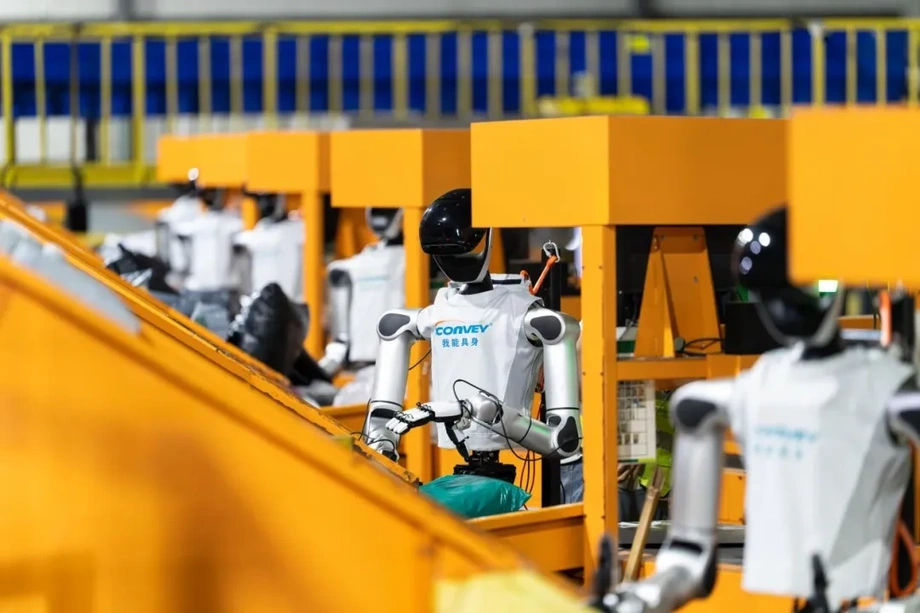
China Post's Hangzhou Postal District Center now runs 45 humanoid robots on the line that feeds packages into its sorting machines. Built by Beijing company Robotera, the machines lift parcels from pallets and shelves, turn each one so the shipping label faces the scanner, pull out odd shaped or soft items that could jam the equipment, and place the rest onto the induction platform. Robotera's announcement on November 26 put throughput at 500 to 600 parcels an hour in the first phase of testing and about 1,200 during specific test periods, with operational accuracy above 90 percent.
Contents
- Forty-Five Robots on the Parcel Line at China Post
- Why Parcel Volumes Keep Pushing Robots Onto the Floor
- The Hourly Figure Deserves a Careful Read
- Guangdong Is Where the Averages Come From
- Funding, Customers and a Valuation Above $1.4 Billion
- Washington Puts Robotics on a Tariff List
- Seoul Writes a Cheque for a Domestic Champion
- Beijing Sets a Target of 10,000 Robots at Work
- How the Timeline Fits Together
- Building 10,000 to the Same Standard
- What a Logistics Buyer Should Weigh
- Key Points
Parcel induction is the awkward end of a sorting hub. Boxes, padded envelopes and bags arrive in every size, shape and orientation. Fixed conveyors and industrial arms are built for standard cartons, and the sorters, scanners and automated guided vehicles that share the floor are just as rigid. The robots are meant to fill that gap by looking at each item and deciding how to handle it. A package that slips past induction at the wrong angle can jam a sorter further down the line, so knowing what not to feed the machine is part of the job.
Robotera calls the Hangzhou trial the largest test deployment of its kind at a comparable postal operation in China. The testing programme began in April 2026. Chinese market accounts of the same project, which identify the machine as the M7 and the Shenzhen partner as CONVEY, describe a deployment in early September and put the current rate above 1,500 parcels an hour, with 1,200 as the opening figure. Robotera has not said whether the hourly figure belongs to one robot, one station or the whole fleet, a gap that changes the meaning of the number by a factor of 45.
Why Parcel Volumes Keep Pushing Robots Onto the Floor
China's delivery volumes explain the interest. During last year's Double 11 shopping festival, the State Post Administration recorded 13.938 billion parcels nationwide, an average of 634 million a day, equal to 117.8 percent of normal volume. A hub that can add capacity for a few weeks without rebuilding its conveyor layout has an obvious appeal.
The M7 is not a walking worker. Chinese reporting describes it as an upper body on a stand, with a 360 degree view from 3D LiDAR, arms with 7 degrees of freedom and hands with 12, with the option of adding legs. Robotera builds the hand itself, a five fingered unit with motors inside, along with the motion control and recognition software that lets a robot flip a parcel so its label faces up. Xi Yue, a co-founder, has said that as long as the machine is plugged in it can work at a constant speed, which trades mobility for stability.
The company's wider pitch rests on flexibility. Robotera says deployment does not require a facility to rebuild its lines, that the robots run around the clock on batteries or mains power, and that fleets can take batch software updates so efficiency improves without new hardware. China Post's Hangzhou branch has said it will push automated equipment, including intelligent sorting and security inspection systems, into more parts of its operations, without publishing its own throughput figures for the trial.
The Hourly Figure Deserves a Careful Read
Two numbers decide whether a robot earns a place in a sorting hall: how many items it handles across a full shift, and how often a person has to step in. The Hangzhou trial supplies neither in a form that can be compared directly with other systems.
Robotera reports operational accuracy above 90 percent without defining what is measured, whether that is a successful grasp, correct placement or something else. Xi Yue put the sorting success rate above 95 percent in August, at a different site and with no stated time frame. The 1,200 figure covers specific test windows, so it describes what the fleet reached in those periods rather than a pace held through a night shift.
Human sorters give the number its scale. Xi Yue told Beijing Daily in August that an average sorter handles 1,200 parcels an hour, and 36Kr reported in June that robots at a Shenzhen site held 1,200 an hour in late May against a human average above 1,000. In a livestreamed 10 hour contest, a Figure AI intern sorted 12,924 packages and the company's F.03 robot sorted 12,732, roughly 1,290 and 1,270 an hour, though those runs included barcode scanning and are not a direct comparison. At 1,200 parcels an hour a machine handles one parcel every three seconds.
Guangdong Is Where the Averages Come From
Hangzhou is a single site with a concentrated fleet. The longer record sits in Guangdong, where Robotera and its legal entity Beijing Xingdongjiyuan Technology have put robots into 11 postal hubs across eight cities: Guangzhou, Shenzhen, Dongguan, Jiangmen, Shantou, Shanwei, Jieyang and Heyuan. The pilot began at the Guangzhou Postal District Center in March 2026, and Robotera reported on November 17 that induction there averages more than 1,500 parcels an hour, a pace it compares with experienced sorters. Guangdong is China's largest province by express parcel volume, and loads there can climb several times above normal in peak shopping seasons.
One published count from the same province gives a lower number. On August 10, China Daily reported that eight robots were being tested at the Jianggao Mail Processing Center in Guangzhou, with five more on the way, feeding 800 parcels an hour toward a goal of 1,600 by the second quarter of 2027. The accounts cover different sites and months, and Hangzhou measures a peak reached in test windows while Guangdong reports an average.
Robotera has also placed machines in more than 10 logistics centres operated by China Post and SF Holding across North, East and South China. A sales representative said in August that the company had more than 100 parcel sorting robots in 15 warehouses nationwide. Chen Jianyu, the founder, said the machines can process up to 1,200 parcels an hour, approaching human productivity in some logistics settings.
We want robots to enter factories and logistics parks and become real productive forces.
Funding, Customers and a Valuation Above $1.4 Billion
Capital has followed the deployments. Robotera closed a strategic round above RMB 2 billion, about $280 million, led by SF Group, which runs one of China's largest express networks and is also a customer. Sequoia China, IDG Capital and CICC Capital joined, along with industrial backers Dongfeng Investment and China Unicom. The round lifted Robotera's fundraising in two months to nearly RMB 2.5 billion, about $350 million, and its valuation past RMB 10 billion, around $1.4 billion. Earlier investors include Geely, Alibaba and Samsung.
The technical claim behind the money is ERA-42, a vision language action model that turns camera images and instructions into motor commands, so a robot can handle new kinds of goods without being reprogrammed for each one. Robotera says it develops 95 percent of its hardware in house, including a hand with 12 degrees of freedom called XHand, and that its machines have reached up to 85 percent of human level efficiency while running around the clock.
The customer list doubles as a testing ground. Automotive partners Geely and BAIC give the company structured settings for picking and assembling parts, Samsung and TCL point to precision manufacturing, and SF Group anchors the logistics work that has drawn the most attention. Robotera reports growth of 300 percent in 2026 as it shifts from pilots to delivering units by the thousand.
Washington Puts Robotics on a Tariff List
Buyers now have a second filter besides throughput. On November 25, US Trade Representative Jamieson Greer issued Section 301 determinations against 14 economies over what his office calls structural excess capacity in manufacturing, and listed robotics among the Chinese sectors it describes as especially affected, alongside semiconductors, batteries, machine tools and cars.
For China, the office proposes duties of up to 20 percent on goods not listed in the notice's annexes, net of a separate forced labor duty, up to 10 percent on Annex A goods and exemptions for certain Annex B goods. Civilian drones and their parts sit in Annex A. If talks with Beijing stall, the office said it could consider duties of up to 40 percent on all Chinese goods, and it also proposes up to 15 percent on goods from Japan and Korea. Nothing has been imposed. Written comments are due January 5, 2027, and hearings begin January 25.
The timing lands in the middle of automation budgets. China accounted for 97 percent of humanoid shipments in the first three quarters of 2026, according to Smart Analytics, so a US buyer weighing a Chinese humanoid against a domestic alternative may soon need to add a tariff line to the calculation, and service contracts signed now could carry exposure later.
Seoul Writes a Cheque for a Domestic Champion
South Korea is trying a different route. At a November 24 briefing, the Ministry of Science and ICT set out its Next-X Humanoid Challenge, a draft plan worth 53.5 billion won over five years. Of that, 23.5 billion won would fund a competition in 2027 and 2028, and 30 billion won would support the selected platforms from 2029 to 2031. Applications would open in mid February and about 10 teams would be picked in April, each receiving 1 billion to 3 billion won over two years plus access to government GPUs, physical AI data and simulation environments.
Teams can enter a championship track with their own hardware or an open platform track writing software for commercially available Korean robots. Buying and modifying complete foreign humanoids, including Chinese ones, is excluded. Finals are set for November 2028, and the budget still needs a National Assembly vote.
Beijing Sets a Target of 10,000 Robots at Work
China's own policy push arrived in the same week. The Ministry of Industry and Information Technology and the State-owned Assets Supervision and Administration Commission launched a nationwide initiative to spread humanoid robots through manufacturing, logistics, retail and healthcare, with a target of more than 100 high value application scenarios by the end of 2026 and large scale deployment of more than 10,000 humanoid robots.
Research houses are cautious about the pace. Morgan Stanley expects spending on data collection, robot training and early customer deployments to rise, with initial commercial use in selected tasks in 2027 and wider adoption further out. The bank pointed to one robotics benchmark where a newer model's success rate more than doubled to 41.2 percent from 19.6 percent while average response time fell 33 percent. Delivery targets are already public. UBTECH aims for about 4,000 industrial and commercial humanoid deliveries in 2026 alongside 1,500 to 2,000 household units, and Geekplus expects to ship a first batch of about 300 humanoids by the end of 2026 or early 2027. Earlier coverage of the 2035 shipment forecast mapped how far the industry expects this to run, with Chinese makers projected to take 51 percent of a global market of 6.48 million units a year.
How the Timeline Fits Together
- March 2026: Robotera's robots begin a pilot at the Guangzhou Postal District Center.
- April 2026: China Post's Hangzhou center launches testing of the 45 robot fleet.
- Early September 2026: Chinese market accounts date the Hangzhou deployment to this point.
- October 2026: Robotera closes a strategic round above RMB 2 billion led by SF Group.
- November 17, 2026: Robotera reports average induction above 1,500 parcels an hour across 11 Guangdong hubs.
- November 24, 2026: South Korea's science ministry briefs on the Next-X Humanoid Challenge.
- November 25, 2026: The US Trade Representative issues Section 301 determinations that name robotics.
- November 26, 2026: Robotera announces the Hangzhou fleet and its testing figures.
- January 5, 2027: Deadline for written comments on the US tariff proposal, with hearings from January 25.
- November 2028: Finals scheduled for South Korea's humanoid competition.
The dates cluster in one week, and they point at the same question from three directions. China is testing humanoids at fleet scale, the United States is weighing how much to charge for Chinese hardware, and South Korea is paying to build an alternative. Each decision feeds the others, because a tariff changes the price of a robot that a Korean contest is designed to replace.
Building 10,000 to the Same Standard
The gap between a working pilot and a factory floor full of machines is manufacturing consistency. Chen Jianyu has framed it around hands: making one is a prototype, while making thousands to the same standard is a production problem. Unitree founder Wang Xingxing has made a similar point about scale, warning that building tens of thousands of robots a year is one challenge and millions another.
Wang has also said the industry still lacks generalization, the ability to drop one model into an unfamiliar building and have it work without retraining. Wu Huihuan, who leads motor and electronic control for humanoid robots at Li Auto, described the physical bind that follows from more capable software: more demanding models need more computing power, which raises power draw and heat, which changes component layout, battery size and weight, which then affects joint loads and how long a machine can keep working.
If we want to run more complex models, we need more computing resources.
Manufacturers are borrowing from carmaking to answer the production question. PrimeBOT, a subsidiary of Swancor Advanced Materials, has partnered with Huguang Electric and Lens Technology on a system that combines automotive quality standards with the precision of consumer electronics production. XPENG, Leju Robotics and AiMOGA have signalled plans to apply similar standards and production line strategies to humanoid manufacturing.
What a Logistics Buyer Should Weigh
Western operators are setting a similar bar. GXO, the contract logistics group, plans a phased US rollout starting in early 2027 of pallet robots, robotic arms for unloading and packing, AI vision and automated sortation, without naming suppliers, site counts or investment size. Chief executive Patrick Kelleher said on the company's August earnings call that humanoids had not yet produced a return on investment. Agility Robotics' Digit, which GXO says has moved more than 100,000 totes at its Flowery Branch, Georgia site, is still being scaled one facility at a time.
Jiang Han, a senior researcher at the consultancy Pangoal, described the change as a move out of the laboratory.
The key breakthrough is not that the robots can move. It's that they can operate autonomously in complex, dynamic environments as part of everyday business operations.
For a postal or e commerce operator weighing a purchase, the questions that decide the case sit below the headline rate. Shift long throughput, intervention rates and how exceptions are handled set the cost per parcel. Where the hardware is made now affects the price and, in the US, possibly what can be deployed. Fleets with more hours in live operations also improve faster, because the gains at Hangzhou came from repeated tuning on real parcels, and a rate measured at one station says little about how a robot performs in a different building.
Key Points
- China Post is testing 45 Robotera humanoid robots on parcel induction at its Hangzhou Postal District Center, a programme Robotera says began in April 2026.
- Robotera reports throughput rising from 500 to 600 parcels an hour to about 1,200 during specific test periods, with operational accuracy above 90 percent.
- Chinese market accounts give 1,200 parcels an hour as the starting rate and above 1,500 now, and Robotera has not specified whether the figure applies to one robot or the fleet.
- The robots pick, reorient and reject irregular parcels and handle exceptions, working alongside existing sorters, scanners and automated guided vehicles.
- Guangdong holds the broader rollout, with 11 postal hubs across eight cities averaging more than 1,500 parcels an hour since a March 2026 pilot.
- Robotera raised more than RMB 2 billion in a round led by SF Group, taking two month funding to nearly RMB 2.5 billion and its valuation past RMB 10 billion.
- The US Trade Representative named robotics in Section 301 determinations on November 25, proposing duties of up to 20 percent on many Chinese goods, with comments due January 5, 2027.
- South Korea's science ministry has drafted a 53.5 billion won contest to build a domestic humanoid industry, with finals in November 2028.