Five Tests Before a Machine Enters a Courtroom
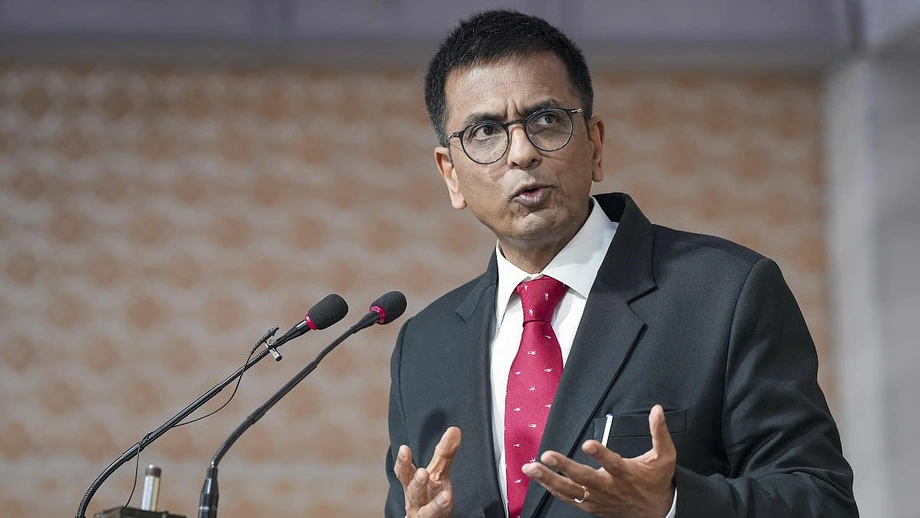
Former Chief Justice of India D Y Chandrachud used the inaugural address of the India Law, AI and Tech Summit and Awards 2026 in New Delhi on Saturday, November 28, to draw a line that India's courts are only beginning to mark out. Artificial intelligence, he said, may find the papers, translate them and summarise them. The decision, and the reasons written for it, must stay with a judge who has taken an oath.
Contents
- Five Tests Before a Machine Enters a Courtroom
- The Best Use of AI Is the Boring One
- Why Liberty Cannot Be Reduced to a Probability Score
- A Real Judgment With an Invented Paragraph
- Inside the Supreme Court's Draft Rules
- The Numbers That Make the Case for Help
- What Is Already Running in Indian Courts
- Court Records and the Most Private Facts of a Life
- What the Profession Is Being Asked to Change
- The Government's Own Turn to AI Drafts
- Dates That Frame the Debate
- A Constitution Read Afresh for the Age of AI
- Key Points
Speaking at the Shangri-La Eros hotel on the theme AI for All: AI Governance and Trust, the Case for Judicial Access and an Empowered India, Chandrachud set out five tests that a tool should clear before it deserves a place in a courtroom.
- A human being decides and signs every judgment.
- A person's liberty is never decided by a probability score.
- Litigants are told when AI has been used in their case and can challenge errors.
- The technology reaches the people at the end of the queue, including those with no digital access.
- Court data sits in secure systems and sovereign databases.
He was careful to frame the list as a description of ordinary judging rather than a rejection of the technology. A tool that passes all five tests, he said, deserves its place.
None of these tests is hostile to technology. Each one describes what a good judge already does.
The reasoning behind the first test rests on accountability. A judgment, Chandrachud argued, is an exercise of public power by a person who has taken an oath, gives reasons for the decision, and can be questioned in appeal. A language model offers none of that.
A language model that has taken no oath; it cannot be asked to explain itself in a higher form, and it does not lose sleep over an innocent man in custody. Let it find the papers, translate them, and summarise them. The decision and the reasons for it must belong to the judge.
The Best Use of AI Is the Boring One
Chandrachud named the tasks where the gains are largest: transcription, translation, case listing and scrutiny of defects in fresh filings. These are the chores that swallow a court's working day, and he described them as exactly where a machine earns its keep.
Look at what these (AI) tools have in common: transcription, translation, listing, scrutiny of defects. It is dull work, and it is where a court loses most of its time.
The temptation, he suggested, begins when the same tool is pushed toward more ambitious work.
I have come to think that the best use of AI in a court is the boring one. The trouble begins when the technology is asked to do something more interesting.
Human verification, in his account, is not an optional courtesy. Every citation and every translation produced by a machine must be checked by a person, and a record must be kept of each use, so that a litigant or a higher court can later find out what the software did.
Why Liberty Cannot Be Reduced to a Probability Score
The second test is the sharpest. A bail decision, Chandrachud said, requires a court to look at the individual standing before it, the allegations, the material on the record and the circumstances of the case. A risk score works from patterns drawn from other people's cases and cannot stand in for that individual assessment.
A bail decision requires the court to consider the individual before it, the allegations, the material on the record, and the circumstances of the case. A risk score may provide certain information based on patterns but it cannot replace an individual assessment.
Any such tool, he added, must remain consistent with the protection of liberty under Article 21 of the Constitution, which guarantees the right to life and personal liberty. The same logic rules out letting software judge whether a witness is telling the truth. The draft rules now before the judiciary go further and bar opaque systems wherever rights or liberty are at stake, and stop AI from forecasting how a pending case will end.
The third test follows from the second. If a tool translated a litigant's evidence or summarised an appeal, that person should be able to find out and to say the machine got it badly wrong. Chandrachud put the risk of unchecked language work in one sentence.
A translation that nobody has checked is a rumour about a judgment.
A Real Judgment With an Invented Paragraph
The caution comes from cases already on the record. In one, a trial court in Andhra Pradesh relied on four Supreme Court judgments that do not exist. In another, a tribunal's orders cited genuine Supreme Court rulings but carried passages invented and attributed to them. The second kind, Chandrachud said, is far harder to catch, and the case of Pooja Ramesh Singh against Jammu and Kashmir Bank brought the problem before the Supreme Court.
A citation of a law report that does not exist can be caught in 30 seconds. A real judgment with an invented paragraph will pass every casual check.
In March, a bench of Justices P S Narasimha and Alok Aradhe held that a judicial order resting on judgments generated by AI and never written by any court is not merely an error but misconduct. That ruling turned a warning into a finding about professional conduct.
Chandrachud carried the point into the daily habits of the bar. Lawyers, he said, must read a judgment in full before citing it, and advocates cannot pin mistakes in their submissions on the software they used, a position the Bar Council of India has taken.
Inside the Supreme Court's Draft Rules
The framework Chandrachud was explaining is the draft Regulations for the Use of Artificial Intelligence in Courts, published by the Supreme Court's AI Committee on June 3, 2026. The committee is headed by Justice P S Narasimha. The draft is written to apply from the Supreme Court down to trial courts and tribunals, and it rests on five principles: human primacy, transparency, accountability, data protection and judicial independence.
Its permissions are modest by design. AI may assist with case management, transcription, translation and legal research. It may not assess a person's risk for bail, predict future criminal behaviour or decide the credibility of a witness. Courts would keep a register of every AI tool in use and a database of incidents when something goes wrong, and parties who rely on AI in their submissions would have to disclose it.
They bar opaque systems wherever rights or liberty are at stake. They propose a register of every AI tool a court uses and a database of incidents when something goes wrong. Parties who use AI in their submissions would have to say so.
Three gaps remain to be filled before the rules are finalised, in Chandrachud's view: a mechanism that lets litigants challenge errors such as mistranslations, proper training in the technology for district judges, and independent audits of the systems courts adopt. No date has been given for notifying the regulations in final form.
The Numbers That Make the Case for Help
The argument for assistance is carried by the backlog. In July, the Law Minister told the Rajya Sabha that about 5.64 crore cases are pending across Indian courts. More than 96,000 sit in the Supreme Court, and more than 80,000 in the High Courts have been pending for over 30 years. Dr Lalit Bhasin, president of the Society of Indian Law Firms, put the total at more than six crore at the same summit, and noted that the laws themselves have not changed at the same pace.
Roughly 21,000 judges handle that load, which works out to about 15 judges for every 10 lakh people. The Law Commission recommended 50 per 10 lakh people in 1987, more than three times the current figure. A judge in the district courts carries about 2,200 cases on average.
Money tells a similar story. Annual legal aid spending comes to Rs 6.46 per person, according to the India Justice Report, a figure Chandrachud did not soften.
That will not buy a cup of tea in most places.
Article 39A of the Constitution directs the state to secure equal justice and free legal aid, but access involves more than filing a petition, Chandrachud said. It means understanding the proceedings, getting a lawyer and reading the order. Language is a further barrier: under Article 348, proceedings in the Supreme Court and the High Courts are conducted in English.
A narrower count exists for the government's own exposure. The Law Ministry told the Lok Sabha in March 2025 that 7,26,901 cases in which the Union of India is a party were pending.
What Is Already Running in Indian Courts
Some of the machinery is already in place. The e-Courts project began in 2007 and entered its third phase in 2023 with an outlay of Rs 7,210 crore. In February 2023, during hearings on the political crisis in Maharashtra, the Supreme Court began using AI to transcribe arguments live.
The court's translation tool, SUVAS, now works in 18 Indian languages. By December 2024 it had translated more than 36,000 judgments into Hindi and more than 42,000 into 17 other languages, all available free of charge through the e-SCR portal. LegRAA handles judicial research and document review. A tool built with IIT Madras is being tested to spot defects in freshly filed cases before they reach a judge.
The states are moving at their own pace. Since November 1, 2025, all trial courts in Kerala have recorded witness depositions by converting speech into text. Those four uses, transcription, translation, listing and the checking of filings, form the core of what the Supreme Court's committee is willing to authorise.
Court Records and the Most Private Facts of a Life
The fifth test concerns what courts hold. Chandrachud asked for a sovereign database and an AI model built in India, arguing that case files carry material that deserves the strongest protection available.
Court records hold the most private facts of people's lives: a failed marriage, a child in conflict with the law, the statement of a survivor of sexual assault.
He anchored that claim in the privacy judgment in Puttaswamy, where a nine judge bench of the Supreme Court recognised privacy as a fundamental right, and in rulings on virtual hearings and internet restrictions that followed, including Swapnil Tripathi and Anuradha Bhasin.
The risk is not confined to courts. A lawyer who uploads a client's privileged documents to a public AI platform has little idea where the material goes, who can read it, or whether it is used to train the system, Chandrachud said. The Digital Personal Data Protection framework and India's AI Governance Guidelines, which stress trust, fairness, accountability and a people first approach, are the two reference points he offered for guarding that traffic. The summit carried a separate panel on legal privilege and on data that crosses borders.
What the Profession Is Being Asked to Change
Dr Shardul Shroff, Executive Chairman at Shardul Amarchand Mangaldas and Co, used his address on the law firm of tomorrow to argue for combining professional expertise with technology while keeping space for young lawyers to develop independent thinking. The theme sat close to Chandrachud's warning that a machine can look productive while quietly weakening the reasoning of the lawyers who rely on it.
Chandrachud also identified algorithmic bias, leaks of confidential data, decisions that cannot be explained and synthetic audio and video as the serious hazards of adoption, alongside the fabricated citations that courts have already had to handle.
The government's top law officer has struck a more cautious note about how far the tools can go. Solicitor General Tushar Mehta, who argues the Centre's cases in the Supreme Court, said on November 5 that AI in law remains a little distant dream, useful for the logistical side of the work as a backup and not as the only mode.
Justice Sanjay Karol, a former judge of the Supreme Court, was chief guest at the summit and delivered the valedictory address before awards for leadership in technology adoption, compliance and governance were handed out.
The Government's Own Turn to AI Drafts
Nine months after the Chief Justice of India said the Supreme Court was alarmed by lawyers drafting petitions with AI, the Union government moved to use the same technology for its own court papers. On November 12, the National e-Governance Division, under the Ministry of Electronics and IT, floated a tender for seven AI tools to sit inside LIMBS, the Law Ministry portal that tracks every case in which the Union of India is a party. Bids close on November 28, and the contract is fixed at Rs 2.59 crore including GST for 18 months, with no negotiation on price.
The system is planned for about 1,100 logins and 4,620 AI queries a day, working in English and Hindi, including scanned and mixed language documents. One tool would read a petition and summarise it, tying each sentence to the page it came from and suggesting which department should handle the case. A drafting tool would match the ministry's instructions to each paragraph and assemble a reply that counsel would settle. The appeal tool pulls up similar decided cases and drafts an appeal, but the tender is explicit that it does not recommend whether to appeal.
The conditions are detailed. Tools must run on open source models on government servers, and government data cannot be used to train any model without written approval. No accuracy threshold is fixed in the request for quotation; those numbers are to be agreed with Law Ministry officers in the first month. When the record holds no answer, a tool must say not established and explain what it searched. Up to 10 percent of a month's payment can be withheld for poor performance, and a tool that shows an officer a case they are not cleared to see counts as a top level emergency, with a response within 15 minutes and a fix within two hours. The tender does not say whether the government will tell courts when a reply was prepared with AI help.
Chief Justice of India Surya Kant has spoken on the subject repeatedly. In February 2026 he said from the bench that the court was alarmed that lawyers had begun drafting petitions with AI, and that it was absolutely uncalled for. In December 2025 his bench said AI would never be allowed to overpower judicial decisions; in August he said AI may augment judicial reasoning but cannot substitute judicial conscience; and on October 1 he described the court's draft rules as grounded in human primacy.
Dates That Frame the Debate
- 1987: the Law Commission recommends 50 judges for every 10 lakh people.
- February 2023: the Supreme Court begins transcribing hearings with AI during the Maharashtra political crisis.
- November 1, 2025: speech to text recording of witness depositions starts in all trial courts in Kerala.
- February 2026: the Chief Justice of India calls AI drafted petitions absolutely uncalled for.
- March 2026: the Supreme Court holds that an order resting on fabricated judgments is misconduct.
- June 3, 2026: the Supreme Court's AI Committee publishes draft regulations for AI in courts.
- November 12, 2026: the National e-Governance Division tenders for seven AI tools for government litigation.
- November 28, 2026: bids close, and Chandrachud sets out his five tests at the summit.
A Constitution Read Afresh for the Age of AI
The same day, across the capital region in Sonipat, O.P. Jindal Global University marked Constitution Day 2026 with a three day international convention on Constitutionalism in the Age of Artificial Intelligence. The programme ran to 40 thematic sessions with 216 panellists, grouped under 12 broad heads covering courts and state power, rights and inclusion, speech and deepfakes, data sovereignty, and sectoral uses from health to armed conflict.
Justice Antonio H. Benjamin of the Superior Court of Justice, Brazil, opened the convention by praising the substance of the Indian Constitution and warning that the speed of generative AI leaves little room for slow lawmaking.
Artificial intelligence can help us understand the law, apply it more effectively and make it more accessible. Everything we are doing in AI will need to be done through constitutional systems. It can make decisions harder to challenge, and vulnerable people facing exclusion may find it difficult to protect their rights. It is our duty to build walls around the detriments of AI.
Justice P. Sathasivam, a former Chief Justice of India, argued that the constitutional text does not need rewriting so much as fresh reading, with privacy, dignity and reputation treated as a single zone that predictive profiling, facial recognition and synthetic media all breach.
The Constitution does not need to be rewritten for the age of AI, but it does need to be read afresh.
Prof. Jeffrey Rosen of George Washington University Law School, who delivered the Constitution Day lecture, pointed to the mechanics of that pressure: posts built on passion travel further and faster than posts built on reason, and citizens form opinions inside algorithmic filter bubbles rather than from primary sources. Prof. Sidharth Chauhan, director of the Cyril Shroff Centre for AI, Law and Regulation at the university, asked the gathering what this generation would add to a document every earlier generation has reshaped.
Key Points
- Former Chief Justice of India D Y Chandrachud set five tests for AI in courts at the India Law, AI and Tech Summit and Awards 2026 in New Delhi on November 28.
- A human judge must decide and sign every judgment, and software may not decide bail, risk of future crime or witness credibility.
- Litigants must be told when AI was used in their case and be able to challenge mistakes such as mistranslations.
- The Supreme Court's AI Committee, headed by Justice P S Narasimha, published draft regulations on June 3, 2026, allowing AI for case management, transcription, translation and research.
- About 5.64 crore cases are pending across Indian courts, with roughly 15 judges per 10 lakh people against the Law Commission's 1987 call for 50.
- Annual legal aid spending stands at Rs 6.46 per person, and only about 21,000 judges handle the caseload.
- SUVAS translates judgments into 18 languages, and Kerala's trial courts have recorded depositions by speech to text since November 1, 2025.
- The National e-Governance Division is buying seven AI tools worth Rs 2.59 crore for the government's own litigation, with no accuracy threshold fixed in the tender.
- No date has been given for finalising the draft rules, and the government tender does not say whether courts will be told when replies are drafted with AI.