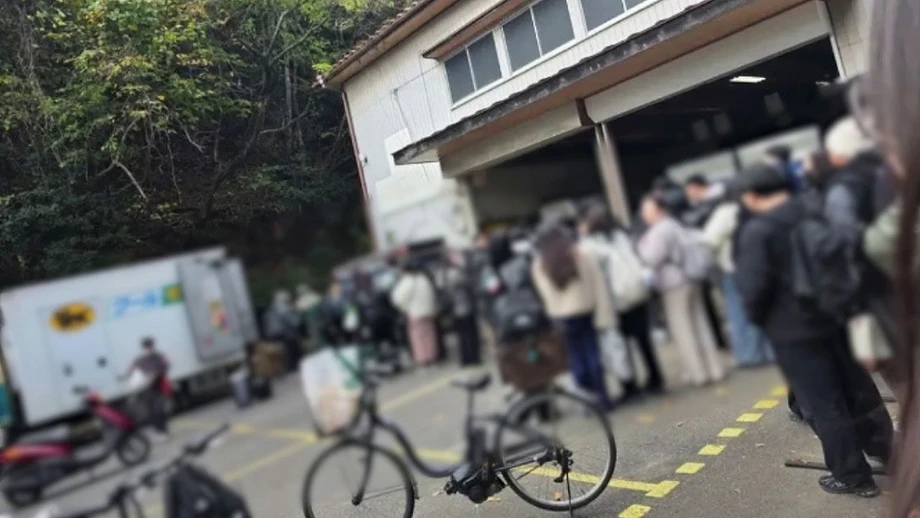
A Courier Office Turns Into a Pharmacy Counter
The line outside Yamato Transport's office in Hitakatsu, on the northern tip of Japan's Tsushima island, formed early and stretched down the street. On 24 November a visitor photographed it, posted the picture on Threads and wrote that collecting a single box of Mounjaro would take an hour. Others described waiting two.
Contents
- A Courier Office Turns Into a Pharmacy Counter
- How the Tsushima Run Works
- The Office That Could Not Keep Up
- Why the Same Drug Costs Four Times More
- What the New Rule Allows, and Where It Stops
- On the Island, Patience Wears Thin
- Sold Out Ferries, Then Cancellations
- Should National Insurance Pay for Obesity?
- Key Points
Tsushima lies about an hour and 30 minutes by fast ferry from Busan, close enough for a trip that starts with a morning sailing and ends with the 3 p.m. return boat. Since 12 November, when the Ministry of Food and Drug Safety and the Korea Customs Service began letting travellers carry home medicine prescribed and bought legally abroad for their own treatment, the island has become the first choice for South Koreans who want the drug at a price they can pay.
The gap is wide. A four week supply of Mounjaro at the lowest dose of 2.5 milligrams sells for more than 300,000 won ($223) in South Korea. The same box can be bought in Japan for as little as 67,000 won, and most accounts put the Japanese price between 80,000 and 120,000 won. Even after a round trip ferry fare of roughly 100,000 won, the trip pays for itself. Passengers at Busan's international passenger terminal now carry insulated bags instead of suitcases, and some bought a new cold bag and even a new passport for the journey.
South Koreans have made a word for the trip: sushijaro, a blend of sushi and Mounjaro. A second coinage, malajaro, has appeared for people who fly to China for the same drug.
How the Tsushima Run Works
No clinic on Tsushima will write the prescription for a foreign tourist. Buyers book an online consultation with a doctor at a hospital on the Japanese mainland before leaving South Korea, and the clinic sends the medicine by courier to an office on the island. The patient turns up with a passport and a tracking number.
The consultations are brisk. In one recorded on the island, a doctor at a Japanese clinic confirmed the whole order in a single question.
Is it correct that you want a 3-month supply of Mounjaro 2.5mg? Then I will prescribe the medication for you.
The Hitakatsu office sits five to ten minutes by taxi from Hitakatsu Port, which is why passengers run from the ferry terminal as soon as they land. Missing the return sailing means an unplanned night on the island, and hotels have been refusing to hold parcels. One buyer who made the crossing said the arithmetic was obvious.
I heard I could get it cheaply if I went to Tsushima. Even including the ferry fare, there is still a difference of about half the price.
Business at the Busan terminal changed as soon as the rule took effect. A cafe owner at the passenger terminal said the crowd shifted almost overnight.
Young people have increased tremendously starting this month. They are mostly here on weekends, whereas weekdays used to be quiet, ever since the Mounjaro rush began.
Japanese clinics adapted in turn. Hospitals began advertising prescription guidance in Korean, and travel sites started selling packages that pair a medicine pickup with sightseeing. Some clinics raised their prices as the queues grew.
The Office That Could Not Keep Up
Yamato Transport handled a few parcels a day at Hitakatsu before November. By late in the month the office was processing more than 200, and the company had doubled its sorting staff without clearing the backlog.
Yamato stopped accepting new requests for its storage and in person pickup service at Hitakatsu on 26 November, saying it could no longer secure enough space for the volume arriving. New registrations had in fact stopped a day earlier, on 25 November, while parcels already dispatched were still handled. The company told customers it had weighed several factors, including the number of people coming directly to the office, and asked for their understanding.
Deliveries slipped anyway. A hospital abroad promised a patient the drug would be ready on a set day and the courier then cancelled, which left travellers who had booked around that promise stranded. An office worker in her 40s, who had reserved ferries from Seoul, described the notice she received.
The hospital said it would be available today, so we also made reservations for the ferry and everything from Seoul, but we received a notice that the delivery cannot arrive by today.
Kim, a buyer whose parcel came late, stayed on the island two extra days rather than lose the order.
I asked them to deliver it yesterday, and just in case it arrived late, I stayed for 1 and 2 days. As a result, it really arrived today, so if I had done a day trip, I probably wouldn't have been able to receive it.
Hospitals then began telling patients to have the medicine sent to their hotel instead. Hotels that had stored parcels for visitors cancelled that service, citing the difficulty of keeping the drug refrigerated as volume rose. Aoki, a Tsushima resident, said the leftovers of the trade were everywhere.
There were quite a few people leaving their Mounjaro cold storage bags behind, and helping them find those was a bit difficult.
Why the Same Drug Costs Four Times More
Both countries buy the same pen from the same manufacturer, Eli Lilly. What differs is what each health system does to the price before a patient reaches the counter.
Japan approved Mounjaro as a treatment for type 2 diabetes and sets an official reimbursement price for it under national health insurance, a price cut by a further 25 percent in August. Japanese insurance does not pay for weight loss, but because the underlying price is low, a clinic can sell the drug for cosmetic use at a fraction of the Korean figure.
South Korea covers Mounjaro for obesity only as a non reimbursed drug, and the government fixes no sale price. Eli Lilly supplies a four week course to pharmacies for around 280,000 won, and patients pay more than 300,000 won over the counter. The Japanese price works out at roughly one third of the Korean one, and the cheapest reports put it near 63,000 won for four weeks.
Mounjaro has also been filed in Korea for reimbursement as a type 2 diabetes treatment, a review that is still running. That assessment is the lever that could move the price. Jang Hyung-woo, a professor of thoracic surgery at Seoul National University Bundang Hospital, explained how the process can open the price to bargaining.
In the course of being evaluated, there can be renegotiation of the drug price and such, and negotiations can move in the direction of lowering prices overall, and of course if the pharmaceutical company cannot accept it, the negotiation will break down.
What the New Rule Allows, and Where It Stops
The change that set off the rush came on 12 November, when the drug safety ministry and the customs service dropped the requirement for a separate import exemption request for medicine approved overseas. A traveller can now bring in up to three months' supply for personal treatment, which for a drug injected once a week means 12 pens. The ceiling is written as six bottles or three months' dose.
Repeat trips are where the allowance ends. On 18 November the Ministry of Food and Drug Safety said repeated imports do not match the purpose of self treatment, and that customs clearance can be held back when the quantity exceeds the limit or when the same drug crosses the border again within a short period. The Korea Customs Service said it would weigh how often a traveller enters and leaves the country, recent inspection history and overseas payment records before deciding whether an import counts as a repeat.
The ministry also said it would run focused checks on online channels to stop imported medicine being resold, and would act through special judicial police where it finds violations. Selling or passing the drug to family members or acquaintances in Korea can breach the Pharmaceutical Affairs Act.
Buyers carry a second risk. Medicine bought abroad personally falls outside Korea's system of compensation for injuries caused by drugs, and the authorities have limited means to trace distribution or handle a recall. The drug must also stay refrigerated, which the insulated bags at Busan Port were meant to manage.
On the Island, Patience Wears Thin
Tsushima's residents watched the queue grow with little enthusiasm. Packaging and empty courier boxes were left on the street around the office, some of it with Korean writing on it, and pedestrians walked in the road beside the traffic rather than on the pavement.
Visitors jostled for places as the return ferry drew closer. One resident said hundreds of people arrived at once and walked off leaving their empty boxes behind, and another said the wrapping that had held Mounjaro turned up often on the roadside and that a visit made purely for sightseeing would have been welcome. Because Tsushima is an island, waste disposal is limited by geography, and visitors are expected to take their rubbish home.
South Korean social media users were just as critical of their own compatriots as the islanders were. One person who collected a parcel wrote that about 150 people were already ahead in the queue on arrival, that each collection took more than 10 minutes, and that two of the three staff on duty had stepped away to eat, leaving one behind. Packages did not appear to be sorted by pickup date.
Others described the office verifying passports and tracking numbers before handing over a parcel, and said some Korean visitors asked staff to release packages by calling out a name and part of a tracking number instead. Online commenters told visitors to queue quietly, to accept that the branch was a shipping office rather than a warehouse for goods sent from abroad, and to stop blaming a small rural office that struggles to hire staff for a sudden surge in parcels. Others warned that the behaviour of a few could deepen anti Korean feeling on the island.
Sold Out Ferries, Then Cancellations
The numbers moved quickly from the middle of November. Passengers boarding Tsushima bound ferries at Busan International Passenger Terminal rose about 40 percent from the previous week to roughly 2,000 as of 24 November, and tickets for day trips were sold out for a month, through 23 December.
Once the Hitakatsu office shut its counter, the current reversed. A ferry operator said 200 to 300 bookings for departures after 10 December were cancelled within two days, as buyers found there was no longer a place to collect the parcel on landing.
The sequence that took the island from curiosity to crisis fits into a fortnight.
- 12 November: travellers win the right to bring in up to three months' supply of medicine prescribed abroad.
- 18 November: the drug safety ministry warns that repeated imports can be held at customs.
- 24 November: a photo of the Hitakatsu queue spreads online, with a one hour wait reported.
- 25 November: the office stops taking new pickup requests.
- 26 November: Yamato Transport confirms the halt, with some visitors waiting two hours.
- 27 November: ferry cancellations for sailings after 10 December are reported.
Doctors on the Japanese side are not the only port of call under consideration. The malajaro label shows that some buyers are already looking past Japan, and clinics advertising Korean language consultations have made the online step easy to repeat. No date has been set for the Korean reimbursement decision that could narrow the gap, and no replacement pickup point has been named on Tsushima.
Should National Insurance Pay for Obesity?
The ferry traffic has pushed a longer argument back into the open: whether obesity treatment belongs in public health insurance, and where a line should fall between medical need and cosmetic weight loss.
The Ministry of Health and Welfare said it would speed up a review of whether GLP-1 drugs, the class that includes Mounjaro and Wegovy, should be covered, examining who would qualify and under what conditions. The ministry said an expedited review does not skip the standard approval procedures, and that the cost to the insurance system is hard to estimate until eligibility rules exist. Health Minister Jeong Eun-kyung set out the balance the government is trying to strike when she appeared before the National Assembly earlier in November.
We recognize the need for coverage for patients with severe obesity or accompanying chronic diseases, but are reviewing the issue, including its financial implications.
The scale of the problem is documented. The Korea Disease Control and Prevention Agency found that 35.4 percent of Korean adults were obese in 2025, a figure above 50 percent among men in their 30s and 40s. The same agency found that type 2 diabetes among people under 30 nearly quadrupled between 2008 and 2021, rising from 73.3 to 270.4 per 100,000.
Park Jung-hwan, a professor of endocrinology and metabolism at Hanyang University, said the absence of coverage leaves the government without a grip on the market, and pointed to a French approach that pays first for the patients with the greatest need.
Obesity-related treatments are generally not covered by health insurance. This inevitably creates a situation in which the government cannot exercise control over them.
He argued that a staged approach would produce evidence for the next step.
Some of these issues could be addressed by first extending coverage to patients with severe obesity or those in lower income brackets, then evaluating the effectiveness of the policy.
Cheap ferry tickets do not solve the problem for the patients who cannot afford the crossing, and the queues on Tsushima have shown how far people will travel when the pharmacy price at home is out of reach.
Key Points
- South Korea began allowing travellers to bring in up to three months' supply of medicine prescribed abroad on 12 November.
- A four week supply of 2.5 milligram Mounjaro costs more than 300,000 won in Korea and as little as 67,000 won in Japan.
- Yamato Transport's Hitakatsu office on Tsushima handled more than 200 parcels a day, up from a few.
- The office stopped accepting new storage and pickup requests on 26 November, with new registrations ending on 25 November.
- Ferry passengers from Busan rose about 40 percent to roughly 2,000, and day trip tickets were sold out through 23 December.
- Between 200 and 300 bookings for departures after 10 December were cancelled within two days.
- The drug safety ministry said repeated imports can be held at customs and that medicine bought abroad falls outside domestic injury compensation.
- 35.4 percent of Korean adults were obese in 2025, and type 2 diabetes among the under 30s nearly quadrupled between 2008 and 2021.
- The Health Ministry is speeding up a review of insurance coverage for GLP-1 drugs, with no decision date announced.