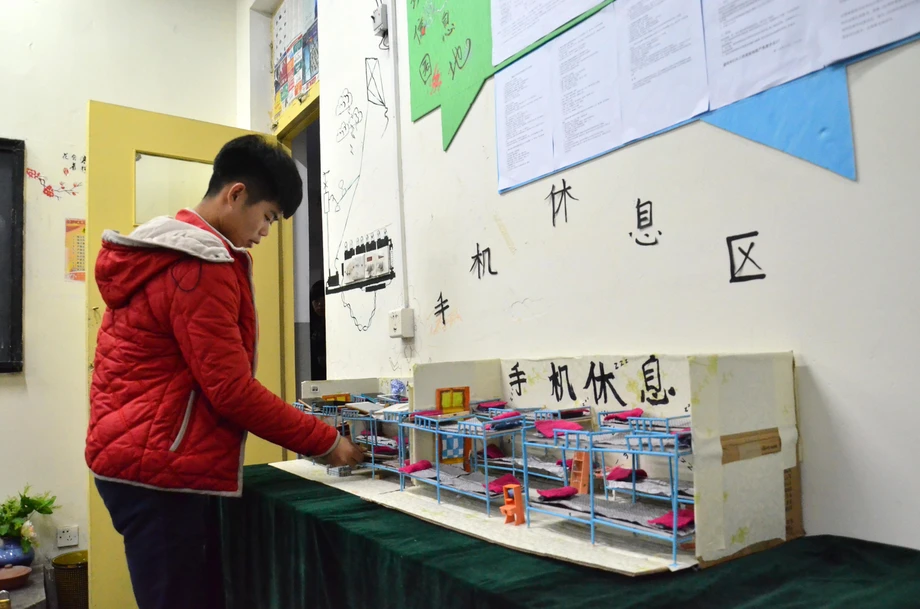
A bag by the desk and two hours of quiet
At six in the evening on 12 November, Liu Bingdi, a first year student in the civil engineering track at Beijing University of Technology's Tongzhou campus, set a phone to a self discipline mode for two hours, dropped the handset into a bag the university hands out at the door and opened the books for a calculus midterm days away. Across the room, Wang Shengyi, who studies big data management and application, went through the same steps.
Contents
- A bag by the desk and two hours of quiet
- Voluntary hands instead of confiscation
- The forty minutes and the five hours that follow
- A contest measured in hours and seconds
- When the phone is also the textbook
- What the ministry rulebook actually covers
- The classroom's share of the problem
- Teaching the algorithm rather than hiding it
- An oxygen tent, not an atmosphere
- Key Points
The classroom is the campus's no-phone study room, opened on 7 November. Fifty places were claimed within an hour of the sign-up notice going out. Over the three day trial that followed, 64 percent of the students who registered turned up.
Hao Yifan, who works in the campus office for student affairs and mental health education, said the project took two weeks to plan and the cap on numbers was deliberate.
We set a limit of 50 because we wanted a small pilot to see how students feel about studying without a phone, and to create the conditions for them to concentrate. In one space, nobody uses a phone, so nobody disturbs anyone else.
Wang Shengyi described the effect as a mood rather than a rule: the sense of a study atmosphere not felt for a long time, because the students on either side were working, and the mind settled without effort.
Voluntary hands instead of confiscation
Chinese campuses have tried bans before, with different results. In 2014, 19 institutions in the Guangxi region jointly pledged to run lessons without phones. What followed was compulsion, with handsets collected before a class and penalties for breaking the rule.
The 2026 version keeps the collecting and changes who decides. The academic affairs office and the student affairs office at Guangzhou Institute of Technology issued a notice on 19 September requiring students to put phones on silent and place them in classroom storage boxes unless a course needs the device, and stating that misuse in class would count in the overall assessment used for scholarships and awards. In October, the school of digital commerce at Beijing Wuzi University told students that every classroom now holds storage bags, to be filled before class and emptied after it.
The resentment behind the old rules was rarely about the phone. Students complained that university felt like an extension of high school, with the smallest detail of the day prescribed. A room that asks for volunteers reverses the direction of the instruction, and the queue for those 50 places measures how much appetite was there all along.
Chen Feng, dean of the School of Sociology at Beijing University of Technology and vice president of the Beijing Social Construction Research Association, said the appeal of both formats lies in the setting rather than the penalty.
The essence of a no-phone classroom or a no-phone study room is that the university provides a relatively undistracted environment that helps students study deeply. The university's role here is to help, not to manage and compel. Students cannot avoid phones in ordinary life, so rules matter, and guidance through the system is the key.
The forty minutes and the five hours that follow
Students who joined the experiment were quick to point out what a room cannot fix. One described the arithmetic of compulsion: the forty minutes of sitting still produced by a confiscated phone often come at the price of three to five hours of scrolling at night, once the phone is back in hand.
Wang Shengyi already uses an app that blocks pop-up notifications and sets blocks of focus time, so that a phone within reach cannot be opened. The difference between that arrangement and the cloth bag is who holds the switch.
The Tongzhou room answers a narrow problem, which is entering a state of concentration once. Whether a student carries that state out of the room, into a dormitory with three other phones and a feed built to keep them there, is a different test, and one the pilot does not measure.
A contest measured in hours and seconds
The China Internet Network Information Center's 57th report, published in February 2026, counted 1.121 billion people using the internet on a phone at the end of 2025, each averaging 32.5 hours a week, 3.8 hours more than in December 2024, or roughly 4.6 hours a day. A commercial monitoring platform's autumn report put monthly use per person at 189.8 hours in September 2026, 6.5 percent higher than a year earlier.
Of the 17.1 billion hours added to total use across all users that month compared with a year before, short dramas accounted for 13.329 billion and short video clips for 5.717 billion. The formats compete for the same pocket of time, and their makers count it in seconds: research cited on the trend puts the average initial attention a viewer gives the first vertical video in a feed at 3.6 to 4.8 seconds, and news clips that once ran 60 or 30 seconds are now often under 5.
Researchers describe the effect of steady exposure to fast, high stimulation material as scattered attention, shallower reading and weaker memory, with some calling it digital dementia and users calling it brain rot. One finding from neuroscience cuts the other way, that the functional changes seen in heavy phone users are reversible at the level of brain function, which makes habits worth interrupting.
- 2014: 19 institutions in Guangxi jointly pledge to run classes without phones.
- End of 2025: 1.121 billion people in China go online by phone, 32.5 hours a week each.
- February 2026: The 57th China Internet Network Information Center report is published.
- September 2026: Monthly phone use per person reaches 189.8 hours, up 6.5 percent in a year.
- 19 September 2026: Guangzhou Institute of Technology restates its classroom phone rules.
- October 2026: Beijing Wuzi University's school of digital commerce equips classrooms with storage bags.
- 7 November 2026: Sign-ups open at the Tongzhou campus, and all 50 places go within an hour.
- 9 November 2026: The no-phone study room begins a three day trial run.
- 12 November 2026: Reporters visit; 64 percent of registrants have attended.
When the phone is also the textbook
Li Wei (a pseudonym), a third year English major, said leaving the phone behind is not practical in every course.
For my major, class is inconvenient without a phone. Some courses are taught in English and unfamiliar words come up constantly. If I cannot look them up in time, I fall behind the teacher's pace.
Li also uses AI tools on the phone to work through exercises the teacher explains. Chengzi (a pseudonym), who studies law at the College of Applied Arts and Sciences at Beijing United University, said the difference from secondary school is the range of tasks a device now carries: online sign-in, in class polls, literature searches and note taking.
That is the awkward part of the story for anyone who wants a single rule. The tool that can swallow an evening is the same tool that opens a journal article, and a campus that removes it also removes the student's dictionary, timetable and library card.
What the ministry rulebook actually covers
The principle most often invoked in this debate is that students should manage, serve, educate and supervise themselves, which is how the Ministry of Education's regulation on student management defines the university's task. The text of the ministry's 1990 provisions shows how much of the surrounding machinery has changed since. Issued as State Education Commission Order No. 7, approved on 26 August 1989, effective on 20 January 1990 and signed by the commission's director, Li Tieying, it governs everything from registration to graduation.
Attendance is its central concern. Article 13 requires students to attend classes, practical training and military training, and bars anyone absent without leave for more than a third of a course's teaching hours from sitting that course's examination. Article 63 lists six sanctions, from a warning and a serious warning through a demerit and probation to ordered withdrawal and expulsion, and puts a semester of more than 50 hours of unexcused absence among the grounds for the last two. Article 64 lets a student answer the case in person, appeal and have the appeal reviewed.
The rules mention no phone, because they were written for a campus where the threat to orderly study was absence and the answer was the register. The current principle of self management asks for something a register cannot produce: a student who decides, with nobody watching, when to stop.
The classroom's share of the problem
The argument over attention rarely stays in the dormitory. Teachers have said publicly that a carefully prepared lecture can draw little response from the room, a complaint Chen Feng describes as long standing and present even in the most selective universities.
Chen starts from the arithmetic of attention. A one way narration cannot hold a class for 50 minutes, he argues, when concentration runs for 20 to 25 minutes at a stretch, so interaction, a change of pace and a change of voice have to be designed into the hour. The test for a teacher, in his words, is to move from being "a porter of knowledge" to "a designer of learning", replacing the phone with the exchange of ideas, prompt feedback and emotional connection.
Chen points to his own subject for evidence that interest beats a screen. Sociology students go into communities and villages for fieldwork, and in those sessions phones mostly stay down, because the pull of a real investigation is stronger than the pull of an app. In one classroom exercise he asks a student to introduce a classmate, a small lesson in seeing people and, through them, a society.
Yang Juan, a professor at Beijing Normal University, treats the device as neutral and puts the weight on rules and teaching.
The key is not banning phones or other devices from the classroom but building students' capacity to manage themselves. Blocking does less than channelling: if all you do is ban the phone and play cat and mouse in class, teachers and students are both exhausted and the effect is limited. The answer is to adjust the teaching design.
Yang adds that students arrive at university with goals blurred by years of aiming at one examination, and classes have to work on motivation, through careers guidance and by tying a subject to problems students can see.
Teaching the algorithm rather than hiding it
Liu Xin, a lecturer at the School of International Journalism and Communication at Beijing Foreign Studies University, describes the phone as an organ grown outside the body.
A phone is already an external organ for individuals in a digital society, and university students have higher needs for social integration. The ability to use a phone partly determines their digital skills.
Her research on phone use among teenagers in rural counties and children whose parents work away from home found that school bans limit what happens on campus without stopping the virtual contact classmates keep up outside it, which pushes existing problems into less visible places and can create new ones.
What follows for universities, in her account, is guidance that changes with age. "The key is not to keep postponing or banning phone use, but to build a step by step guidance mechanism suited to the characteristics of each stage of growing up," she said. Media literacy in that sense is not a list of prohibitions but the ability to read a medium, judge what it carries and set one's own limits.
The scale of the opposition matters here. The feeds competing for a student's evening are built by thousands of engineers working to measured targets, and a bag at the door explains none of it. Knowing that a recommendation system is tuned for time spent is the difference between a student who thinks the problem is weak will and one who understands the game being played.
An oxygen tent, not an atmosphere
The image that has stayed with readers of the commentary around the trend is that of an oxygen tent pitched inside the campus, where anyone short of breath can take a few gulps. A tent is not an atmosphere, and students go back out to places where the signal is strong, to work, to study and to love.
What the pilot has not settled is how far the model runs. The Tongzhou campus has not said whether the room will continue past the trial, whether more places will be added or how attendance will be tracked beyond the first three days. A student writer proposed that dormitories draw up their own agreements, so that the quiet of the room could survive outside its door, with the university pairing the space with guidance on attention.
The 50 places were a test of appetite, and the appetite was there. The harder question for the campuses is what happens in the room after the phone goes into the bag, because the phone comes out again at the gate, and past the gate there is no supervisor, no register and no bag.
Key Points
- Beijing University of Technology's Tongzhou campus filled all 50 places in its no-phone study room within an hour of opening sign-ups on 7 November 2026.
- In a three day trial, 64 percent of the students who registered attended.
- Guangzhou Institute of Technology restated classroom phone rules on 19 September and Beijing Wuzi University added storage bags to classrooms in October.
- China had 1.121 billion mobile internet users at the end of 2025, averaging 32.5 hours a week online, or about 4.6 hours a day.
- Monthly use per person reached 189.8 hours in September 2026, up 6.5 percent in a year, with short dramas adding 13.329 billion hours.
- Educators argue the answer is self management and media literacy rather than confiscation, and that lectures must compete for attention too.