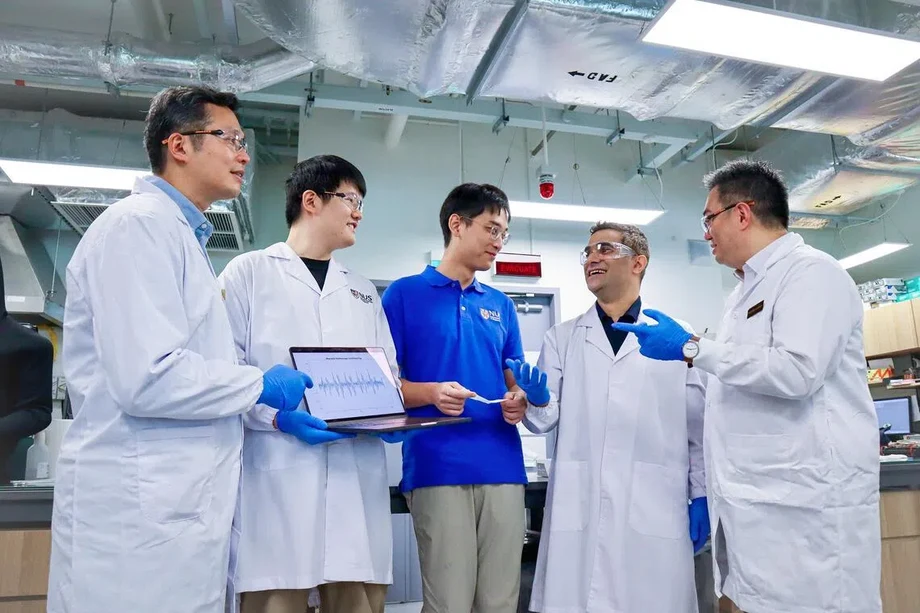
A stethoscope sewn into everyday clothing
Singapore researchers have turned fabric into a listening device. A team at the National University of Singapore has built the all-fibre wireless auscultation system, known as FiWAS, in which microphones 0.15mm wide, roughly the width of a human hair, are woven into clothing alongside flexible electronics that digitise the sounds of the heart and lungs and send them by Bluetooth to a phone or computer.
Contents
The research was published in the journal Nature Cardiovascular Research in October. Its first clinical tests put the clothing on 10 patients hospitalised with heart failure at the National Heart Centre Singapore and on 20 newborns at KK Women's and Children's Hospital, among them extremely preterm infants born before 28 weeks of pregnancy.
Those small trials recorded heart murmurs, the crackles that signal fluid gathering in the lungs, and a brief episode of atrial fibrillation, an irregular heartbeat that a routine electrocardiogram often misses. In the newborn group the system caught an episode in which a premature infant's heart rate slowed.
Why a smart watch cannot hear what a doctor hears
Watches and rings sold as health trackers count steps, measure pulse and estimate blood oxygen. None of them captures the sounds a clinician listens for through a stethoscope: the whoosh of blood forced through a narrowed valve, the extra note that hints at a struggling heart, the fine popping of airways in lungs that are filling with fluid.
Auscultation, the act of listening to the inside of a body, has sat at the centre of the bedside examination for about two centuries. It also depends on a device pressed to the skin for a minute at a time, in a clinic, with a doctor present. FiWAS is an attempt to move that listening into the clothes a patient already wears and to keep it running for days.
How a thread becomes a microphone
The fibre microphone senses tiny vibrations where it touches the body. Contact is the mechanism: the fibre feels the chest wall move as sound travels through tissue, which lets it pick up internal noise while shutting out much of the clatter of the room around the wearer.
From there the signal passes to what the researchers call a fibre computer, a flexible strip of miniature components that amplifies and digitises it before transmission. Both pieces can be sewn into a garment, so the sensing element is not a pod strapped to the sternum but part of the cloth itself.
A prototype ran for about 40 hours on a small coin cell battery. FiWAS also survives washing machine and dryer cycles, a practical requirement for anything meant to be worn at home for weeks rather than monitored in a hospital bed for an afternoon.
What the heart failure trial heard
Heart failure is a syndrome in which the heart cannot pump hard enough for the body's needs, and fluid collects in the lungs. Patients are usually stabilised in a ward and sent home, where the same congestion can return.
At NHCS the system recorded heart murmurs, the sounds made by turbulent blood flow, and an S3 gallop, a faint extra beat that clinicians associate with a failing heart. It picked up lung crackles, the noise of air moving through airways that hold fluid. In one patient it captured a stretch of atrial fibrillation.
Tural Khudiyev, an assistant professor at the NUS College of Design and Engineering who led the research, said the sound quality matched that of current digital stethoscopes, which outdo the conventional acoustic kind at picking up faint noises.
The 30 second problem
An electrocardiogram reads the heart's electrical activity for as long as the test lasts, and a routine recording typically runs for 30 seconds. A heart that slips out of rhythm later in the day leaves no trace on that strip. Atrial fibrillation, which can come and go, raises the risk of stroke and other cardiac trouble, and catching a short burst is exactly what a brief test struggles to do.
Continuous listening changes that arithmetic. The irregular rhythm in the NHCS patient surfaced because the clothing was still recording when it happened.
Derek Hausenloy, director of the National Heart Research Institute Singapore at NHCS, said the system could allow heart failure patients to be monitored at home for problems such as fluid building up in the lungs after discharge. Those changes are easy to miss when no one is listening.
"Usually, by the time it's been detected and a patient's short of breath, that means they're nearly going to end up in hospital," said the cardiologist.
Newborns, and the trouble with sticky pads
At KK Women's and Children's Hospital the fibres went into infant onesies and bedding. The team monitored 20 newborns, including extremely preterm infants born before 28 weeks of pregnancy, and the system recorded a premature baby's heart rate slowing.
Neonatal units keep a continuous read on babies with adhesive electrodes and cables. Yeo Kee Thai, a senior consultant in KKH's neonatology department, described what that setup costs the smallest patients.
Continuous monitoring is critical to keeping newborns safe, but frequent use of traditional sticky pads and wires may hurt their fragile skin and make it harder for parents to hold and bond with their baby.
He added that FiWAS gives clinicians the continuous clinical data they need "while letting the baby rest completely undisturbed."
Li Qianyi and Li Ziang, PhD candidates at NUS, worked on the research behind the system.
Movement is still the weak spot
Sound quality falls when the wearer moves. Khudiyev links the drop to the way a garment sits on the body and suggests that improving the fit could limit it, since a microphone that stays put against the chest has less to correct for.
The next stage is larger clinical trials with NHCS and KKH, covering more varied patients and a wider range of heart and lung conditions. No start dates or target numbers of participants have been given for those studies.
The follow up work is built to test how the system behaves on hundreds of patients in their own bedrooms over months, which is a different question from whether the fibres can hear a murmur in a ward.
From hospital clothing to gym kit
The team is working to set up a company that would commercialise the technology. Khudiyev said the system could eventually track conditions beyond the heart and lungs, and that the same fibres could form fitness trackers built into clothing instead of worn on a wrist.
His longer aim is clothing that acts as a wide interface to the body, listening, mapping and interpreting heart and lung activity all day, with artificial intelligence turning the stream into information a doctor can act on.
For patients the appeal is concrete. A person discharged after a stay for heart failure could be watched for the lung congestion that precedes a return trip to hospital, without a nurse visiting or a device to recharge every night. A premature baby could be monitored without tape on its skin, and a parent could hold the child while the readings continue.
What the two trials show is narrower and firmer: thread that hears and thread that computes can be washed, worn and powered by a battery small enough to hide in a seam.
Key Points
- NUS researchers built FiWAS, a system of fibre microphones 0.15mm wide woven into clothing that transmits heart and lung sounds by Bluetooth.
- The research was published in Nature Cardiovascular Research in October, and was announced publicly in late November 2026.
- Trials covered 10 heart failure patients at the National Heart Centre Singapore and 20 newborns at KK Women's and Children's Hospital, including infants born before 28 weeks.
- The system recorded heart murmurs, an S3 gallop, lung crackles and one brief episode of atrial fibrillation, plus a slowed heart rate in a premature infant.
- A prototype ran about 40 hours on a coin cell battery and withstands washing machine and dryer cycles.
- Routine ECGs record for up to 30 seconds, which is why the continuous recording caught the irregular rhythm.
- Movement reduces sound quality, and the team points to better garment fit as the likely fix.
- Larger trials with both hospitals are planned, and the researchers are forming a company to commercialise the technology, with fitness tracking as a possible use.