Three jars under a Klaten paddy field
On Wednesday, 17 October 1990, Witomoharjo and five other men were lowering the surface of a paddy field in Plosokuning hamlet, Wonoboyo village, Klaten regency, Central Java, a short walk from the Prambanan temple complex. The field belonged to the household of Cipto Suwarno. The crew was cutting the ground down so that irrigation water would drain across it, and the soil they lifted was to be sold as fill for building projects.
Contents
At about 2.5 metres, a hoe struck something that would not give. The men thought they had hit a stone. It was the shoulder of a large terracotta jar, and beside it stood two more, one of them a piece of Chinese ceramic from the Tang dynasty. The vessels were packed with gold and silver.
Popular retellings give the decisive blow to Cipto Suwarno, hoeing his own field for more than a week; the excavation record places Witomoharjo and his five companions at the spot. Either way, the farmer's cry when the jars came open passed into local memory.
Emas, emas, emas!
Gold, gold, gold. The shout emptied the hamlet into the field. Village officials took charge of the digging, and the deposit was lifted in front of a crowd before the regional culture office was told. What left the ground that Wednesday is now ranked among the most important archaeological finds in Indonesian history, and it sits in the treasure room of the National Museum in Jakarta.
What came out of the jars
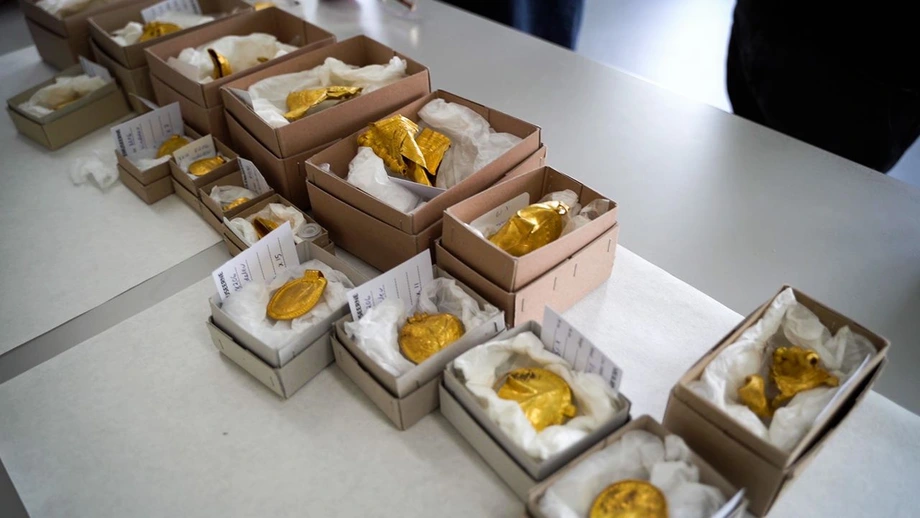
The haul turned out to be more than 1,000 ceremonial pieces: the tableware and personal jewellery of somebody rich enough to eat off gold. The measured total was 16.9 kilograms, of which 14.9 kilograms was gold and 2 kilograms was silver. The inventory runs:
- a squat bowl carved with a scene from the Ramayana, and a wide bowl with Ramayana relief
- six gold lids, three water dippers and one tray
- 97 gold arm bracelets, 22 small bowls, seven plates, eight gold earrings and 11 gold rings
- a gold handbag, a pipe, beads, and a gold handle made for a keris, or possibly a finial for a ceremonial parasol
- gold coins shaped like grains of maize
- the large Tang terracotta jar that served as the container, plus two smaller jars
Underneath the display pieces sat the money: more than 6,000 gold and silver coins, close to 7,000 on one count. The wide bowl with the Ramayana relief was formally recorded as an item of Indonesian cultural property in 2013.
The Ramayana carving matters for more than its beauty. The epic was already the standard story of the Javanese courts, and the same scenes would later be chiselled into the balustrades of the Prambanan temples a few kilometres away. Here they are worked in repoussé gold, which shows how closely the goldsmith's craft tracked the sculptor's.
Coins that carried a name and a reign
Two inscriptions fix the hoard in time. On the face of the gold coins is the letter "ta", short for tahil, the Javanese unit of weight used to value gold. On one of the objects is the name Saragi Diah Bunga, written in Kawi, the old Javanese literary language. Scholars read it as the name of the owner, a noble or a member of the royal family.
The carving style and the coinage point to the reign of King Balitung, who ruled from 899 to 911 over the Mataram kingdom, also called Medang, whose heartland was the plain between Borobudur and Prambanan. Balitung is the king whose Mantyasih inscription of 907 listed the rulers who had come before him, one of the documents historians use to rebuild the dynasty's line of succession. A treasury buried on his watch, within sight of the temples his predecessors had raised, fits that picture of a court with wealth to store.
A weight that grows in the retelling
The figure on the national collection record is 16.9 kilograms in total. Villagers who watched the digging have said the haul ran far past that, past 100 kilograms and up to two quintals, or 200 kilograms, at the top of the range. Timbul Haryono, a historian who studied the find, put the gold alone at 30 kilograms. One description of the dig places the jars at 2.75 metres rather than 2.5.
No public reweighing has settled the gap, and the difference shapes how the find is remembered locally, as a fortune that was larger than the museum shelves suggest. The number in the display case is the one archaeologists work from.
Why a noble buried the family silver
A single household owned the whole hoard, and somebody chose to put it in the ground. Historians of the period read such burials as a response to danger: as the old kingdoms weakened and political order broke down, families hid jewellery and precious metal from enemies and from chaos, intending to come back for it. Many never did.
The Mataram court eventually left Central Java, and colonial rule arrived centuries later. Gold that had been packed into jars for a season stayed underground for a thousand years, which is why the pieces reached the National Museum with their shapes intact and their surfaces still bright.
Gold in the kitchen, the market and the palace
Wonoboyo is evidence of how thoroughly gold ran through Javanese life. In Uang Indonesia: Sejarah dan Perkembangannya (2021), Erwin Kusuma describes gold as an official means of payment in ancient Java, used for large transactions such as the sale of land rather than for shopping in a market. A farmer would not buy vegetables with a gold coin; a family buying a field might.
Court life pushed the metal further. Under the Majapahit kingdom, which ran from 1293 to 1527, nobles had everyday objects layered with gold, from ceremonial carriages to fans. The Desawarnana of Mpu Prapanca, in Stuart Robson's 1995 translation, describes a princess of Daha travelling in a chariot finished in gold. The Nagarakertagama, as discussed by the archaeologist Slamet Mulyana in 2012, treats the amassing of gold and money as a mark of prestige that families competed for.
Visitors noticed. Chinese travellers whose notes are collected in Nusantara dalam Catatan Tionghoa (2009) recorded that the kings of Java ate from tableware made entirely of gold. The Portuguese apothecary Tome Pires, writing in Suma Oriental (1944) about his 1513 visit, described a king dressed in gold from head to foot, with gold collars and bracelets on his guards and even on his pet dogs.
The island that had to import its gold
Java produced little of the metal it loved. To meet demand, ancient Javanese traders brought gold in from India and from Sumatra, an island long nicknamed the Gold Island. The hoard therefore holds two stories at once: the craft of local goldsmiths and the reach of a trading network that stretched across the Bay of Bengal.
The tahil stamps on the coins belong to that trading world, where value was checked by weight as much as by authority. A coin that names its weight is a coin meant to change hands between people who may not trust the same ruler.
Where to see it now
The originals are in the treasure room of the National Museum in Jakarta, and the collection has travelled abroad for exhibition, including to Australia. Prambanan Museum, inside the temple park north of the main shrines, shows a replica set: bowls with the Ramayana story, dippers, a bag, coins and jewellery, alongside stone statues from the surrounding temples. Museum entry comes with the Prambanan ticket, and the short audiovisual history shown there costs Rp5,000.
Klaten has its own regional museum on Jalan Veteran in North Klaten, and the Wonoboyo replica is its main draw. The museum recorded 5,742 visits up to October 2026, and staff expect the year to close near 6,000. School groups fill the galleries from Tuesday to Friday, usually 50 to 100 pupils at a time; on 26 November 2026, SDN 2 Prambanan arrived with 144 pupils and teachers. Foreign visitors numbered four in 2026 and 12 over two years.
Naufal Sa'ad, the museum's conservator, says the gold replica raises the same question again and again.
What usually makes people curious is the Wonoboyo gold replica. Many still ask where the real gold is, and we explain that this collection is only a replica, the original is in the National Museum in Jakarta.
The museum itself grew out of survey work. Kumpul Hartadi, its head and the culture division chief for the regency, says teams recorded objects suspected of being cultural heritage, known by the Indonesian initials ODCB, across the district, and many of the finds were lying in gardens, on riverbanks, beside roads and in abandoned colonial factory grounds without proper care.
To date more than 200 ODCB points have been found and recorded, from the Hindu-Buddhist, Islamic, Colonial periods, and from the revolutionary and post-independence era.
The dates that built the institution:
- 4 August 2022: soft launch, held alongside a travelling exhibition from Ronggowarsito Museum
- 29 October 2024: full inauguration by Klaten regent Sri Mulyani
- 27 November 2025: national registration with NPNM number 33.10.U.04.0372
- October 2026: 5,742 visits for the year so far
Three themes organise the space, Jejak Budaya, Warisan dan Tradisi and Kekayaan Alam, and the permanent gallery covers about 180 square metres. A javanese ceremonial umbrella from the intangible heritage collection is the corner most often photographed for social media.
Key Points
- Witomoharjo and five other workers struck three terracotta jars on 17 October 1990 in Plosokuning hamlet, Wonoboyo village, Klaten, while lowering a paddy field for irrigation
- The field belonged to the household of Cipto Suwarno, who is remembered for shouting "Emas, emas, emas!" when the jars opened
- The hoard weighed 16.9 kilograms, made up of 14.9 kilograms of gold and 2 kilograms of silver
- It contained more than 1,000 ceremonial objects and over 6,000 gold and silver coins, including a bowl carved with a Ramayana scene listed as cultural property in 2013
- Coins stamped "ta", for tahil, and the Kawi name Saragi Diah Bunga date the find to the reign of King Balitung, 899 to 911
- Some villagers say the haul reached 100 to 200 kilograms, and historian Timbul Haryono put the gold at 30 kilograms
- Gold served ancient Java as jewellery, a status marker and payment for large deals such as land sales, and was imported from India and Sumatra
- The originals are held at the National Museum in Jakarta, with replicas at Prambanan Museum and the Klaten regional museum, which logged 5,742 visits up to October 2026