A record red light with a cooler reading underneath
Taiwan's economy remained in the National Development Council's red zone in October 2026, extending an unprecedented run to 11 consecutive months. The council announced on November 27 that the composite score had slipped from 41 points in September to 40, leaving the signal red despite the loss of one point. It is the longest red light streak since the council adopted its current system of nine components in 1984. The figures capture two developments at once: exports, industrial production and equipment imports are surging, while some manufacturers have become more cautious about what comes next.
Contents
- A record red light with a cooler reading underneath
- The one point decline came from sentiment, not production
- Export orders are spreading beyond technology
- Leading indicators still point upward
- Can AI spending keep the boom going?
- Why different AI chips can still lead back to Taiwan
- More advanced production is staying in Taiwan
- What the boom could mean for households
- What could end the red light streak?
- Key Points
Chen Mei-chu, director of the council's Department of Economic Development, said a Taiwan Institute of Economic Research survey found weaker confidence among petrochemical and transportation equipment companies. Electronics and information technology businesses remained cautiously optimistic. Across the survey, the share of companies expecting better conditions still exceeded the share expecting worse conditions, although the council did not release percentages for those groups.
The council's system uses five colors to summarize economic conditions. Red means the economy is booming or could be overheating, yellow-red indicates improvement, green represents stability, yellow-blue signals a slowdown and blue indicates sluggish conditions. Because the headline signal combines nine measures, a red light for the economy can coexist with a cooler reading for manufacturers' expectations.
- September 2026: The composite score was 41, and the manufacturing sentiment reading was later revised to 101.79.
- October 2026: The score covered by the new announcement was 40, producing an 11th consecutive red light.
- November 2026: Sharp stock market movements raised concerns that were not fully reflected in the October measurements.
- November 27, 2026: The council published the October results, its assessment of artificial intelligence investment and its economic outlook.
The one point decline came from sentiment, not production
Six of the nine components flashed red in October, one flashed yellow-red and two were green. Only the manufacturing business climate reading changed color. It fell from September's revised 101.79 to 98.94, crossing below 100 and moving from yellow-red to green. That single change reduced the composite score by one point; the other eight components retained their previous signals.
The manufacturing reading is based on companies' views of business conditions, making it different from measurements of goods actually produced or sold. Several activity measures accelerated even as that survey weakened:
- Annual growth in machinery and electrical equipment imports jumped from 82.2 percent to 114.8 percent.
- Industrial production growth increased from 20 percent to 30.5 percent.
- Growth in the manufacturing sales volume index rose from 15.1 percent to 22.4 percent.
- Annual growth in customs export value held at 67.9 percent.
- Growth in the share price index slowed from 86 percent to 74.1 percent, but the component remained red.
- Growth in wholesale, retail and food and beverage revenue eased from 36.9 percent to 36.1 percent, also without leaving the red zone.
Chen attributed the weaker manufacturing outlook partly to international political and economic developments surrounding the United States midterm elections. Companies continued to see artificial intelligence demand as a support for Taiwan, but some were less certain about future policy and market conditions. The loss of one point therefore came from expectations, while measures of production, sales and equipment purchases remained strong.
Export orders are spreading beyond technology
Export orders received by Taiwanese companies reached US$123.82 billion in October, rising for a seventh consecutive month. Electronics and information and communications products remained important, but orders also grew for basic metals, machinery, plastics and rubber products, and chemicals. That broader pattern matters because some of those traditional industries were among those expressing weaker confidence.
October's total was US$9.61 billion, or about 8.4 percent, above September's record orders of US$114.21 billion. The Ministry of Economic Affairs expects orders to exceed US$100 billion again in November. Orders and exports measure different things: orders represent new business received by companies, including work that may be completed later or at overseas factories, while customs exports record goods shipped across Taiwan's borders.
Customs exports reached US$96.76 billion in October, a monthly record. The council expects exports for the full year to exceed US$930 billion if the current momentum continues. The contrast between strong orders and cautious executives helps explain the present moment. Factories are receiving substantial business now, including in some sectors outside advanced electronics, while their managers are assessing United States policy, financing conditions and geopolitical risks for 2027.
Leading indicators still point upward
The council's leading index, which is designed to indicate where the economy may be heading, reached 104.64 in October after removing its long-term trend. It rose 0.46 percent from September, marking a 15th consecutive monthly increase and a cumulative gain of 6.55 percent. The coincident index, which tracks current conditions, reached 105.66, up 0.38 percent. It has risen for three months, with a cumulative increase of 5.88 percent. The lagging index, which tends to confirm changes after they have occurred, reached 105.89, up 0.79 percent.
Four of the seven components in the leading index improved: floor area in building construction starts, the export order trend index, the net entry rate for employees in industry and services, and the share price index. Three declined: inflation adjusted semiconductor equipment imports, the manufacturing business climate reading and real M1B, a measure of money readily available for spending.
The coincident index was lifted by inflation adjusted customs exports, overtime working hours and industrial production. Its other four components declined. The council's conclusion from these mixed movements was that the domestic economy remained stable, with the forward-looking and current measures both continuing to rise. Construction starts were especially relevant because technology companies are expanding capacity to meet international demand for artificial intelligence computing.
Can AI spending keep the boom going?
Nine major global cloud service providers are expected to spend about US$1.5 trillion on capital projects in 2027, according to the council's assessment. Cloud service providers, often shortened to CSPs, operate data centers and rent computing power, storage and related services to customers. Their capital spending pays for servers, chips, networks, buildings and other equipment that lasts for years.
The 2027 projection compares with more than US$900 billion in 2026. Even using US$900 billion as the comparison base, the difference is about US$600 billion. Chen allowed for some revision to the forecasts after the United States elections but said spending was still expected to grow. That outlook supports the council's expectation that deeper adoption of artificial intelligence will continue to generate export business for Taiwanese supply chains.
November's market turbulence has nevertheless fed concerns about an artificial intelligence investment bubble. Chen said the financing pressure was concentrated mainly among smaller, emerging cloud providers facing circular financing arrangements and higher funding costs. Larger providers have more varied sources of revenue, greater access to resources and stronger pricing power. She also argued that constraints on smaller competitors could increase demand for the computing capacity of established providers and improve their cash flow.
The distinction is between financial market confidence and physical investment. Share prices and financing conditions can change quickly, while data center construction and equipment orders take longer to plan and complete. The council's case for continued growth rests on the second category: capital budgets are still increasing, and Taiwanese companies supply many of the components and manufacturing services those budgets require.
Why different AI chips can still lead back to Taiwan
NVIDIA has been closely associated with graphics processing units, or GPUs, which can perform many calculations in parallel and are widely used to train and operate artificial intelligence systems. Large technology companies are also developing their own application-specific integrated circuits, or ASICs. An ASIC is designed for a narrower set of tasks, potentially making it attractive for particular computing workloads.
Chen described the competition between GPUs and custom chips as a redistribution of market share rather than a disappearance of underlying chip demand. Companies designing different processors still need manufacturing capacity to turn those designs into physical products. Taiwan's foundries, which manufacture chips for other companies, therefore remain central to her assessment of the island's advantage.
A November chip output forecast provides a measure of that manufacturing base. The Taiwan Semiconductor Industry Association projected that Taiwan's semiconductor output would reach NT$9.7615 trillion in 2026, up 49.7 percent from a year earlier. Wafer foundry production was forecast at NT$6.0249 trillion, an increase of 44.5 percent, accounting for about 61.7 percent of total industry output. Taiwan Semiconductor Manufacturing Co. was identified as the main source of foundry growth.
For Taiwan, the commercial contest is consequently wider than NVIDIA's share of AI processor sales. Cloud companies can change chip designs, suppliers can win or lose individual contracts, and export restrictions can alter where particular products are sold. The volume and sophistication of chips that still require Taiwanese manufacturing remain central to exports, factory investment and supply chain employment.
More advanced production is staying in Taiwan
Technology companies are expanding production and research spending in Taiwan to meet international AI demand. The annual growth rate for factory and office construction starts increased for a fifth consecutive month, according to the council's analysis. Government plans for 10 new AI infrastructure initiatives, a larger technology budget and assistance for smaller businesses seeking to upgrade are expected to add to that investment.
Information and communications technology manufacturers have also reduced their overseas production ratio from 91 percent in 2020 to about 70 percent. That is a decline of approximately 21 percentage points. Chen linked the change to customers rearranging supply chains to rely less on production in China, alongside a visible return or retention of advanced manufacturing in Taiwan.
The overseas production ratio helps explain why export orders and customs exports can tell different parts of the same story. A Taiwanese company may receive an order for production abroad, but a larger share of domestic manufacturing means more of the resulting work can support local factories, construction and equipment purchases. The council sees that shift as evidence that Taiwan's manufacturing position remains firm even as companies maintain international operations.
What the boom could mean for households
Households are expected to benefit through several channels identified by the council. Stable employment supports income, while stronger corporate earnings can finance employee bonuses and dividend payments to shareholders. Pay increases for military personnel, civil servants and teachers, together with a higher minimum wage, are also expected to raise disposable income.
Those channels connect an economy driven heavily by technology exports with spending in shops, restaurants and other domestic businesses. Wholesale, retail and food and beverage revenue was still growing at 36.1 percent annually in October, despite a small slowdown from the previous month. The council did not announce new pay amounts or implementation dates in this release, but presented employment, profits and wage adjustments as reasons consumption could remain resilient.
What could end the red light streak?
The NDC named three principal uncertainties: changes in United States trade and economic policy after the midterm elections, developments in international geopolitics and the direction of global monetary policy. These factors can affect export demand, investment decisions and borrowing costs. Chen also said some manufacturers were considering the possibility that Democrats would take a more regulatory approach to AI data center construction after taking office.
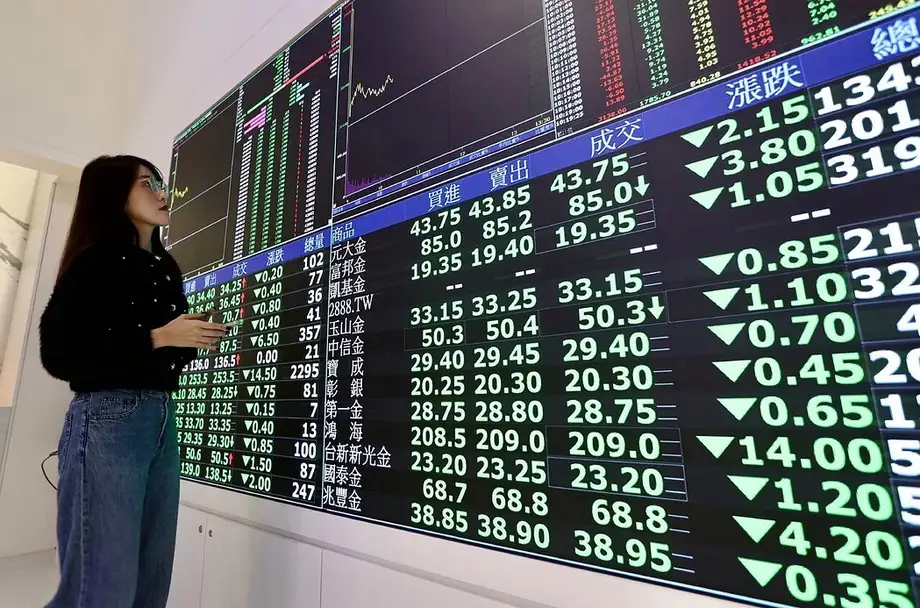
Wu Ta-jen, executive director of the Taiwan Economic Research Center at National Central University, offered a more cautious assessment. He said a November retreat of more than 10,000 points in Taiwan's stock market could affect consumption and the share price component of the economic signal. Because the indicator incorporates stock market conditions, he said the November reading might not remain red.
Wu also linked his longer-term caution to the Democratic victory in the United States. He argued that a more active energy transition could delay AI infrastructure construction, creating risks for Taiwan's exports from 2027. On that basis, he was less confident that repeated red lights could continue comfortably through the next two to three years.
The council's October indicators and Wu's warning cover different periods. The former show orders, production and leading measures rising through October; the latter focuses on November's financial turmoil and possible policy changes afterward. The next economic signal will provide the first indication of whether those market movements have altered the composite score. No release date for the November reading was given. Until then, the record stands at 11 consecutive red lights, with 40 points and manufacturing sentiment below 100.
Key Points
- Taiwan's October composite score was 40, down one point, but its 11th consecutive red light set a record under the system used since 1984.
- Manufacturing sentiment fell from 101.79 to 98.94 and turned green, while the other eight components kept their previous signals.
- October export orders reached US$123.82 billion, and customs exports hit a monthly record of US$96.76 billion.
- The leading index rose for a 15th month and the coincident index for a third month.
- Nine major cloud providers are projected to spend about US$1.5 trillion on capital projects in 2027, compared with more than US$900 billion in 2026.
- The overseas production ratio for information and communications technology companies has fallen from 91 percent in 2020 to about 70 percent.
- United States policy, geopolitics, monetary conditions and November's stock market turmoil are the main tests for the next reading.