A Ten Year Blueprint Arrives in Beijing
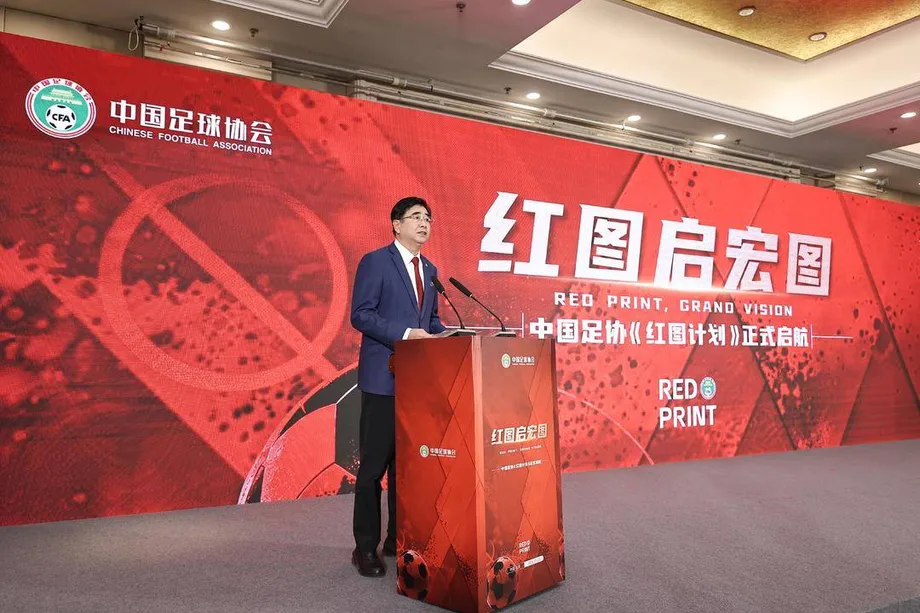
On Monday, Nov. 23, 2026, the Chinese Football Association (CFA) unveiled the Red Print in Beijing, a national technical plan for youth football that tries to make a child in a county town and a prospect in a top club academy learn from the same playbook. Also translated as the Red Map Plan, it covers ages six to under 21 and sets a path to 2035.
Contents
- A Ten Year Blueprint Arrives in Beijing
- What the Red Print Actually Says
- Why One Style From Age Six Matters
- How the 1-4-3-3 Fits the Message
- The Belgian Behind the Blueprint
- A Generation Already Giving Clues
- Coaches and Data Become the Real Test
- The Overseas Bridge Called Future Stars
- Old Habits Still Push Against the Plan
- A Timeline to 2035
- What Changes for Players and Supporters
- Key Points
The CFA calls it the top level technical framework for youth development. It sets one philosophy, one playing style, one training method, one coach education route and one talent pathway. The document is 254 pages long, with the practice section taking close to half of the book. That size matters because it turns broad hopes into age by age instructions, not just a slogan.
The plan was designed by Chris Van Puyvelde, the Belgian CFA technical director, with the technical committee, club representatives and technical experts. Song Kai, the CFA president, wrote the preface and said Chinese football has suffered from chasing quick results and needs a direction it can keep for ten years or more.
At the center of the announcement is a simple promise: the way a child is taught should not depend on which province, school or club happens to find him or her.
What the Red Print Actually Says
The framework is organized into four blocks: theory, practice, scientific support and dissemination. It answers three questions: what kind of player China wants to produce, how that player should develop and how matches should be played. Those questions may sound basic, but the CFA is using them as a way to stop children moving between school football, private academies, club youth teams and national camps under different rules.
Four priorities sit at the center: development over results, learning over winning, quality over quantity and potential over early selection. Five pillars fill out the player: technical skill, tactics, physical fitness, psychological, emotional and social growth, and culture. Culture here means building a Chinese football identity instead of copying Spain, Portugal, Belgium or any other successful system wholesale.
The same idea runs through competition rules. The plan quantifies player numbers, goal sizes, ball sizes, rules and training templates for nine age bands from U6 to U21. It starts with enjoyment at six, moves to learning to play at nine, learning matches at ten, understanding matches at twelve, then tactical and competitive development. For young children, the key words are high participation, high ball touches, high enjoyment and high movement quality.
Why One Style From Age Six Matters
Chinese youth football has often been described as fragmented. A child might hear one instruction at a grassroots club, another after joining a professional academy and a third after entering a national team camp. That forces players to reset their habits just as they grow, and it makes coaches judge the same player by different standards. The Red Print is an attempt to create one shared language across the country.
The broad three stage structure is clear. The document describes a basic stage for ages six to 11, a development stage for 12 to 16 and an elite competition stage for 17 to 21. Some descriptions of the same plan use six to 12, 13 to 16 and 17 to 21. The boundary moves by one year, but the idea stays the same: build basics first, then use technique under pressure, then turn potential into performance. Van Puyvelde has spoken about beginning as early as four to six, while the written framework begins at six.
A seven stage player pathway breaks those years into smaller steps such as enlightenment, learning, understanding the game, tactical development and professional preparation. U6 to U12 matches should emphasize participation, interest and equal playing time. From U13 upward, competition and high level matches gain weight. This is meant to protect late developers, children whose bodies mature later than those of teammates born in the same year.
How the 1-4-3-3 Fits the Message
The CFA has chosen 1-4-3-3 as the basic formation. In simple terms, that means one goalkeeper, four defenders, three midfielders and three forwards. Van Puyvelde has said the number is not a rigid cage. It is a map for space, built around triangles so players always have passing options and can create numerical advantage in an area of the field.
The tactical rule is short: create superiority, avoid equality and refuse inferiority. Coaches are asked to teach the same idea in five moments of a match: in possession, out of possession, when winning the ball back, after losing the ball and at set pieces. In possession, players stretch the field. Out of possession, they stay compact and protect the middle. After a turnover, the team either expands quickly or presses immediately to win the ball back.
This style asks for high pressing, combination play, breaking defensive lines and moving the ball forward. A child can understand high pressing as chasing and closing space near the opponent instead of waiting in a low block. Coaches should let players make choices instead of directing every movement from the touchline, and children should be able to try skills without fear of being shouted down. The plan also says 13 and under teams can learn the 1-4-3-3 shape, while adult teams must adapt to opponents.
The Belgian Behind the Blueprint
Van Puyvelde is the plan principal author and a familiar figure in Chinese football. He first came to China in late 2018, stayed until June 2022, then returned in January 2025 on a three year contract. He has also worked as technical director of the Belgian and Moroccan football federations. His return means the ideas now carry the backing of a senior technical leader rather than sitting in an unused drawer.
Van Puyvelde has described the aim in direct terms. He said Chinese players must become brave with the ball and accept the risks that come with modern football.
Chinese players need to dare to play modern, technical football.
The technical director has also said China should borrow from strong football systems while keeping its own character. He argues that copying another country without adaptation has repeatedly failed in Chinese football, where expensive projects often changed direction after a few years.
We need to learn from the best and develop our own identity.
Van Puyvelde points to China's ability to plan over many years and said the same patience can apply to football. He also warned supporters and coaches that young players will lose matches while learning.
Don't expect overnight transformation. Accept losses, because there is a lot to learn from failure. Keep following the path of development, and good results will naturally come.
A Generation Already Giving Clues
The plan arrived as China's youth teams were producing results that looked close to its message. On the day of the unveiling, China drew 2:2 with Morocco in the second group match of the U17 World Cup. That ended a 21 year wait for points and goals at World Cup level for Chinese national teams. Zhao Songyuan scored China's second goal after a move involving 16 passes, the kind of sequence the Red Print wants more often.
Zhao had already won a penalty through pressing in the 2026 U17 Asian Cup final against Japan. FIFA later featured him and his football notes, which included simple reminders about blocking passing routes while pressing and staying aggressive in high pressure moments. His path came from campus football, the school based route that the plan wants to connect more tightly with elite development.
Other young players show different doors into the system. Wang Yudong and Buniyaming came through domestic professional academies or football schools, Zhao Songyuan and Zhang Aihui through campus football, and Li Hao after a spell in Spain. Their generation grew after the 2015 overall reform plan for Chinese football put youth development high on the national agenda. U17 qualification for the World Cup ended another 21 year wait, while the U23 team won runner up at the U23 Asian Cup and bronze at the Asian Games.
Coaches and Data Become the Real Test
A national plan only changes football when coaches use it on a Tuesday training session. The CFA has begun with workshops and practical demonstrations, including a Qingdao training class for more than 60 youth development directors. The CFA also plans a model youth development center that combines school education, high level training, natural grass pitches and coaches working under one philosophy. Once tested, that model is meant to be copied nationwide.
Lifelong growth profiles are another pillar. Instead of selecting a child once and cutting the others, the CFA wants records that follow training, matches, physical development and position changes. Sports science platforms, video footage and social media resources will support coaches. A profile is like a long school report for a player, showing progress over years rather than judging one tournament.
The scale is large. The plan describes a five level network made up of national, regional, provincial, city and county centers. The stated structure includes five regional centers, more than 20 provincial centers, more than 250 city centers and more than 500 county centers, a chain of more than 775 sites on paper. In the past year alone, the CFA ran 31 camps involving 1,541 players and 569 coaches, and opened 2,551 elite under 15 player files. Other measures include a national scouting network, better youth competitions and match rules designed to reward attacking play.
The Overseas Bridge Called Future Stars
The same week as the Red Print launch, the Chinese Football Development Foundation published a list of 28 players proposed for support under the Future Stars program. The public notice ran from Nov. 23 to Dec. 1. Starting in 2026, the five year program aims to support more than 100 players abroad, with language and cultural preparation included in the support.
The money is tied to real football activity. The top tier offers 450,000 yuan a year for players in Europe's top five league youth systems, 350,000 yuan for top academies in the Netherlands, Belgium, Brazil and Argentina, and 250,000 yuan for high level teams in Japan, South Korea and Australia. Eligibility requires registration, actual appearances, residence of at least 183 days and school attendance. Claims are checked after matches, and false material can permanently end eligibility and trigger repayment.
The list includes Wan Xiang, born in 2009, at Red Star Belgrade's under 19 team, Lyu Mengyang at Espanyol, and Liu Kaiyuan, born in 2010, at Villarreal. Sha Ming, born in 2011, is at Shimizu S-Pulse, while He Haoyuan, 17, is at Sant Cugat. Cai Yunyi and Liao Ziheng, both 15, are at Genoa and Carrara. More than 20 of the 28 are in Spanish youth systems, a sign that the CFA sees Spain's technical style as a useful route.
The order has changed. In the past, China often tried to send players abroad after their domestic path stalled. Now the support follows players who have already earned minutes overseas. The Red Print handles the base at home, and Future Stars helps the top end move abroad, though the link between the two still depends on domestic selection.
Old Habits Still Push Against the Plan
The biggest test is incentives. Many youth academies need results to attract students and keep funding, while coaches can lose their jobs if a team stops winning. A coach whose under 10 team loses because players were given equal minutes and encouraged to try skills may struggle to explain that to a club manager or parent. The Red Print asks that coach to value learning, but the reward system outside the document has not fully changed.
The pressure to settle on a style is visible in Asia, where teams such as Vietnam and Thailand have built more recognizable approaches. Sports and school life also remain practical worries. Parents ask whether football will hurt studies, whether a talented child can keep climbing, and what happens if the child never becomes professional. The model center and growth profiles are meant to answer those fears by linking education and long term tracking. County level centers will decide whether the promise reaches ordinary families.
Observers have also questioned whether the document can survive changes in leadership. Van Puyvelde's earlier work from 2018 to 2022 stopped when he left, and the new version was prepared after his 2025 return. Song Kai's preface warns against repeated reversals in Chinese football. Wang Qinbo, a commentator, argued that players who start at six under the Red Print will only be 15 in 2035, while the national team then will likely rely on players currently aged 14 to 21. Dong Lu, another commentator, showed a video of Japanese primary school players using long balls and argued that technique and direct play can coexist.
A count of the 254 pages found no budget, accountability rules or guarantees written into the document. The plan sets methods and targets, but it does not provide a staffing floor, a budget line or an audit trail.
A Timeline to 2035
The plan gives a phased schedule rather than a single promise of World Cup qualification. For fans asking when the men's national team will return to the World Cup, the answer in this document is a sequence of system targets. No qualification year is named.
- 2025 to 2027: foundation work, including youth academy assessment standards and the first round of training for youth directors, lecturers and key coaches.
- 2028 and 2029: expansion across member associations, youth centers, football universities, club youth teams and a national rollout.
- Years three to five: wider delivery of the model through associations, centers, universities and club academies, with scouting and data tools developing alongside.
- Years six to ten: completion of a national elite training center system and a full football culture capable of producing players who can control the ball under pressure and make smart decisions.
- 2035: a Chinese technical system, a steady flow of elite players and national teams able to compete with Asia's top group and hold their own against strong world teams.
What Changes for Players and Supporters
For a six year old, the change should be simple: more touches, more small sided games and less fear of mistakes. Small sided games use fewer players on a smaller field, so each child gets more chances to pass, dribble and decide. For a 15 year old, the change should be a clearer bridge from school or academy football to higher competition, with records that show growth instead of one bad selection camp.
For supporters, the plan offers a concrete route but no instant ticket to a World Cup. It says the national teams should reach Asia's first group and become world competitive by the end of the decade long process. That would mean players who can keep possession under pressure and make intelligent choices, not simply athletes who win youth trophies through early physical strength.
The next visible tests are practical. The Future Stars notice ends on Dec. 1. Coaches will be watched for whether they follow the age templates, whether late developers stay in the pathway and whether youth matches reward attacking play. If those daily details change, the Red Print will be more than a thick document. If they do not, the plan's own language about patience will remain a target rather than a habit.
Key Points
- The CFA unveiled the 254 page Red Print in Beijing on Nov. 23, 2026, with a 2025 to 2035 horizon.
- The plan sets four priorities, five player development pillars and one basic 1-4-3-3 style built around creating numerical advantage.
- Van Puyvelde designed the framework and wants technical, attacking football with patience for late developers.
- Youth teams have shown encouraging signs, including China's 2:2 draw with Morocco at the U17 World Cup and Zhao Songyuan's 16 pass goal.
- The Future Stars program lists 28 players for overseas support, with subsidies tied to registration, appearances, residence and school attendance.
- The plan gives system targets to 2035 but no World Cup qualification year, budget line, staffing floor or accountability rules.