Closures reach Beijing and beyond
At least 18 golf courses and practice facilities across China announced closures in November, according to a tally of public notices and social media posts. Ten were in Beijing. Many notices cited government demands, while online footage showed at least four facilities being torn down.
Contents
- Closures reach Beijing and beyond
- Inside the final days at a Beijing driving range
- What do the closure notices actually say?
- Two decades of controls: a timeline
- What the official cleanup record shows
- Why land and water are central to enforcement
- How golf became a political warning sign
- Professional golf grew despite the restrictions
- What to Know
The announcements reached far beyond the capital. They included a course on the tropical island of Hainan, a venue named after St Andrews, the famous Scottish golf town, and at least two courses in Jiangsu, a prosperous province on China's east coast. A popular driving range in central Beijing also closed with little warning.
The closures revive a tension that has shaped Chinese golf for two decades. Courses have continued to attract players and produce professional stars, while national authorities have pursued illegal construction, excessive land and water use, and behaviour by officials that the Communist Party considers extravagant or corrupt.
Inside the final days at a Beijing driving range
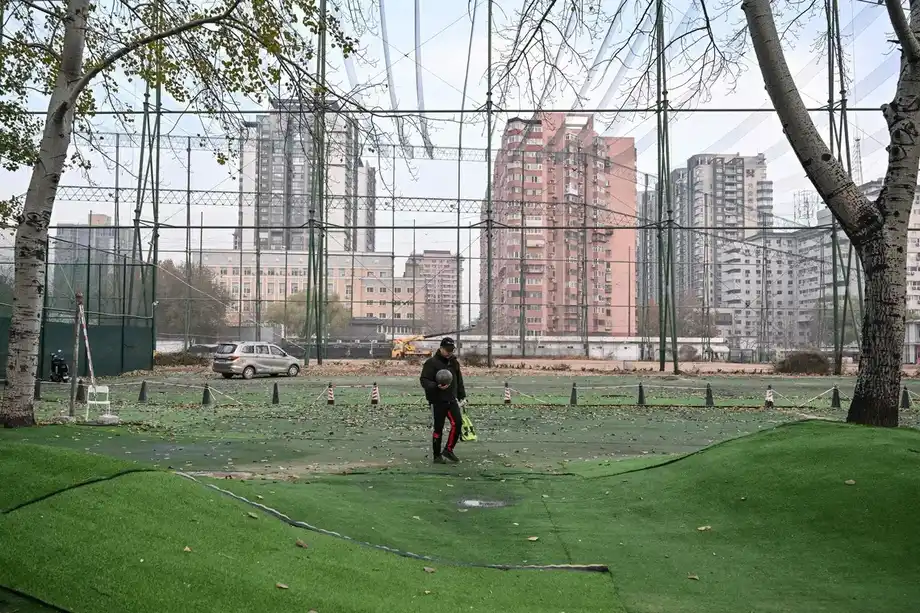
Dongfeng International Sports Park, which operates a driving range in Beijing's Chaoyang district, announced on Nov 26 that the facility had shut. A driving range is a practice venue where players hit balls from designated bays, without needing access to a full course.
The sports complex gave its reason in a social media notice addressed to users of the range.
In accordance with requirements from relevant departments, the golf driving range at Dongfeng International Sports Park has ceased operations from Nov 25, 2026.
Hours after the announcement, a construction truck sat idle on the grass while a few people moved practice equipment into storage. Practice mats, signboards and heating lamps had already been removed. Two employees took turns answering a telephone that rang every few minutes, with members calling about refunds.
One employee had worked at the range since 2016. He said there had been no shortage of members willing to pay thousands of yuan for memberships lasting several months. Thousands of yuan amount to hundreds of US dollars, although the exact value depends on the exchange rate and the membership.
The employee said he knew only what had been written in the online notice. He described his surprise and joked about the years he had devoted to the business.
It's the first time I've experienced something like this. I've worked this project into oblivion.
The other employee, who was 24 and had started work in March, learned about the closure from a colleague on the morning of Nov 24. She worked her final shift that night and later sorted through paperwork for membership refunds.
I said, 'No way, you're joking, right?' I might look for other jobs or go back to my hometown. Work isn't easy to find now, so I'll do what I can.
What do the closure notices actually say?
Some notices said the closures accorded with national plans regarding the political work of golf course renovation. Employees at several venues confirmed after the announcements that authorities had ordered them to close, although some said they had not been given a clear reason.
The word renovation can sound like a programme to improve fairways or clubhouses. In China's golf controls, the related work of cleaning up and rectifying courses has involved identifying sites built or operated in violation of official rules, stopping construction, returning illegally occupied land and shutting facilities. The reference to political work places the November action within that system of Party and government discipline.
The notices and employee accounts do not provide one detailed explanation covering all 18 venues. No date was given for a new consolidated national list, so the public tally could change if more facilities announce closures.
Two decades of controls: a timeline
China's golf restrictions rest on a series of official orders and enforcement counts rather than a single decision taken this November.
- 2004: The General Office of the State Council issued a notice suspending the construction of new golf courses. The measure, identified as Guo Ban Fa (2004) No. 1, was intended to protect scarce farmland and water resources.
- 2011: The National Development and Reform Commission and other departments began a comprehensive national cleanup of golf courses under a joint notice issued that year.
- 2015: China banned the use of public funds to play golf. The Ministry of Land and Resources also listed 66 courses described as illegal that had been closed, although it did not specify when those closures occurred.
- January 2017: The National Development and Reform Commission said 111 of China's 683 courses had been ordered to close. Another 18 were ordered to return illegally occupied land, and 47 were told to stop construction.
- End of 2018: The official cumulative count reached 127 courses shut through the cleanup. Authorities also listed 14 courses with serious violations that local governments had closed.
- November 2026: At least 18 venues announced closures during the month. The Dongfeng range's notice gave Nov 25 as its final date of operation, followed by the public announcement on Nov 26.
Each count describes a particular stage of enforcement: closure orders in 2017, cumulative closures by the end of 2018, and fresh local announcements in November.
What the official cleanup record shows
The National Development and Reform Commission set out the legal basis and enforcement results in its 2018 cleanup results. The document said 11 departments continued the campaign that year, covering planning, natural resources, environmental protection, housing, water, agriculture, tourism, market regulation, sports, financial regulation, and forestry and grassland.
The departments said the campaign had largely stopped new courses from being built in defiance of the ban. Inspections and special monitoring nevertheless found missing local oversight and weak regulation. They identified 14 courses accused of building against official orders, refusing to stop work, concealing projects, falsifying information or reviving developments after earlier action.
Those courses were spread across Shanxi, Jilin, Fujian, Shandong, Henan, Hubei, Hunan, Hainan, Sichuan, Yunnan and Shaanxi. They included the Changfeng course in Taiyuan, three courses around Yantai in Shandong, the Baihualing Sports Park course in Hainan and the Qinling No. 1 course in Shaanxi. The document said local governments had closed all 14 and pursued responsibility against the organisations and people involved.
Satellite remote sensing, routine inspections and media supervision were named as tools for future monitoring. Remote sensing allows authorities to examine land from satellite images, making it possible to spot fairways, construction or changes in land use without relying only on local reports. The departments promised zero tolerance for newly discovered courses engaged in the serious violations listed in the document, alongside investigations into regulatory responsibility.
Why land and water are central to enforcement
The National Development and Reform Commission cited three principal kinds of infringement when it announced the 2017 closure orders: illegal occupation of arable land, extraction of groundwater in areas where it was prohibited, and construction on nature reserves. Arable land is farmland suitable for growing crops, while groundwater is water stored beneath the surface and accessed through wells.
The growth of golf helps explain the scale of the enforcement task. China had fewer than 200 courses when the moratorium on new construction was imposed in 2004. The total exceeded 600 by 2015 and stood at 683 in the 2017 commission figures. The 111 closure orders in 2017 therefore covered about 16 per cent of that total, roughly one course in every six.
Development continued after 2004 as local authorities pursued revenue and investment. Some offered tax breaks to operators, including in Hainan, which became closely associated with the sport. When the Ministry of Land and Resources listed 66 illegal courses as closed in 2015, three were in Beijing, eight in Shandong, six each in Guangdong and Yunnan, and three in Hainan.
How golf became a political warning sign
Mao Zedong famously denounced golf as a sport for millionaires. The Communist Party has continued to associate it with wealth and Western elites, even while courses provided business opportunities for local authorities and recreation for some officials. State media have frequently mentioned golf when setting out evidence in corruption cases.
The 2015 ban on spending public money to play brought that association into a direct financial rule. Golf also appeared among Communist Party disciplinary violations during President Xi Jinping's campaign against corruption. That campaign targeted banquets, lavish gifts and other official excesses alongside more conventional graft allegations.
Soon after the 66 closures were listed in 2015, the commerce ministry announced that senior official Wang Shenyang was being investigated for playing golf in violation of Xi's eight rules on official conduct. Those rules were designed to restrain extravagant behaviour and bring officials into closer contact with the public.
Guangdong's commission against graft had already announced in 2014 that provincial officials could be punished for nine activities related to golf, including joining a golf club. It encouraged members of the public to report suspected violations through a telephone hotline. A commentary on its website said memberships typically cost far above the normal annual income of officials and the general public, warning that officeholders enamoured with the sport risked losing touch with the masses.
Dan Washburn, author of The Forbidden Game: Golf and the Chinese Dream, said officials keen to join clubs sometimes did so under false names because they feared appearing corrupt or detached from ordinary people. Around the time of the 2015 closure announcement, US star Tiger Woods was also set to receive $16.5 million to redesign a course in Beijing, illustrating how commercial ambition and official disapproval could exist side by side.
Professional golf grew despite the restrictions
Shenzhen's Mission Hills Golf Club became a symbol of the industry's expansion. Founded in 1994 near Hong Kong, the resort covers 20 square kilometres and has 12 courses with 18 holes each. At the time of the 2015 closures, it was described as the world's largest golf resort.
Shanghai also hosted the World Golf Championships HSBC Champions, an event known as Asia's Major. In November 2014, the $8.5 million tournament attracted 40 of the world's top 50 players for the second consecutive year. Course controls and professional ambition were already advancing along separate tracks.
China's professional presence is now visible through players such as Yin Ruoning. At 24, she is ranked world No. 5 and has won seven LPGA titles. The LPGA Tour is the leading circuit in women's professional golf, and her success gives China a prominent champion even as practice facilities and courses face renewed closures.
For urban players and employees, the immediate consequences are more mundane than rankings or resort developments. At Dongfeng, members sought refunds, practice equipment went into storage and employees considered other jobs or returning to their hometowns. The closure removed both a business and a place where Beijing players could practise without travelling to a full course.
What to Know
- At least 18 Chinese golf venues announced closures in November, including 10 in Beijing.
- Online footage showed at least four facilities being demolished, while many notices cited government demands.
- Beijing's Dongfeng driving range said it ceased operations on Nov 25, 2026, leaving employees to process refunds and consider new work.
- Some notices cited national plans for the political work of golf course renovation, but some employees said they had not been given clear reasons.
- China suspended new course construction in 2004 and began a national cleanup in 2011.
- In 2017, 111 of 683 courses were under closure orders; the official cumulative count of courses shut reached 127 by the end of 2018.
- Golf remains connected in official discipline with extravagance and corruption, even as Chinese professionals such as Yin Ruoning succeed internationally.