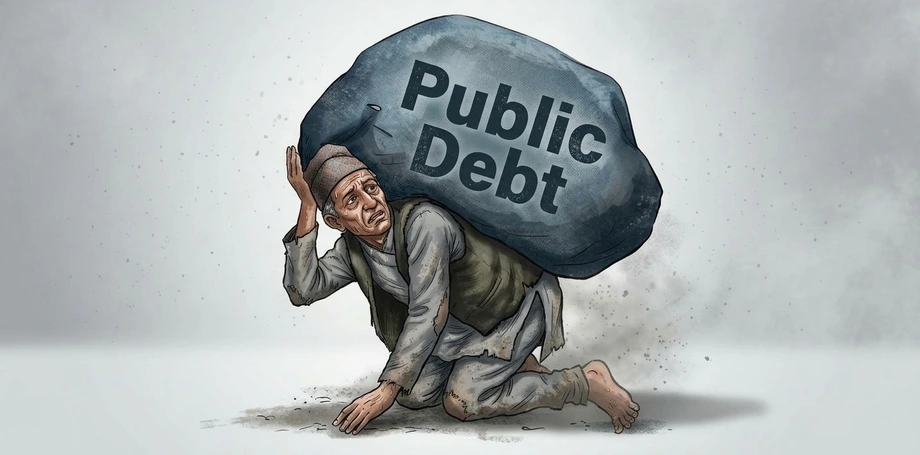
A Record Debt Load With a Per Person Share
Kathmandu, November 25: Nepal's public debt stood at Rs 2.975 trillion by November 16, the end of Kartik, equal to 45.08 percent of gross domestic product (GDP). The Public Debt Management Office's report covering the date shows that the average share is about Rs 98,930 for each of more than 30 million people. A family of five would face about Rs 495,000 on that calculation. It is a way to understand scale; repayment runs through the national budget.
Contents
- A Record Debt Load With a Per Person Share
- Who Holds Nepal's Debt
- Why the Debt Fell While Borrowing Continued
- How Much Borrowing Is Planned
- Why Repayment Pressure Is Rising
- What Internal Debt Means for Banks and Borrowers
- Why Projects Matter More Than the Debt Number
- Can Nepal's Revenue Keep Pace?
- How Risky Is Nepal's Debt?
- What Comes Next for Taxpayers and Future Budgets
- Key Points
Public debt is money the state has borrowed and must repay. It pays for activities such as roads, hospitals, schools, hydropower and irrigation. The government repays from taxes, fees and other public revenue. When revenue falls short, it can borrow again. That keeps services running in the present and leaves future budgets with the repayment.
The new figure matters because Nepal is borrowing and repaying at the same time. In the first four months of fiscal year 2026/27, the government raised Rs 153.847 billion in new debt and spent Rs 140.936 billion on principal and interest. Principal is the original amount borrowed. Interest is the extra cost paid for using the money. That leaves a narrow gap between fresh borrowing and old obligations, even before other budget needs are counted.
Who Holds Nepal's Debt
The debt office's figures show external debt at 52.93 percent of the total and internal debt at 47.07 percent. External debt is money owed to foreign lenders. Internal debt is borrowed inside Nepal, often from banks, funds and investors who buy government securities.
The published headline figures were Rs 1.574 trillion in external debt and Rs 1.400 trillion in domestic debt at the end of Kartik. Detailed figures gave Rs 1.57464 trillion external and Rs 1.40447 trillion domestic. The Public Debt Management Office also says total debt was Rs 2.981 trillion at the start of the fiscal year, before the decline to Rs 2.975 trillion.
GDP is the value of goods and services produced in a year. A debt ratio of 45.08 percent means the country owes about Rs 45 for every Rs 100 of yearly output. That is a measure of the whole economy; repayment runs through public revenue rather than individual household bills. The National Statistics Office's projection of a population above 30 million is used for the per person calculation.
Why the Debt Fell While Borrowing Continued
Nepal's debt declined by Rs 6.584 billion from the start of the fiscal year to November 16. The decline came through a mix of new borrowing, principal payments and currency valuation. The government borrowed Rs 153.847 billion, paid Rs 117.32 billion in principal and recorded a foreign exchange gain of Rs 43.112 billion that lowered the rupee value of the debt.
External loans are recorded in foreign currencies. If the dollar becomes cheaper in rupee terms, the same dollar debt is worth fewer rupees on Nepal's books. In Kartik alone, public debt fell by Rs 33.9986 billion, from Rs 3.0091166 trillion at the end of Ashwin, the month before Kartik, to Rs 2.975118 trillion at the end of Kartik. The dollar had fallen to about Rs 143 during the month.
- At the start of fiscal year 2026/27: Rs 2.981 trillion.
- At the end of Ashwin: Rs 3.0091166 trillion.
- At the end of Kartik, November 16: Rs 2.975 trillion, or 45.08 percent of GDP.
- In mid December 2024: Rs 2,492.91 billion, or 43.69 percent of GDP.
A similar exchange rate effect appeared in Mangsir, the Nepali month that spans November and December, in the earlier period. Debt obligations fell by Rs 25.64 billion as rates moved, even as the government paid Rs 58.24 billion toward debt and received Rs 21.23 billion in loans during that month.
How Much Borrowing Is Planned
The debt office set a fiscal year 2026/27 target of Rs 658.28 billion in public borrowing. It includes Rs 410 billion from domestic sources and Rs 248.28 billion from external sources. By the end of Kartik, Nepal had raised Rs 125 billion at home, or 30.49 percent of the domestic target, and Rs 28.84 billion abroad, or 11.62 percent of the external target.
That added up to Rs 153.84 billion, 23.37 percent of the annual goal. Rs 504.43 billion remained to be raised: Rs 285 billion domestically and Rs 219.43 billion externally.
The budget financing plan gives a slightly different line, Rs 657.29 billion, including Rs 247.28 billion in external debt. The debt office borrowing target is Rs 658.28 billion, including Rs 248.28 billion external. The two figures sit side by side in the public documents for the same year.
Why Repayment Pressure Is Rising
In the first four months, the government paid Rs 117.32 billion in principal and Rs 23.616 billion in interest. The total, Rs 140.936 billion, was about 91.6 percent of the Rs 153.847 billion in new borrowing. Together, those payments are called debt service. Nepal's budget pools revenue, new debt and other receipts, so the useful reading is pressure on the budget rather than a direct transfer from each new loan to an old payment.
The split shows how much of the pressure comes from domestic debt. Principal payments on internal debt were Rs 99.94 billion, while principal on external debt was Rs 17.38 billion. Interest payments were Rs 19.2482 billion on internal debt and Rs 4.3679 billion on external debt.
For the full year, the budget set aside Rs 318.092 billion for principal and Rs 99.795 billion for interest, together Rs 417.887 billion. By November 16, 36.88 percent of the principal allocation and 23.66 percent of the interest allocation had been spent. The combined debt service budget was 33.73 percent spent by that date.
Prakash Kumar Shrestha, a former vice chair of the National Planning Commission, warned that the government is increasingly borrowing to repay debt. In his account, revenue pays interest while new borrowing is needed for principal. Rolling over maturing debt is a normal financing practice, because a borrower pays an old loan with a new one. Maturity is the date when a loan falls due. Repeated use raises risk if interest rates rise, since the next loan can cost more than the one it replaces.
What Internal Debt Means for Banks and Borrowers
Nepal plans to raise Rs 410 billion through internal debt this fiscal year. Estimated principal payments on internal debt are Rs 245.89 billion. That means the gross amount raised is much larger than the money left after maturing domestic loans are paid.
Most internal debt comes through development bonds, which made up 79.24 percent, and treasury bills, which made up 19.57 percent. Treasury bills are usually short term government IOUs, promises to repay with interest within a year. Development bonds usually have longer maturities and are used for public projects.
When banks and financial institutions put large sums into government bonds, they have less money to lend to households and businesses. That can raise borrowing costs for the private sector. External loans can bring lower interest rates and longer repayment periods, known as concessional terms, but they must be repaid in foreign currency. Nepal has to earn or obtain dollars or other currencies to meet those payments, and exchange rate movements can change the rupee cost.
Why Projects Matter More Than the Debt Number
Borrowing helps when it pays for roads, hospitals, schools, hydropower, irrigation and other infrastructure. Those projects can raise production, create jobs and increase income, which gives the government more tax revenue. In that case, a per person share of debt can be linked to assets that serve the country for years.
The case weakens when projects remain unfinished, costs rise or loans cover regular expenses and repay old debt without creating new economic returns. Delays in land acquisition, environmental approvals, procurement, contract management and construction can stop a project from opening on time. Interest keeps accumulating while the project is stalled.
Better project preparation, careful selection and public reporting on costs, progress and results can improve the return. For ordinary citizens, the difference is practical: a completed road can lower travel time and trade costs, while an unfinished one leaves the loan on the books without the expected benefit.
Can Nepal's Revenue Keep Pace?
The current budget targets Rs 1.405 trillion in revenue and Rs 61.74 billion in foreign grants. It also plans to mobilize Rs 657.29 billion to meet financing needs, including domestic and external loans. This makes revenue collection and project performance central to debt management.
Stronger domestic production, exports, tourism, energy, agriculture, information technology and services can widen the tax base. A wider tax base means more public money without raising rates. It also improves the country's capacity to repay loans because more economic activity creates more income and more tax receipts.
Foreign loans can be useful when they offer concessional rates and long repayment periods. The tradeoff is foreign exchange exposure. A weaker rupee makes foreign debt more expensive in local currency, while a stronger rupee lowers the reported rupee value. The reported decline in Nepal's debt this year came from that currency effect while borrowing continued.
How Risky Is Nepal's Debt?
The joint debt sustainability analysis of the International Monetary Fund and World Bank assesses Nepal's public debt distress risk as low. That assessment looks at whether a country is likely to face severe repayment trouble under current policies and reasonable economic conditions.
A low risk rating still leaves exposures that matter for daily budgets: debt service compared with revenue, maturity schedules, foreign currency exposure and returns from projects financed by loans. A country can be rated low risk and still face a tight budget when many loans mature in the same year or when revenue grows slowly.
Compared with mid December 2024, Nepal's debt is Rs 482.09 billion higher, about 19.3 percent more than the Rs 2,492.91 billion recorded then. The GDP ratio rose from 43.69 percent to 45.08 percent, an increase of 1.39 percentage points.
The budget comparison has shifted too. In the mid December 2024 period, the debt service budget was Rs 402 billion, while capital expenditure, the budget for public assets such as roads, was Rs 352.35 billion. Debt service was Rs 49.65 billion larger. In the current figures, debt service is Rs 417.887 billion and capital expenditure Rs 431.1 billion, leaving capital spending Rs 13.213 billion higher on paper. Actual capital spending was Rs 40.8 billion by December 15 in the earlier period, while debt service payments were Rs 170.49 billion in principal and interest.
Borrowing pace also changed. By December 15 in the earlier period, the government had mobilized Rs 192.29 billion of a Rs 547 billion target, or 35.15 percent. By November 16 in the current period, it had raised Rs 153.847 billion of Rs 658.28 billion, or 23.37 percent.
What Comes Next for Taxpayers and Future Budgets
Nepal's public debt was built up across successive governments. Current and future administrations must manage repayment through budgets that also fund schools, health care, roads, salaries and public services. No new repayment schedule or project completion dates were announced with the November 16 figures. The known markers are the annual borrowing target, the debt service allocation and the amounts already raised or paid.
The central issue is the use of the borrowed money. If loan funded projects deliver lasting benefits, the per person figure can reflect investment in infrastructure and productive capacity. If projects stay incomplete or fail to generate income, repayment will lean more heavily on future generations. Nepal's low risk assessment gives policymakers some room, but the budget still has to turn borrowing into jobs, revenue and public assets.
Key Points
- Public debt stood at Rs 2.975 trillion by November 16, equal to 45.08 percent of GDP.
- The average share was about Rs 98,930 per person, or roughly Rs 495,000 for a family of five.
- External debt made up 52.93 percent of the total, and internal debt 47.07 percent.
- The debt fell by Rs 6.584 billion from the fiscal year start, helped by a Rs 43.112 billion foreign exchange gain.
- The government raised Rs 153.847 billion in four months and spent Rs 140.936 billion on principal and interest.
- The annual debt service allocation is Rs 417.887 billion, close to the Rs 431.1 billion capital expenditure allocation.
- The IMF and World Bank assess debt distress risk as low, while budget pressure and project returns remain central.