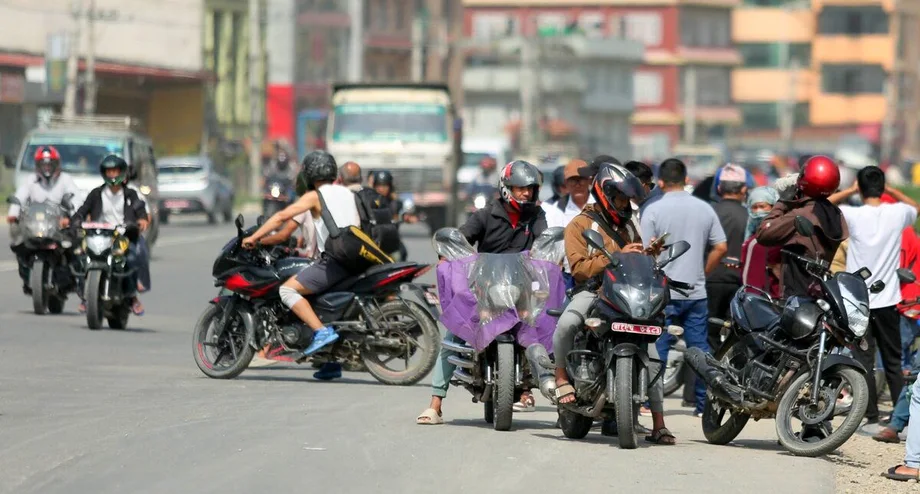
A passenger's fare can jump while a rider's income falls
Motorcycle and taxi drivers working through Pathao, Yango and inDrive in Nepal say the price of a journey can multiply for passengers while their own earnings move in the opposite direction. The Independent Drivers Foundation Nepal says drivers received about Rs 27 to Rs 28 for each kilometre a few years ago, but that figure has fallen to Rs 9 to Rs 10 in 2026. It wants a regulated minimum of Rs 30 for each kilometre, adjusted when fuel prices and inflation rise.
Contents
- A passenger's fare can jump while a rider's income falls
- What the ministry has ordered
- How dynamic pricing can turn distress into revenue
- Why riders say cheap trips leave them with nothing
- Commissions, targets and automatic penalties
- Partners without labour protection
- Blocked accounts and passengers whose identities are unknown
- Six years after a court order, who regulates the apps?
- Street protests and a shutdown warning
- Pokhara shows the dispute can also hurt passengers
- What the deadlines could change
- The Bottom Line
Passengers face the other side of the dispute. A taxi journey that usually costs Rs 300 to Rs 400 in the Kathmandu Valley can reach Rs 1,400 during rain, late at night or busy travel periods. Other passengers describe paying Rs 100 or Rs 130 for a morning journey and as much as Rs 500 for the same route in the evening or during rain. Students travelling to classes, employees returning from late shifts and people taking patients to hospital are among those affected.
The Ministry of Industry, Commerce and Supplies has now intervened on passenger fares. Its orders address prices and consumer complaints, while thousands of riders are pressing a separate set of demands concerning commissions, working hours, insurance, social security, safety and the sudden blocking of their accounts.
What the ministry has ordered
Minister Dipak Kumar Shah directed the Department of Commerce, Supplies and Consumer Protection to obtain information from major ride sharing companies within seven days. The companies must explain their fare determination systems, service charges, commissions, surge pricing and mechanisms for hearing consumer complaints.
The ministry also ordered arrangements that would show passengers the fare and any additional charges before a journey begins. The department must monitor and study abnormal increases during emergencies, rain, festivals, nighttime and periods when public transport is unavailable. Where investigators find unfair commercial practices or consumer exploitation, the ministry wants action under existing law.
A special mechanism must be established to register and resolve consumer complaints. A preliminary report on that mechanism is due within 15 days, followed by an actionable improvement plan within 30 days.
The department must also coordinate with the Department of Transport and provincial governments on a proposal clearly dividing responsibility for fares, service operation and regulation. Shah said the objective was not to discourage the companies, but to develop technology based services alongside consumer rights, fair competition and business accountability.
How dynamic pricing can turn distress into revenue
Dynamic pricing, also called surge pricing, means that software changes a fare according to demand, supply or other conditions. An algorithm is simply the set of instructions used by the software to make that calculation. Supporters of the model say higher prices can attract more drivers when demand rises. In Kathmandu, the central complaint is that there is no publicly fixed minimum rate for each kilometre and no ceiling on the additional charge.
The commission system gives the platforms a financial interest in the final fare. A 19 percent commission produces Rs 19 for a platform on a Rs 100 journey. If software raises the fare for the same distance to Rs 500, that commission becomes Rs 95. At 26 percent, the platform's share would be Rs 130. The distance travelled and the fuel required can remain unchanged.
Consumer rights campaigner Sapna Sharma Neupane argues that charging a service fee for connecting passengers and drivers is reasonable, but multiplying the base fare during a crisis and then taking a commission is unethical. She pointed to the Black Market and Some Other Social Crimes and Punishment Act and its 20 percent profit ceiling for ordinary trade. She suggested that, if a premium is necessary during rain or periods of high demand, it should be limited to 10 or 20 percent above a fixed normal rate.
The three main apps do not use identical pricing systems. Pathao displays a fare calculated by its software before booking. InDrive allows a passenger to propose a price and a driver to accept it or make a counteroffer. Yango entered Kathmandu in May 2025 and attracted attention with an entry fare of Rs 40. A consumer guide published in 2026 says Yango can still be more expensive than its rivals during peak hours. It also records Pathao fares ranging from Rs 115 to Rs 175 for the same route and time slot, alongside complaints about surge additions and longer routes.
Why riders say cheap trips leave them with nothing
Thousands of young people, students and migrant workers returning from overseas employment joined the platforms after being offered flexible work and the prospect of a reasonable income. Many borrowed money or used savings to buy motorcycles, scooters or taxis. They remain responsible for loan instalments, fuel, engine oil, tyres, spare parts, servicing, mobile data and the risks of travelling on congested or damaged roads.
Public transport fares are normally calculated using fuel prices, maintenance costs, drivers' wages and inflation. Kathmandu taxi fares also have government rates based on distance and the initial flag down charge. Ride sharing drivers say no comparable scientific formula protects their earnings when platforms reduce fares to attract customers.
Accounts from 10 active riders working on different Kathmandu Valley routes describe long hours and falling returns. Their identities were withheld because they feared that the companies could retaliate by permanently deactivating their accounts. One rider described the pressure of meeting daily costs.
Fuel prices have soared, while the costs of spare parts, engine oil, tyres and regular servicing have doubled. Living costs in Kathmandu have become unbearable. Even after driving continuously for 12 to 14 hours, from morning until late at night, I sometimes cannot earn enough to cover fuel and basic maintenance.
The foundation's current figure of Rs 9 to Rs 10 for each kilometre is close to the cost of some public bus travel, but a ride sharing driver must pay for the vehicle and its operation. Its demand for Rs 30 would restore earnings to slightly above the earlier Rs 27 to Rs 28 range and provide roughly three times the current rate.
Commissions, targets and automatic penalties
Passenger and rider accounts put platform commissions as high as 26 percent, with the lower end variously given as 19 or 20 percent. Those figures are not universal: the 2026 consumer guide says inDrive charges riders 10 percent and describes Yango's model as commission free. The ministry's demand for company information should help establish which charges apply to each service.
Riders also describe deductions beyond the basic commission. Some platforms offer bonuses for completing a specified number of trips within a fixed period. Missing the target can mean losing the incentive after a full day of work.
Technical errors and conditions outside a rider's control can create further losses. An incorrect passenger location, a traffic jam or road construction can delay an arrival until the app cancels the trip. Riders say penalties can then be deducted from their accounts even when they have already spent fuel and time travelling to the pickup point.
Company representatives have previously assured protesting riders that they would consider scientific fares, lower commissions, insurance, security and an end to arbitrary account blocking. Riders say those assurances have not produced consistent changes in practice.
Partners without labour protection
Platforms commonly call riders partners or captains rather than employees. Riders argue that this language leaves them outside protections associated with formal employment, including the minimum wage, contribution based social security, sick leave, gratuity and job security. A person can work through an app for 12 hours a day without acquiring the employment record that those rights normally require.
Accidents expose the consequences most sharply. Companies advertise insurance during rides, but injured riders and their families describe claim procedures that can be difficult to complete while coping with medical treatment and lost income. Protesters say some families have had to raise money publicly to pay medical bills.
Coverage is not identical across the market. Pathao has improved aspects of its insurance policy, according to driver campaigners, while the consumer guide says Yango added automatic insurance during every trip at no extra cost in 2026. Protesters maintain that other arrangements provide little reliable help when an accident occurs. Their demands include access to the Social Security Fund and insurance that can actually be claimed.
Blocked accounts and passengers whose identities are unknown
An account suspension can abruptly cut off a rider's income. Riders say companies do not always explain which rule was broken, what evidence was used or what punishment applies. A dispute over a fare, route or pickup location, or a negative passenger complaint, can lead to blocking without a meaningful opportunity to present the rider's version.
Appealing that decision can mean visiting an office, submitting an application and waiting weeks. Riders describe encountering dismissive treatment and having no effective independent channel for resolving the dispute. The ministry's new instruction concerns consumer complaints; it does not create the separate grievance mechanism that riders are seeking.
Safety is another unequal condition, according to riders. Companies collect and verify their citizenship documents, driving licences, vehicle registration books, photographs and personal details. Riders say passengers do not face equivalent mandatory identity verification.
That leaves drivers concerned about robbery, abuse, assault and threats when travelling at night or to secluded places. They also describe passengers leaving without paying, making threats or filing false accusations. Mandatory passenger identification is therefore one of the drivers' central safety demands.
Six years after a court order, who regulates the apps?
The legal dispute predates the latest fare controversy. The Transport and Vehicle Management Act 2049 BS, also cited in the driver campaign as the Motor Vehicle Act 1992 (2049), was written before services operated through smartphone apps. It technically restricts the commercial use of private vehicles, while companies describe themselves as technology businesses and riders as independent partners.
A short sequence shows how slowly formal regulation has followed the growth of the services:
- February 2020 (29 Magh 2076 BS): The Patan High Court ordered the government to regulate ride sharing. Driver campaigners say the order remains largely unimplemented at the federal level.
- 2024: An amendment to the Industrial Enterprises Act recognised ride sharing as an industry providing services.
- 2025: Gandaki Province implemented its Ride Sharing Management Regulation 2025, providing a provincial example. Yango launched in Kathmandu in May of that year.
- 2026: Kathmandu drivers intensified their campaign over earnings and labour rights, while the industry ministry ordered fare and consumer complaint information from the companies.
Bagmati Province, which includes Kathmandu, has yet to put an equivalent framework into practice. An official in the provincial transport ministry said standards and procedures had been prepared, but implementation had not happened.
Lawyer and rights campaigner Shreekrishna Nakarmi describes a cycle of responsibility shifting. He says the transport department can treat a complaint as a matter of technology and company registration, the commerce department can direct fare questions to the transport ministry, and traffic police can point to legal ambiguity. The ministry's order for coordination between federal and provincial bodies is intended to address that division.
Street protests and a shutdown warning
The Independent Drivers Foundation Nepal organised a rally that began at Maitighar Mandala and moved through Tripureshwar and Baneshwar. Scooters and motorcycles carried demands for a minimum fare of Rs 30 for each kilometre, a ceiling on commissions, social security, dependable insurance, regulation of account blocking and mandatory passenger identification.
The campaign has appealed to the new government and to Balendra Shah, widely known as Balen, for intervention. Protesters want Bagmati's proposals turned into enforceable rules and point to Gandaki's regulation as evidence that a province can act.
Muktinath Phuyal, president of the foundation, summed up the drivers' position by saying that they wanted to continue working but could not absorb every cost themselves.
Government support is vital. We want to work, but we cannot work for free.
Phuyal also described ride sharing as a pillar of urban transport that should be treated accordingly in law. The foundation has warned of a strict protest phase if its demands are not addressed, potentially including a complete shutdown of ride sharing services in the Kathmandu Valley. It has not announced a date for such a shutdown.
Pokhara shows the dispute can also hurt passengers
Complaints from Pokhara show why regulation needs to address driver conduct as well as platform software. Passengers there say some drivers accept a booking and then demand more than the fare displayed online. If the passenger refuses, the driver may cancel the ride, decline to complete the journey or intimidate the customer.
Those complaints differ from an algorithm raising a fare before booking, but they produce a similar sense of uncertainty. A passenger cannot rely on the displayed price, while a driver struggling with fuel and commission costs may see the app fare as inadequate. Clear fare rules, functioning complaint channels and enforceable standards would address both experiences.
What the deadlines could change
The seven day information request could reveal how each company calculates fares, what commission it deducts and how surge income is divided. Upfront disclosure would allow passengers to see extra charges before committing to a journey. The 15 day and 30 day requirements create specific tests for whether the consumer complaint mechanism and improvement plan materialise.
The directives do not themselves establish a minimum rate for each kilometre, cap commissions, grant riders employment status or create their requested grievance channel. No date has been given for comprehensive federal ride sharing legislation.
For riders, the immediate question is whether falling earnings and account security receive the same official attention as passenger fares. For passengers, the risk is that a fare dispute or a threatened shutdown could bring further price fluctuations and service interruptions in cities where the apps have become part of daily transport.
The Bottom Line
- Kathmandu drivers say earnings fell from Rs 27 to Rs 28 for each kilometre to Rs 9 to Rs 10 in 2026; they demand a regulated minimum of Rs 30.
- Passengers report some usual Rs 300 to Rs 400 taxi journeys rising to Rs 1,400 during rain, nighttime or periods of heavy demand.
- The industry ministry ordered fare, commission, surge pricing and complaint information within seven days, a preliminary complaint report within 15 days and an improvement plan within 30 days.
- Riders are seeking commission limits, social security, usable insurance, fair account suspension procedures and mandatory passenger identification.
- The Patan High Court ordered regulation in February 2020. Gandaki Province acted in 2025, but Bagmati Province has not implemented its proposed standards.
- The Independent Drivers Foundation Nepal has warned of a possible Kathmandu Valley shutdown, without announcing a date.